






Morgan Stanley Digital Asset Head: Bitcoin Breaking $1 Million Not Surprising, But a Crisis That Shatters the Old System May Be Needed to Truly Ignite It


- Core Perspective: Amy Oldenburg, Head of Digital Asset Strategy at Morgan Stanley, believes Bitcoin's next major surge may not come from new products or favorable policies but rather requires a crisis sufficient to shatter the existing traditional financial system as a catalyst. She also stated she wouldn't be surprised if Bitcoin breaks $1 million within five years, though she hopes for a more gradual increase.
- Key Elements:
- Morgan Stanley's spot Bitcoin ETF (MSBT) set a record for the bank's first-day issuance, primarily driven by client demand. However, its status as a bank holding company subjects it to stringent Fed regulations, preventing it from acting as swiftly as independent asset managers.
- Most financial advisors are still not actively recommending Bitcoin. One reason is that since Morgan Stanley issued its official allocation recommendation (2%-4% for moderately aggressive portfolios), Bitcoin's price has remained range-bound, lacking upward momentum, which weakens advisors' incentive to recommend it.
- The education and awareness gap is a key obstacle, including clients' and advisors' insufficient understanding of the difference between Bitcoin and other crypto assets, as well as the fundamental difference between holding ETP shares and holding spot Bitcoin (self-custody).
- Global mainstream capital attention is diverted to other assets (e.g., gold, AI). Coupled with regulatory and capital efficiency constraints, banks lack the incentive to hold Bitcoin, preferring assets with more efficient capital treatment.
- Oldenburg believes Bitcoin adoption will be a slow, gradual climb rather than a 'J-curve' style surge. Its future value may need to be revalidated through crisis events (such as the collapse of the traditional system) to achieve a greater breakthrough.
Organized & Compiled by: Odaily TechFlow
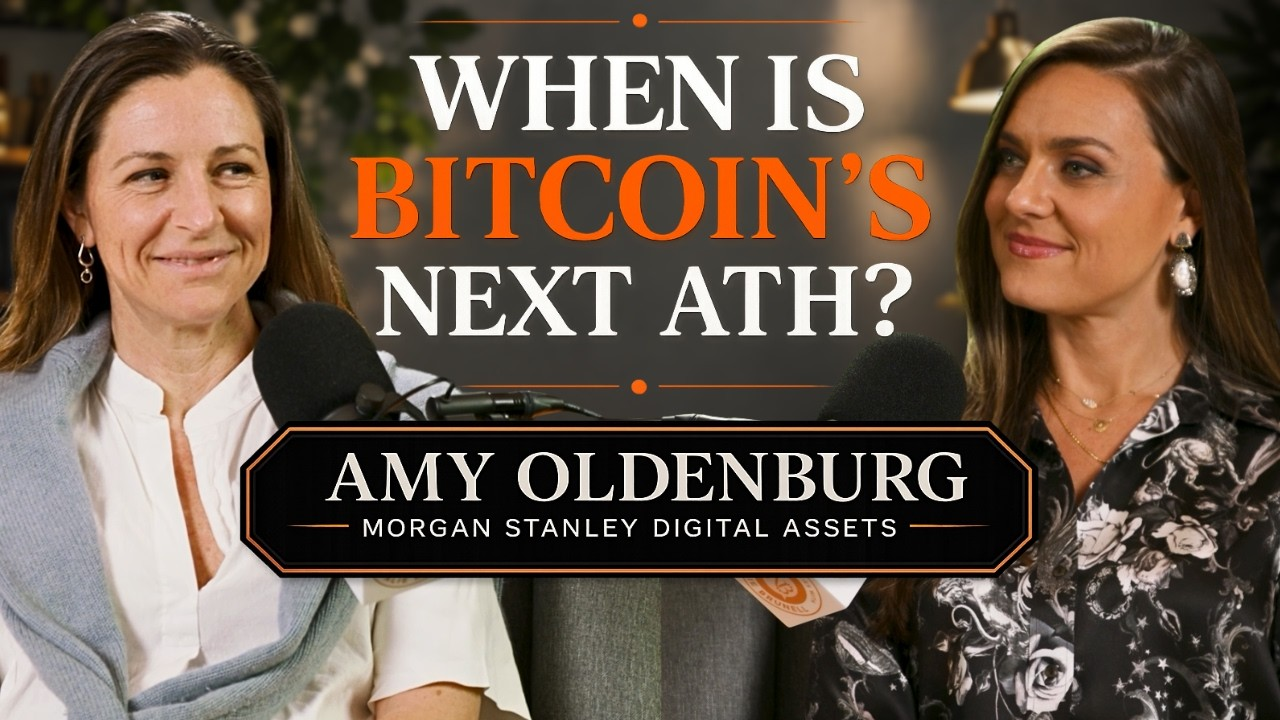
Guest: Amy Oldenburg, Head of Digital Asset Strategy at Morgan Stanley
Host: Natalie Brunell
Podcast Source: Natalie Brunell
Original Title: When Will Bitcoin Hit a New ATH? Wall Street Insider Explains
Release Date: June 10, 2026
Key Takeaways
Morgan Stanley, managing trillions of dollars in assets, is now bringing Bitcoin to its clients. In this conversation, Amy Oldenburg, Head of Digital Asset Strategy, reveals a paradox: MSBT set a record for the bank's highest first-day ETF launch, yet most financial advisors remain reluctant to recommend it to clients because Bitcoin's price has largely moved sideways since the recommendation. She doesn't believe the next major surge will come from a new product or policy catalyst, but might instead require an event that truly shatters the traditional financial system. She wouldn't be surprised to see Bitcoin exceed one million dollars within five years, though she hopes the rise would be gradual.
Key Insights Summary
Tech Roots: From the 1999 Tech Bubble to Emerging Markets
- "Every stage of my life has been accompanied by some technological change that seemed incredibly obscure and widely questioned at the time. Only now can I clearly see how the entire historical puzzle pieces together."
- "The veterans and traders I dealt with daily in the market stayed with me through the 2008 global financial crisis. We weathered that financial tsunami together, and the core members of this group were among the earliest hardcore Bitcoin buyers."
- "Bitcoin's earliest evangelists and heavy users came not only from the geek circles of Silicon Valley but also significantly from cross-border and international financial markets—those who were on the trading floor back then, desperately seeking alternatives to the traditional centralized banking system."
Why Bitcoin Made Early Sense
- "In those underdeveloped markets, the traditional brick-and-mortar banking system is extremely lagging. The vast majority of the common population can never open a bank account in their lifetime, so they have to rely entirely and embrace mobile money."
- "You're in a small village without 24-hour electricity and with dirt roads, but there's a Vodafone shack, like a lemonade stand, with 'M-Pesa' written on it. That's where you put cash onto your phone."
- "Because we've deeply worked in so many emerging markets, we know intimately that people in those places have ample reasons to embrace decentralization. The traditional financial infrastructure there is extremely unreliable, devoid of contracts, and often accompanied by severe systemic corruption—all of which we personally experienced on the trading desk."
Why Haven't Institutional Investors Gone All-In on Bitcoin?
- "Our entire group is legally structured as a bank holding company. This means we must adhere to a set of much stricter capital adequacy and risk control requirements that belong specifically to the banking system—because we're under the watchful eye of the Fed."
Record Demand for MSBT
- "You'll naturally advocate for your own product, but you don't truly know what will happen until it goes live. The results surprised many."
- "Combining GSIB-level issuance with GSIB-level custody was both the first goal we wanted to bring to market and a way for us to understand what else the ecosystem needs to develop."
Will Morgan Stanley Issue Digital Credit?
- "I know there's something in digital credit—but most people haven't even figured out Bitcoin yet, let alone more advanced products built on top of it."
- "Education is the barrier limiting the community and financial advisors from engaging with these products."
- "Some product elements are very compelling, but there's always something that doesn't quite fit—a bit like the early BlackBerry story."
The Advisor Gap: Why Isn't Everyone Recommending Bitcoin?
- "If we had made the recommendation at $10,000 or $15,000 and it later went to $100,000, the momentum would naturally follow. But interestingly, since our recommendation, we've generally been in a sideways range."
- "Financial advisors have a fiduciary duty to choose the right assets for their immediate clients. Not every client is a growth investor."
What's Holding Bitcoin Back?
- "We always get caught in black-and-white debates: Will Bitcoin succeed or fail? But we live in a very complex world where various narratives intertwine, dividing attention and allocation."
- "The attention and liquidity of global mainstream capital for asset allocation has been brutally fragmented."
- "I hate to say it, but it might take a crisis—where we break the existing system, and Bitcoin is the only thing left intact."
Corporate Balance Sheet
- "Banks don't hold Bitcoin because they dislike it, but because there are more capital-efficient assets. If capital regulations don't improve, we will focus on more advantageous assets."
- "If no one truly needs tokenized stocks, we have no reason to spend a lot of money doing it. If demand comes, we will. The same logic applies to Bitcoin."
The Future of Bitcoin
- "I don't think we'll see a magical J-curve and a sudden takeoff in 2027. It's more likely we'll continue a slow climb, with more participants gradually entering, getting educated, and slowly understanding."
- "Bitcoin reaching one million dollars? That's fine. I don't see why it's impossible. Given everything I've seen in my life, I believe anything is possible."
Winner-Takes-All Tech vs. Redundant Finance: The Future of the Industry
- "That 'winner-takes-all' culture, which you see in tech and many tech-related fields, doesn't fit financial services at all. The essence of financial services is redundancy and numerous participants."
- "When we do RFPs, we start with a dozen names, winnow it down, hoping to have a top three to choose from. But in the tech field, often only one, maybe two, can truly meet our hard requirements."
Responding to Skepticism About Big Banks
- "In emerging markets, the 'distrust' of the traditional official financial system is not some abstract theory written in textbooks; it's a bleeding, brutal reality every single day."
- "From a hardened Bitcoin maximalist perspective, taking spot Bitcoin and putting it into a traditional financial institution's ETP is heresy to many. Yet, it's happening at a scale I didn't anticipate."
- "Holding an ETP share is not the same as holding Bitcoin—you have price exposure. This needs constant re-education."
Tech Roots: From the 1999 Tech Bubble to Emerging Markets
Host Natalie Brunell: Today's guest is Amy Oldenburg, Head of Digital Asset Strategy at Morgan Stanley. Amy, I'm particularly interested in hearing your story about how you connected with Bitcoin and your legendary two-decade journey at Morgan Stanley.
Amy Oldenburg:
I've been at Morgan Stanley for twenty-six years, though it wasn't my initial plan. I grew up in a small Midwestern town in Ohio. Interestingly, just like you asked me before the show: 'How did you end up here? How did you get on this crazy journey of digital assets and Bitcoin?'
I'm a deep Xer like you, and I completely resonate with your experiences. Sometimes when I see memes online about what it was like growing up in the 80s and 90s—you realize technology started subtly reshaping us very early in life. I remember being seven or eight, spending hours in the basement playing Atari with my cousins. Then the NES came out, and Super Mario Bros blew our minds. It feels like every key point in my life was accompanied by some disruptive tech wave.
One Christmas, my dad got us a Tandy computer. We started fiddling with early computer games—it felt incredible back then. Technology kept accelerating. In high school, we were still learning basic typing in the computer lab; by college, technology started cutting deeper into our daily lives.
I remember a professor getting early access to a BlackBerry, and our entire marketing class became beta users. We sat in class, completely puzzled about what it was for—it had no apps, just a brick of hardware. We joked, "What's the difference between this and a high-school pager? It can send letters and numbers, but none of our friends have one, so who are we going to page?" Later, it evolved to the iconic full-keyboard version, became ubiquitous, and then was suddenly swept away, and it was indeed obsolete.
What's even funnier was my major in college. I was studying accounting, but the school wouldn't allow accounting majors to study abroad. At that time, all I wanted was to escape Ohio—the farther, the better. I would have willingly been sent to an international market across the ocean. Since I couldn't go abroad, there was a domestic exchange program in San Francisco. I was studying in New York at the time, so in 1999, I packed my bags for San Francisco, and landed right in the middle of the most fervent Dot-com Bubble.
Being young, I had no idea how crazy the world was. In Silicon Valley, I started an internship the next day at an internet startup helping Fortune 500 companies build websites. After two months of paid internship, I definitively dropped my accounting major. The feeling was too strong—this ongoing technological transformation would profoundly disrupt the future.
We went to various industry conferences with the company. Google was just a little startup then; they could only hand out small slips of paper at the conference to recruit, saying "If interested, check out our Craigslist page to apply for a job at Google." We raised an eyebrow: "Google? What kind of name is that? The business model doesn't make sense—who would use it to search? It's never going to succeed."
So you see, every stage of my growth was accompanied by some technological change that seemed incredibly obscure and widely questioned at the time. Only now can I clearly see how the entire historical puzzle fits together.
As for how I got into digital assets and Bitcoin—I actually moved to Morgan Stanley after the dot-com bubble burst. I stayed with the startup in San Francisco after the crash, then was transferred back to New York HQ for a full-time role. But everyone knew the environment had collapsed; we even had to withdraw our S-1 filing, failed to go public, and then faced two brutal rounds of layoffs. I needed an immediate Plan B because I had rent to pay—and there was no way I was going back to Ohio.
Around that time, I stumbled into Morgan Stanley. I had a close friend in HR there who told me, "I know you're not into traditional finance right now, all focused on tech. But I have tons of positions that need filling. If you know anyone looking for a job, send them my way." I figured I might as well try it myself, just to keep my options open.
So, I crossed over into Morgan Stanley's Emerging Markets team. The aftermath of the 1997 Asian Financial Crisis was still lingering, and the 1994 Tequila Crisis had just passed—the entire emerging markets space was a mess. The team I joined had seen several managers in a few years. We were also feeling the sharp impact of the tech bubble bursting on financial assets—this was around 2000, 2001. To make it more dramatic, exactly nine months into my tenure, 9/11 happened. It was one crisis after another, all while underlying tech changes were racing ahead.
At Morgan Stanley, I spent years on the trading desk, specializing in Programmatic Trading and Emerging Markets FX Trading. The veterans and traders I dealt with daily in the market stayed with me through the 2008 global financial crisis. We weathered that financial tsunami together, and the core members of this group were among the earliest hardcore Bitcoin buyers.
Bitcoin's earliest evangelists and heavy users came not only from the geek circles of Silicon Valley but also significantly from cross-border and international financial markets—those who were on the trading floor back then, desperately seeking alternatives to the traditional centralized banking system.
Because we've deeply worked in so many emerging markets, we know intimately that people in those places have ample reasons to embrace decentralization. The traditional financial infrastructure there is extremely unreliable, devoid of contracts, and often accompanied by severe systemic corruption—all of which we personally experienced on the trading desk.
So, it was through this frontline experience in finance, combined with my early network in tech (like friends who were into early peer-to-peer file sharing software), that I became aware of Bitcoin very early and very keenly. The digital trading and risk management skills from those days later transitioned very smoothly into the digital asset space.
Why Bitcoin Made Early Sense
Host Natalie Brunell: Since you were exposed to this space so early, did you get in early as an investor, or did you stay on the sidelines until traditional financial institutions formally entered and the whole industry became compliant?
Amy Oldenburg:
Not really. Funny enough, my brother was over at my house last week, and we were reminiscing—around 2012, he got excited and wanted to set up some machines to mine Bitcoin. I laughed at him, saying we didn't have powerful enough hardware at home to build a mining rig.
And you have to understand, the crypto environment back then was incredibly dangerous and wild—nothing like today where you just download a sleek Coinbase app and click a few times to safely buy and sell Bitcoin. Honestly, if you wanted to buy coins back then, your only option was dealing with a shoddy operation like Mt. Gox. Meanwhile, I was working at Morgan Stanley, worried that if I touched this stuff, I'd be fired the next day. The compliance risks and operational hurdles were just too high for me then. So, while I followed it closely and spent a lot of time observing its evolution, I was definitely not an early hardcore miner coding away in front of a computer.
Host Natalie Brunell: Let's zoom out a bit. Looking back at your experience investing in Emerging Markets, was there a core conclusion that directly aligned with Bitcoin's later rise? Was there a particular lesson from emerging markets that made you think, 'Oh, this is why Bitcoin makes sense!'
Amy Oldenburg:
Yes, and that intuition is very strong. Let's go back to 2007, just before the global financial crisis. Many people following fintech today are familiar with M-Pesa and how mobile payments exploded in Africa and other emerging markets. But few know that our Morgan Stanley team was deeply involved





