2026 イーサリアム将来展望 2.2万字レポート(前編):「インフラ」から「エコシステムの中心」への道のりは?


- 核心的な見解:イーサリアムは単一の技術システムから、実行、検証、調整、資金配分を網羅する総合的なインフラへと進化しています。内部アーキテクチャの再編、プロトコルの最適化(ePBS、SSF、Blob拡張など)、そしてL1とL2の関係調整を通じて、ガバナンスの論争、パフォーマンスのボトルネック、外部競争の課題に取り組んでいます。
- 重要な要素:
- イーサリアム財団は組織再編を行い、人員を削減し戦略の焦点をLayer1に戻すと同時に、資金提供モデルを「受動的受理」から「能動的誘導」へと転換し、年間支出比率を5%に引き下げました。
- Pectraアップグレードでは、EIP-7251(バリデーターの上限を2048 ETHに引き上げ)とEIP-7691(Blob目標数を6に引き上げ)により、PoSステーキング効率とLayer2のデータ可用性を最適化しました。
- MEVの集中化問題に対処するため、GlamsterdamアップグレードにおけるEIP-7732(ePBS)を通じて、提案者-構築者分離メカニズムをプロトコルに組み込み、サードパーティリレーヤーへの依存を低減する計画です。
- Rollupエコシステムの断片化に対応するため、「イーサリアム経済圏(EEZ)」とネイティブロールアップ(EIP-8079)の提案を打ち出し、L1とL2の連携強化とメインネットの価値捕捉を強化します。
- ユーザー体験を最適化するため、シングルスロットファイナリティ(SSF)の長期的構想と、その移行計画である「高速確認メカニズム(FCR)」が提案されており、確認時間を数分から約13秒に短縮することを目指しています。
As one of the most important smart contract platforms today, Ethereum has built the richest on-chain ecosystem and continues to lead the development direction of Web3 technological innovation. However, as the ecosystem continues to expand, a series of problems accumulated in Ethereum's underlying architecture and development path are gradually emerging and becoming more complex. For example, the ecological governance and profit distribution mechanisms remain controversial; during the scaling process, it is difficult to balance consensus security, verification efficiency, and decentralization; data availability and expansion paths (such as sharding and Blob mechanisms) are still uncertain; the architecture transformation centered on Rollups is impacting the main chain's value capture and ecological structure; the power distribution and ordering mechanism formed around MEV is reshaping the block production system; and competition from high-performance public chains is exerting external pressure on Ethereum's performance and ecological appeal.
Against this backdrop, the Ethereum Foundation and core developers have intensively promoted a series of key adjustments and innovative attempts in the past year, such as reorganizing the foundation's organizational structure, clarifying the responsibilities of the Protocol team, redefining the functions of L1 and L2, adjusting the foundation's positioning within the ecosystem, exploring Ethereum's commercialization path, and participating in the formulation of agent economy standards. These changes signify that Ethereum is evolving from a single technical system into a comprehensive infrastructure system encompassing execution, verification, coordination, and capital allocation.
Based on this, this research report will take the core problems currently facing Ethereum as a starting point, systematically review its latest progress in technology, architecture, and ecosystem, and interpret Ethereum's mid-to-long-term development direction. At the same time, it will also combine its exploration of funding mechanisms and potential commercialization paths to further analyze the strategic direction of the Ethereum Foundation and assess the potential risks it may face during its development, helping you fully understand the logic behind Ethereum's frequent moves.
Author: ShirleyLi, Researcher at Web3Caff Research
Cover: Photo by Unsplash+, Typography by Web3Caff Research
Word Count: Nearly 22,000 words in total
Note: Due to length, this research report is published in two parts. This is the first part (including chapters: Background, Review of Ethereum's Core Problems). The remaining chapters (Detailed Explanation of the Strawmap Draft, Exploring Compliant Commercialization Paths, Market Competition and Risk Assessment, Other Notable Directions, Ethereum Foundation's Support Focus, New Risks the Ethereum Ecosystem May Face, Future Outlook) will be updated and completed in the second part.
Table of Contents
- Background
- Review of Ethereum's Core Problems
- Questions Surrounding the Ethereum Foundation and Vitalik Buterin
- Improvements in PoS Technology
- Blob Capacity Crisis
- A Rollup-Centric Future
- The Struggle Over MEV
- Impact from Layer1s like Solana and Sui
- Detailed Explanation of the Strawmap Draft
- Gigagas L1
- Post Quantum L1
- Private L1
- The 7 Upgrades Planned in the Strawmap Draft
- Exploring Compliant Commercialization Paths
- Commercialization Attempts
- Compliance
- Other Notable Directions
- Adjustments to the Gas Mechanism
- From DeFi to Defipunk
- AI
- Ethereum Foundation's Support Focus
- New Risks the Ethereum Ecosystem May Face
- Future Outlook
- Key Points Structure Diagram
- References
Background
Since Vitalik Buterin and his team officially introduced Ethereum to global users at an international conference in 2014, the network has gone through nearly twelve years of development. From an early niche experiment to a core infrastructure supporting a diverse ecosystem, Ethereum has grown into one of the most influential underlying platforms in the Web3 world. However, with the continuous expansion of the ecosystem, this "behemoth" Ethereum is becoming increasingly large and its pace is becoming heavier. Under the fierce law of the jungle, this inherent burden is being amplified by external challengers – it must not only cope with its own operational pressures but also face eager newcomers.
For Ethereum, "maintaining stability" and "seeking change" have always been contradictory yet tightly intertwined directions. On one hand, it needs to maintain the stability of the network and ensure the steady progress of the entire ecosystem. On the other hand, it constantly needs to chart new directions for the ecosystem. To this end, Ethereum continuously publishes phased roadmaps to confirm and revise its development coordinates.
Between 2014 and 2016, during its advancement, Ethereum gradually formed an early phased development plan, divided into four stages: Frontier, Homestead, Metropolis, and Serenity. Among them, the first three stages are generally regarded as Ethereum 1.0, mainly focusing on basic function improvement and network stability enhancement. Serenity represents its long-term evolutionary goal, with the core being to achieve scalability and performance leaps through the restructuring of the consensus mechanism and underlying architecture.
In 2020, Ethereum further clarified the technical path for the Serenity phase, formally established the transition to the Proof-of-Stake (PoS) mechanism, and introduced the sharding logic, marking Ethereum's entry into a phase of systemic architectural restructuring.
In 2022, Ethereum released a relatively complete mid-to-long-term roadmap, establishing a Rollup-centric scaling path. This meant that Ethereum shifted its execution layer to Layer 2 networks, while the main chain's positioning began to focus on security and data availability. This change laid a new foundation for subsequent ecosystem development but also planted hidden dangers.
In February 2026, the Ethereum Foundation released a "Strawmap" draft roadmap for the next decade, proposing more specific optimization goals for multiple dimensions such as the consensus layer, data layer, and execution layer, further refining Ethereum's long-term optimization direction, reflecting Ethereum's continuous thinking on the evolution direction of its overall architecture as it matures.
Review of Ethereum's Core Problems
However, the adjustment and refinement of the development path itself reflects Ethereum's dynamic trade-offs between multiple goals such as scalability, security, decentralization, and ecological benefit distribution based on its actual development process. Each version of the plan or roadmap can be seen as a phased balance of the overall system structure.
The author discussed some problems Ethereum is facing in a research report at the end of 2024, "Ethereum's Future Path: Development Amidst Controversy, Can the Ecosystem Giant Withstand Potential Crises?", including:
- Ecological governance and profit distribution mechanisms remain controversial;
- During the scaling process, it is difficult to balance consensus security, verification efficiency, and decentralization;
- Data availability and expansion paths (such as sharding and Blob mechanisms) are still uncertain;
- The architecture transformation centered on Rollups is impacting the main chain's value capture and ecological structure;
- The power distribution and ordering mechanism formed around MEV is reshaping the block production system;
- Competition from high-performance public chains is exerting external pressure on Ethereum's performance and ecological appeal.
So, more than a year later, what is the latest progress on the above issues? The author will review them one by one in the following content.
Questions Surrounding the Ethereum Foundation and Vitalik Buterin
Since the establishment of the Ethereum Foundation, the team centered around Vitalik Buterin has undergone multiple rounds of personnel changes. Due to Vitalik Buterin's prominent influence in the Ethereum ecosystem, the power structure surrounding the foundation has been subject to long-term external attention and discussion.
Against this backdrop, some argue that certain projects may tend to cater to Vitalik Buterin's technical preferences or the foundation's funding directions in their development, leading to periodic resource concentration or even overcapacity in specific tracks. At the same time, the distributed nature of the technical team makes it difficult for Ethereum's overall progress to meet people's expectations for its iteration and innovation speed.
Furthermore, the selling activities of the Ethereum Foundation and Vitalik Buterin have also triggered market concerns. Although Vitalik Buterin and relevant foundation members have stated that these funds are mainly used to support ecosystem development and project funding, these actions have still sparked some discussion and interpretation at the market level.
Latest Progress:
At the beginning of 2025, as the overall market environment warmed up and new narratives emerged continuously, Ethereum's development pace was relatively slow, which also triggered dissatisfaction within the community to some extent. Some believe that the Ethereum Foundation and core developers have lagged in terms of progress efficiency, market communication, and ecosystem expansion, showing a certain disconnect from the overall industry pace.
To respond to these criticisms, the Ethereum Foundation made a series of important adjustments.
In February 2025, Aya Miyaguchi, who had served as the Executive Director of the Ethereum Foundation since 2018, transitioned to the newly established role of President. Her responsibilities shifted from daily operations and executive management to external cooperation, institutional relations, and cultural dissemination. Meanwhile, Tomasz Stańczak, founder of Nethermind, and Hsiao-Wei Wang jointly assumed the position of Co-Executive Director.
Under the new management structure, the Ethereum Foundation streamlined its organization, laid off 19 employees, and shifted its strategic focus back from Layer 2 to Layer 1 itself. At the same time, the foundation began to place more emphasis on external communication, further enhancing transparency in areas such as technical roadmap, development direction, and resource utilization, to build community trust.
In June 2025, the Ethereum Foundation also reorganized its internal R&D system. The original department name was simplified from "Protocol Research & Development (PR&D)" to "Protocol," aiming to achieve three goals in the short term: Scaling L1 performance; Scaling Blobs; Improving User Experience. This adjustment marked a shift in its R&D focus from being research-oriented towards engineering implementation and actual delivery. Earlier this year, the Protocol team further upgraded its work objectives, specifying them as:
- Scale: Expand L1 performance by increasing the gas limit, advancing proposer-builder separation, introducing zkEVM to the mainnet, and optimizing the Blob mechanism;
- Improve UX: Enhance user experience by continuously promoting native account abstraction and cross-chain interoperability;
- Harden the L1: Strengthen L1 security and censorship resistance by enhancing post-quantum security preparations, reducing node burden, and weakening reliance on centralized infrastructure.
However, in February 2026, Tomasz Stańczak announced his resignation as Co-Executive Director of the Ethereum Foundation, to be jointly succeeded by Bastian Aue and Hsiao-Wei Wang. During his tenure, Tomasz Stańczak promoted exploration in areas including privacy protection, quantum computing security, and the integration of AI with Ethereum. After leaving, he will devote more energy to building products and infrastructure related to the convergence of AI and blockchain. [1]
Interestingly, Tomasz Stańczak's resignation statement revealed a mindset of "realizing he was no longer the core driving force, it was better to gracefully pass the baton." This also reflects the gradual decentralization of power within the Ethereum Foundation's governance layer. This change fundamentally reflects the friction and balance between "Ethereum," the decentralized open ecosystem, and the "Ethereum Foundation," the centralized core coordination body. This contradiction actually exists throughout the entire Web3 system and is one of the key issues all projects in the industry must continuously face.
According to the latest internal organizational structure, the board of directors of the Ethereum Foundation includes Vitalik Buterin, Aya Miyaguchi, Patrick Storchenegger, and Hsiao-Wei Wang. They are mainly responsible for Ethereum's governance and strategic direction adjustments, while specific execution and operations are jointly undertaken by the management and various functional teams. The Ethereum Foundation divides its overall work into multiple directions based on function, mainly including:
- Protocol Team: Responsible for advancing the design and implementation of Ethereum's underlying protocol, covering sub-fields such as zkEVM, post-quantum, and dAI;
- Privacy Team: Responsible for promoting the research and implementation of on-chain privacy-related technologies, such as privacy transactions, zero-knowledge proof systems, etc.;
- Ecodev Team: Responsible for promoting the construction of the Ethereum ecosystem, including developer support, project incubation, and ecological collaboration;
- Ecosystem Unblocking Team: Responsible for promoting ecosystem development through fund coordination, research support, and public goods infrastructure construction;
- Operations Team: Responsible for the daily operations of the organization, including functions such as finance, legal, human resources, and internal management.
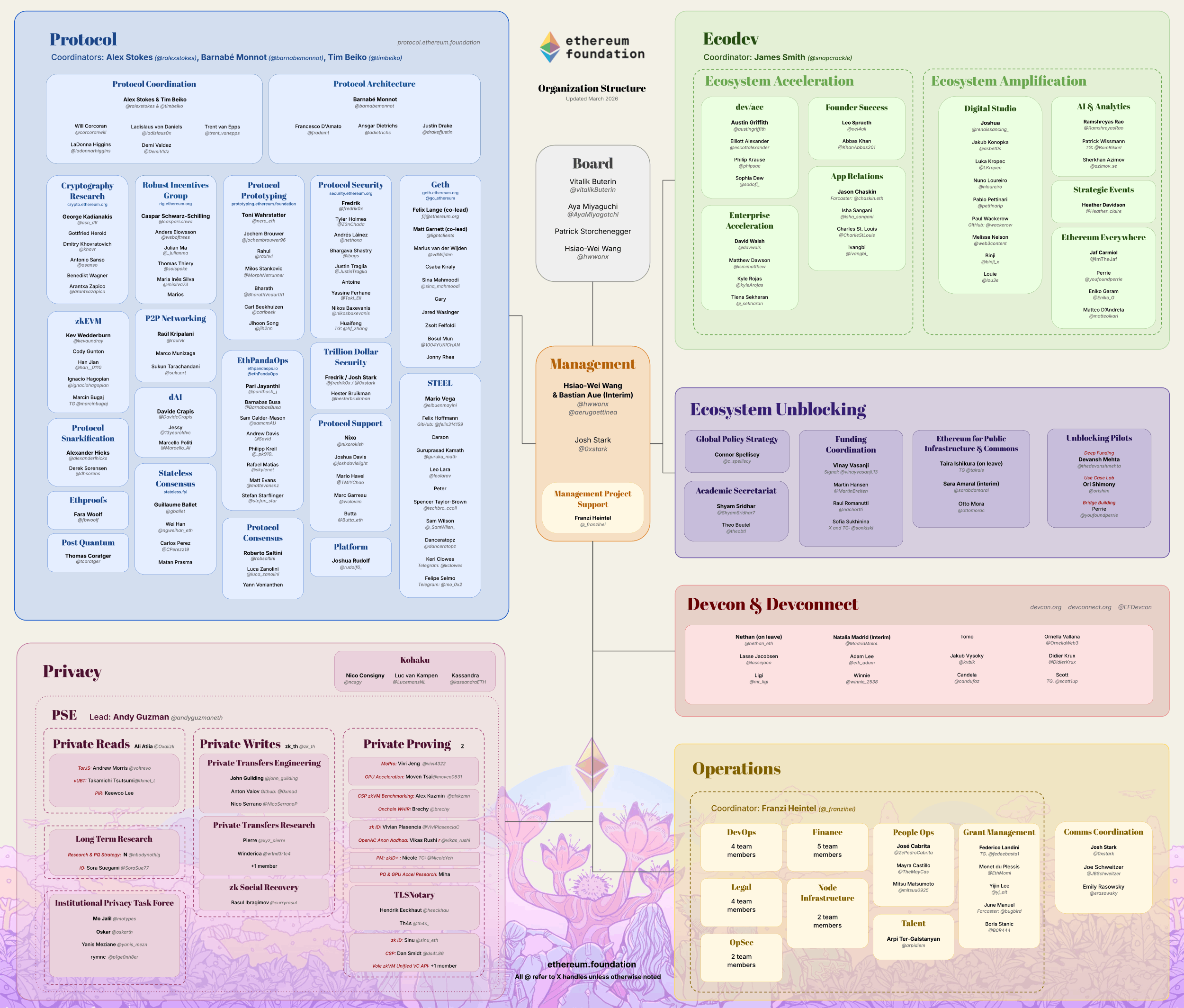
Source: Ethereum Foundation
At the same time, to respond to changes in the ecosystem's development stage and resource allocation needs, the Ethereum Foundation also made key adjustments to its grant program in August 2025, pausing the open grant program that had been running since 2018, and relaunched the new Ecosystem Support Program (ESP) in November. After the adjustment, the fund allocation model shifted from "passive application processing" to "active guidance," with its first round of funding covering areas such as cryptography, privacy, application layer, security, and community growth. At the same time, the foundation decided to reduce its annual expenditure rate from approximately 15% to 5% to slow down the depletion rate of its ETH reserves. [2] This adjustment marks the Ethereum Foundation shifting from a broad-coverage ecological funding model to a refined resource allocation strategy focused on infrastructure and core technologies.
In May of this year, Ethereum Foundation researchers Carl Beek and Julian Ma announced their departures, and former Ethereum Foundation researcher Dankrad Feist even publicly stated that the Ethereum ecosystem needs to establish a new organization more aligned with Ethereum's economic interests to "save" Ethereum. In response, Vitalik Buterin and Ethereum co-founder Joe Lubin successively responded, stating that these controversies essentially reflect the friction between Ethereum's "long-term technological construction" orientation and the current commercialization process, but this is a necessary "growing pain" that must be experienced during development.
Improvements in PoS Technology
While transitioning to the PoS mechanism freed Ethereum from the energy-intensive consensus model, the 32 ETH staking threshold has implicitly raised the barrier to entry for validators, to some extent also introducing the risk of validator centralization. If the goal is to lower the staking threshold for individual validators, then after the number of validators increases, reducing the communication and coordination costs for the network to reach consensus and increasing the cost of malicious behavior becomes a key issue.
In response, Vitalik Buterin has proposed enhancing network security by increasing the participation ratio required for block finalization (e.g., from the current ~2/3 threshold signature to 75% or even higher). [3] The core of this idea is to hedge against potential security risks by raising the consensus threshold, which can balance decentralization and security to some extent.
Latest Progress:
In May 2025, the Pectra upgrade was activated on the Ethereum mainnet.
In this upgrade, EIP-7251 increased the maximum effective balance limit for validators from 32 ETH to 2048 ETH. It's important to note that 32 ETH remains the minimum staking threshold to become a validator. This proposal mainly increases the upper limit of consensus weight a single validator can represent, meaning one validator can directly represent more ETH for voting. Through this adjustment, large stakers no longer need to split their stake into multiple validator nodes to receive corresponding incentives, thus helping to reduce the number of validator nodes controlled by the same entity, thereby lowering the communication and coordination overhead between nodes in the network-wide consensus process.
EIP-7002 optimized the staking withdrawal mechanism. This proposal introduced a withdrawal method triggered by the execution layer, allowing stakers to complete withdrawals under specific conditions without requiring the validator's active signature. This mechanism helps enhance stakers' control over their assets, reduces the operational complexity of entering and exiting staking to some extent, and further improves the overall flexibility of the PoS system.
Besides this, the Ethereum Foundation has also explored applying Distributed Validator Technology (DVT) to optimize the staking structure. This technology essentially reduces the risk of single points of failure by splitting the private key and signing capabilities of a single validator across multiple nodes to be executed collaboratively. In the traditional model, the system has high requirements for the