






Bitget CEO Gracy:AIはCryptoのバブルを強制的に除去し、取引所は全資産競争へ


- 核心見解:BitgetはUEX(全景取引所)戦略を推進しており、自社開発のRWAプロトコル「Reality」を通じて米国株のトークン化を実現。従来の株式トークンにおける流動性の低さや配当メカニズムの不透明性という問題を解決し、ユーザーの資金効率を向上させることで、Cryptoを基盤となる金融インフラとして伝統的資産市場に拡大することを目指している。
- 重要要素:
- Realityは、米国の認可ブローカーAlpacaと直接連携することで、注文をNASDAQやNYSEに直接通すことを可能にし、流動性は従来の証券会社と同等となり、価格乖離の問題を解決した。
- Realityのトークン(rToken)は、1:1の株式分割同期と現金配当のUSDTへの自動変換エアドロップをサポートし、業界における配当や株式分割処理の不足を補っている。
- ユーザーは、米国株トークン(例:rNVDA)をBitgetでのBTC/ETH取引における証拠金として利用したり、Arbitrumなどのパブリックチェーンを介してDeFiシーンに転送し、資産の利用率を活性化できる。
- Realityの原資産は、Alpacaによって独立したSPVで保管され、1:1の完全準備金が維持され、第三者による米国認可機関の毎日の監査を受けており、公式サイトにはリアルタイム監査ダッシュボードが公開されている。
- データによると、非暗号資産取引はすでにBitgetの総取引量の40%を占めており、米国株永久先物の累計取引量は100億米ドルを突破(世界第2位)。これは、ユーザーがCryptoから伝統的資産へと移行する傾向を示している。
- Bitgetは社内でAIの利用を全面的に推進しており、全社員2167名にエンタープライズ版Claudeをサブスクリプション提供。AIツールによる生産性向上を奨励するとともに、GetAgentなどの取引補助AI製品を開発している。
Throughout June, major exchanges have been aggressively rolling out US stock products. As the earliest and most aggressive platform in this赛道, Bitget has also launched its own RWA platform, Reality, and made significant upgrades to its US stock products. Today, we invited Bitget CEO Gracy to discuss this trend and other hot topics in the industry.
Bitget previously integrated stock token solutions like Ondo. Now, with US Stocks 2.0, it has chosen to switch to Reality. What is the biggest difference between the two? What key issues is this upgrade mainly aiming to solve?
Gracy: We started collaborating with Ondo in Q3 last year, at one point accounting for nearly 90% of the market share for its issued stock tokens. It wasn't just Ondo; we also launched US stock tokens in partnership with xStocks. However, during this process, the most common feedback we heard from users was: liquidity wasn't good enough, and the settlement mechanisms for dividends and stock splits weren't clear or transparent.
So, we decided to solve this problem ourselves. Reality is the compliant RWA protocol we launched. Its biggest difference lies in directly connecting with Alpaca, a US-licensed broker, allowing orders to be routed directly to NASDAQ and the NYSE. Simply put, when trading Reality's US stock rTokens, users get the same price as Apple or Tesla on the US stock market, with liquidity directly comparable to traditional brokerages.
Furthermore, Reality also solves the pain points of dividends and stock splits. Cash dividends are automatically converted to USDT and airdropped to users, and stock splits are synchronized 1:1, preventing the token price from decoupling from the real stock price.
In the future, will users be able to use stock tokens like Nvidia and Tesla as margin to continue trading BTC, ETH, or other contracts?
Gracy: This feature went live on June 4th. This is also the core reason we insist on tokenization, rather than just doing a "direct broker connection." The rNVDA (Nvidia rToken) purchased by users can be directly used as contract margin on Bitget, or transferred out via public chains like Arbitrum and Morph for use in DeFi scenarios. What we want to do is truly activate the US stock tokens in users' hands and improve overall capital efficiency.
Recently, many exchanges are upgrading their US stock-related products. Compared to the stock products of other platforms, what are the core differences in Bitget's latest upgrade?
Gracy: Indeed, many platforms are laying out US stocks recently, but from what I've seen, most competitors are still competing on "direct broker connection." That means users deposit stablecoins, then open an account with a traditional broker to trade. Bitget recently launched US Stocks 2.0, and a key upgrade point is that we chose a more crypto-native path, which is RWA stock tokens.
The core difference is that stocks bought via "direct broker connection" usually just sit in the user's US stock account. But on Bitget, rTokens issued through Reality are true on-chain assets, currently integrated with the Arbitrum and Morph public chains. This means users can not only use them as margin within Bitget but also withdraw them to their own wallets, and in the future, they can even enter DeFi protocols for staking, yield generation, etc.
We specifically solved two problems that the industry has struggled with for a long time. First is liquidity: our orders go directly to NASDAQ and the NYSE, with prices, order books, and depth synchronized with the real market. Second is dividend distribution and stock splits: cash dividends are directly converted to USDT and airdropped automatically, and stock splits are synchronized 1:1, avoiding the decoupling of token prices from real stock prices.
More importantly, in the UEX environment, these rTokens can truly achieve higher capital efficiency. For example, a user holding rNVDA (Nvidia rToken) can directly use it as margin to continue trading BTC or ETH contracts, allowing the same asset to work in two markets simultaneously. This is a more native on-chain experience, something a traditional broker connection cannot achieve.
One long-standing criticism of stock tokens is: Are users buying a tokenized representation of actual stock equity, or just a price-tracking tool? How will Reality prove to users that the underlying stocks are real, auditable, and traceable? Will it provide things like proof of reserves, custodian disclosures, audit reports, or explanations of the brokerage structure in the future?
Gracy: This is an excellent question. Indeed, if it were just a "synthetic asset" tracking a price, it would have no soul. Reality's rTokens are backed by real, tangible underlying assets. Our underlying stocks are custodied by Alpaca, a US-licensed broker, and placed in an independent SPV, completely segregated from the platform's own assets. We achieve 1:1 full reserves.
Additionally, we undergo daily audits by a third-party US-licensed auditing firm. The Reality official website has already launched a real-time audit dashboard, where users can check the reserve ratio at any time. We expect to add the audit report from a CPA-licensed audit firm to this dashboard around August once they are ready. Coupled with Bitget's user protection fund of over $300 million, this forms a triple layer of protection.
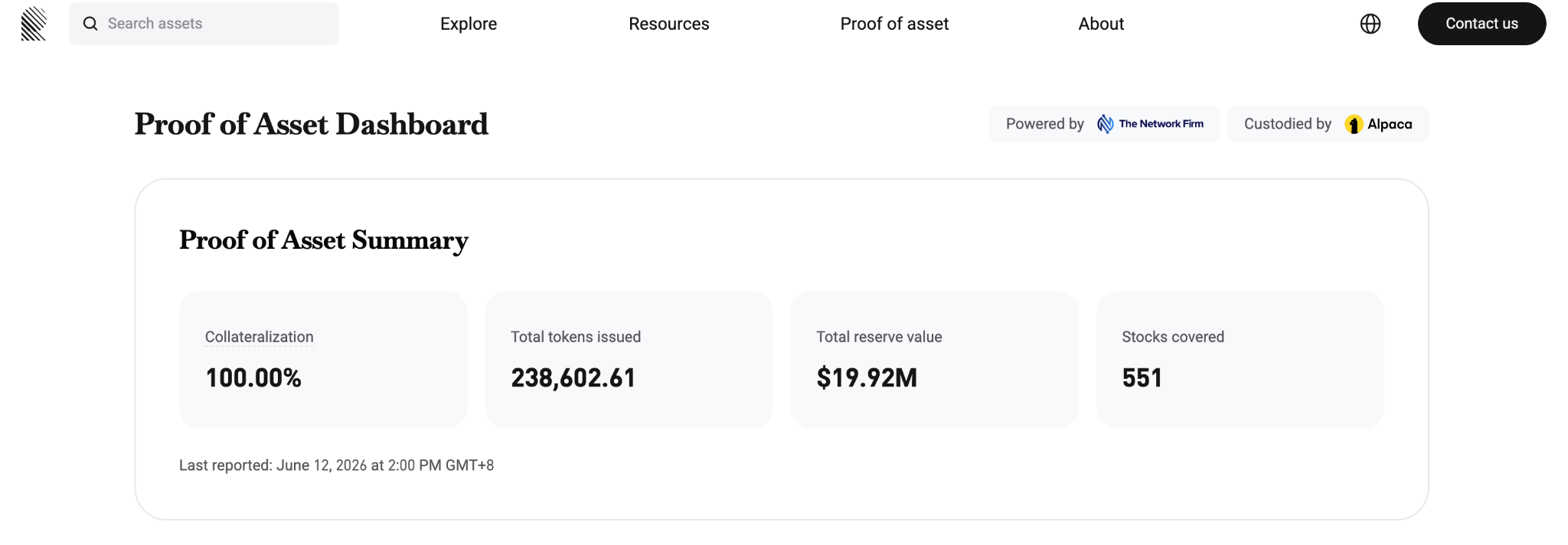
(Source: Reality PoR dashboard screenshot from June 12, 2026, 2:00 PM GMT+8)
If a particular stock undergoes a split, reverse split, special dividend, merger, or delisting in the future, how will Reality handle it?
Gracy: Regarding the handling of Corporate Actions, this is also an area where we are much stronger than many products on the market. Take stock splits as an example. When Netflix recently did a 1-for-10 split, some platforms' tokens didn't rebase synchronously, causing the token price for that stock to differ from the real stock price by 10 times, which was confusing for users. With Reality, stock splits are synchronized automatically. If you hold 1 token, it becomes 10 tokens, with the unit price pegged to the real stock price, leaving the total asset value unaffected.
Cash dividends are also directly converted to USDT and automatically airdropped to the Bitget account, ensuring clarity and transparency. Whether for individual retail investors or institutional users we support in the future, especially participants needing hedging, valuation, liquidation, and portfolio management, the structure where "price is price, dividend is dividend" is closer to the usage habits of the traditional financial system.
In the past few years, the mainstream narrative for crypto users has been BTC, ETH, DeFi, NFTs, Memes, L2s, and public chain competition. But recently, it's clear that assets and companies like AI, US stocks, Nvidia, OpenAI, and SpaceX are absorbing a massive amount of capital and attention.
Have you observed this migration in your platform data? What is the current proportion of non-cryptocurrency trading on Bitget? How fast is it growing?
Gracy: We have indeed observed this trend. As early as late 2024 and early 2025, we noticed altcoins underperforming, while users' enthusiasm for assets like AI, US stocks, gold, and silver began to rise. This is why I proposed the vision of UEX (Universal Exchange) back in September last year.
Last December, our cumulative trading volume for US stock perpetual contracts exceeded $10 billion, ranking second globally. Earlier this year, our TradFi segment, including gold, forex, etc., saw daily trading volume exceed $2 billion for the first time. Currently, 40% of Bitget's trading volume comes from non-crypto assets.
The reason is simple: capital chases returns. Where there is more certain growth and wealth effects, funds will flow there. AI giants in the US stock market are delivering real revenues and profits, while many projects in the Crypto space are still in the story-telling phase.
As for whether this will reverse in the future, I don't think it's a zero-sum game. Crypto assets, like BTC as digital gold, and US tech stocks can become complementary components in a user's investment portfolio. What we need to do is enable users to smoothly buy different asset classes using stablecoins like USDT and USDC within a single account.
From a macro perspective, US stocks, especially AI-related assets, have seen significant gains in the past six months, with many assets growing tenfold. For many crypto users, they might only start paying attention to US stocks after the wealth effect in the crypto market declined. Entering the market at this point could potentially mean facing the risk of buying at the top.
How do you view the current position of the US stock market? What is the biggest mistake users transitioning from crypto to US stock trading need to avoid?
Gracy: The biggest pain points for crypto users are capital efficiency and asset fragmentation. If funds are kept on an exchange to earn interest, one might miss out on stock market gains. If one goes to open an account with a traditional broker, it's hard to get the funds back to the exchange to trade contracts. Our rToken product is designed to solve this: when users buy US stocks, their holdings can still be used as contract margin, keeping the capital active at all times.
Whether US stocks are expensive depends on the user's time horizon. Crypto users entering the US stock market must first realize that, like crypto assets, the US stock market is not a one-way bet. Especially for hot sectors like AI, semiconductors, and tech stocks, which have already experienced considerable gains, short-term volatility and valuation pressures need comprehensive assessment.
Setting aside my CEO hat, as an investor managing my personal account, I recently shared some judgments on Twitter about the potential bottom price of Bitcoin in this cycle, which drew criticism from many netizens who said, "As an exchange CEO, you shouldn't be bearish on your own business." But I want to say that every industry has its cycles. I'm just presenting data and logic, pointing out possible cyclical changes. We are certainly long-term bullish on the crypto industry and believe tokenized assets will bring new opportunities. However, being "long-term bullish" doesn't mean "always bullish." After all, trading opportunities come from volatility. For increasingly mature investors, both ups and downs can be opportunities.
From a technical perspective, the current market shows some extreme deviations. A report from Bank of America (BofA) and related charts show that the Philadelphia Semiconductor Index (SOX) has risen 62% above its 200-day moving average. Historically, when major market bubbles peaked, the average deviation of relevant market indices from their 200-day moving averages was around 35%. The current deviation exceeds the 55% level of the Nasdaq index relative to its 200-day moving average before the burst of the Internet bubble in 2000.
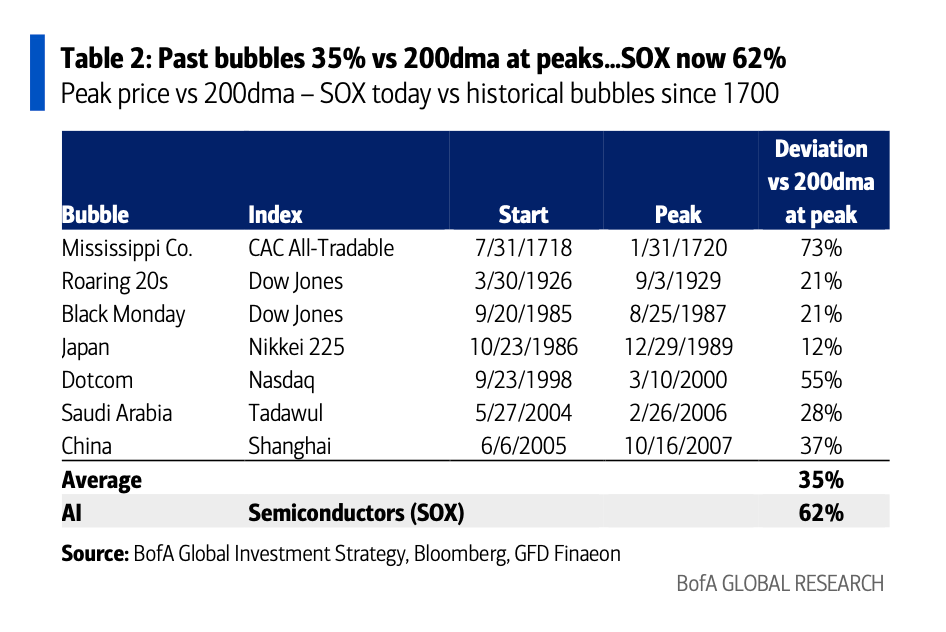
(Source: BofA The Flow Show report, May 14, 2026, 10:45 PM EDT)
Furthermore, the current rise in US stocks is extremely dependent on a handful of tech giants. If super IPOs like SpaceX and Anthropic come to market in the future, they could further divert market liquidity.
Crypto users are accustomed to high volatility, high leverage, and short-term trading. While US stocks also have volatility, they fundamentally rely more on fundamentals, earnings, valuation, interest rates, and macro cycles. What trading habits do you think they need to change the most?
Gracy: For users just transitioning from crypto to US stocks, my most important piece of advice is: Don't trade US stocks like Meme coins. In the crypto space, users might be used to following sentiment, community hype, and using high leverage for short-term trades. However, the US stock market is a highly institutionalized market that focuses on earnings reports, EPS (Earnings Per Share), interest rate environments, and macro cycles.
Users accustomed to the crypto market need to learn to closely monitor Treasury yields and inflation data. For example, when the yield on the 10-year US Treasury note approaches 5%, it can put pressure on high-valuation tech stocks.
Additionally, users transitioning from crypto to US stocks need to change a trading habit: reduce leverage and extend investment horizons. US blue-chip stocks have underlying real earnings, cash flow, and business moats, making them more suitable for asset allocation and long-term dollar-cost averaging, rather than going all-in today expecting a double tomorrow like trading shitcoins. Be patient, and be a friend of time. To help crypto users better adapt to the rhythm of US stocks, Bitget will continue to launch educational content related to US stocks. Everyone is welcome to follow along and learn to become a "distinguished US stock trader."
In the past, crypto was one of the areas with the highest concentration of young talent, venture capital, tech narratives, and speculative funds. But now, AI has clearly become the stronger main narrative: top talent goes to AI, VCs invest in AI, secondary market funds chase AI, and US tech giants are delivering real revenue and growth.
How big do you think the impact of AI is on crypto? How is AI used internally at Bitget? Is it mandatory or part of performance reviews? Which AI products are used?
Gracy: The impact is definitely there, but I prefer to see it as a "de-bubbling" touchstone for the crypto industry. In the past, money was too easy to make in crypto. Now that AI is siphoning off capital and talent, it forces the crypto industry to settle down and find truly valuable real-world applications, such as stablecoin payments and RWA.
Internally at Bitget, we require all employees to fully embrace AI. AI-driven innovation is one of our three core strategies for 2026. We don't rigidly make AI usage a mandatory part of performance reviews because people naturally will use useful tools. For example, I frequently use tools like Manus and NotebookLM to summarize materials – it's truly addictive.
At the same time, we provide organizational support for employees to use AI. Bitget has purchased enterprise-level Claude access for all its 2,167 employees, costing $200 per person per month. This isn't due to external requirements, but because after observing employees using AI tools, we saw a real boost in productivity, so we want to ensure our team members don't fall behind in the wave of AI application.
Even our design team, which doesn't have a tech background, has learned to use tools like Google AI Studio and developed 6 or 7 AI tools to assist with business tasks, such as automatically auditing UI compliance in external materials. On the product side, we have also launched AI tools specifically designed for traders, like GetAgent and GetClaw.
We have AI-related training almost every day. Just this week, I attended a "Data Team AI Product Thematic Sharing Session" and a "Digital Employee Plan and BG Agent Platform Introduction Sharing Session."
AI is a productivity lever. Whoever uses it well will run faster in the next cycle. Now and in the future, it will surely be an era where silicon-based and carbon-based life work together.
More and more crypto exchanges are now offering products like US stocks, gold, forex, stock tokens, and Pre-IPO products. Optimistically, this is an expansion of crypto infrastructure towards global assets. Pessimistically, it might indicate that crypto itself lacks quality assets, forcing exchanges to bring in US stocks to maintain growth.
How do you see this issue? When crypto exchanges connect to US stocks, are they enhancing the value of crypto's financial infrastructure, or are they funneling crypto user traffic towards traditional finance, ultimately becoming an outsourced market for US stock liquidity?
Gracy: I don't see this as a black-and-white issue. Crypto exchanges integrating US stocks, gold, forex, and Pre-IPO products appears on the surface to be "bringing traditional financial assets into Crypto." But on a deeper level, it's testing a fundamental question: Is Crypto just an asset class, or is it a new set of financial infrastructure?
My judgment is that the answer depends on how the exchange operates. If it simply packages a US stock price exposure as a trading product, it might indeed become a distribution channel for traditional financial liquidity, or even just funnel crypto user traffic to US stocks.
But if it can reorganize asset issuance, trading, clearing, custody, and risk management based on stablecoin accounts, on-chain settlement, global accessibility, fractional trading, and 24/7 markets, then it enhances not just a single US stock, but the value of Crypto as the next-generation financial infrastructure.
Moreover, if you've used many traditional financial platforms, you know they have high user barriers: difficult account opening, high entry thresholds, and slow capital movement. Our goal is to use stablecoin settlement and on-chain RWA protocols to access underlying assets, allowing Bitget's 120 million global users to trade high-quality global assets with just a mobile phone and an email address.
I think this is not outsourcing; it's using Crypto's high efficiency and low friction to disrupt and improve the traditional brokerage experience. We aren't losing users; instead, through tokenization solutions like Reality, we are bringing real-world assets onto the chain, making them part of DeFi. This is expanding Crypto's territory. We believe that as the industry develops, the definition of Crypto is also evolving. Initially, Crypto only meant Bitcoin. Later, Crypto also became the memecoin everyone was talking about. In the future, much of Crypto will be RWA. Regardless of the asset, underlying technologies like blockchain are the cornerstone driving this new financial system. Our long-term optimism for the industry partly stems from our confidence in its technology.
Bitget proposed UEX, essentially allowing users to trade cryptocurrencies, stocks, gold, forex, ETFs, and other assets within


