






从社区「硬件宅」到AI圈「浑水」:年入近亿美元的SemiAnalysis如何搅动半导体市场?


- 核心观点:文章深度剖析了SemiAnalysis这家半导体与AI基建研究机构,揭示其凭借深度分析、独特情报采集方式和顶级行业关系,已从匿名硬件爱好者成长为影响AI市场定价的关键力量,近期一份关于光模块CPO的负面报告引发市场剧烈震荡,类似“浑水”模式的做空或情报研究机构在AI时代愈发具有影响力。
- 关键要素:
- SemiAnalysis因测算DeepSeek真实成本(约16亿美元,而非600万美元)和通过实测MI300X指出AMD软件短板而一战成名,其分析直接左右市场对AI算力投资的信心。
- SemiAnalysis在2026年GTC大会上被英伟达CEO黄仁勋点名引用,其芯片性能榜单被用于主题演讲,标志着其权威性得到产业界最高层认可。
- 其商业模式依赖于深度、非公开的信息收集能力,包括卫星图像、供应链访谈、政府文件及Discord内幕消息,甚至被前员工指控利用个人投资获取未公开机密数据。
- SemiAnalysis的营收预计从一年前的约2000万美元飙升至1亿美元,客户包括超大规模云厂商、顶级投资机构,体现出市场对其高价值情报的强烈需求。
- 其创始人Dylan Patel与AI核心圈层(如Anthropic、OpenAI前研究员、红杉资本)紧密联系,共享办公空间,这种“内幕”圈层效应进一步强化了其信息优势与话语权。
In the past month, the hottest sub-sector in the US AI stock market has been optical modules.
Building an AI data center isn't just about stacking rows of GPUs. Between GPUs and between servers, massive amounts of data must also be exchanged. The larger the model and the bigger the cluster, the more likely data transfer between machines becomes a bottleneck. Consequently, the market has turned its attention to the optical communication chain, with the hottest concept being CPO. CPO can be roughly understood as placing optical communication components closer to the core chip. This proximity enables faster data transfer and lower power consumption. In the context of ever-expanding AI data centers, this narrative sounds almost perfect.
This narrative was truly ignited by Jensen Huang. As Nvidia continues to push the AI infrastructure story forward, companies in the optical communication chain like Marvell, Coherent, Lumentum, Corning, and AAOI have either been rumored to have secured large orders or have seen their stock prices surge significantly.
However, a couple of days ago, a highly controversial research report suddenly threw cold water on this red-hot sector. Stocks across the optical communication chain experienced a collective pullback, with many falling by high single digits or even double digits.
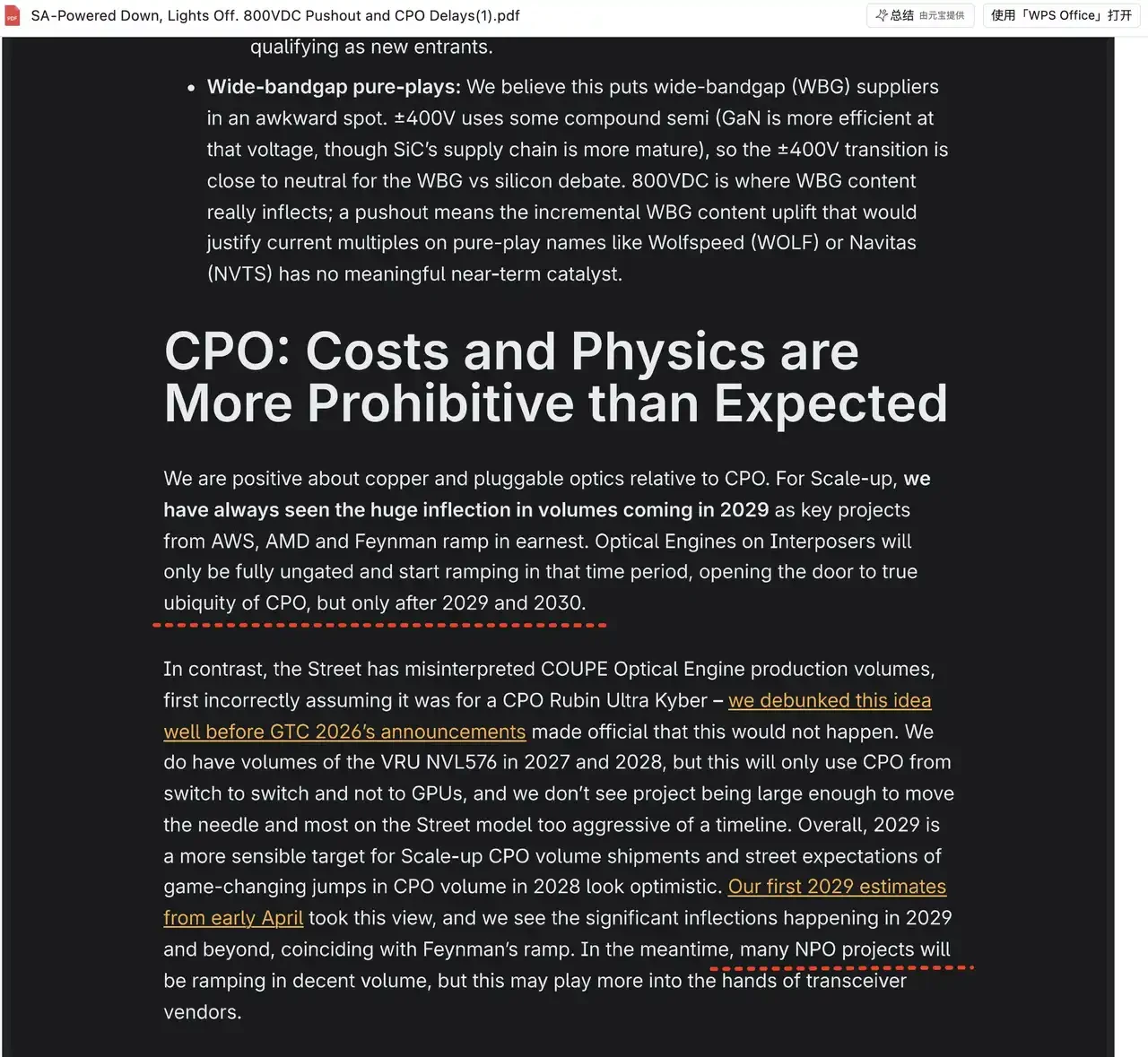
The question naturally arises: What exactly did this report say? Who is SemiAnalysis, the publisher of the report? And why could one report from them cause the market to reprice the entire AI optical module chain?
This article from BlockBeats delves into this institution.
Why is SemiAnalysis Treated as an "Industry Bible"?
In the eyes of many institutions in the AI and investment circles, SemiAnalysis is hardly an unfamiliar name. However, it remains somewhat mysterious to ordinary retail investors.
SemiAnalysis is one of the fastest-rising star institutions in semiconductor and AI infrastructure research in recent years. Although still a newcomer to the industry, it has rapidly gained fame in AI and investment circles due to its in-depth analysis and sharp perspectives. Currently employing around 85 people, it focuses on providing in-depth reports and data models for the AI ecosystem, covering areas such as data center construction, supply chain economics, chip deployment, networking, power, packaging, and equipment.
SemiAnalysis's official website introduction
SemiAnalysis's classic battle that earned the industry's respect was likely its recalculation of DeepSeek's costs.
In early 2025, DeepSeek exploded onto the global scene with a highly compelling narrative: "Training a model comparable to OpenAI's o1 for only $6 million." This figure directly undercut the investment logic for AI computing power. The market began to doubt it: if models could be this cheap, were the billions of dollars in GPU capital expenditures all for nothing?
In the ensuing panic, Nvidia's market cap evaporated by approximately $600 billion in a single day, setting a record for the largest single-day market cap loss in US stock market history.
While the world debated the veracity of the $6 million figure, SemiAnalysis recalculated DeepSeek's hardware costs in a detailed report. It didn't simply deny DeepSeek's technological progress but dissected this "low-cost myth": What exactly did the $6 million cover? And what did it leave out?
SemiAnalysis concluded that the $6 million only covered the extremely narrow cost of GPU pre-training and did not account for R&D, infrastructure, cluster construction, and long-term operations. It estimated DeepSeek's actual server capital expenditure to be around $1.6 billion, with cluster operating costs close to $944 million.
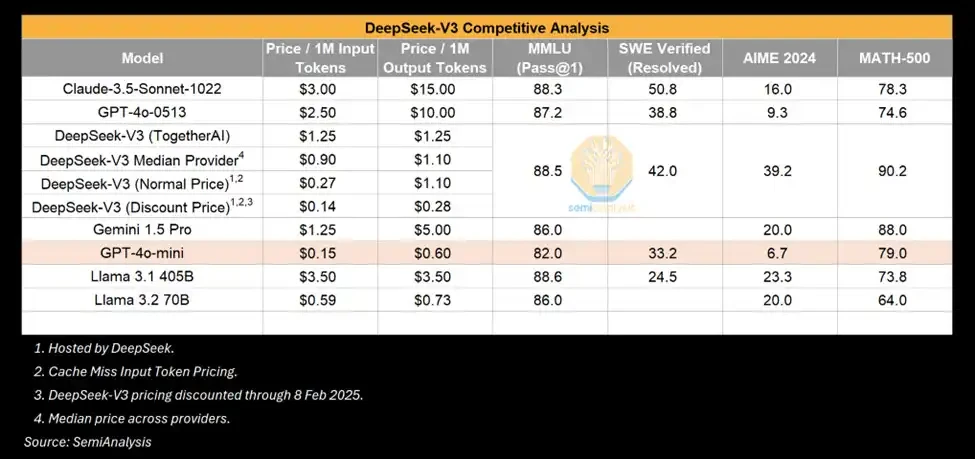
SemiAnalysis's cost calculation data for DeepSeek
More critically, it deconstructed DeepSeek's existing computing power. SemiAnalysis estimated that DeepSeek owned approximately 50,000 Hopper GPUs, but this wasn't 50,000 H100s. It was a mix of H800, H100, and the China-specific H20. These cards were also shared with the quantitative hedge fund behind DeepSeek, High-Flyer, distributed across multiple locations and used for various tasks like trading, inference, training, and research.
Besides DeepSeek, another often-cited case is SemiAnalysis's "bearish" report on AMD.
At the time, a hot topic in the market was AMD's potential to catch up with Nvidia. Most people were comparing the raw paper specs of AMD and Nvidia GPUs. However, SemiAnalysis repeatedly stressed that Nvidia's true moat was never just its chips, but its CUDA software ecosystem, networking, system design, supply chain capabilities, and the deployment experience accumulated by clients over many years. *This* is Nvidia's moat.
In December 2024, SemiAnalysis published a report based on five months of hands-on testing of the AMD MI300X. The report bluntly stated: "We hoped AMD would be a strong competitor to Nvidia on the training side, but that day has not yet arrived." Its core conclusion was that while the MI300X should theoretically lead Nvidia's H100 and H200 on paper specs and TCO, its actual performance didn't fully deliver, precisely because of the software side.
Just one day after the report's release, AMD CEO Lisa Su proactively reached out to SemiAnalysis founder Dylan Patel. The scheduled 30-minute call ended up lasting a full 90 minutes.
Of course, this also led to community speculation that SemiAnalysis is an institution funded and supported by Nvidia.
SemiAnalysis's influence has also begun to spill over from report pages into the industry arena.
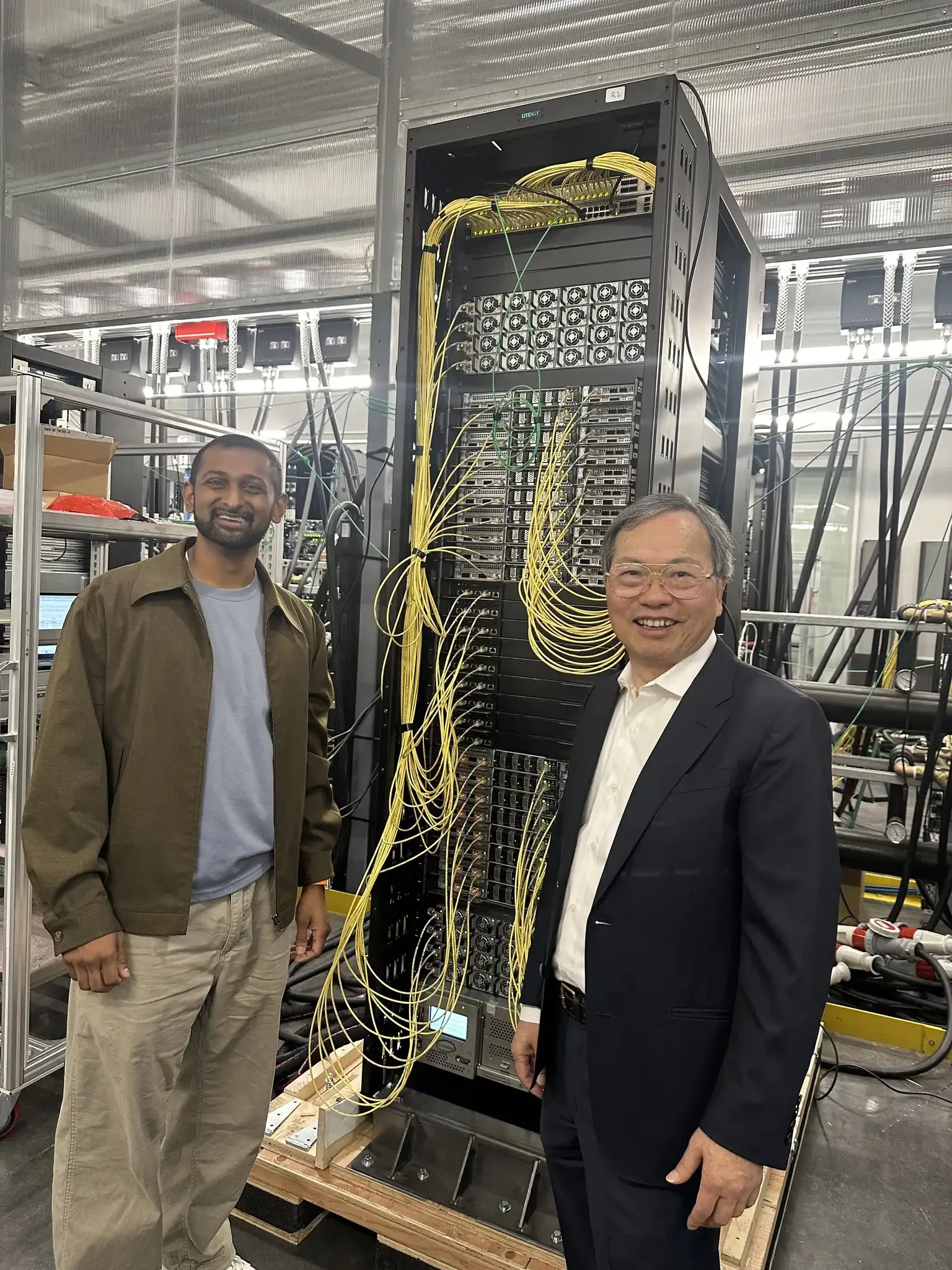
Dylan (left) with SuperMicro founder and CEO Charles Liang (right)
Last year, Dylan was invited to tour the Supermicro factory, personally guided by CEO Charles Liang. According to a reporter from The Information, when visiting Dylan's San Francisco office for an interview, he nearly bumped into Dylan's next visitor in the lobby: Sequoia Capital partner Shaun Maguire was sitting there waiting to see him.
The highlight came at GTC in March 2026.
During Jensen Huang's over two-hour keynote speech, he only mentioned two people by name, one of whom was Dylan Patel. Not only did he cite SemiAnalysis's recently released chip performance ranking, InferenceX, but he also put SemiAnalysis's logo up on the big screen, spending a full 5 minutes explaining it. During the speech, Huang even publicly acknowledged: "Dylan Patel (SemiAnalysis founder) said I was hiding my strength, saying the real performance was 50x. He wasn't wrong."
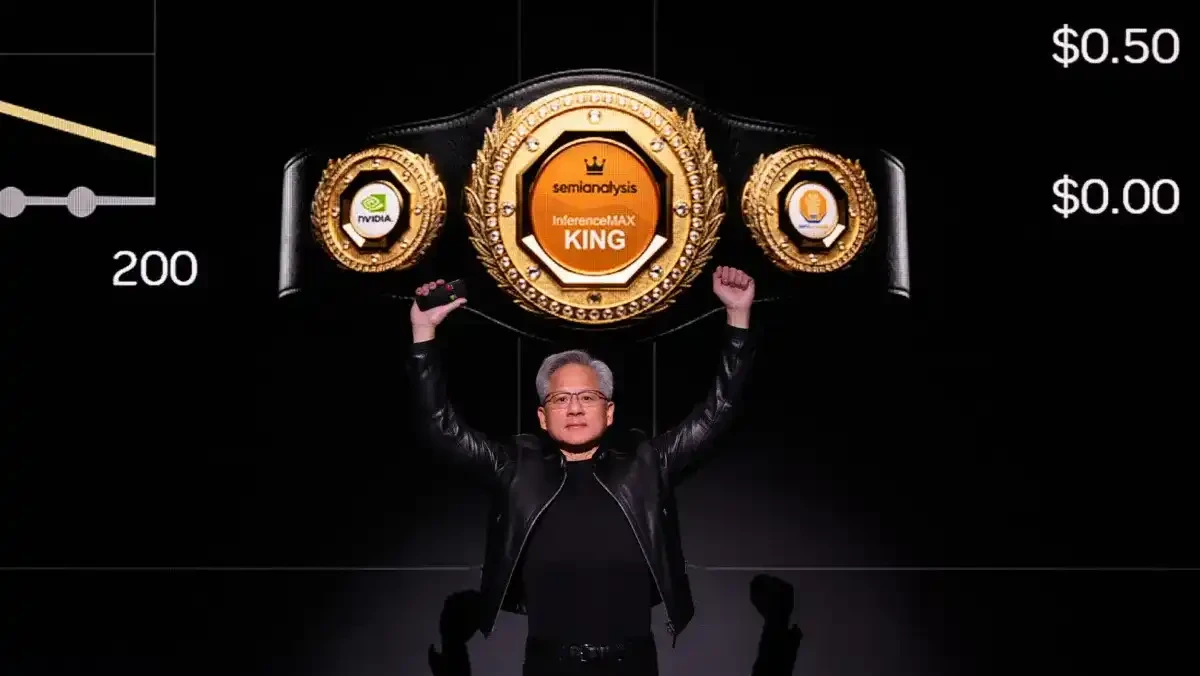
Nvidia CEO Jensen Huang celebrates with hands raised at the latest GTC developer conference, mentioning SemiAnalysis and its recent evaluation report on Nvidia chips
This status is also directly reflected in its commercial revenue.
SemiAnalysis's revenue is projected to hit $100 million this year, compared to just about $20 million a year earlier. Its clients span tech giants and top-tier investment institutions. It doesn't publicly display client logos, but the publicly disclosed client profile is telling enough: hyperscale cloud providers, major chipmakers, and large public and private equity investors.
In other words, SemiAnalysis's primary revenue doesn't come from ordinary newsletter subscribers, but from selling these reports to the startups, investors, institutions, and traders who decide on billions of dollars in AI infrastructure spending.
From Anonymous Hardware Enthusiast to Top-Tier AI Institution
Much like the recent 'White-Haired Stock Guru,' the background of SemiAnalysis founder Dylan Patel has a distinctly internet-era flavor.

Dylan Patel
According to an article by Dr. Ian Cutress, a friend of Dylan Patel, before founding SemiAnalysis, Dylan was a moderator on a popular hardware forum.
Dylan himself recalled on a podcast that before starting the company, he had run an anonymous blog for many years within the 'Silicon Valley Twitter circle.' It was a niche community unfamiliar to the average tech Twitter user, but it was filled with hardware, chip, and supply chain professionals.
Some Reddit community users also mentioned that Dylan Patel was initially just a 'nobody' on Reddit. Public Reddit archives we found show the username u/dylan522p and u/SemiAnalysis appearing in r/hardware moderation discussions.
These clues piece together a picture of Dylan as an early hardware enthusiast active on Reddit and the WordPress community. At the time, he hadn't turned writing into a serious business. He was doing consulting on the side while maintaining a personal blog called 'A Thousand Million,' and this consulting work was intrinsically linked to his blog content and industry connections.
Besides Dylan, his partner Doug O'Laughlin is also a key figure at SemiAnalysis and was the turning point that commercialized the blog.
After Doug also started posting on the forum, Dylan found him 'interesting,' and they began interacting more. Later, Doug repeatedly urged him: 'You should use your real name, move to Substack, and start charging.' A few years later, Doug eventually joined the company.
Today, SemiAnalysis is the largest paid technology newsletter on Substack, with over 285,000 subscribers. In addition to Substack posts, it also has a podcast called Transistor Radio.
According to Dylan, the podcast serves as a vessel for industry opinions that don't make it into the formal articles. Articles handle complete, in-depth stories, while the podcast handles fragmented news commentary, off-the-cuff judgments on the overall market, and weekly real-time industry discussions. It's roughly bi-weekly, featuring casual chats about semiconductor news from the preceding two weeks.
Now, the podcast operates routinely, no longer relying solely on the two founders but featuring various team members. For instance, an episode in March 2026 featured Sravan Kundojjala, Ivan Chiam, and Jordan Nanos dissecting the AI chip shortage, covering everything from TSMC and Nvidia CPO to how the memory crisis affects GPU pricing and even next-generation smartphones.
Beyond his own channels, Dylan Patel is a frequent guest on major tech and investment podcasts, almost becoming a standard guest for AI hardware topics. He's appeared on No Priors, Invest Like the Best, Unsupervised Learning, and the Dwarkesh Patel Podcast. He also did an in-depth conversation with Jon Y from Asianometry, which many viewers consider one of the best YouTube channels on semiconductors and business history.
More Like an 'Intelligence' Agency, Even More Like Muddy Waters
A detail in The Information's report highlights Dylan Patel's modus operandi.
In the early days of his career, to fill gaps in his semiconductor knowledge, Dylan Patel attended almost every industry conference he could. Once there, he would grab people and ask questions. Not just casual pleasantries, but relentless questioning, turning engineers, supply chain experts, and company executives into his sources one by one.
Later, as SemiAnalysis grew, this method didn't change; it just became more industrialized.
According to The Information, the company now has 85 employees spread across 11 countries. Every Monday, Dylan reviews the weekly briefs submitted by team managers. Each team focuses on a specific segment of the AI economy, compressing the news, leads, anomalies, and reasoning from the previous week into a single document.
Think of it as a weekly AI infrastructure intelligence report. Someone monitors each line: GPU, HBM, packaging, data centers, power, cloud providers, optical modules, chip manufacturing equipment. This includes former ASML engineer Jeffrey Koch, who specializes in the semiconductor equipment supply chain. When analyzing AI supply chain bottlenecks, his focus extends beyond electricity to whether chip manufacturing equipment might become the primary constraint.
SemiAnalysis is also adept at uncovering information from gray areas.
The article mentions that Dylan once saw a leaked internal Google memo circulating on Discord. He downloaded it and then verified its authenticity with someone inside Google.
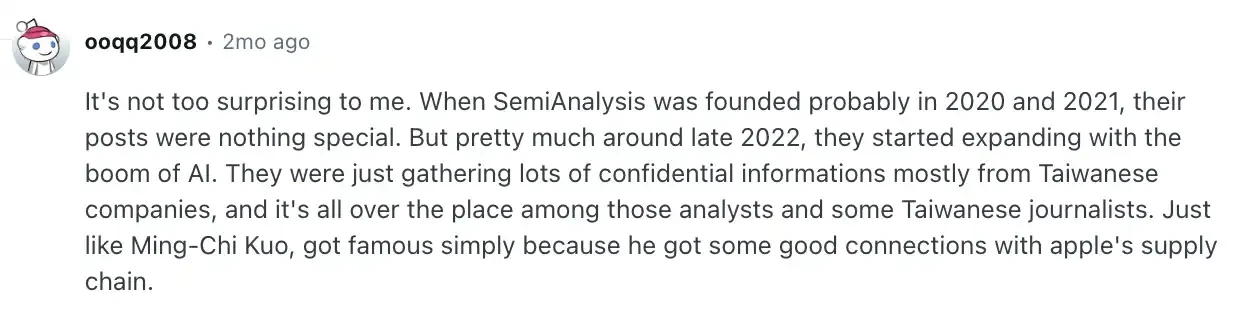
Reddit communities also pointed out: Around the time of SemiAnalysis's founding in 2020 or 2021, its published content wasn't particularly special. But around the end of 2022, as the AI boom intensified, it began to expand rapidly. This user believes SemiAnalysis collected a large amount of non-public or semi-public information, primarily from Taiwanese companies, which circulated among analysts and some Taiwanese journalists.
"To some extent, SemiAnalysis is like Ming-Chi Kuo, famous simply for building strong relationships with the Apple supply chain."
Recently, a lawsuit between SemiAnalysis and a former employee brought this 'gray information-gathering capability' to the forefront.
According to court documents from the San Francisco County Superior Court, former SemiAnalysis employee Wei Zhou accused Dylan Patel of simultaneously operating SemiAnalysis and personally investing in Fluidstack, using non-public information obtained through this relationship for research. Zhou alleged that after refusing to incorporate this information into SemiAnalysis products, he faced retaliation and was fired. (It should be noted that these are currently allegations from one party in the litigation documents and have not been finally determined by the court.)
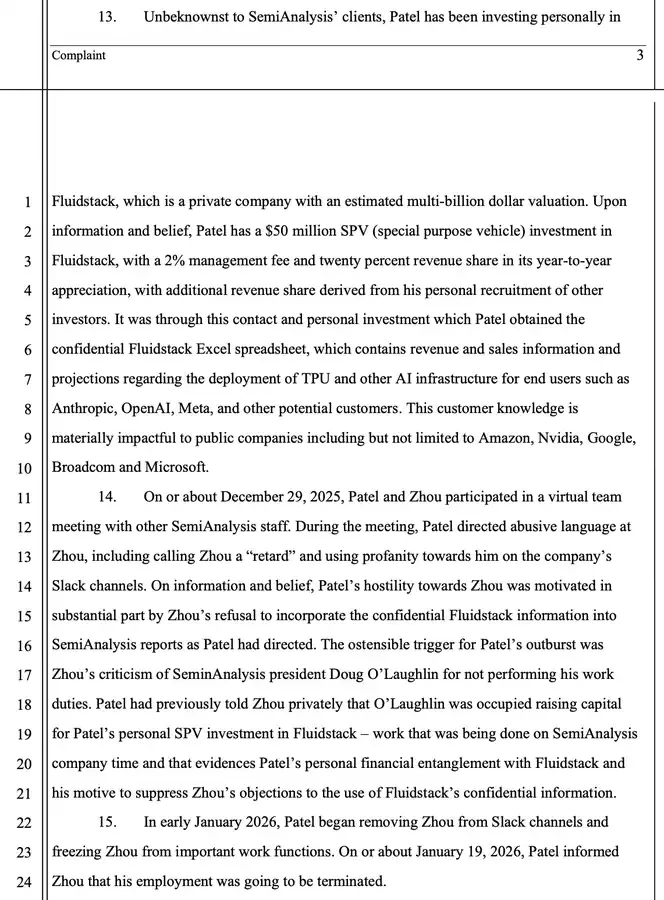
SemiAnalysis former employee accuses Dylan Patel of improper information gathering
The complaint states that SemiAnalysis clients were unaware of Patel's personal investment in Fluidstack. Fluidstack is a private cloud services company reportedly valued at tens of billions of dollars. Zhou alleged that Patel invested in Fluidstack through a $50 million SPV, a special purpose vehicle. Patel could also collect a 2% management fee from this SPV, share in the investment appreciation, and potentially earn additional income from introducing other investors.
More critically, the complaint alleges that through this personal investment relationship, Patel obtained a confidential Excel spreadsheet from Fluidstack. The spreadsheet contained Fluidstack's revenue, sales data, and forecasts related to TPU and other AI infrastructure deployments, with end customers including Anthropic, OpenAI, Meta, and other potential clients.
Zhou's claim implied that this customer demand and deployment information was not just Fluidstack's own trade secrets but could also affect the evaluation of a range of publicly listed companies like Amazon, Nvidia, Google, Broadcom, and Microsoft, as they are all part of the AI cloud, GPU/TPU, networking, and data center infrastructure supply chain.
From these third-party details, we can roughly discern SemiAnalysis's research methodology: it's a complete intelligence-gathering machine involving forums, Discord, industry conferences, networks, shipping records, government documents, supply chain data, on-site data center photos, benchmarks, models, and weekly internal briefings.
According to Dr. Ian Cutress, the data sources for institutions like SemiAnalysis are far more complex than average people imagine. Examples include submitting FOIA requests, scouring public shipping manifests, digging into supply chain documents and government files. Regarding data centers, they might even apply for permits to send drones over construction sites to take high-resolution photos of installed equipment.
SemiAnalysis's own product page is also quite straightforward. Its AI Data Center Model tracks over 5,000 data centers globally, with data sources including property records, construction permits, electricity usage, FOIA requests, and satellite imagery. To handle the massive volume of satellite photos, they trained a computer vision model, specifically a CNN, to automatically identify the scale, capacity, and construction progress of each data center. The goal is to cover every data center in every country.
This approach resembles less a traditional analysis firm and more an open-source intelligence company.
Interestingly, it reminds this BlockBeats editor of the investigative methods of the famous short-selling research firm Muddy Waters. Muddy Waters also made its name targeting Chinese companies.
For instance, Muddy Waters' investigation of Orient Paper included site visits to factories, observing the plant environment, machinery, and inventory, chatting with workers and nearby residents, even secretly squatting outside the factory to record the load of incoming and outgoing trucks and taking photographic evidence. They ultimately concluded that the so-called inventory was basically a pile of scrap paper.
Similarly, when investigating China Media Express, Muddy Waters surveyed ad playback on terminals across over 50 buses. They found drivers preferred playing their own DVDs, indicating the company had weak control over its terminals. When investigating Multi-Dynamic Water, they found one of the listed office locations was practically empty, with employees showing no sign of work, which they jokingly called an 'adult daycare center.'
The most recent blockbuster short-selling attack was against Luckin Coffee, which this editor drinks daily. Muddy Waters mobilized 92 full-time investigators and 1,418 part-time ones, surveilling over 620 stores across 38 cities. They recorded 11,260 hours of store surveillance footage covering 981 business days and 100% of store operating hours. They also collected


