On the night the Nasdaq plunged 6.4% intraday, wiping out $3 trillion, what happened across asset classes?


On November 5, U.S. stocks posted their largest single-day decline since the tariff turmoil of April 2025. The Nasdaq Composite fell 5.52%, the Nasdaq 100 dropped about 6.4%, the S&P 500 fell 4.35%, and the Philadelphia Semiconductor Index plunged 12%, its biggest drop since 2020. Nvidia fell 9.26%, AMD dropped 17.26%, SanDisk fell 22.26%, and Micron declined 17.46%. The Financial Times calculated that Wall Street stock market value evaporated by about $3.2 trillion in a single day, while The Wall Street Journal put the figure at about $2.5 trillion; the two use different scopes of measurement.
This selloff did have a new policy trigger: local referendums restricting data center construction in many parts of the U.S. passed with high approval rates, and exit polls showed 76% of voters opposed building data centers in their communities. Sanders subsequently proposed an "immediate national moratorium on data center construction." As of now, this remains a political statement; no bill text has entered congressional review.
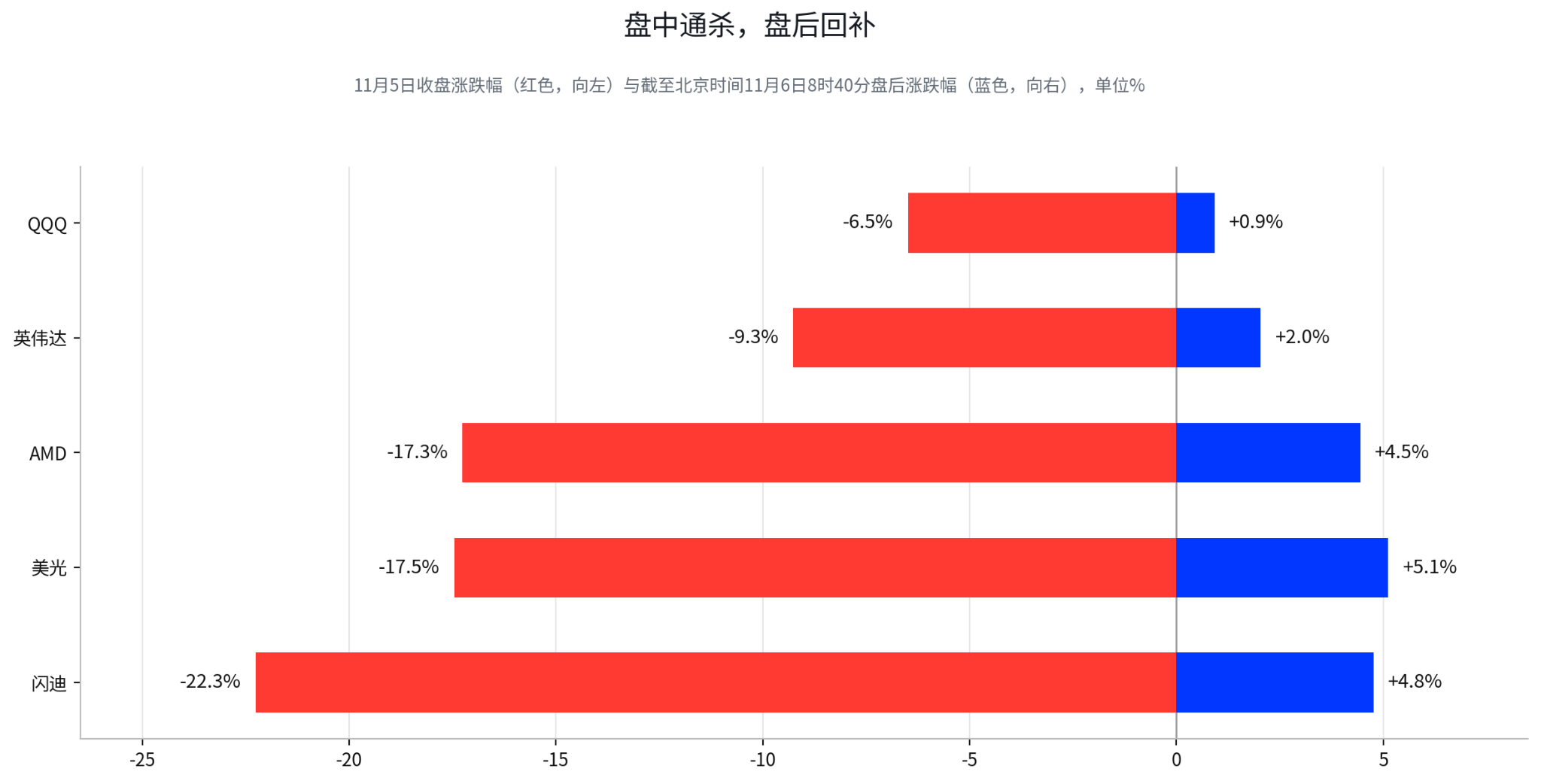
The after-hours market recovered quickly. As of 8:40 a.m. Beijing time on November 6, Micron was up 5.1%, SanDisk up 4.8%, AMD up 4.4%, Nvidia up 2.0%, QQQ had rebounded 0.93% from the close, and Nasdaq 100 futures had turned positive by about 0.4%.
Between the intraday rout and the after-hours recovery, what the market is truly repricing is whether policy risk can transmit to data center capital expenditure; whether AI demand has disappeared is secondary.
1. From Divergence to Broad Selloff: What Really Blew Up Was Crowded Positioning
The policy news was only the fuse; the damage came from capital expenditure expectations and crowded positioning that had been piling up over the past two years.
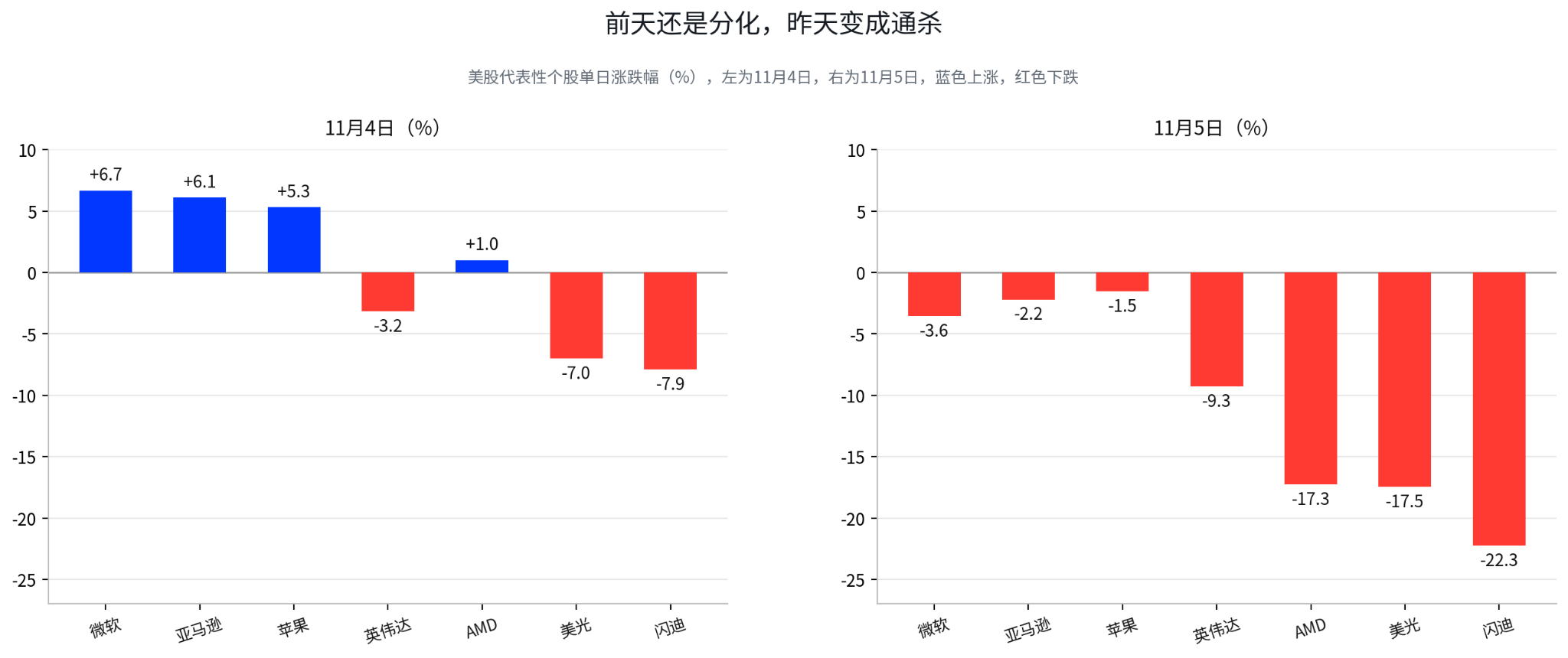
The November 5 decline is hard to explain with "the Democrats won" alone. The day before, the U.S. AI chain was still clearly diverging, with large tech platforms rising and AI hardware only modestly pulling back. One day later, everything from GPUs and memory to optical communications and PCBs fell across the board, and the Magnificent Seven shed more than $1 trillion in market value in a single day (as reported).
Over the past year, AI hardware and data center construction have repeatedly been validated by orders, capital expenditure, and earnings, and trades such as the memory super-cycle and compute leasing have continuously strengthened. When the market has already priced AI infrastructure expectations to a very high level, any variable that could slow capital expenditure will trigger concentrated profit-taking. The local referendums on November 5 gave the market a sufficiently strong reason: data tracked by Redbud Consulting shows that 38 of 44 local measures restricting data centers across the U.S. passed, while another media tally put it at 40 of 41, a slight discrepancy. Exit polls showed 76% of voters opposed building data centers in their communities (both as reported).
Sanders' statement therefore needs to be positioned accurately. On November 5, he posted on social media, citing local referendum results and calling for an "immediate national moratorium on data center construction." This is a political position; it has not been submitted to a committee, nor is there any bill text. What the market really needs to wait for is whether local opposition sentiment can enter federal policy and then transmit to data center construction and cloud providers' capital expenditure.
The market is currently trading a chain that has not yet played out:
Local opposition to data centers → tighter federal policy → slower data center construction → downward revision of cloud providers' capital expenditure → fewer AI hardware orders → downward revision of chip and memory earnings expectations
The November 5 share prices jumped straight to the final step, while the intermediate links have not yet been confirmed. This round of decline looks more like a concentrated deleveraging of high-valuation, high-positioning AI trades; the market has not confirmed that the AI infrastructure cycle is over.
2. Memory Fell Hardest: The Market Cut the Orders Closest to Capital Expenditure
Memory's decline was nearly twice that of the core compute names; funds first cut the orders most sensitive to new capital expenditure.
Nvidia fell 9.26%, but what really widened the decline was memory. Micron fell 17.46%, SanDisk fell 22.26%, Western Digital fell 17.35%, while Nvidia fell 9.26% and AMD fell 17.26% over the same period. This structure itself is a signal.
Data center capital expenditure ultimately transmits to the supply chain through servers, GPUs, HBM, DRAM, NAND, and other links, and memory companies' earnings expectations are more tightly tied to new data center demand. Once the market begins to doubt the future pace of data center construction, the first things to be cut are the orders most sensitive to new capital expenditure and also with the highest past gains and crowding in positioning.
That is why memory fell harder than GPUs: the read is that funds are prioritizing a downward revision of the marginal increment of AI infrastructure, while AI demand itself has not yet been falsified. This is also why November 5 cannot simply be defined as the "bursting of the AI bubble." If the market confirmed a full collapse in AI demand, cloud providers' capital expenditure, orders, and earnings expectations should be revised down in tandem; what has actually happened so far is only that funds have used share prices to cut away part of the previously overly optimistic capital expenditure assumptions.
The after-hours rebound illustrates exactly this point. As of 8:40 a.m. Beijing time, Micron was up 5.1%, SanDisk up 4.8%, AMD up 4.4%, Nvidia up 2.0%, and QQQ had rebounded 0.93%. Funds are recalculating the distance between political statements and actual changes in capital expenditure, and the stocks that fell the most earlier naturally saw short covering and oversold rebounds first.
The after-hours rebound alone cannot prove a trend reversal. After-hours liquidity is lower, price swings are easily amplified, and the truly valuable signal must wait until the regular trading session opens on November 6: if GPUs stabilize first while memory remains weak, it means funds are repricing within the supply chain. If the entire AI hardware chain recovers in sync, it is closer to a rebound after panic deleveraging. If the after-hours gains quickly disappear, it means deleveraging is not over.
3. Hong Kong Stocks Rose on Platforms and Fell on Hardware
The divergence between Hong Kong stocks and U.S. AI hardware is actually the two ends of the same rotation trade.
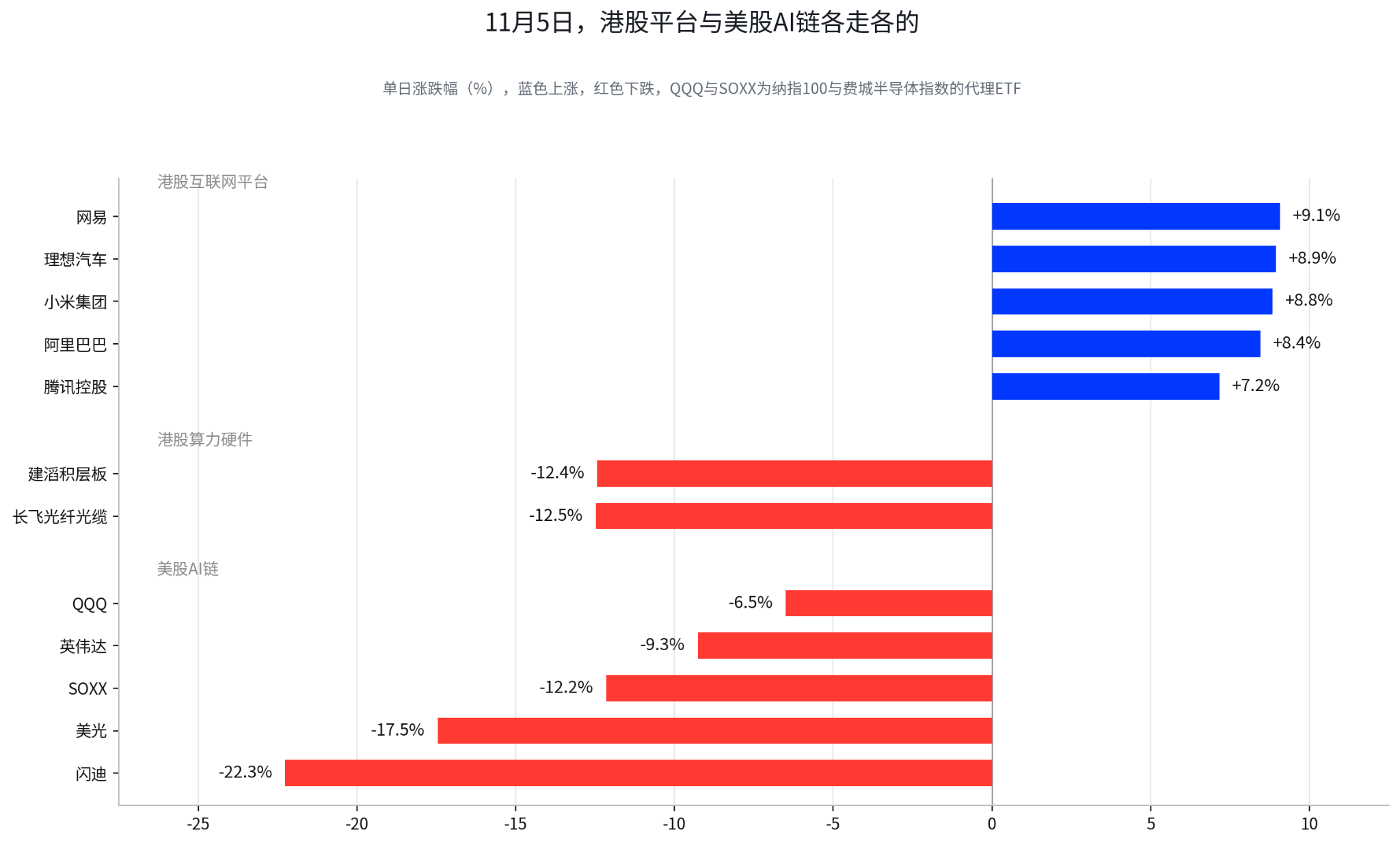
On November 5, the Hang Seng Index rose 3.67%, the Hang Seng Tech Index rose 5.55%, and turnover expanded to HK$356.667 billion, up 50.56% from the previous trading day, superficially the exact opposite of the sharp decline in U.S. AI hardware. Broken down, Hong Kong stocks did not rise across the board; funds were likewise making a clear directional switch.
NetEase rose 9.07%, Li Auto rose 8.94%, Xiaomi rose 8.83%, Alibaba rose 8.45%, and Tencent Holdings rose 7.17%. At the same time, Kingboard Laminates fell 12.43% and Yangtze Optical Fibre and Cable fell 12.48%; compute hardware that had been strong the previous day came under clear pressure.
The read on Hong Kong stocks' rise is that after reducing exposure to AI infrastructure, funds re-selected targets within tech assets; the safe-haven narrative is only superficial. The platform internet side benefited from valuation repair and marginal improvement in the policy environment, while the other side saw funds withdraw from compute hardware with high valuations and high sensitivity to capital expenditure; both ends can be understood within the same rotation trade. A-shares opened lower and closed higher that day, with the Shanghai Composite up 0.10%, the ChiNext Index up 0.87%, and LONGi Green Energy up 3.92%; the new energy sector's support is consistent with this rotation thread.
Southbound funds recorded net selling of about HK$21.3 billion that day, which also shows that an index rise does not equal a full return of southbound funds; peripheral funds, platform heavyweight stocks, and market style rotation together supported the day's行情.
What to watch going forward is whether this rotation can persist. If Hang Seng Tech continues to be led by platform stocks while compute hardware continues to underperform, it means funds are actively reducing exposure to AI infrastructure. If compute hardware outperforms again, it means the policy shock of November 5 is being quickly digested.
4. Before Direction Is Confirmed, Watch the Bill Text, Capital Expenditure, and Intra-Chain Divergence
Whether this market move can escalate from a clearing out of a crowded trade into a genuine adjustment of the AI capital expenditure cycle, the answer hinges on three points.
Bill text: Local referendums and political statements can only prove that data center construction faces greater social resistance; what truly affects valuations is whether restrictive clauses enter legislation, appropriations, or energy policy. Only when explicit restrictive clauses appear at the federal level will the market have reason to further lower data center construction expectations. If it remains at the level of social media statements, then a large part of the November 5 decline reflects sentiment and positioning factors.
Cloud providers' capital expenditure: How much Microsoft, Google, Amazon, and Meta are ultimately willing to spend matters more than anything any politician says. If cloud providers maintain or even raise capital expenditure, November 5 looks more like a valuation and positioning adjustment. If project delays, order slowdowns, and downward revisions to capital expenditure guidance appear in the coming months, then the memory, optical communications, and server supply chains will need to further cut earnings expectations.
Who stabilizes first within the AI chain: The relative performance of GPUs, memory, optical communications, and PCBs is more informative than simply watching the Nasdaq. If GPUs stabilize first while memory remains weak, it points to the market lowering expectations for the memory super-cycle and crowded trades. If the entire AI hardware chain rebounds in sync, it means panic is being digested. If memory, optical communications, and PCBs continue to make new lows, the market is mapping policy risk further onto the entire capital expenditure cycle.
What was broken on November 5 can be clearly defined: the market had previously assumed that AI capital expenditure could only go up, not down, and that confidence was cracked that day. The after-hours recovery in chip stocks shows the market is re-distinguishing between political statements and policy implementation; direction is not yet fully confirmed.
Bill text determines the level of policy risk, cloud providers' capital expenditure determines whether the fundamentals are real or not, and divergence within the AI chain determines whether funds are actually rotating or retreating.
5. Bonds, Gold, Oil, and FX Were Not Dragged Down
This round of selling was concentrated in the crowded end within equities; a liquidity squeeze across all assets did not occur.
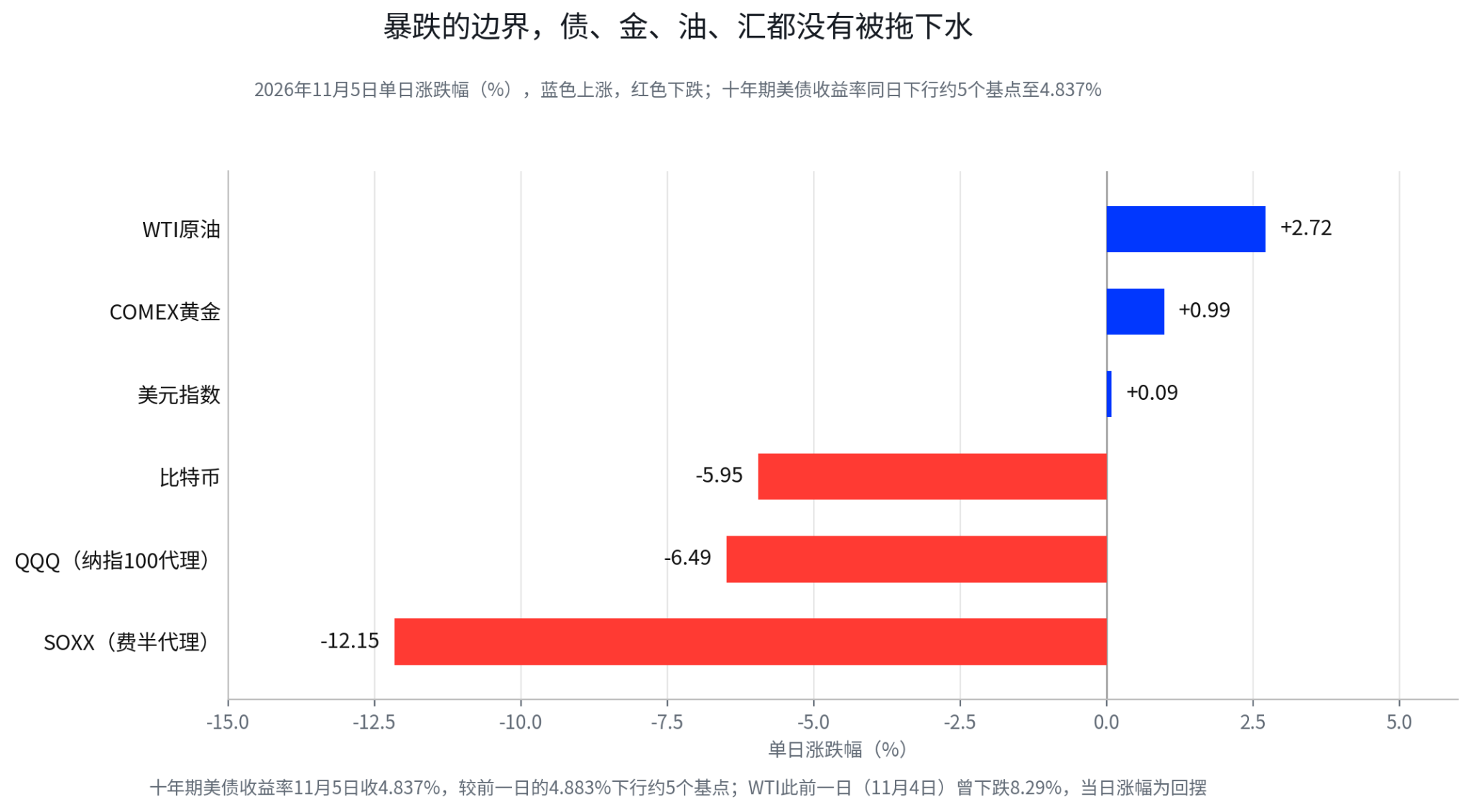
Looking at stocks alone, this was a decline on the scale of a liquidity crisis. Zooming out to all assets, the picture is completely different. Gold had already risen 3.37% on November 4 and added another 0.99% on November 5; safe-haven buying was not only present but entered for a second consecutive day. WTI rose 2.72%, but to be clear, it had just fallen 8.29% on November 4; the day's gain was a rebound after a plunge and cannot be taken as evidence of strengthening demand.
The bond answer is more interesting. The 10-year U.S. Treasury yield moved from 4.883% down to 4.837%, a move of only about 5 basis points; there was safe-haven buying, but modest in scale. The dollar index was flat near 101.49. If this decline were understood as a deleveraging squeeze, gold would have been sold off along with everything else to raise margin, and bond yields would have been driven down by dozens of basis points by panic buying; neither happened.
So the selling that night had a clear boundary: it was drawn at crowding of positioning, not at asset class. What was sold were the most fully positioned stocks and crypto with the heaviest narratives; what was caught were assets with real supply and demand or with interest. Bitcoin fell 5.95%, sitting exactly on this boundary; its decline followed stocks, and its commodity attribute did not show.
6. Profit Evidence Cashed In on the Spot
The same AI chain moved in two directions on November 5; the difference lay in whether profit evidence could be produced.
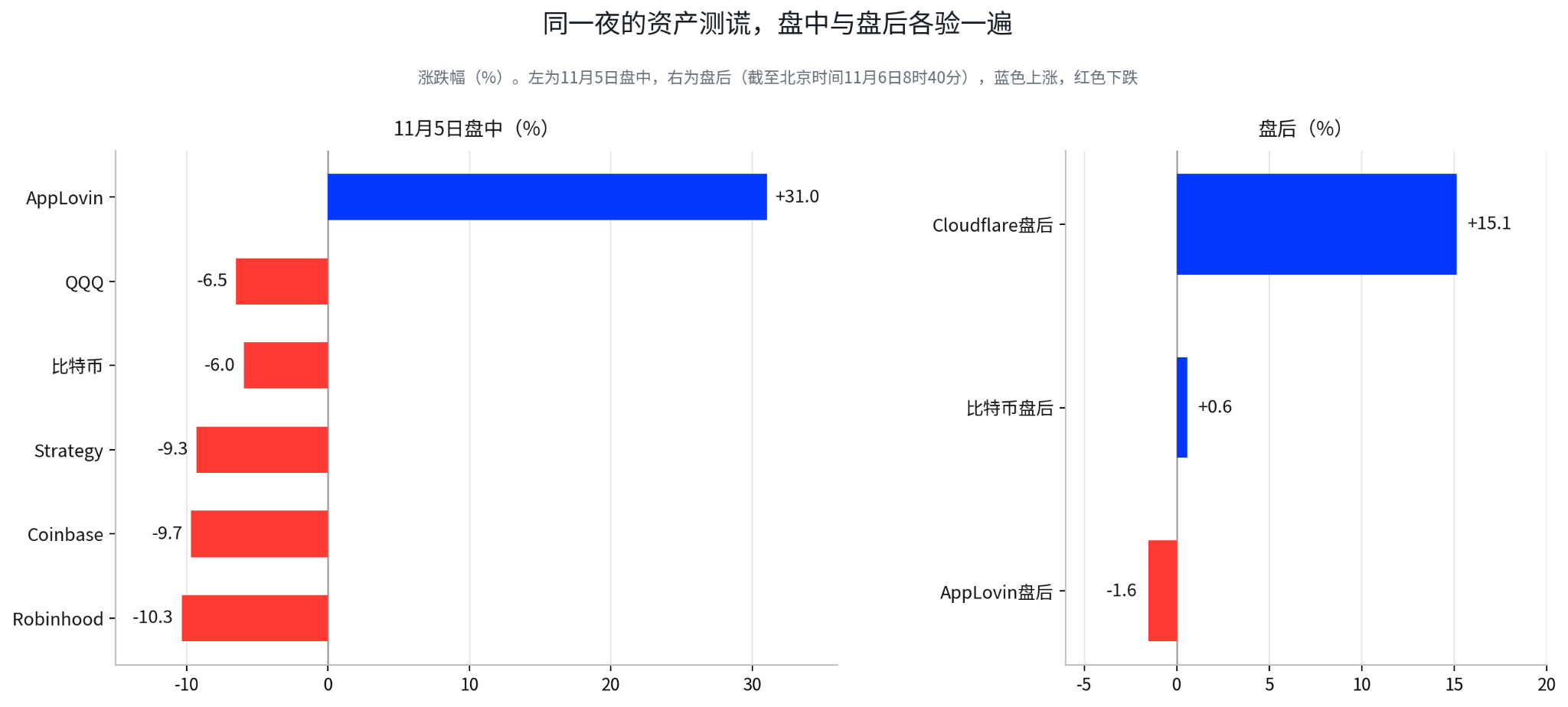
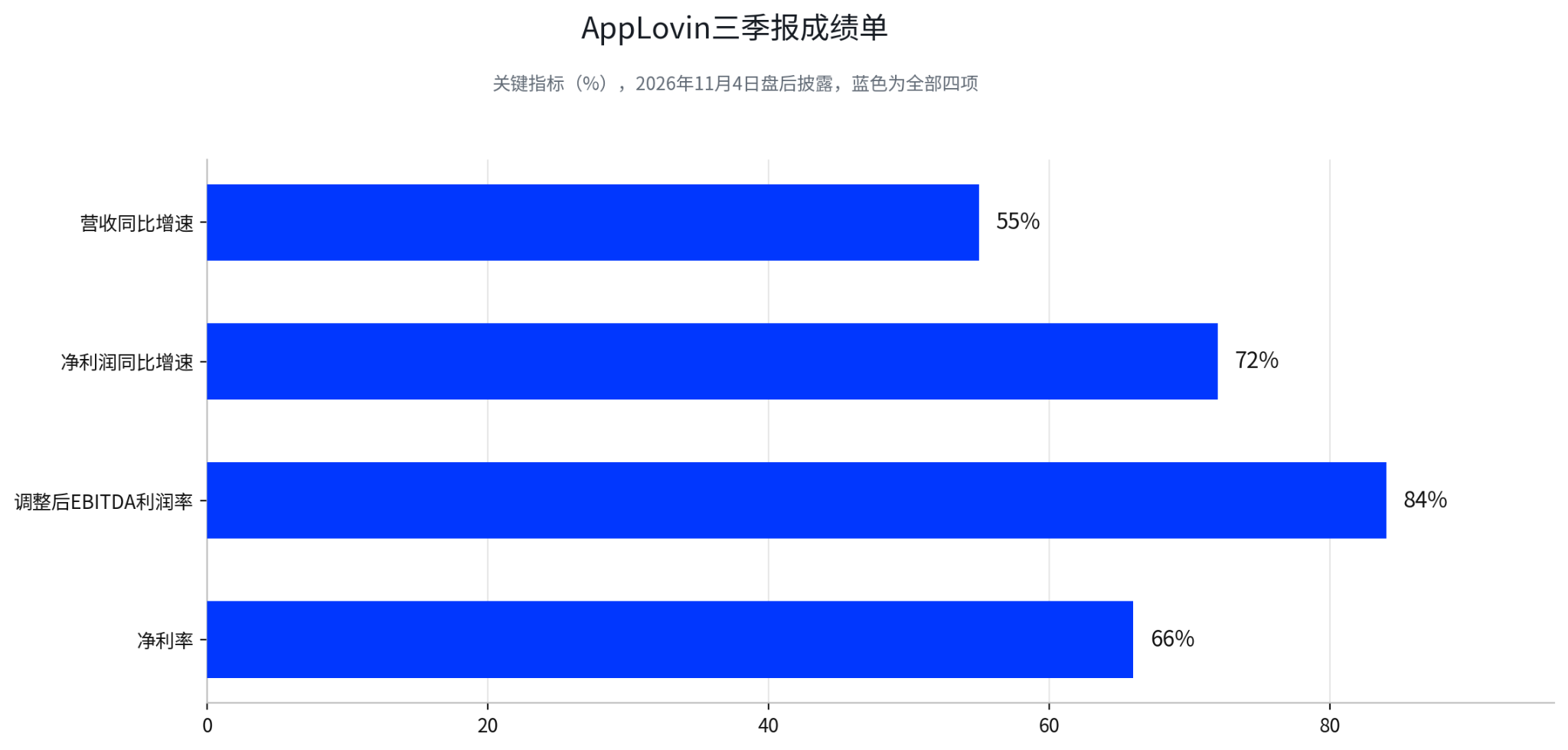
AppLovin's Q3 report was released after the close on November 4: revenue of $2.185 billion, up 55% year-over-year; net income of $1.439 billion, up 72% year-over-year; net margin of 66%; adjusted EBITDA margin of 84%; adjusted EBITDA of $1.84 billion; free cash flow of $1.4 billion (company disclosure). The company also expanded its repurchase authorization, and Q4 guidance implies 8% to 10% sequential revenue growth (as relayed from the earnings call). Thus came the most striking picture of the night: on the same day the Philadelphia Semiconductor Index fell 12%, AppLovin rose 31.04% intraday.
Position also matters. AppLovin's 52-week high is $738.01; after a two-day rally of 45%, the stock is still about 52% below its high, with a 52-week percentile of only 25.5%. It is hardly a victory for a crowded stock; it is more like a recovery ticket forcibly ignited by profit evidence after an oversold decline. The market did not reject AI; it expelled names with revenue but no profit and rewarded businesses that can convert AI into cash flow.
Cloudflare turned this split into two acts. On November 5 intraday, it fell 8.03% along with the AI infrastructure chain. After the close, it released earnings: Q3 revenue of $782.5 million, up 39% year-over-year, with growth accelerating; annualized revenue crossed $3 billion; non-GAAP operating margin of 18%; current remaining performance obligations up 37% year-over-year (company disclosure, November 5). The after-hours stock price recovered 15.1%, recapturing more than half of the day's decline. The same company was priced by two sets of logic within one day: sold during the day on AI infrastructure beta, revalued after hours on profit evidence.
7. The Market May Have Already Partly Priced In Related Policy Changes
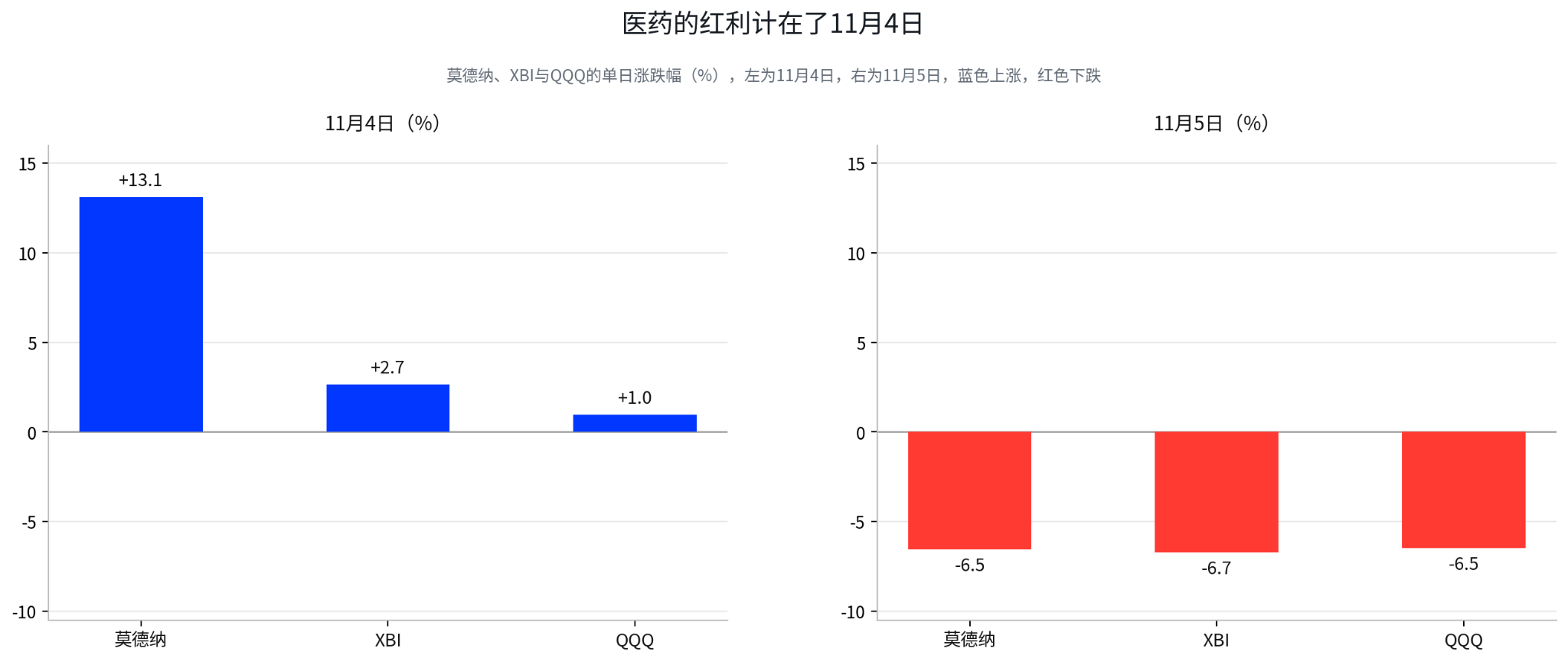
Pharma did not rise against the trend on November 5; its policy re-rating had already been completed the day before, and that day it simply fell less than the AI chain.
First, the data. On November 4, Moderna rose 13.11% to close at $258.38, hitting a new 52-week high of $260.67 intraday, with market value briefly exceeding $100 billion based on that day's share count. The same day, the S&P 500 healthcare sector rose 3.06%. On November 5, in the broad decline, Moderna fell 6.55% to $241.46, the biotech ETF XBI fell 6.73%, and the S&P 500 fell 4.35%; XBI's decline was actually deeper than the broad market. But looking at the two days together, Moderna rose 5.70% cumulatively, while the Nasdaq proxy QQQ fell 5.57% over the same period, and the divergence remains clear. Moderna's current price is only 7.4% below its 52-week high, with a 52-week percentile of 91.9%.
The policy arithmetic is also easy to calculate. After Democrats took control of Congress, the阻力 to advancing spending plans to cut Medicaid increased sharply, and the extension of Medicare subsidies and the Medicaid issue were pushed to the December 11 appropriations node (SPDB International; noted in our November 5 article). On the drug pricing side, the Inflation Reduction Act negotiation mechanism already exists, and Congress's legislative energy in the short term will be occupied by data centers and crypto regulation, making additional pricing pressure on pharmaceutical companies a lower priority. What pharma has received looks more like the exhaustion of bad news: the largest policy tail risk has been removed, and the combination of essential-demand attributes and valuations that have just shed the policy shadow has made this type of asset a natural destination for institutional funds during a contraction period.
8. Coins Without Cash Flow, and Hardware Betting on Others' Capital Expenditure
The criteria for being left out are equally consistent: either the cash flow does not