AI stock selloff spills into bond market, SoftBank dollar bonds lead declines


- Key Takeaway:The AI stock selloff has spread to credit markets, with SoftBank dollar bonds posting their largest single-day drop in nearly ten weeks, pushing Asia investment-grade dollar bond spreads to the widest since July 2025. However, the intensity of the selloff is milder than in equities, and the long-term AI demand thesis remains intact.
- Key Elements:
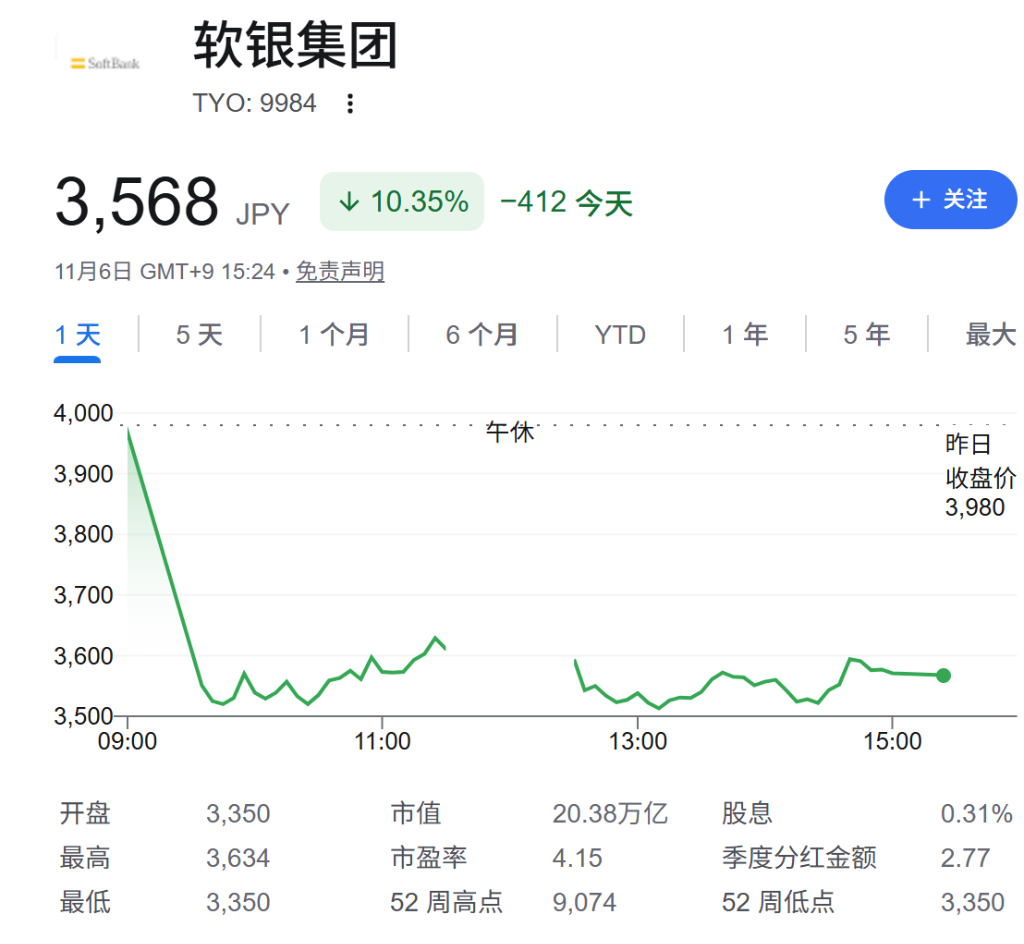
- SoftBank's 2032-maturity dollar bonds fell 0.9 cents, while its shares plunged as much as 16% intraday.
- Average spreads on Asia investment-grade dollar bonds widened to 73 basis points, the widest since July 2025.
- U.S. stocks shed roughly $2.3 trillion in market value in a single day, with CDS spreads on CoreWeave, SpaceX, and Broadcom jumping to record highs.
- Dutch bank ING is reportedly seeking to sell a data center loan portfolio of about $500 million; hedge funds have aggressively sold AI-related bonds in recent weeks.
- Analysts view this selloff as more of an unwinding of crowded trades; AI buildout may become slower and more disciplined, but long-term demand remains sound and prices are being recalibrated.
Author: Zhang Yaqi
Source: Wallstreetcn
The sell-off in AI stocks has spread from the equity market to the credit market, with SoftBank Group bearing the brunt as its dollar bonds posted their largest single-day decline in nearly ten weeks.
SoftBank's dollar bonds maturing in 2032 fell 0.9 cents on Friday, while its shares plunged as much as 16% intraday. Meanwhile, spreads on Asian investment-grade dollar bonds widened by at least 3 basis points, and actively traded Asian high-yield bonds also came under notable pressure. The turmoil in credit markets, compounded by rising fiscal deficits, higher oil prices and mounting inflation, is exposing the global economy—already buoyed by the AI spending boom—to new downside risks.
The sell-off is a continuation of a broader repricing across global credit markets. The debt binge driven by the AI boom has already pushed yields higher, and the latest equity market turbulence has accelerated that process. According to Bloomberg-compiled data, the average spread on Asian investment-grade dollar bonds rose to 73 basis points on Thursday, the widest since July 2025.
Credit Sell-Off Still Less Severe Than Equities
Despite the pressure on credit markets, the intensity of this sell-off is markedly lower than in equity markets. CreditSights analyst Zerlina Zeng noted that falling US Treasury yields have provided some buffer for investors focused on total returns.
"The sell-off in both US and Asian markets has been relatively restrained overall," Zeng said. She added that October's sharp decline had already drawn many investors to bargain-hunt in some Asian high-yield bonds, including real estate credit that has held up reasonably well.
AI-Related Stress Transmits to Credit
The core question in the market now is whether the stress accumulated by companies tied to the AI investment boom will trigger a more sustained repricing in Asian credit markets.
US stocks shed roughly $2.3 trillion in market value on Thursday alone, with credit default swap spreads for CoreWeave, SpaceX and Broadcom jumping to record highs. ING is reportedly seeking to sell a data center loan portfolio of about $500 million. Meanwhile, according to Zeng, a Democratic sweep, a recent wave of debt issuance by hyperscalers, and negative news around Oracle's data center permits in New Mexico are all further weighing on spread performance.
In terms of actual fund flows, signs of stress had emerged before the latest round of volatility. Andrzej Skiba of RBC Global Asset Management said in a Bloomberg Television interview on Thursday that hedge funds have been aggressively selling AI-related bonds in recent weeks, heightening the risk that the repricing of AI-related debt spreads more broadly across global credit markets.
Long-Term Thesis Intact; Market May Be Resetting, Not Collapsing
Despite the recent turbulence, some market participants see this sell-off as more of an unwinding of a crowded trade than the end of the AI investment cycle.
Brian Levitt, Chief Global Market Strategist at Invesco, said:
"The pace of AI buildout may become slower and more disciplined from here. But long-term demand for AI and computing power remains intact—investors are simply recalibrating the price they need to pay for this opportunity."
Zerlina Zeng said investors have already been reaching out to her to assess the implications of the US midterm election results for tariff policy, AI investment, the Iran war situation and US Treasury supply. "Bond supply pressure in AI-related sectors remains the market's focus," she said.