


Raises Another $630 Million, Strive Takes the Baton from Strategy as the BTC Engine


- Core Viewpoint: Against the backdrop of a Bitcoin downturn and peers slowing their accumulation, Strive has bucked the trend by issuing perpetual preferred stock to finance large-scale Bitcoin purchases, adding 7,356 BTC within two weeks to rise to fourth among listed companies' holdings—yet the cash obligations and unrealized loss risks stemming from its high-yield preferred stock cannot be overlooked.
- Key Elements:
- Strive's weekly purchase volume has grown week by week to 4,045 BTC, bringing holdings to 36,818 BTC and surpassing MARA to rank fourth, roughly 7,182 BTC shy of second-place Metaplanet.
- Financing relies not on debt but on perpetual preferred stock: SATS issued 7 million shares at $90 per share with a fixed dividend of 15% (effective yield of approximately 16.7%), raising about $630 million.
- Purchases over the past two weeks were roughly 13–15 times those of Strategy, yet its holdings are only one-twentieth of the latter's; Strategy's focus has already shifted to repurchasing preferred stock and managing its capital structure.
- Metaplanet did not buy Bitcoin during the same period, using its fundraising to repay approximately ¥23.6 billion in Bitcoin-collateralized loans and to repurchase shares; its borrowing has reached 17.7% of net asset value, exceeding its self-imposed cap.
- Risks include: annual dividend payments of about $280 million on the two preferred stock classes, unrealized losses from buying at highs, dilution of Bitcoin-per-share value due to the preferred stock's senior claim priority, and roughly 23.1% of circulating shares being sold short.
Original | Odaily (@OdailyChina)
Author | jk

Over the past year, Bitcoin has continued to decline, and the story of crypto treasury companies is no longer one of relentless buying. Strategy has bought only 250 to 267 BTC per week over the last two weeks, while Metaplanet is using newly raised funds to repay loans and buy back stock. Against this backdrop, Strive (NASDAQ:ASST) bought 7,356 BTC in two weeks.
Strive is headquartered in Dallas, USA, co-founded by Vivek Ramaswamy, with Matt Cole as current Chairman and CEO. The company went public in September 2025 through a merger with Asset Entities, subsequently acquired Semler Scientific, and bills itself as the first listed asset-management-style Bitcoin treasury company, using growth in "Bitcoin per share" as its capital allocation benchmark. Its financing approach also differs from peers: rather than relying on debt, it issues perpetual preferred stock—first SATA, a floating-rate series paying dividends on business days, and now SATS, a fixed-rate series.
With recent purchases, Strive's holdings have risen to 36,818 BTC, surpassing MARA Holdings to fourth place among listed companies, 7,182 BTC behind second-place Metaplanet (44,000 BTC). On October 15, the company priced 7 million shares of its 15% fixed-dividend preferred stock SATS at $90 per share, raising approximately $630 million, with settlement on October 20. CEO Matt Cole said the goal is to become the second-largest public holder by year-end, but the company has not committed to using all newly raised funds to buy Bitcoin.
To Surpass Metaplanet by Year-End, It Needs to Buy About 700 BTC per Week on Average
According to Strive's 8-K filing with the SEC, over the past three weeks Strive's weekly purchases have expanded week by week: 2,000 BTC from September 28 to October 2, then 3,311 BTC the following week, and 4,045 BTC in the most recent week. The most recent week's purchases came in two tranches: 2,822 BTC (about $235 million) on October 12–13, and 1,223 BTC on October 14–16 at an average price of about $81,734, for a combined average of about $82,803.
Breaking it down by week: in the week of September 28 to October 2, Strive's average purchase price was about $84,422, bringing holdings to 29,462 BTC; in the week of October 5–9, the average was about $84,500, lifting holdings to 32,773 BTC; in the week of October 12–16, the average was about $82,803, raising holdings to 36,818 BTC. The funding sources differed across the three weeks: the first week came mainly from the SATA offering, the second from an ATM issuance of SATA, and the third from warrant exercises.
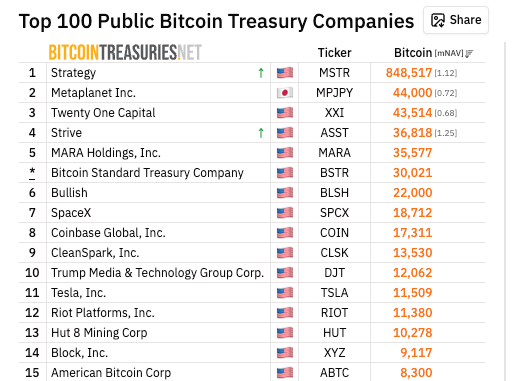
According to BitcoinTreasuries, Strive currently ranks fourth, 1,241 BTC ahead of fifth-place MARA and about 7,182 BTC behind second-place Metaplanet.
Current holdings ranking, source: Bitcoin Treasuries
On the holdings leaderboard, Strategy leads with 848,517 BTC; Metaplanet holds 44,000 BTC and Twenty One Capital holds 43,514 BTC, ranking second and third respectively; Strive's 36,818 BTC places it fourth; fifth-place MARA Holdings holds 35,577 BTC. At the end of 2025, Strive's holdings were still only about 7,500 BTC.
According to The Block's estimates, if Strive wants to surpass Metaplanet by year-end, it needs to buy about 700 BTC per week on average.
Meanwhile, second-place Metaplanet is not buying Bitcoin right now. On October 13, the company announced the issuance of ¥52 billion in zero-interest convertible bonds, with proceeds used to repay approximately ¥23.6 billion in Bitcoin-collateralized loans and about ¥28.3 billion to buy back stock—not to increase Bitcoin holdings. As of the end of September, its borrowings equaled 17.7% of its Bitcoin net asset value, exceeding the company's self-imposed 10% cap. In addition, the company sold 10,000 BTC and then bought back 11,000 BTC in the third quarter, for a net increase of 1,000 BTC, which it used to overtake Twenty One and rise to second place.
Financing via SATS: 15% Fixed Dividend, Effective Yield of About 16.7%
On October 13, Strive launched the SATS offering, initially planning 5 million shares; on the evening of October 15, the company upsized it to 7 million shares and priced it at $90 per share, for total proceeds of about $630 million, led by Barclays and Cantor. The offering settled on October 20, and SATS is now listed on Nasdaq.
SATS carries a 15% annual cumulative dividend rate based on a $100 par value, accrued daily, with the first dividend payment on November 9. At the $90 offering price, the effective yield is about 16.7%; based on a total par value of $700 million, the company must pay about $105 million in dividends annually.
Strive's Nasdaq moment
At settlement, the company funded a dividend reserve at $22.50 per share (equivalent to 18 months of dividends), totaling about $157.5 million (based on 7 million shares).
In terms of liquidation priority, SATS ranks below Strive's previously issued floating-rate preferred stock SATA and above common stock. Cole emphasized that, unlike SATA, SATS has no target trading range. After the offering, Strive's capital structure is approximately $2.8 billion in common stock, $1.4 billion in SATA, and $700 million in SATS, with no debt.
This article uses the most conservative estimate (not company-disclosed data): after deducting the roughly $157.5 million reserve from the $630 million, about $470 million remains, which at a Bitcoin price of about $83,000 could buy at most about 5,700 BTC. Even if all of it were used to buy Bitcoin, holdings would only rise to about 42,500 BTC, still below Metaplanet's 44,000 BTC, requiring SATA sales proceeds and other funds to make up the difference.
The launch of SATS is directly tied to warrant expiration. Strive previously had a batch of traditional warrants with a $27 strike price covering 15,255,900 shares, the last tranche of which expired worthless on October 13. Concentrated exercises on October 12 and 13 brought the company about $369 million and added about 13.7 million new Class A common shares. Cole said that with the warrants cleared out, it was the right time to launch a second preferred stock.
As for the proceeds, the company lists intended uses including buying Bitcoin and related products, acquiring income-generating assets, and repurchasing common stock or SATA, but it did not specify how much would go to Bitcoin purchases or provide a timeline. The company also stated a goal in its 8-K: as long as Bitcoin is below $100,000, management will strive to keep the amplification ratio above 60%.
Compared with Strategy: Purchase Volume About 13–15 Times Higher
Over the past two weeks, Strive's weekly purchases have far exceeded Strategy's. From October 5–11, Strive bought 3,311 BTC versus Strategy's 250 BTC, about 13 times as much. From October 12–18, Strategy's 8-K showed purchases of 267 BTC at an average price of about $82,900, with holdings of 848,517 BTC (per ChainCatcher's account of the 8-K), while Strive bought 4,045 BTC over the same period, about 15 times as much. It should be noted that this compares two weeks of purchase volume, not holdings: Strategy's holdings are still more than 20 times Strive's.
Strategy's focus has shifted to capital structure management. Its October 19 8-K showed that the board raised the preferred stock buyback authorization from $2 billion to $3 billion, with $1.16 billion remaining as of October 18; during the week of October 5–11, it repurchased $192.4 million of STRC. This summer, Strategy also sold Bitcoin to fund STRC buybacks and preferred dividend payments (see its July 6 and August 10 8-Ks).
Strive is taking a different path: financing Bitcoin purchases with preferred stock while avoiding debt. Its leverage comes from two layers of perpetual preferred stock, SATA and SATS, rather than convertible bonds. Strive acquired Semler Scientific in an all-stock deal worth about $1.3 billion, completed in January 2026—the first case of a listed Bitcoin treasury company acquiring a peer. Strive was co-founded by Vivek Ramaswamy and held only about 70 BTC before its September 2025 listing and merger announcement; according to company disclosures, its BTC yield has reached 63.2% year-to-date.
Risks and Controversies: Hard Cash Obligations and Unrealized Losses
The first is cash pressure. Preferred stock can be understood as a financing instrument between equity and debt: the company promises to pay investors dividends at an agreed rate on a regular schedule, and preferred dividends must be paid before common shareholders get anything. SATS has a fixed 15% dividend rate and is non-convertible, meaning investors cannot convert it into common stock to share in stock price gains, so this money is essentially more like high-interest borrowing—regardless of whether Bitcoin rises or falls, the company must pay out about $105 million in cash each year.
The company's other outstanding preferred stock, SATA, has about 13.5 million shares (disclosed in early October), equating to about $1.35 billion at a $100 par value per share; its dividend rate is not fixed but set by the company, and stood at about 13% in September. Combined, the two preferred stocks require about $280 million in annual dividend payments (this article's estimate). The company has set aside cash equal to 18 months of dividends as a reserve, so it is not short of money to pay in the near term, but once the reserve is used up, it will still need new financing or operating income to cover payments.
The second is unrealized losses. Unrealized losses refer to paper losses: as long as the Bitcoin is not sold, the loss has not been truly realized, but at current prices the Bitcoin on hand is worth less than what was originally paid. Bitcoin has fallen sharply from its high of about $120,000 last October, and the market value of Strive's holdings is below their purchase cost, mainly dragged down by earlier purchases at high prices. The company's recent purchase prices were between $81,000 and $85,000, while Bitcoin's current price is about $82,000–$84,000, meaning the portions bought in recent weeks are roughly break-even.
The third is the liquidation priority of preferred stock. Liquidation priority refers to who gets paid first if the company runs into trouble: preferred shareholders rank ahead of common shareholders, so the more preferred stock is issued, the further back common shareholders who bought the company's stock stand in line, and the less they receive. The metric the company values most is "Bitcoin per share"—how much Bitcoin corresponds to each average share—but the company itself cautions that this figure does not reflect the higher-priority claims created by the preferred stock, because some of that Bitcoin must first satisfy preferred shareholders. As of September 30, SATA's par value equaled about 55.3% of the value of its Bitcoin, meaning that for every $100 of Bitcoin, about $55 corresponds first to preferred stock—a ratio that does not yet include SATS. In addition, the company disclosed in early October a SATA buyback authorization of up to $500 million, meaning it can spend money to repurchase its own preferred stock and pay less in dividends; but this authorization exceeds the cash disclosed at the time by about $210 million, it is unclear whether it will be used, and money spent on buybacks cannot be used to buy Bitcoin.
Finally, short-selling pressure. Short selling means borrowing stock from a broker, selling it first, then buying it back after the price falls to return it, pocketing the difference—in other words, betting the stock price will decline. September data showed about 23.1% of the float was sold short, meaning roughly one in every four or five shares was being bet against. Cole said ASST is more heavily shorted than any company in the S&P 500, and described October's price action as a contest between shorts and warrant holders. Warrants are rights to buy company stock at a fixed price ($27 here); holders want the stock to rise above that price, while shorts are betting the opposite way.
On Wall Street, all five brokerages covering the stock rate it a Buy.
Next, attention will be on the 8-K to be released on the evening of October 26—the first purchase disclosure following SATS's October 20 settlement, which will show how much of the new funds actually flowed into Bitcoin. In addition, on November 9 SATS will pay its first dividend, an important test of whether the fixed dividend can be paid on time. Furthermore, whether the $500 million SATA buyback authorization is used will also affect the cash available for Bitcoin purchases.





