


Shaw Publicly Reverse-Engineers Pump.fun Contract: For the Sake of Open Source, or to Promote a New Project?


- Core Viewpoint: Eliza Labs founder Shaw announced that he used AI large models to complete approximately 90% reverse engineering of the Pump.fun contract, promoting byte-by-byte reconstruction under the banner of "forced open-sourcing," while actually building hype for his new project slop.cash.
- Key Elements:
- Shaw has made public a GitHub repository containing on-chain deployment evidence for the Pump main program, PumpSwap, Pump Fees, and Mayhem, but byte-level reconstruction of all four core programs remains incomplete.
- The goal is not a fork but pixel-level reconstruction, requiring the rebuilt binary to be byte-for-byte identical to the on-chain original, without fixing any of the original logic flaws—far more difficult than rewriting the contract.
- The primary reverse-engineering tool is ChatGPT Max ($200/month), with GLM-5.3 and Kimi K3.1 named as alternatives; Gemini was criticized for poor performance, and Claude refused to execute due to compliance restrictions.
- Shaw criticized the normalization of closed-source contracts in the Solana ecosystem, citing data that over $40 million was stolen in the past year due to vulnerabilities in closed-source contracts.
- The new project slop.cash is planned to launch on Umia Finance, focusing on internet security and private bug bounties; the reconstructed source code will be included, and related Meme coin fees will be used for buybacks and as a bounty pool.
- Community opinions are clearly divided: supporters believe transparency facilitates collaborative auditing, while opponents worry that publishing bugs as-is will lower the barrier for hacker attacks.
- The industry generally believes that source code disclosure is unlikely to shake Pump.fun's position, as its moat lies in ecosystem network effects, wallet and terminal integrations, and user trust—not the contract code itself.
Original | Odaily (@OdailyChina)
Author | Azuma (@azuma_eth)

"Nothing is absolutely safe, and nothing is sacred and inviolable. The bright forest has arrived."
On October 25, Shaw (@shawmakesmagic), founder of Eliza Labs (perhaps better known as ai16z), announced his latest move on X. Shaw took aim at Pump.fun, the leading token launch platform in the Solana ecosystem, claiming that he had completed reverse engineering approximately 90% of Pump.fun's related smart contracts and expected to finish the remaining work that evening.
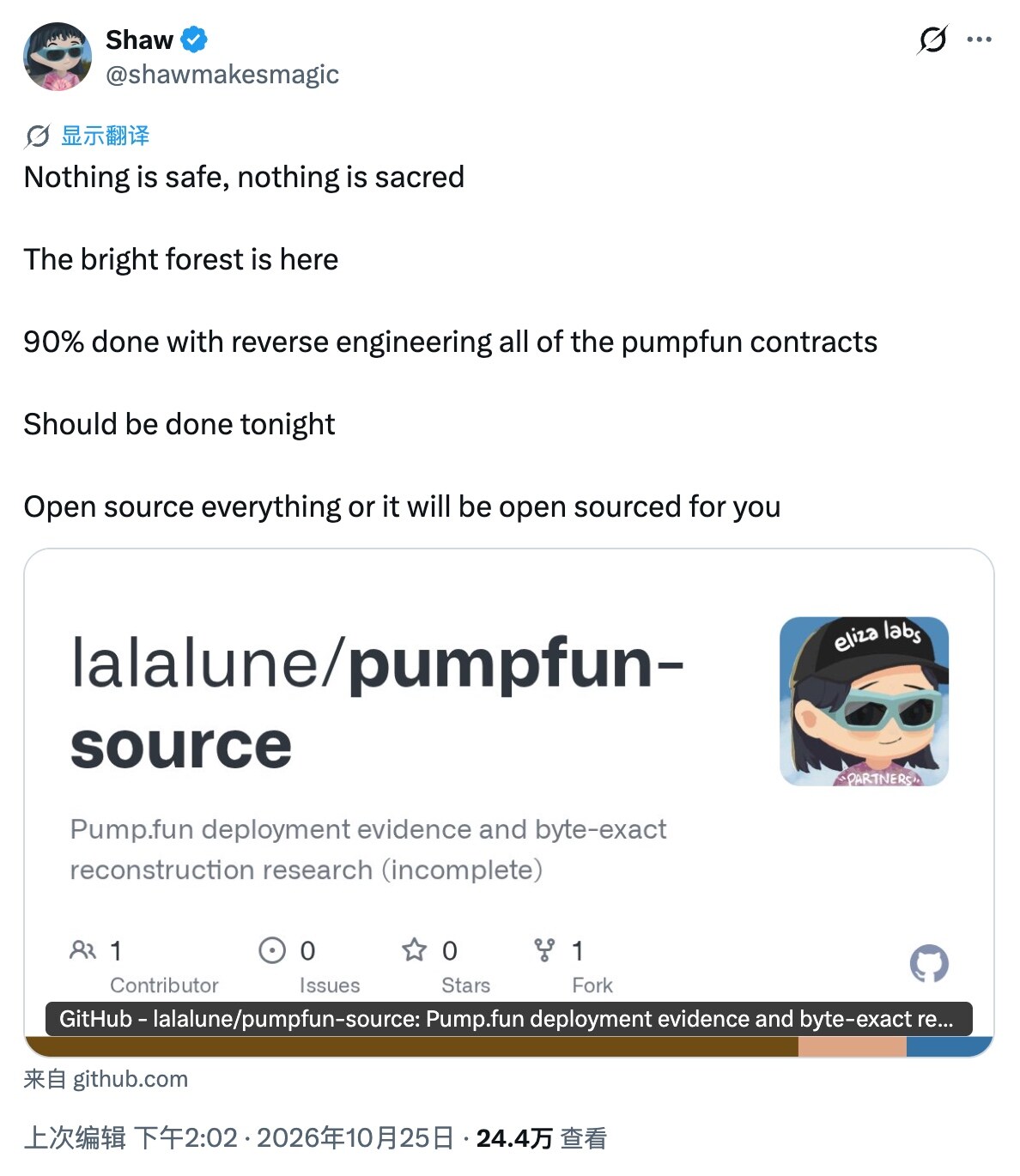
In his X post, Shaw's language was notably provocative: "Either open source everything, or I'll open source it for you."
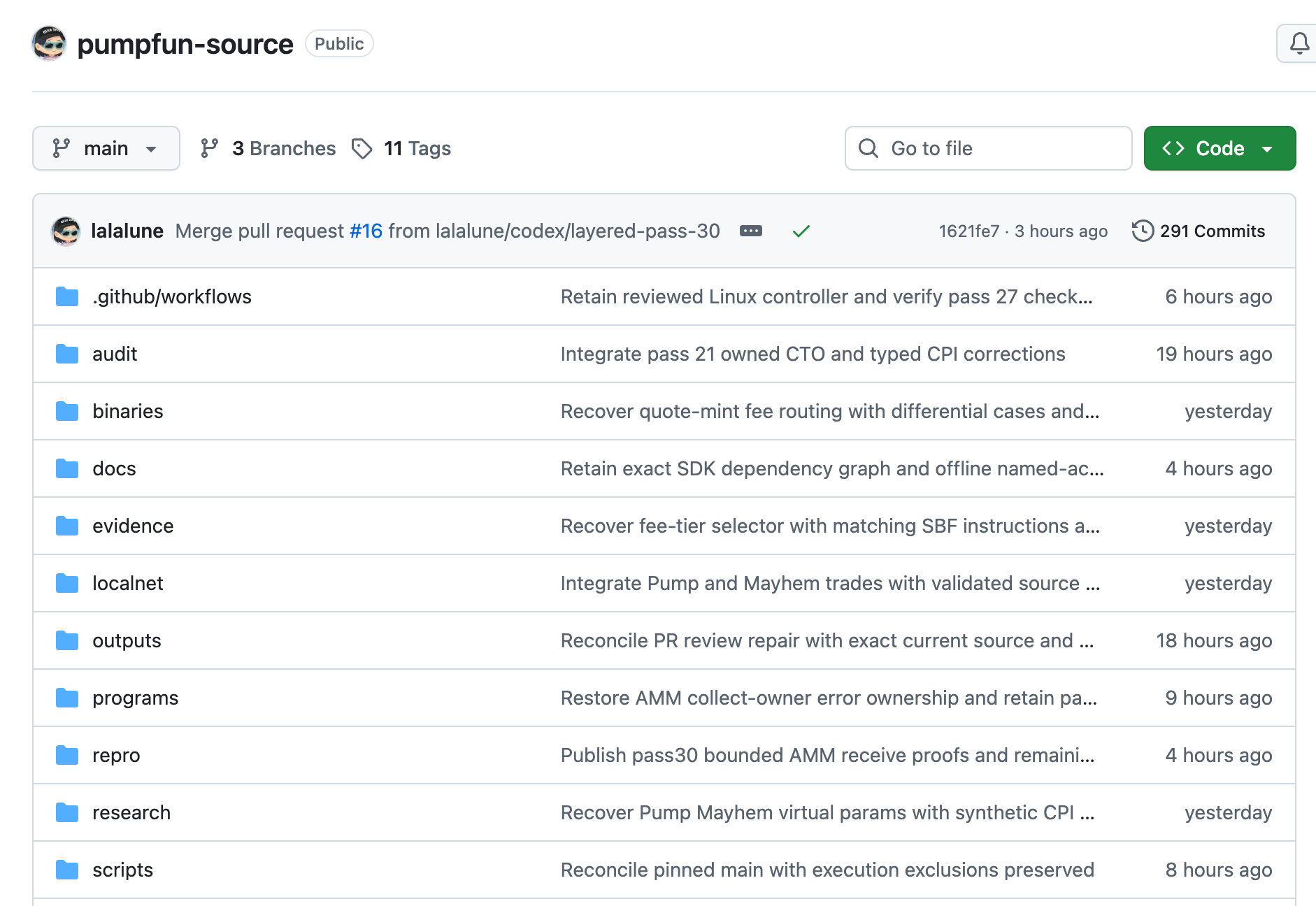
Currently, the GitHub repository associated with Shaw has been made public. Judging from the repository's contents, it has already collected complete on-chain deployment evidence for core programs including the Pump main program, PumpSwap, Pump Fees, and Mayhem, and is attempting to decompile the binaries and restore them byte by byte into readable source code. However, the repository has also clearly marked that the complete byte-level restoration of all four core Pump.fun programs has not been completed. Although there are currently some handler implementations and extensive differential testing results, the bytecode of the entire program still differs from the original version. Furthermore, partial test passes do not mean the entire program has been restored, let alone that a security audit has been completed.
Not Building a Copycat, but a Pixel-Perfect Restoration
After the news broke, many developers in the community had the same first reaction: questioning the necessity — after all, with existing development tools, writing a bonding curve token launch contract similar to Pump.fun often takes only a dozen minutes or so.
In response to such voices, Shaw subsequently published another long post. Shaw emphasized that what he wants to do is not write another functionally similar copycat, but to restore the original program as faithfully as possible, ultimately making the binary compiled from the reconstructed version byte-for-byte identical to the on-chain original. According to his goal, logic flaws in the original program must not be arbitrarily corrected either, otherwise it would not count as a true restoration.
Compared with writing a new contract from scratch, this kind of work — restoring the underlying blueprint through decompilation without source code drawings — is clearly on a different order of technical difficulty. The core tool that enabled Shaw to quickly advance to 90% progress is precisely today's mainstream large language models.
Shaw publicly shared his reverse engineering workflow in his post, and even offered a "crowdsourcing tutorial" calling for community participation, along with an effectiveness review of mainstream AI models on the market.
- Primary tool: He first recommends subscribing to the $200-per-month ChatGPT Max plan, considering it "completely worth the price" for high-frequency, high-intensity code reverse engineering tasks;
- Alternatives: Shaw also explicitly named China's GLM-5.3 or Kimi K3.1 as alternative solutions;
- "Underperformers": Shaw stated bluntly that Gemini performs poorly (garbage), while Claude refuses to execute reverse engineering instructions due to built-in safety compliance restrictions — unless reverting to older versions such as Opus 4.8.
According to the workflow Shaw outlined, developers only need to combine open-source reverse engineering tools, input specific prompts into an AI Agent, and let it automatically perform decompilation, compare bytecode, and submit PRs (pull requests), thereby reverse engineering "anything."
Behind the Criticism of Closed Source, Marketing for a New Project
As for why he would spend time and effort cracking Pump.fun, Shaw displayed a clear dual motivation in his post — on the surface, a critique of the public chain security culture, but behind it, an underlying motive to build hype for his new project.
On the ideological level, Shaw first sharply criticized the long-standing phenomenon of "closed-source contracts becoming the norm" in the Solana ecosystem — "Smart contracts should never be closed source; this is a cancer on public infrastructure."
Shaw stated that as early as 2019, during the early days of DeFi, closed-source contracts were almost equivalent to high-risk or even scam operations in the industry; but at some point, closed source became commonplace in the Solana ecosystem. Shaw cited data pointing out that over the past year, funds stolen by hackers due to fatal security vulnerabilities in closed-source contracts have exceeded $40 million. In his view, only by thoroughly making code public can white-hat hackers and AI promptly identify and report vulnerabilities.
But after discussing the industry's security pain points, Shaw pivoted and introduced the real protagonist — a new project he is building called slop.cash.
According to Shaw's introduction, slop.cash plans to launch on Umia Finance, with its core focus on internet security and private bug bounty mechanisms. To incentivize the community to assist in completing the Pump.fun code restoration, Shaw also revealed that he is using creator trading fees generated by a certain related meme coin for token buybacks, and plans to use these funds as a bounty pool to distribute to all code contributors who help achieve "byte-by-byte restoration." Once slop.cash completes its mainnet upgrade, this restored Pump.fun source code will be directly incorporated into the platform.
It is not hard to see that the high-profile reverse engineering show Shaw is pushing forward under the banner of "ending the closed-source chaos" is essentially a geek-flavored cold-start marketing campaign for slop.cash.
Reverse-Engineered Open Source May Be Feasible, but It's Still Hard to Shake Pump.fun's Moat
As of publication, Pump.fun and its founder Alon have not publicly responded to Shaw's reverse engineering open-source project.
Setting aside marketing considerations, if Pump.fun's money-printing underlying contract were truly 100% restored and made public, what impact would it have on the ecosystem? Community views on this are currently quite divided.
On the security front, supporters argue that for a leading protocol like Pump.fun that holds massive retail funds, long-term black-box operation is itself a systemic risk, and transparency helps the community conduct joint audits and eliminate hidden dangers; but opponents also have concerns — since Shaw is pursuing a restoration that "even reproduces bugs as-is," without the official team's active cooperation in upgrading, directly exposing core logic to the public would undoubtedly significantly lower the threshold for hackers to find attack paths.
On the business competition front, although some believe that open-sourcing the code will spawn more similar token launch platforms, the industry generally believes this is unlikely to truly threaten Pump.fun's market position. Over the past year, fork projects attempting to challenge Pump.fun have emerged one after another, but the vast majority faded into obscurity after a brief surge. For today's token launch platforms, the real moat is no longer those few lines of smart contract code, but the ecosystem network effects built around the platform — including deep integration with mainstream trading terminals and wallet applications, users' long-term trust in contract security, and whether the platform has ever produced benchmark tokens with wealth effects.
From this perspective, Shaw may be able to use AI to restore Pump.fun's full codebase, but wanting to shake the latter's commercial foundation through open source alone is clearly not so easy.





