


Meta Stock Split Guide: What Does the New Class C Share Mean for Shareholders? Key Dates and Voting Rights Explained


- Key Takeaways: Meta announced the creation of a non-voting Class C common stock to be distributed 1:1 to existing shareholders. On the surface it resembles a 2-for-1 split, but in substance it opens a equity financing channel that does not dilute control. The backdrop is negative free cash flow and surging capital expenditures.
- Key Elements:
- The only confirmed date is January 19, 2027 (the effective date of the amended charter); the dividend record date and distribution date will be determined by the board at a later time and have not yet been announced.
- Q3 capital expenditures of $34.91 billion exceeded operating cash flow of $32.79 billion, resulting in negative free cash flow of $2.12 billion; long-term debt increased by $22.2 billion over nine months to $80.9 billion.
- The distribution does not change any shareholder's voting rights; the charter amendment has been approved through written shareholder consent; Class C shares carry no voting rights, and the ticker symbol and listing date remain undetermined.
- After the distribution, the Class A price is expected to reflect an effect similar to a 2-for-1 split—a mechanical adjustment under which the total value of holdings theoretically remains unchanged; Class A and Class C may trade at different prices due to the difference in voting rights.
- If Class C shares are issued in the future for financing, existing shareholders' economic interests would be diluted while voting rights remain unaffected—the main point of contention surrounding this structure; the CFO stated there are currently no specific financing plans.
- According to Benzinga, Zuckerberg-related entities hold 56.1% of voting power; according to Yahoo Finance, after the distribution they would hold approximately 60.6% of voting power, corresponding to roughly 13.4% of economic interest.
Overview
Meta announced in its Q3 earnings report released on October 21 that it will establish a class of publicly listed non-voting Class C common stock and will distribute one share of Class C stock for each existing share of Class A and Class B common stock. The company stated that after the distribution is completed, the market price of Class A shares is expected to reflect an effect similar to a 2-for-1 split.
Regarding the dates, an accurate distinction is needed, because this is where the most common errors occur in current coverage. According to the original earnings report, Meta plans to file an amended and restated certificate of incorporation in Delaware, with an effective date of January 19, 2027. The stock dividend is conditioned on the effectiveness of that certificate and will be distributed after it takes effect, with the record date and distribution date to be determined later by the board of directors and currently unannounced. Therefore, it is inaccurate to describe January 19 as the date the split is completed or the date new shares begin trading.
Another premise that must first be clarified is voting rights. The company explicitly stated that this stock dividend does not change any shareholder's voting rights, and the amended certificate has been approved by written consent of shareholders without the need for a separate vote.
As for why the capital structure is being adjusted at this time, the earnings report itself provides the answer. Q3 capital expenditures of $34.91 billion exceeded operating cash flow of $32.79 billion, and free cash flow was negative $2.12 billion. The purposes listed by the company include raising capital, employee compensation, potential acquisitions, and other general corporate needs, and it directly mentions the costs of AI competition and infrastructure.
Key Points
Only one date has been confirmed. The effective date of the amended and restated certificate of incorporation is January 19, 2027; the record date and distribution date of the stock dividend have not been announced and will be determined by the board of directors.
Each existing share receives one Class C share. Class A and Class B shareholders will receive non-voting Class C shares on a one-to-one basis according to their holdings, and the distribution is conditioned on the effectiveness of the certificate.
The price effect is similar to a 2-for-1 split. The company expects that after the distribution is completed, the market price of Class A shares will reflect an effect similar to a 2-for-1 split, but this is a mechanical adjustment in price and does not change the total value of holdings.
Voting rights remain unchanged. The company explicitly stated that this stock dividend does not change any shareholder's voting rights, and the certificate amendment has been approved by written consent of shareholders.
The Class C ticker has not been announced. Class A will continue to trade on Nasdaq, and the company said it intends to list Class C shares on Nasdaq after issuance.
The financial backdrop is a cash shortfall. Q3 capital expenditures of $34.91 billion exceeded operating cash flow of $32.79 billion, free cash flow was negative $2.12 billion, and long-term debt increased by $22.2 billion to $80.9 billion over nine months.
What Meta Announced, Which Dates Are Confirmed and Which Are Not
Separating what is confirmed from what is not is the only way to understand this announcement.
There are six confirmed items. The board of directors approved the establishment of a class of publicly listed non-voting Class C common stock, effective in January 2027; a special committee composed of independent and disinterested directors unanimously recommended the plan after evaluating the company's capital structure; the company plans to file an amended and restated certificate of incorporation in Delaware, with an effective date of January 19, 2027; the certificate has been approved by written consent of shareholders; the ratio of the one-time stock dividend is one Class C share for each Class A or Class B share; and this stock dividend does not change any shareholder's voting rights.
There are four unconfirmed items. The record date and distribution date of the stock dividend have not been announced, and the company said they will be determined later by the board of directors; the ticker for Class C shares has not been announced; the company only said it intends to list Class C shares on Nasdaq after issuance, without giving a specific listing date; and there is no specific plan for whether and when to raise funds through future issuance of Class C shares. Chief Financial Officer Susan Li said the company has no specific financing plan to announce but wants access to diversified sources of funding.
Therefore, the correct way to read the timeline is: January 19, 2027 is the effective date of the certificate, the stock dividend will be distributed after that, and the specific timing of the distribution depends on the record date and distribution date later determined by the board of directors. The company will file a Form 8-K and an information statement with the U.S. Securities and Exchange Commission, and these documents are the source for subsequent dates. In this transaction, Moelis & Company is serving as independent advisor to the special committee, and Morgan Stanley is serving as the company's advisor.
Differences Among Class A, Class B, and Class C Shares
The differences among the three classes of stock are concentrated in voting rights and usage, not in economic rights.
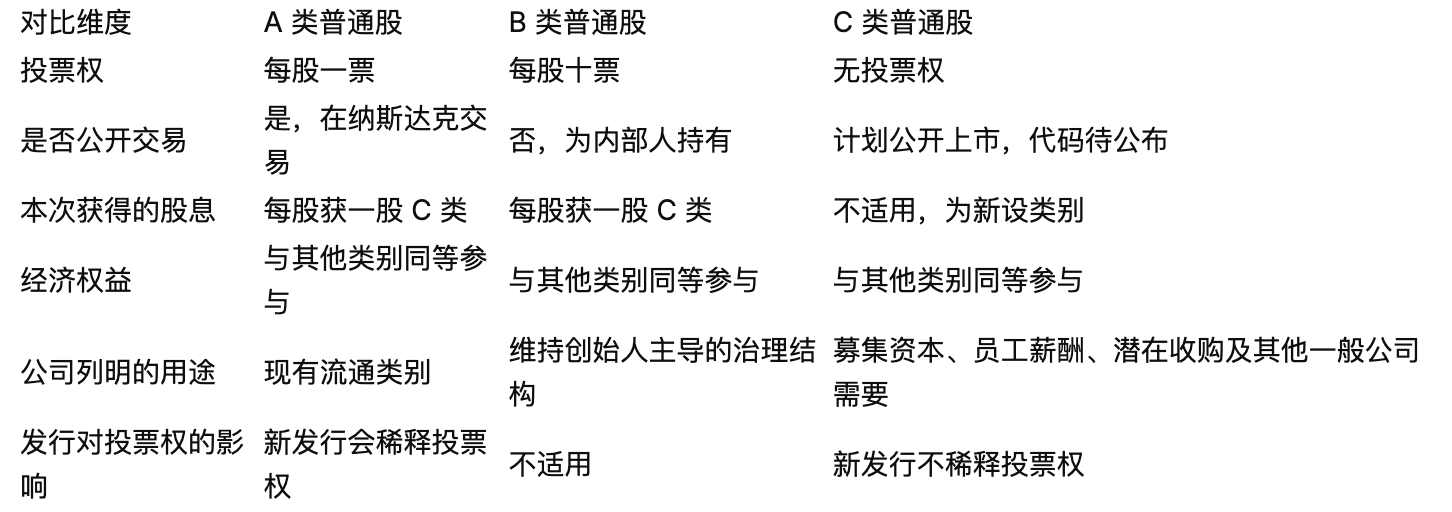
The most important row in this table is the last one. The core function of establishing Class C stock is to allow the company to raise funds through future share issuance without diluting voting rights. The purposes listed by the company in the announcement include raising capital, employee compensation, potential acquisitions, and other general corporate needs, and it directly mentions the costs of AI competition and infrastructure; at the same time, the announcement also lists maintaining Zuckerberg as the founder-led chief executive officer as one of its objectives.
Specific figures on the control structure require attention to differences in methodology. According to Benzinga's report, entities associated with Zuckerberg and his spouse Priscilla Chan hold 56.1% of Meta's voting power, which is precisely why the certificate amendment could be completed by written consent without convening a shareholder vote. According to Yahoo Finance's report, after the distribution is completed, the related entities will retain approximately 60.6% of voting power, corresponding to approximately 13.4% of economic rights. The two media outlets give different voting power percentages, while the company itself states that this stock dividend does not change any shareholder's voting rights, so sources and timing should be noted when citing these figures.
The company has also signed a founder consistency agreement with Zuckerberg, covering arrangements for his sale of Class C shares received in this dividend, his service obligations to the company, and the conditions for future distributions of Class C shares. According to TradingKey's description, under this arrangement he may sell up to 20% of the newly received non-voting shares, a proportion that reflects that media outlet's characterization.
How the Stock Dividend Works Using 100 Class A Shares as an Example
Demonstrating with specific numbers can help avoid misunderstanding the stock dividend as additional return.
Suppose an investor holds 100 Class A shares on the record date. At a one-to-one ratio, the investor will receive 100 non-voting Class C shares, and after the distribution will hold a total of 100 Class A shares plus 100 Class C shares, with total shares increasing from 100 to 200.
On price, the company expects that after the distribution is completed, the market price of Class A shares will reflect an effect similar to a 2-for-1 split. Using the October 21 closing price of $697.52 for Class A shares as a purely illustrative calculation: before the distribution, the market value of 100 shares is approximately $69,752; if after the distribution the Class A price is mechanically adjusted to about half, or approximately $348.76, then 100 Class A shares would be worth approximately $34,876, while 100 Class C shares would theoretically carry the other half of the value. The two parts would still total approximately $69,752, and the total value of the holdings would not change because of the distribution.
This example requires three qualifications. First, it is an illustration based on the company's statement about the price effect, not a price forecast provided by the company, and the actual trading price will be determined by the market. Second, because Class A and Class C shares differ in voting rights, they may well trade at different prices after listing, and a discount for non-voting shares relative to voting shares is a common market phenomenon, so the two are not necessarily worth half each. Third, the record date has not been announced, so the premise of "holding on the record date" cannot currently be mapped to a specific date.
One more point needs to be made clear: the stock dividend itself does not bring cash to the company or create wealth for investors. What it changes is the class composition of shares and the per-share price, not the value of the company or the value of holdings. What could truly affect existing shareholders' economic rights is future additional issuance of Class C shares, which is a different matter from this distribution and is explained separately in the next section.
Why Adjust the Capital Structure Now
The earnings data provide a fairly direct answer.
Q3 revenue was $64.60 billion, up 26% year over year and above market expectations of approximately $63.3 billion; net income was $9.86 billion, up 264% year over year; diluted earnings per share were $3.83, above expectations of approximately $3.56, and approximately $7.40 excluding legal-related expenses. However, operating income was $12.99 billion, down 37% year over year, and the operating margin fell from 40% to 20%, because costs and expenses rose 68% year over year to $51.61 billion, including $9.89 billion in expenses related to an agreement reached in August 2026 with 52 state attorneys general over litigation concerning teen mental health and social media.
Cash flow is the key. Q3 capital expenditures of $34.91 billion (including principal payments on finance leases) exceeded operating cash flow of $32.79 billion, and free cash flow was negative $2.12 billion. According to Yahoo Finance's summary, long-term debt increased by $22.2 billion to $80.9 billion over nine months, while the company did not repurchase shares in 2026, compared with $26.2 billion repurchased in the first nine months of 2025. Cash and marketable securities at period end were $82.45 billion.
Guidance further explains the source of funding pressure. Full-year 2026 capital expenditure guidance is $135 billion to $145 billion, narrowed from the previous $130 billion to $145 billion; according to Yahoo Finance's calculation, this implies $49 billion to $59 billion in Q4 alone. Q4 revenue guidance is $73 billion to $76 billion, full-year 2026 expense guidance is $175 billion to $179 billion (raised to include legal expenses), and Reality Labs is expected to lose $18 billion to $19 billion in 2026, narrowing to approximately $15 billion in 2027. The company did not provide 2027 revenue or capital expenditure guidance, saying only that it will continue to invest aggressively. For the full background of this quarter's earnings and our earlier observation framework, please refer to our Meta earnings analysis.
Putting these together, the logic of the capital structure adjustment becomes clear: with free cash flow turning negative, debt already significantly increased, and buybacks paused, the company needs an equity financing channel that does not dilute voting rights. According to Yahoo Finance's calculation, based on a market capitalization of approximately $1.78 trillion, each issuance equivalent to 1% of the company could raise approximately $17.8 billion, and that media outlet estimates a possible funding gap of $16 billion to $26 billion in Q4, equivalent to approximately 1% to 1.5% of the company.
For comparison, it is worth looking at how compute-side participants operate. Independent AI infrastructure companies typically rely on complex debt and structured financing to support expansion, and for details on how such arrangements work, please refer to our analysis of AI infrastructure financing. Meta's difference is that it has substantial advertising cash flow and an investment-grade balance sheet, so it can keep equity as an option alongside debt, and Class C stock is precisely intended to ensure that this option does not come at the cost of control.
Three Things That Must Be Viewed Separately
This section is the most practical part of the article, because conflating these three things will directly lead to incorrect judgments.
The first is this stock dividend. Its ratio is one-to-one, it involves no cash, it creates no value, and it does not change voting rights. For existing shareholders, its entire effect is a change in share class composition and a mechanical adjustment in per-share price, while the total value of holdings remains theoretically unchanged. The company explicitly stated that this distribution does not change any shareholder's voting rights.
The second is possible future additional issuance. This is the part that truly affects economic rights. If the company later issues new Class C shares to raise funds, the economic rights of all existing shareholders will be diluted, while the voting rights structure will not be affected. According to a market participant cited by Benzinga, shareholders bear all the economic dilution from future issuance, while Zuckerberg bears no control dilution. This is the most direct criticism of the structure and should be presented honestly. It should also be noted that the chief financial officer said there is currently no specific financing plan to announce, so the timing and scale of any issuance remain undetermined, and Yahoo Finance believes this will depend on 2027 capital expenditure guidance, which is expected to be provided on the Q4 earnings call.
The third is existing shareholders' voting rights. They remain unchanged in this distribution and will likewise not be diluted in future Class C issuance. This means that the voting power percentage of existing Class A shareholders will not decline because of new issuance, but this does not change the existing control structure created by Class B shares carrying ten votes per share. According to Benzinga's report, the related entities currently hold 56.1% of voting power.
After separating the three, the conclusion for existing shareholders can be stated as follows: this distribution is economically neutral; future issuance is economically dilutive, but its scale and timing have not yet been determined; and voting rights remain unchanged in both cases, which is both the purpose of the design and the source of controversy.
One additional note related to holding form is necessary. Entitlement to the stock dividend belongs to shareholders who actually hold the relevant class of common stock on the record date, while derivative positions are not common stock holdings. Therefore, derivatives such as perpetual contracts on the stock do not correspond to the right to receive the Class C stock dividend, and the specific treatment should be based on the contract rules and adjustment plans published by the relevant platform.
On MEXC, view META stock perpetual contract quotes and contract information. It should be noted that stock perpetual contracts are derivatives, not common stock holdings, and do not correspond to the right to receive this Class C stock dividend.
James Mitchell's Exclusive View
In James Mitchell's view, this announcement has been widely reported as a stock split, but the split is only a byproduct. A one-to-one stock dividend will indeed make the Class A price reflect an effect similar to a 2-for-1 split, and that effect is economically neutral. What is truly substantive is the creation of a new equity instrument that can be issued indefinitely without diluting voting rights, and the company explicitly states its uses as raising capital, employee compensation, and potential acquisitions. In other words, this is a capital structure overhaul that pre-builds a channel for future financing, and the split-like effect is merely an incidental phenomenon produced when implementing that overhaul.
There is one point in the timeline that is most prone to error and deserves separate emphasis. January 19, 2027 is the effective date of the amended and restated certificate of incorporation, not the date the split is completed and not the date new shares begin trading. The stock dividend is conditioned on the effectiveness of the certificate and will be distributed after it takes effect, while the record date and distribution date will be determined later by the board of directors and are currently unannounced. Some media have already written this date as the date new shares begin trading, and this error will directly affect holders' judgment on the timing of entitlement, so before the subsequent Form 8-K and information statement are published, arrangements should not be made based on any specific distribution date.
From a financial logic perspective, the timing of this adjustment is very direct. Q3 capital expenditures of $34.91 billion exceeded operating cash flow of $32.79 billion, and free cash flow was negative $2.12 billion; long-term debt increased by $22.2 billion to $80.9 billion over nine months; no repurchases were made in 2026, compared with $26.2 billion repurchased in the first nine months of 2025. When a company simultaneously shows three characteristics—negative free cash flow, rising debt, and paused buybacks—while full-year capital expenditure guidance remains at $135 billion to $145 billion, the emergence of a new equity financing channel is not surprising; what is surprising is that it was designed to avoid touching control entirely.
Criticism deserves serious attention because it points to the





