


BiyaPay Market Watch: SMCI Surges Over 15% After Hours as AI Server Gross Margins Rebound—Can It Last?


- Core View: Super Micro Computer significantly raised its revenue and gross margin guidance for fiscal 2027 Q1, sending shares up over 15% after hours, but whether revenue growth can translate into real profit and cash flow still requires full financial statements for verification.
- Key Elements:
- Revenue guidance was raised from $14.5 billion–$15.5 billion to $18.5 billion–$19.5 billion, a midpoint increase of approximately 26.7%; gross margin expectations rose from 10.4%–10.8% to 12.0%–12.5%.
- Based on midpoint estimates, gross profit increased from approximately $1.590 billion to approximately $2.328 billion; simultaneous improvement in revenue and gross margin is the primary reason for the market's repricing.
- Core AI server components account for the bulk of costs; higher整机 prices do not equate to higher vendor profitability—added value comes more from rack integration, liquid cooling, power supply, and operations and maintenance capabilities.
- Server business requires inventory build-up before payment collection; close attention should be paid to whether accounts receivable, inventory, and operating cash flow improve in tandem with revenue.
- Customer order concentration is high, and delivery timing may cause quarterly revenue volatility; order continuity and customer structure balance remain to be observed.
- Current data are unaudited preliminary estimates; full financial statements are scheduled for release on November 3, with gross margin sustainability and next-quarter guidance being key verification points.
How strong is AI server demand? It's not just about how many units were sold, but also how much profit ultimately remains from those orders. Supermicro's latest update happens to provide two noteworthy signals -- a significant upward revision to revenue expectations, alongside a simultaneous improvement in gross margin guidance.
On October 20, US Eastern Time, Supermicro released preliminary business updates for the first quarter of fiscal year 2027. The company expects revenue of $18.5 billion to $19.5 billion for the quarter ending September 30, 2026, up from its prior guidance of $14.5 billion to $15.5 billion; gross margin is projected at 12.0% to 12.5%, also above the prior expectation of 10.4% to 10.8%.
According to BiyaPay market data, SMCI closed regular trading that day at $32.47, up 1.15%; as of 19:59 US Eastern Time, it was quoted at $37.52 after hours, up 15.54% from the regular close.
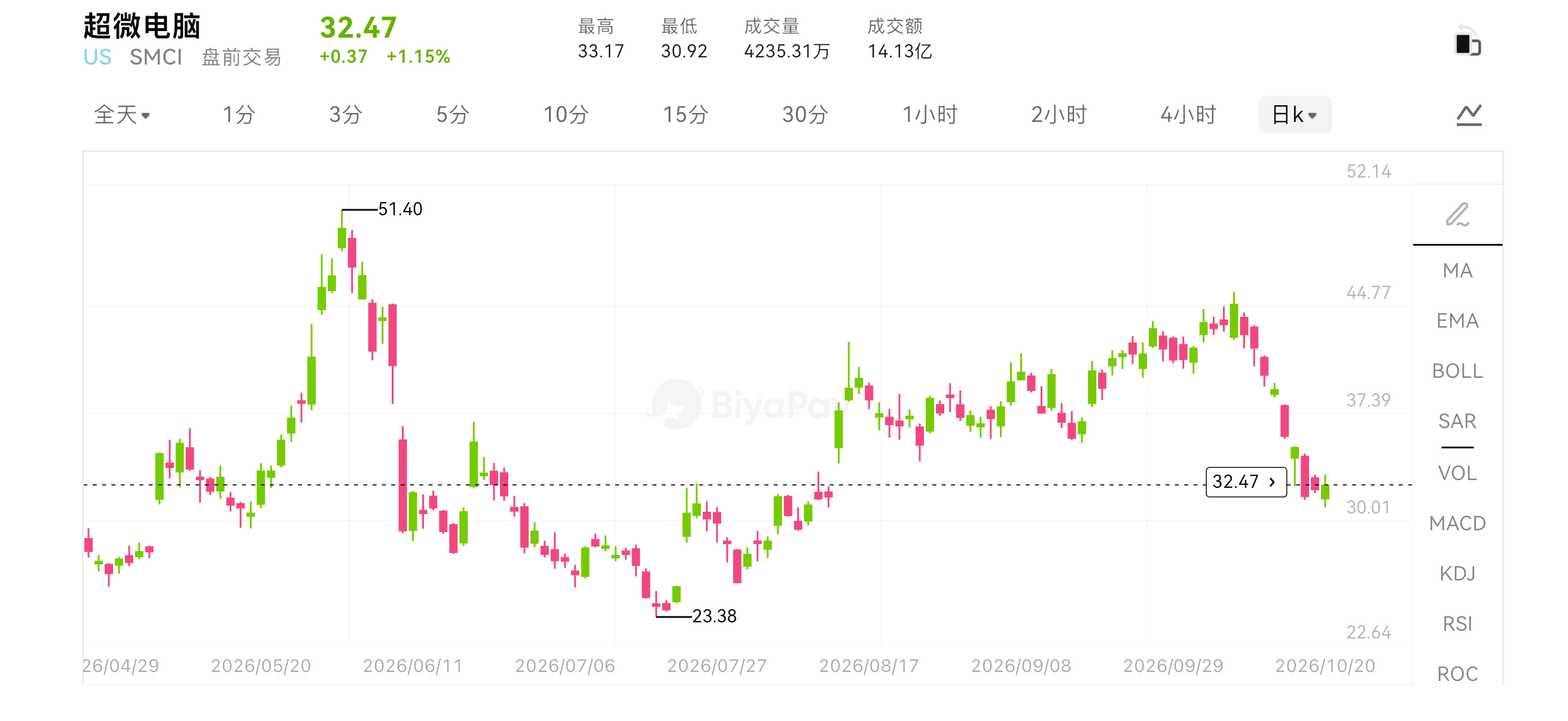
The market's excitement cannot be attributed solely to strong AI demand. The hardest question for server companies to answer has always been: after taking on ever-larger orders, how much profit can actually be retained? This update at least offers a signal of interim improvement.
However, what has been disclosed is an unaudited preliminary estimate, with the full financial report scheduled for November 3. The good news on revenue and gross margin still requires a further step before full verification through cash flow, net income, and forward guidance.
SMCI Rises Over 10% After Hours: What Else to Watch After the Stock Price Move?
The after-hours surge primarily reflects the market repricing the upward revisions to revenue and gross margin. But for US stock investors tracking SMCI, the next step is to distinguish between after-hours quotes and the following day's regular trading performance: whether volume is active, whether spreads widen, and whether gains can hold after more traders enter the market are all clues for observing this market reaction.
From market tracking to US stock trading, the currency in which funds in an account are held and how they are converted can also affect operational workflows. From market tracking to actual trading, beyond watching stock price changes, how funds enter a trading account is also a consideration for many users. For users holding USDT while also watching the US stock market, BiyaPay offers USDT-to-USD conversion and US stock-related trading services, providing visibility into the funding arrangements from digital asset conversion to stock trading. Connecting multiple scenarios through a single account.
Beyond the trading pathway, judging whether SMCI's rally has earnings support still requires returning to the company itself. The revenue upgrade explains why the market is excited, while gross margin, collections, and follow-on orders will determine how much profit and cash this growth can retain.
Revenue Above Prior Guidance, Gross Margin Gives Growth More Weight
Calculated at the midpoint of the range, the new revenue estimate is $19.0 billion versus the prior guidance midpoint of $15.0 billion, a difference of $4.0 billion, or approximately 26.7% growth. This compares the quarterly estimate with the company's prior guidance, not year-over-year growth.
The gross margin midpoint rises from 10.6% to 12.25%, an increase of 1.65 percentage points. For server companies with very large revenue bases, even a small percentage-point change can significantly affect gross profit scale.
If we simply multiply the two midpoints of revenue and gross margin, the new estimate corresponds to gross profit of approximately $2.328 billion, versus approximately $1.590 billion under the prior guidance. This is merely a midpoint calculation for ease of understanding, not the company's disclosed final profit, and certainly not equivalent to net income -- but it explains why simultaneous improvement in revenue and gross margin is more capable of shifting market expectations than shipment increases alone.
Comparing chip suppliers, server manufacturers, and cloud service customers along the same industry chain makes this easier to understand: customers being willing to spend more is one layer, while whether server companies can obtain a better profit share is another.
AI Servers Selling at a Premium Doesn't Mean Assemblers Necessarily Earn More
High-end AI servers contain expensive chips, memory, networking, and storage components. When complete-system prices rise, manufacturer revenue expands accordingly, but a considerable portion of that amount may simply be a pass-through of procurement costs.
Therefore, a server selling at a higher price does not equate to an increase in the manufacturer's technological value-add. If core components account for most of the cost, system integrators still need to rely on procurement, delivery, and system integration efficiency to secure limited profit margins.
The areas that can truly enhance competitiveness may lie in rack-level integration, liquid cooling, power supply, network coordination, debugging, and ongoing operations and maintenance. For large customers, whether equipment can be deployed on time, run stably, and keep total lifecycle costs under control is often more important than the price of any single component.
Supermicro attributes this gross margin improvement to customer and product mix. This explanation deserves attention and also leaves follow-up questions: does the improvement come from a higher proportion of high-value-added solutions, or from a more favorable delivery mix for a certain batch of orders? If it is merely quarterly mix variation, a single upward revision cannot be directly extended into a long-term margin step-up.
After Gross Margin Improvement, Cash May Still Be Tied Up in Inventory
There is a link in the server business that is easily masked by revenue growth: inventory stocking typically precedes cash collection.
Companies need to first purchase chips and components, organize production, and then complete delivery and acceptance. Some customers have longer payment terms, and some projects require phased recognition. Revenue may already have entered the income statement while cash remains tied up in accounts receivable; inventory prepared for the next batch of orders may also continue to consume capital.
Therefore, the full financial report should be examined by linking revenue, accounts receivable, inventory, and operating cash flow together. If collections improve in tandem as the business expands and inventory turnover remains normal, the funding burden of growth is lighter. If receivables and inventory grow significantly faster than revenue, the company may need additional financing to sustain deliveries even if it is profitable on paper.
This does not mean that an increase in accounts receivable is necessarily abnormal. Rapid expansion inherently consumes working capital; the key lies in whether collection arrangements are reasonable and whether capital occupation can be gradually released in subsequent quarters. Rapid expansion inherently consumes working capital. The key is whether growth is backed by corresponding orders, customer credit, and clear collection arrangements, and whether capital occupation will be released in subsequent quarters.
For AI equipment companies, technological iteration also amplifies the importance of inventory management. After a new platform is launched, pricing, demand, and delivery cadence for the old platform may all change. A successful large-volume delivery is not only a sales issue but also a reflection of procurement and production management capabilities.
The Larger the Major Customer Order, the More Profit and Bargaining Power Need to Be Viewed Separately
Major customers can bring scale but may also possess stronger negotiating power.
When a single order is large enough to significantly change quarterly revenue, early or delayed delivery will affect the market's judgment of growth. If acceptance is concentrated in a certain quarter, revenue may significantly exceed prior expectations; but this does not automatically mean the next quarter will expand at the same pace.
Therefore, follow-up observation is needed on order continuity and whether the customer mix is more balanced. Demand from different customers and different delivery cycles typically forms a more stable operating rhythm than reliance on a few large projects. What is discussed here is the variables that a business model should examine, not a determination that the company has already experienced collection or order problems.
Customer and product mix also affects after-sales costs. High-spec systems can command higher prices but may also increase installation, debugging, warranty, and on-site support expenses. Whether gross margin improvement can ultimately flow through to operating income requires incorporating these expenses as well.
This Update Proves Demand Is Strong but Cannot Yet Answer for the Entire AI Industry
SMCI's upward revision shows the company obtained stronger revenue support this quarter. But performance across different links in the industry chain cannot be mechanically extrapolated.
Server manufacturers recognizing revenue may mean equipment has been delivered to cloud service companies; whether cloud service companies have fully utilized the equipment and can recover sufficient fees from end customers requires another set of evidence. Strong infrastructure demand and sufficient profitability of end applications can exist at different stages simultaneously.
Similarly, Supermicro's gross margin improvement does not mean all peers can improve in tandem. Customer structure, supplier terms, solution capabilities, and delivery efficiency may all create differences. In analyzing the AI market, what should most be avoided is infinitely expanding one company's good news into a unified conclusion for the entire industry.
After the full financial report is released in November, the focus should be on the sustainability of the gross margin upgrade, operating cash flow, changes in inventory and receivables, and demand arrangements for the next quarter. If these indicators support each other, this pre-announcement will not just be a short-term surprise but may also become a basis for the market to reunderstand the company's profitability.
This earnings pre-announcement gave the market a view of SMCI's growth potential in AI server demand and also drove the stock price notably higher after hours. However, an upward revision to revenue expectations does not equal a solid improvement in profitability; whether gross margin can continue to recover and whether working capital can be smoothly collected still require further verification in the formal financial report. Next, the full financial report to be released on November 3 will be an important basis for observing the quality of this round of growth.





