


MSX US Stocks Daily Watch: AI Overtakes Starlink! SpaceX Quarterly Revenue Surges 161%, Three Major Growth Engines Accelerate Across the Board


- Core View: SpaceX has transformed from a space launch company into a comprehensive infrastructure platform spanning AI compute, satellite communications, and space transportation. Its AI business has become the largest revenue source for the first time, but Starlink remains the primary profit driver. Under heavy capital investment, synergies and return on investment are key to valuation.
- Key Elements:
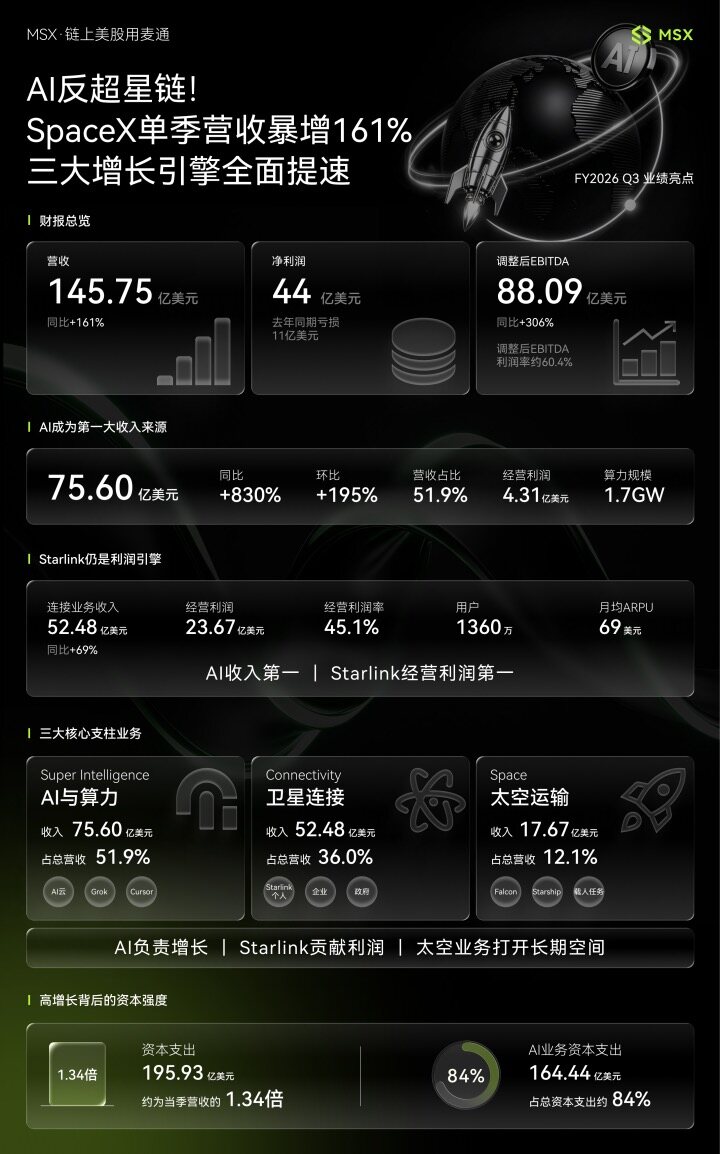
- FY2026 Q3 revenue was $14.575 billion, up 161% year-over-year; net income was $4.404 billion, turning profitable; adjusted EBITDA was $8.809 billion, with a margin of approximately 60.4%.
- The SI (AI) segment generated $7.560 billion in revenue, up 830% year-over-year, accounting for 51.9% of total revenue. It surpassed the Connectivity segment, which houses Starlink, for the first time and turned to an operating profit of $431 million.
- The Connectivity segment generated $5.248 billion in revenue and $2.367 billion in operating profit, with a margin of approximately 45.1%. Starlink users reached 13.6 million, but ARPU fell to $69.
- The Space business completed its first revenue-generating Starship orbital mission, with single-mission downlink capacity approximately 10 times that of a Falcon 9 Starlink launch, supporting long-term cost reduction and expansion.
- Capital expenditure for the quarter was $19.593 billion, approximately 1.34 times revenue, with 84% directed to SI. The gap between operating cash flow and capital expenditure for the first nine months was approximately $34.972 billion.
- SI growth includes $608 million in revenue from the consolidation of Cursor. Adjusted EBITDA excludes depreciation, stock-based compensation, and other items, so earnings quality still needs to be observed.
[MSX Research Institute · Daily US Stock RWA Watch] is a signature daily report produced by MSX, a leading RWA trading platform. Leveraging our strong macro research capabilities, we help you capture the core pulse of global traditional US stocks, liquidity changes, and the RWA tokenization market, empowering you to proactively position in high-quality assets.
Today's Observation:
SpaceX is transforming from an aerospace company centered on rocket launches and satellite internet into a comprehensive infrastructure platform spanning AI compute, communication networks, and space transportation.
In Q3 FY2026, SpaceX revenue reached $14.575 billion, up 161% year-over-year, beating market expectations of approximately $12.86 billion; net income was $4.404 billion, compared with a net loss of $1.054 billion in the same period last year. Adjusted EBITDA reached $8.809 billion, up 306% year-over-year, corresponding to a margin of approximately 60.4%. After the earnings release, SpaceX shares initially rose about 5% in early after-hours trading before paring gains.
What truly changed SpaceX's business structure is the Super Intelligence (SI) segment. The segment generated $7.560 billion in revenue this quarter, up 830% year-over-year and 195% quarter-over-quarter, surpassing the Connectivity segment that houses Starlink for the first time and accounting for approximately 51.9% of total company revenue, making it SpaceX's largest revenue source.
However, "AI overtaking Starlink" mainly refers to revenue scale and does not mean AI has become the company's largest profit source. The SI segment posted operating income of $431 million this quarter, corresponding to an operating margin of approximately 5.7%; the Connectivity segment generated operating income of $2.367 billion, with an operating margin of approximately 45.1%. In other words, AI is driving revenue growth, while Starlink remains the company's most important source of operating profit.
The space transportation business plays a long-term infrastructure role. In Q3, SpaceX completed its first revenue-generating Starship orbital mission, deploying 26 Starlink V3 satellites into orbit. The company said the incremental downlink communication capacity from a single mission is approximately 10 times that of a single Falcon 9 Starlink launch. If Starship can consistently increase launch frequency, it will simultaneously reduce Starlink expansion costs and support larger-scale satellite deployment.
These three businesses are forming a more complex commercial system than pure rocket manufacturing: AI contributes growth, Starlink contributes profit and recurring revenue, and rockets and Starship provide underlying transportation capability.
Data in a Minute:
• Q3 FY2026 revenue of $14.575 billion, up 161% year-over-year, beating market expectations of approximately $12.86 billion;
• Net income of $4.404 billion, compared with a net loss of $1.054 billion in the same period last year;
• Diluted EPS of $0.35, versus market expectations of approximately $0.16;
• Operating income of $2.791 billion, compared with an operating loss of $273 million in the same period last year;
• Adjusted EBITDA of $8.809 billion, up 306% year-over-year, with a margin of approximately 60.4%;
• SI revenue of $7.560 billion, up 830% year-over-year and 195% quarter-over-quarter, accounting for approximately 51.9% of total revenue;
• SI operating income of $431 million, ending the prior quarter's operating loss of $1.257 billion;
• SI adjusted EBITDA of $4.953 billion, but this excludes depreciation, stock-based compensation, and acquisition-related stock-based compensation, among other items;
• AI nominal compute scale reached 1.7GW, up from 1.4GW in the prior quarter and 0.6GW in the same period last year;
• Connectivity revenue of $5.248 billion, up 69% year-over-year and 22% quarter-over-quarter;
• Connectivity operating income of $2.367 billion, up 99% year-over-year, with an operating margin of approximately 45.1%;
• Starlink consumer users reached 13.6 million, an increase of 1.6 million from the prior quarter;
• Starlink consumer monthly ARPU was $69, up 5% quarter-over-quarter but still below the $83 in the same period last year;
• More than 3,800 aircraft have Starlink installed;
• Space business revenue of $1.767 billion, up 6% year-over-year and 84% quarter-over-quarter;
• Space business operating loss of $7 million, with adjusted EBITDA of $357 million;
• Total capital expenditures in Q3 were $19.593 billion, approximately 1.34 times quarterly revenue;
• Of this, SI capital expenditures were $16.444 billion, accounting for approximately 84% of total capex;
• As of quarter-end, the company held $51.294 billion in cash and cash equivalents and $38.561 billion in marketable securities;
• For the first nine months of 2026, operating cash flow was $13.097 billion and capital expenditures were $48.069 billion, implying a funding gap of approximately $34.972 billion on a simple subtraction basis.
MSX View:
Historically, the market's valuation of SpaceX was primarily built on two assets: the launch advantage created by reusable rockets and the global satellite communications network built by Starlink. But after integrating its AI business, expanding compute infrastructure, and acquiring Cursor, more than half of SpaceX's Q3 revenue already came from the Super Intelligence segment.
SI revenue increased from $2.561 billion in the prior quarter to $7.560 billion, an increase of nearly $5 billion. The company explained that growth was mainly driven by the launch of new cloud service agreements, the consolidation of Cursor, and increased use of Grok among enterprise and consumer users. From the completion of the Cursor acquisition on August 14 through quarter-end, Cursor contributed $60.8 million in revenue to SpaceX, so this quarter's AI growth did not come entirely from organic expansion of existing operations but also included consolidation effects from acquisitions.
More importantly, the AI business has turned from an operating loss to profitability. SI's operating result improved from a loss of $1.257 billion in the prior quarter to a profit of $431 million, indicating that newly added compute is beginning to generate revenue and absorb prior costs.
However, the quality of SI's profitability still warrants further observation. SI adjusted EBITDA this quarter was as high as $4.953 billion, far above operating income of $431 million, mainly because the adjusted metric excludes $2.473 billion in depreciation and amortization, $821 million in regular stock-based compensation, and $1.217 billion in acquisition-related stock-based compensation. For a business that needs to continuously purchase GPUs and build data centers, depreciation is not a cost that can be ignored over the long term. Therefore, when judging the return on the AI business, operating income, capital expenditures, and cash flow are more important than looking at adjusted EBITDA alone.
By contrast, Starlink's business model has become more mature. Connectivity revenue grew 69% year-over-year to $5.248 billion, with operating income reaching $2.367 billion, accounting for the vast majority of SpaceX's segment operating profit. Consumer users increased from 12 million to 13.6 million, and enterprise and government revenue grew 91% year-over-year, reflecting Starlink's expansion from home broadband to aviation, maritime, mobile communications, and government customers.
Space business revenue grew 84% quarter-over-quarter this quarter, mainly driven by higher launch service revenue. The first revenue-generating Starship orbital mission is particularly important because Starship is not just another rocket product but the infrastructure underpinning the continued expansion of SpaceX's other businesses. If Starship can deploy more V3 satellites at once, the unit cost of expanding Starlink network capacity is expected to decline; if space computing and orbital data centers become a reality in the future, Starship could also handle large-scale equipment transportation missions. However, these long-term applications are still in the validation stage, and at this stage it is more appropriate to focus on launch frequency, reliability, and per-mission capacity rather than prematurely factoring in too much revenue.
The biggest constraint this quarter remains capital investment. SpaceX capital expenditures reached $19.593 billion, about $5 billion higher than quarterly revenue, of which $16.444 billion went to the SI business. Although the company generated $4.404 billion in net income and $8.809 billion in adjusted EBITDA, these metrics cannot directly cover actual investment needs.
From the beginning of the year through the end of September, the company's operating cash flow was $13.097 billion and capital expenditures were $48.069 billion. SpaceX has been able to sustain such high investment largely through its IPO, debt financing, and previously accumulated cash. Cash and marketable securities totaled nearly $89.9 billion at quarter-end, providing ample short-term liquidity, but whether AI infrastructure investment can generate sufficiently high long-term returns remains the core question for whether its valuation can be sustained.
Therefore, this earnings report simultaneously validates SpaceX's growth capability and capital intensity. AI has become the largest revenue source, but its operating margin remains significantly lower than Starlink's; Starlink continues to contribute the bulk of profit, but ARPU is still below the same period last year; Starship opens up new capacity space, but R&D investment remains enormous.
The most noteworthy thing going forward is whether the three businesses can form true synergies: whether AI compute can continue to improve operating margins under high capital investment; whether Starlink can increase per-user value through enterprise, aviation, and mobile communications; and whether Starship can expand satellite deployment and commercial launch scale at lower unit costs.
About MSX:
MSX is a leading RWA trading platform dedicated to providing secure, efficient, and transparent access to global financial markets. As one of the world's earliest on-chain US stock trading platforms, MSX has always been at the forefront of the industry, leading market transformation through continuous innovation.
The platform deeply integrates blockchain technology with compliance frameworks, comprehensively offering spot and derivatives trading for nearly 400 tokenized stocks and Pre-IPO assets, perfectly bridging the gap between traditional finance and the digital asset industry.
Centered on its core mission of "enabling high-quality assets to circulate freely," MSX has built a diversified digital financial services system covering US stock spot and perpetual contracts, crypto trading, Pre-IPO, and MSX Research Institute, aiming to provide global investors with all-hours, high-performance access to high-quality assets.
Official Website: https://msx.com/
Chinese TG:https://t.me/MSXOfficial
Global TG:https://t.me/MSXGlobal
Now available on the global App Store / Google Play.

Risk Disclosure: Macroeconomic conditions and US stock markets are highly volatile. This content is provided solely for academic and research observation reference by MSX Research Institute and does not constitute any investment advice.





