U.S. SEC's Latest "9 Questions, 9 Answers": Clarifying the Securities Attributes of Crypto Assets


- Core Viewpoint: The SEC's Division of Corporation Finance has published an FAQ on crypto asset regulation, further clarifying the regulatory boundaries of whether crypto assets are subject to the investment contract framework in scenarios such as functional networks, staking receipt tokens, and token buybacks.
- Key Elements:
- The standards for functionalization and decentralization are defined by the issuer itself and are unrelated to determining whether the issuer has fulfilled its commitment to essential managerial efforts.
- If a staking receipt token pertains to a non-investment-contract digital commodity, it is a digital tool; those issued by liquid staking service providers may be classified as digital commodities.
- Merely promoting the current utility or future vision of a crypto system without promoting potential profits generally does not constitute a statement of essential managerial efforts.
- Once a crypto system becomes functional, activities such as maintenance, upgrades, and promoting network effects no longer satisfy the Howey test.
- If a functional system has no centralized controlling entity, the issuer typically cannot form a new investment contract.
- Token buybacks after functionalization do not constitute a promise of returns; if not yet functionalized and returns are promoted, they may constitute such a promise.
- Secondary market trading platforms are considered promoters only when they meet the definition of promoter under Section 405 of the Securities Act.
Source:U.S. Securities and Exchange Commission Official Website
Compiled by Odaily (@OdailyChina); Translator: Moni
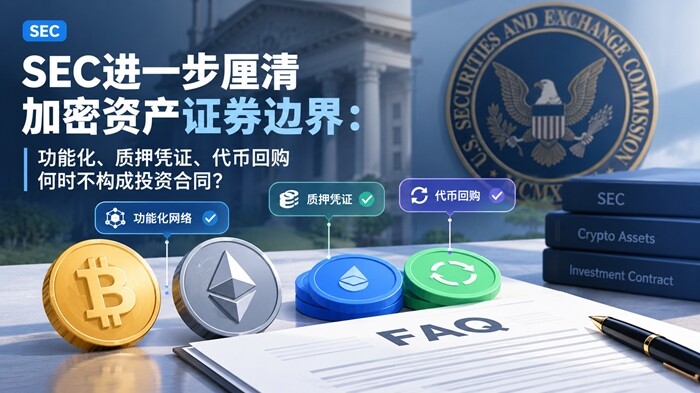
Editor's Note: The Division of Corporation Finance of the U.S. Securities and Exchange Commission (SEC) has released an FAQ on crypto asset regulation, focusing on functional networks, staking receipt tokens, token buybacks, and marketing and promotional activities, providing further guidance for understanding the circumstances under which crypto assets may not be subject to the investment contract framework.
The following is the original content, compiled by Odaily.
The Division of Corporation Finance of the U.S. Securities and Exchange Commission (SEC) has released an FAQ regarding the application of federal securities laws to certain types of crypto assets and related transactions, further addressing questions left unresolved in its previous crypto asset interpretive release. Although this FAQ is not a formal SEC rule or statement and does not carry the force of law, its contents further outline the regulator's understanding of the boundary between "non-security crypto assets" and "investment contracts."
From functional networks and staking receipt tokens to token buybacks, marketing and promotional activities, and whether trading platforms constitute "promoters," this FAQ covers a range of practical issues that the industry has long been watching. One important throughline is: once a crypto system has achieved functionality and has progressively reduced or eliminated any central controlling party, under what circumstances do ongoing maintenance, upgrades, promotion of network effects, and similar activities by issuers and other participants cease to be considered "essential managerial efforts" under the Howey test.
It is important to note that the FAQ does not simply discuss "which tokens are not securities," but rather further explains the relationship between crypto assets and investment contracts under specific circumstances, and which activities may not cause the relevant assets to remain subject to the investment contract framework. For the crypto industry, these details may affect project teams' token issuance, marketing, network operations, and buyback arrangements, and also provide new reference points for understanding the boundaries of U.S. crypto asset securities regulation.
Questions Regarding the Classification of Crypto Assets
Question 1: The U.S. Securities and Exchange Commission has provided definitions for "functional" and "decentralized." However, regarding whether an issuer has fulfilled its representations or promises to engage in essential managerial efforts, the prior Interpretive Release stated: "...whether an issuer has achieved functionality should be determined based on how the issuer defines or otherwise describes functionality, rather than based on what the market generally considers to be functionality"; and "...whether an issuer has achieved decentralization should be determined based on how the issuer defines or otherwise describes decentralization, rather than based on what the market generally considers to be decentralization."
So, what is the relationship between the definitions of "functional" and "decentralized" in the Interpretive Release and the definitions or other descriptions of "functional" and "decentralized" that an issuer may include as part of its representations or promises when promoting and marketing an investment contract?
These definitions are irrelevant to determining whether an issuer has fulfilled its representations or promises, because with respect to its representations or promises, each issuer determines for itself the standards that must be met to achieve functionality and/or decentralization.
Question 2: How are Staking Receipt Tokens classified?
If a staking receipt token is a receipt issued for a digital commodity that is not subject to an investment contract, then the staking receipt token itself is a digital tool, because as a receipt it has the practical function of proving that the holder owns the relevant underlying digital commodity.
However, if the staking receipt token is issued by a protocol-based Liquid Staking Provider, it may also be classified as a digital commodity. In this case, the staking receipt token is intrinsically linked to the programmatic operating mechanism of a functional crypto system, and its value derives from that operating mechanism as well as supply and demand dynamics.
Question 3: The FAQ addresses staking receipt tokens and Redeemable Wrapped Tokens, describing them as "receipts." How do "receipts" differ from other financial instruments?
A "receipt" is an instrument that proves a specific quantity of assets has been deposited with the depository or custodian issuing the receipt, and also proves that the depositor owns that asset.
A receipt does not change any of the original rights, obligations, or interests of the deposited asset, nor does it provide the holder with any additional financial incentive or benefit.
What distinguishes a receipt from other financial instruments is that it does not transfer ownership or control of the deposited asset to the receipt issuer. Therefore, the issuer may not, for any reason, transfer, lend, stake, re-stake, or otherwise use the deposited asset, nor may it subject the asset to the claims of third parties.
Questions Regarding Crypto Assets Subject to Investment Contracts
Question 4: The prior Interpretive Release stated: "...when the relevant representations or promises clearly and unambiguously relate to essential managerial efforts the issuer will undertake, contain sufficient detail to demonstrate the issuer's ability to carry out the proposed project, and explain how the issuer's efforts will produce profits reasonably expected by purchasers, such representations or promises are more likely to create a reasonable expectation of profits." So, under what circumstances do marketing and promotional information constitute representations or promises to engage in essential managerial efforts?
Whether marketing and promotional information constitutes representations or promises to engage in essential managerial efforts depends on the specific facts and circumstances.
However, merely promoting the current utility and functionality of a crypto system may not constitute a representation or promise to engage in essential managerial efforts, unless other factors are present. Similarly, if the relevant promotional activities do not advertise potential profits and merely promote the possible future utility, functionality, and capabilities of a crypto system through uncertain, aspirational statements, they may not constitute representations or promises to engage in essential managerial efforts, unless other factors are present.
Question 5: The prior Interpretive Release addressed certain circumstances: where a non-security crypto asset was initially issued and sold under an investment contract framework, but if purchasers no longer reasonably expect the issuer to fulfill or continue to engage in the essential managerial efforts it represented or promised, then the non-security crypto asset will no longer be subject to the investment contract.
If the issuer's representations or promises are taken over by another party, whether voluntarily or by operation of law, will the non-security crypto asset be separated from the relevant investment contract and no longer subject to it?
No. If another party takes over the issuer's representations or promises to engage in essential managerial efforts, whether such assumption is voluntary or occurs by operation of law, the non-security crypto asset will not thereby be separated from the relevant investment contract.
Question 6: Software and networks are typically in a state of continuous development, as ongoing maintenance and upgrades are required. In addition, a functional crypto system may need to grow through network effects. After a crypto system has achieved functionality, what activities can the issuer and other market participants undertake with respect to that crypto system that would not constitute essential managerial efforts?
The U.S. Securities and Exchange Commission has recently stated that once a crypto system has achieved functionality, activities that provide security, maintenance, improvement, or enhancement services for the system or its functions, or that promote network effects — whether through initiating or funding development projects or through other similar activities — do not involve essential managerial efforts.
Therefore, after a crypto system has achieved functionality, any representations or promises by the issuer to provide or continue to provide (or arrange for others to provide) such services would not satisfy the Howey test. (See Regulation Crypto Assets, Release No. 33-11434 (August 18, 2026), at 56 [91 FR 54510, 54525 (August 21, 2026)].)
Question 7: If a functional crypto system has no entity capable of centrally controlling, managing, or materially affecting the operation and success or failure of the crypto system, could the issuer's relevant representations form a new investment contract that subjects the native crypto asset to that investment contract?
If a functional crypto system has no entity capable of centrally controlling, managing, or materially affecting the operation and success or failure of the crypto system, it is generally unlikely that the issuer would form a new investment contract, because neither the issuer nor anyone else can control the functional crypto system, and therefore cannot take any action that would affect the success or failure of the crypto system.
Question 8: Issuers of non-security crypto assets may conduct buyback programs for various reasons, including treasury management, supply reduction, protocol-funded burns, and rebalancing. Does an issuer's announcement of a buyback program for a non-security crypto asset amount to a promise to investors that "I will, through my own management and operational actions, generate returns for this project/token"?
If the crypto system has already achieved functionality, an issuer's announcement of a buyback program for a non-security crypto asset would not amount to a promise to investors that "I will, through my own management and operational actions, generate returns for this project/token."
However, if the crypto system has not yet achieved functionality, and the issuer describes the buyback as capable of creating income or returns for token holders, then the buyback announcement may amount to a promise to investors that "I will, through my own management and operational actions, generate returns for this project/token."
Question 9: The prior Interpretive Release stated that "issuer" includes "affiliates and agents of the issuer or promoter." So, would a trading platform that provides a secondary market for crypto assets be considered a promoter when determining whether an investment contract issuance exists?
A trading platform that provides a secondary market for crypto assets would only be considered a promoter if it meets the definition of "promoter" under Securities Act Rule 405.