Dollar Index Breaks 101 to Hit Eight-Week High! US Plans to Promote Overseas Dollar Stablecoins, Seeking a New Way Out for US Treasuries?


- Core View: Strong PMI data has fueled rate hike expectations, and combined with four forces—the Fed turning hawkish, widening short-end rate spreads, AI capital absorption, and expanding Treasury supply—the dollar index has hit an eight-week high. A strong dollar is spilling over pressure through global asset repricing and a "siphon effect," while the US may promote overseas dollar stablecoins to find new buyers for US Treasuries.
- Key Elements:
- The preliminary US Composite PMI for September came in at 58.4, the highest since July 2021, with the input price index rising to 66.4. Market expectations for a 25 basis point rate hike in October jumped from 55% to nearly 70%.
- The 10-year US Treasury yield broke above 5%, the highest since 2007; the 2-year yield has risen about 55 basis points since late August, with real rates driving this round of dollar strength.
- Dovish representative Goolsbee shifted hawkish, hinting at the need for more aggressive rate hikes, directly triggering a repricing in the rates market.
- AI-related capital expenditure is projected at $800 billion, with a single quarter in Q2 2026 attracting over $400 billion in foreign equity capital—a record high—providing highly sticky support for the dollar.
- Bloomberg reported that the US government is considering promoting dollar stablecoins overseas. The GENIUS Act mandates that issuers hold US dollar cash and short-term US Treasuries as reserves, aiming to cultivate structural buyers for US Treasuries.
- The European Central Bank hiked rates to 2.5%, and the Bank of Japan to 1.25%, a 31-year high. This rare global central bank tightening共振 is essentially a passive defense against the dollar's siphon effect.
- Key upcoming validation: September nonfarm payrolls and CPI data will determine whether this repricing holds. CPI is the core evidence of cost pass-through to end-consumer spending.
On September 23, the US Dollar Index rose 0.49% to close at 101.096, hitting an eight-week high; the 10-year US Treasury yield broke through 5%, climbing to its highest level since 2007; spot gold fell below the $4,300 mark, and all three major US stock indices closed lower. As the US Treasury market continues to come under pressure, Bloomberg exclusively reported that the US government is considering promoting dollar stablecoins overseas in an attempt to cultivate a new group of overseas buyers for US Treasuries.
What force exactly is driving the dollar index to new highs? Once a strong dollar takes hold, what kind of repricing will global assets face? How will the "siphon effect" that forces other countries to follow with rate hikes evolve, and how will it ultimately backfire on the United States itself? This article starts from last night's market movements and breaks it all down one by one.
1. Why Did the Dollar Index Hit a New High? How Did the S&P PMI Push Rate-Hike Expectations Higher?
Data released by S&P Global on Wednesday showed that the preliminary US Composite Purchasing Managers' Index (PMI) for September climbed to 58.4, well above the market expectation of 55.3 and the highest since July 2021. The sub-indices were equally strong: the Services PMI rose to 58.7, and the Manufacturing PMI jumped to 57, both substantially beating expectations. In its commentary, S&P Global stated bluntly that excluding the rebound period after pandemic lockdowns were lifted, this improvement in business activity was the largest since early 2015. Calculations show that a reading of 58.4 roughly corresponds to an annualized economic growth rate of 5%. Although this PMI data is not official government data, because it is the first preliminary reading released in late each month, it has become the market's first leading indicator for interpreting that month's economic activity.
Compared with the strong macro readings, the full return of the report's price sub-components is the real focus that triggered the bond market repricing. The input price index rose to 66.4, the highest since October 2022, with supply chain bottlenecks reappearing at the same time. If the economy were merely strong, the Federal Reserve could still afford to wait and see; but the dual upward pressure of "growth + costs" has turned a rate hike from an "option" into a "necessity." After the PMI release, the market's priced probability of a 25 basis point rate hike in October quickly jumped from 55% to nearly 70%.
The bond market reacted quickly and in a clear direction. The 10-year nominal US Treasury yield rose by about 15 basis points, the same-maturity TIPS (inflation-protected bonds) rose by 12.5 basis points, while the breakeven inflation expectation rose only slightly by about 2 basis points—indicating that this round of increases was almost entirely driven by real interest rates (the true cost of funds), directly supporting a stronger dollar. As FHN Financial strategist Will Compernolle put it: "An economy strong enough to withstand rate hikes and an economy strong enough to start pushing up inflationary pressure are two entirely different macro logics."
2. Besides the PMI Data, What Four Forces Are Simultaneously Pushing the Dollar Higher?
The PMI was not an isolated event, but a spring that had already been wound tight for a month.
Fed officials turned hawkish this week, boosting market expectations for tightening: Federal Reserve Governor Michael Barr said on Wednesday that to bring inflation back down to 2% in a timely manner, further policy adjustment "is likely to be necessary in the baseline scenario," which was still within expectations. But more critical was the comment this week from Chicago Fed President Goolsbee: he noted that "US inflation may have moved past the effects of past tariff and energy price shocks," hinting that a more aggressive pace of rate hikes may be needed. As a traditional representative of the dovish camp, the tightening signal conveyed by his shift in stance was far stronger than hawkish officials reaffirming their positions, directly triggering a repricing in the rates market.
The continued widening of short-end rate differentials provided short-term momentum for a stronger dollar: the core of forex market trading lies in changes in short-end rate differentials, and the US 2-year Treasury yield has cumulatively risen by about 55 basis points since late August—this was the direct driver of the dollar's continued strengthening over the past month. In fact, the dollar index had already been rising continuously before this, and breaking through the 101 mark was not the work of a single day, but the inevitable result of a continuously widening rate differential advantage; the strong PMI data merely accelerated the realization of a trend that had already been established.
The AI industry's continued absorption of global capital injected highly sticky equity-style support into the dollar: the recently warming AI race is deeply tied to the dollar: corporate AI capital expenditure is expected to reach $800 billion, venture capital fundraising exceeds $400 billion, and bond financing by mega-cap tech companies has risen to about ten times the average of recent years. These financing arrangements drove more than $400 billion in foreign equity capital inflows in a single quarter in Q2 2026, a record high. Unlike short-term arbitrage rate-differential flows, the capital drawn in by AI is mainly longer-duration, more sticky direct investment and equity capital, giving the dollar a capital-absorption power similar to that of a "high-risk stock." However, the hidden risk of this support is that it depends on the continued validation of AI business models; once the technological leadership advantage weakens or commercialization falls short of expectations, large-scale capital flight would directly hit the dollar exchange rate.
The swelling fiscal deficit and the significant expansion of Treasury supply have, in the short term, conversely become a barrier supporting a stronger dollar: Goldman Sachs strategist Privorotsky pointed out that the US currently faces a fiscal deficit ratio of more than 6% and a massive fiscal gap of nearly $1.9 trillion per year. Faced with this "spending beyond its means" predicament, the US Treasury can only complete financing by issuing large amounts of new Treasuries to the market. Increased supply pushes bond prices down and yields up, and market buyers demand a more expensive "term premium" for massive long-duration bonds—the previously weak-demand $70 billion 5-year Treasury auction, after the results were announced, drove that day's yields up by nearly 20 basis points. The rise in yields passively widened the rate differential between US Treasuries and other sovereign bonds, attracting global arbitrage capital to convert currencies and flood into dollar assets. In the short term, high deficits support the dollar through high interest rates, but in the long term, the continuously accumulating debt scale will eventually erode dollar credit; this precisely explains why the US is eager to deploy overseas dollar stablecoins, attempting to rely on stablecoins' rigid reserve demand to cultivate in advance a new group of "structural buyers" for US Treasuries.
3. The US May Push Overseas Dollar Stablecoins to Find Overseas Buyers for US Treasuries?
Bloomberg exclusively reported on September 23: the Trump administration is considering an initiative to promote dollar-denominated stablecoins overseas, with the aim of consolidating the dollar's status as a global reserve asset. According to the report, the Trump administration is considering cooperating with the private sector through a cross-agency initiative to promote dollar-denominated stablecoins overseas. The initiative is expected to involve the Treasury Department, the State Department, and the US International Development Finance Corporation (DFC), and already has the GENIUS Act, signed into law last year, as its policy basis. This regulatory framework mandates that stablecoin issuers must hold US dollar cash and short-term US Treasuries as reserves. The more widely stablecoins are used globally, the greater the private sector's rigid reserve demand for short-term US Treasuries. The Treasury Department and the White House have not responded to requests for comment, and the initiative remains in the "under consideration" stage.
4. After the Dollar's New High, How Will the Economy Be Repriced?
A strong dollar is not an isolated exchange-rate number; it is the "discount rate" for global assets.
The across-the-board rise in US borrowing and financing costs has dealt a direct blow to the real economy and rate-sensitive industries. As of mid-September, the average rate on a 30-year fixed mortgage in the US had risen to 7.12%, a new high in recent years. Real estate and utilities sectors came under obvious pressure as a result, and higher corporate borrowing costs significantly dampened willingness to make capital expenditures.
The discount rate for risk assets has generally risen, systematically suppressing the premium levels of high-valuation assets such as US stocks. The forward price-to-earnings ratio of the S&P 500 Index has fallen back to a stage low of about 19 times, and the overall upward shift of the yield curve has raised the profit threshold for risk assets. At the same time, the accumulation of short positions has also kept the market in a highly volatile state, and any modest rebound could trigger short covering, further amplifying the risk of two-way volatility.
Non-yielding assets were reduced as the opportunity cost of holding them rose. When 5-year US Treasuries can provide a risk-free return of as high as 5%, the relative appeal of non-interest-bearing assets such as gold and silver declines markedly. Spot gold subsequently fell below the $4,300 mark, and silver also saw a significant pullback, reflecting the suppressive effect of real interest rates on precious metals prices.
The pressure of a strong dollar spills over to the non-US world, raising global financial risk through multiple channels. A stronger dollar makes dollar-denominated commodities more expensive, forcing non-US countries to bear imported inflation; at the same time, the repayment cost of overseas dollar debt increases out of thin air, raising debt-servicing pressure on emerging markets and highly leveraged companies; accelerated capital flows back to the US also put simultaneous pressure on non-US stock and bond markets.
5. Who Else Is Following the US in Raising Rates? Why Does the Siphon Happen?
In the just-concluded super central bank week, the three major central banks of the US, Europe, and Japan rarely raised rates collectively in the same month. The European Central Bank raised its deposit rate to 2.5%, the Bank of Japan hiked to 1.25%, a 31-year high, and the Hong Kong Monetary Authority also passively followed by raising its base rate to 4.25%. Central banks around the world gathered in the rate-hiking camp, showing a rare tightening resonance.
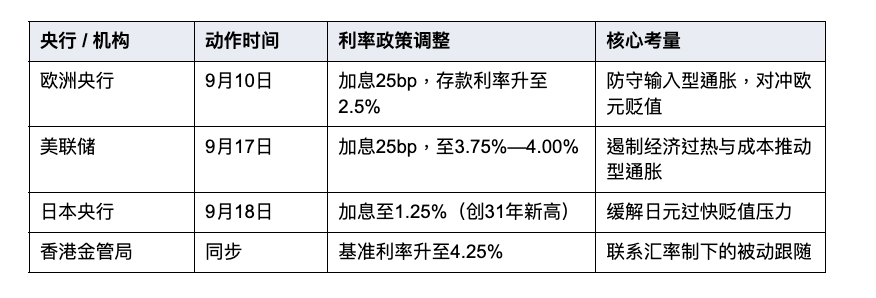
The essence of the siphon effect is that global capital is chasing the highest risk-free return at the same time. When the US raises its policy rate to 3.75%–4.00% and the 5-year US Treasury yield breaks through 5%, dollar assets become the highest-return and most liquid option globally, and capital then flows back to the US from other markets. For economies whose capital is being drained, this means three pressures arriving simultaneously: their own stock and bond markets come under pressure due to capital outflows; their currencies depreciate due to rising currency conversion demand, and depreciation in turn raises the cost of imported energy and food, exacerbating imported inflation; and governments and companies that previously borrowed dollar debt find that their debt-servicing costs increase out of thin air amid exchange-rate movements.
The purpose of central banks following with rate hikes in this round is often not to suppress domestically generated inflation, but rather a form of passive defense. Raising domestic interest rates is meant to make capital feel that staying at home still offers decent returns, thereby slowing the pace of outflows; narrowing the rate differential with the US is meant to ease the pressure of currency depreciation. If a large currency depreciation were allowed to run unchecked, imported inflation would become even harder to control, and the cost paid by the central bank would only be higher. This also explains why Europe and Japan still chose to continue raising rates even though their economic fundamentals are clearly weaker than those of the US—what they are fighting is not domestic overheating, but the dollar's pumping.
The cost of synchronized global tightening is suppressed growth. When major economies tighten credit at the same time, global financing costs rise overall, and corporate capital expenditure and household durable goods consumption are suppressed simultaneously; for economies already reliant on external demand, defensive rate hikes mean actively stepping on the brakes at a time of weak growth. The eurozone manufacturing PMI remaining below the boom-or-bust line is a case in point. This tightening resonance will ultimately transmit back in reverse through contracted global demand, putting pressure on US exports and multinational corporate revenue as well—what the siphon drains may be other countries' capital, but the boomerang of shrinking demand will eventually land back on the US itself.
6. The Middle East Struggles to Control Oil Pricing: Has the Rate-Hike Narrative Returned to the Data?
The most important development in the Middle East this week was not in the Strait of Hormuz, but at the UN General Assembly hall in New York:
On September 22, Trump delivered a speech at the 81st UN General Assembly, presenting Iran with a binary choice. He said it should either reach an agreement with Iran and help rebuild the country, or "swiftly obliterate the Islamic Republic," leaving it with no hope of survival, prompting the Iranian delegation to walk out on the spot. But in the same speech, he also gave a clear time expectation: a US-Iran nuclear deal will be reached after the November midterm elections. Energy was another main thread of the speech—Trump announced that the Pentagon will take an equity stake in a company holding extraction rights to 17 Venezuelan oil fields, and met with Venezuela's acting president during the UNGA, while predicting that as long as all parties remain united, "oil prices will plummet, even below the level at the start of the conflict." It should be noted that two claims in the speech were verified to be exaggerated: first, that the US and Venezuela together possess more than 60% of the world's oil, when the actual figure is about 22%; second, that oil flows through the Strait of Hormuz hit a record high, when they actually remain below pre-war levels.
On September 23, Iranian President Pezeshkian responded at the UNGA, and the US representative walked out midway. His core statement contained three layers: Iran will not surrender in a war against the US, but welcomes dialogue and will not yield under sanctions, threats, and military pressure; Iran will not give up its right to peaceful use of nuclear technology, saying "what we need is nuclear energy, not nuclear bombs"; and as for the Strait of Hormuz, he refused to accept an arrangement in which external forces use the waterway while threatening Iran, and stressed that the strait must not be used to transport weapons against Iran.
But what truly moved the market was a closed-door meeting outside the hall. Iranian Foreign Minister Araghchi and US Special Envoy Witkoff met in New York for about three hours during the UNGA, with Trump's son-in-law Kushner also participating. After the meeting, Trump called the talks "productive" and said Iran had a strong willingness to reach an agreement with him. After the news emerged, WTI crude oil at one point fell 2.31%, breaking below the $90 mark to a three-week low. Iran, for its part, reiterated three preconditions for opening the strait: the US must immediately lift its maritime blockade, immediately unfreeze all Iranian assets, and end the war on all regional fronts. The divisions remain clear—what the US wants is a comprehensive agreement covering the nuclear issue, while Iran wants the blockade lifted first before discussing anything else.
Oil prices traced a complete V-shape on the same day, which also demonstrated the pricing power of geopolitical factors. First they fell below $90 due to progress in the talks, then rebounded after Pezeshkian reaffirmed at the UNGA that "there will be no discussion of freedom of navigation unless the blockade is lifted," with Brent returning above $103 and WTI closing up 2.4% at $92.68, ending its previous five-day losing streak. The complete round trip within a single day shows that the impact of geopolitical news on prices is intraday in nature—it can create volatility, but it is hard-pressed to change the trend.
7. What to Watch Next: CPI and Nonfarm Payrolls Will Validate This Repricing
The release of the next nonfarm payrolls and CPI data is both scheduled before the Fed's October policy meeting, making the timing quite tight:
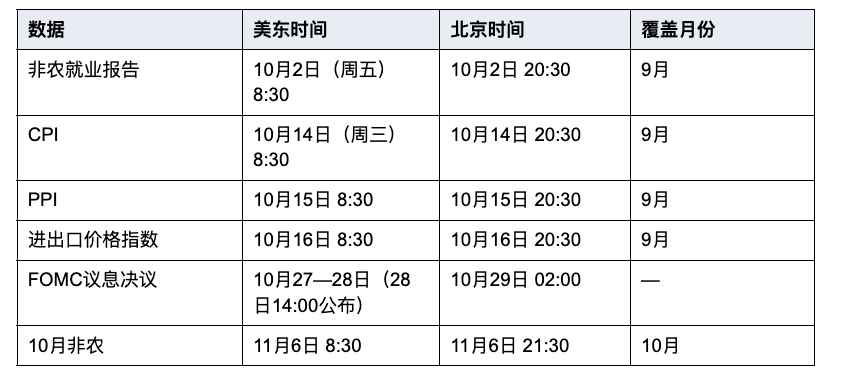
The September nonfarm payrolls report is the first validation: as the nearest official hard data, it will directly test whether the overheating shown by the PMI actually exists. If the employment data is equally strong, market doubts about the PMI's reliability will basically be disproven, and the probability of an October rate hike will move from the current nearly 70% toward "almost certain"; conversely, if nonfarm payrolls weaken markedly, a considerable portion of last night's repricing in yields and the dollar will be given back.
But what is truly decisive is the September CPI. The core debate in this round has never been "whether the economy is strong," but the distinction Compernolle pointed to—whether the economy is strong enough to withstand rate hikes, or strong enough to have already begun pushing up inflation. The PMI's input price index of 66.4 is only companies' sense of costs in a survey; CPI is the evidence that costs are actually being passed through to end consumers. If the September CPI confirms this pass-through, the Fed's renewed tightening cycle will have received formal endorsement.
Disclaimer
This article was compiled and written by this platform based on public information, and the market data, institutional views, and news reports cited all come from public disclosures by S&P Global, Bloomberg, the US Bureau of Labor Statistics, the US Federal Reserve, and major financial media. This platform has made every effort to verify their accuracy, but makes no express or implied guarantee as to the completeness, timeliness, or accuracy of the relevant information.
The content related to dollar stablecoins mentioned in this article originates from media reports citing people familiar with the matter and has not yet been confirmed by US officials. The relevant initiative is still in the discussion stage, and whether it will ultimately proceed and its specific form both remain uncertain. Readers are advised to treat it with caution.
The analysis, judgments, and expectations contained in this article represent only the views at the time of writing and may be adjusted with