Ondo, the leading asset tokenization company, is embroiled in an inheritance battle after its founder's unexpected death


- Core Viewpoint: Nathan Allman, founder of asset tokenization leader Ondo, died unexpectedly without leaving a will, triggering a complex legal battle over company control and inheritance involving the new CEO, the founder's family, and courts across multiple states.
- Key Elements:
- Nathan Allman died unexpectedly in May of this year at the age of 32. He was the company's sole director and controlling shareholder and left no will; President Ian De Bode took over as CEO.
- A court ruled that Nathan's parents are the legal heirs. His mother Kathleen was appointed personal representative of the estate in June, and in July announced a restructuring of the board and appointed herself as chairwoman and interim CEO, attempting to remove De Bode from his position.
- Kathleen filed suit in Delaware against De Bode for assuming the CEO role without valid authorization, and challenged the validity of his compensation exceeding $11 million and an incentive plan of 26 million ONDO tokens.
- In September, Nathan's half-sister Lani Clinton joined early investor David Chen in petitioning for a limited conservatorship over Kathleen, alleging alcohol abuse, questionable cognitive ability, and lavish spending.
- The dispute has formed two legal fronts: a fight for corporate control in Delaware and a fight over estate administration in Hawaii, both centered on the Ondo equity and token rights left behind by Nathan.
- A court ordered that De Bode remain acting CEO and retain his board seat. The battle is still ongoing, and while Ondo's business continues to advance, it faces uncertainty.
Original | Odaily (@OdailyChina)
Author|Azuma (@azuma_eth)

With the U.S. Securities and Exchange Commission (SEC) formally issuing the relevant exemption documents, asset tokenization has become the most prominent narrative in this round of crypto recovery.
Over the past few years, an increasing number of traditional financial assets — from U.S. Treasuries and funds to equities — have been brought on-chain, and Ondo secured its position as the sector leader early on thanks to its earlier strategic positioning and faster execution pace. However, just as Ondo's bet was beginning to pay off, the project suddenly ran into a problem that was never part of any business plan — the founder's sudden death, and the battle over control of his estate, is gradually escalating into a complex dispute involving corporate governance, family members, and even courts across multiple states.
The story begins in May of this year.
Founder's Sudden Death, De Bode Takes Over as CEO
In May of this year, Ondo founder Nathan Allman died unexpectedly at the age of just 32.
At the time of his death, Nathan was not only Ondo's founder and CEO, but also the company's sole director and controlling shareholder.His sudden passing left Ondo with a very straightforward question — who would take over the company?
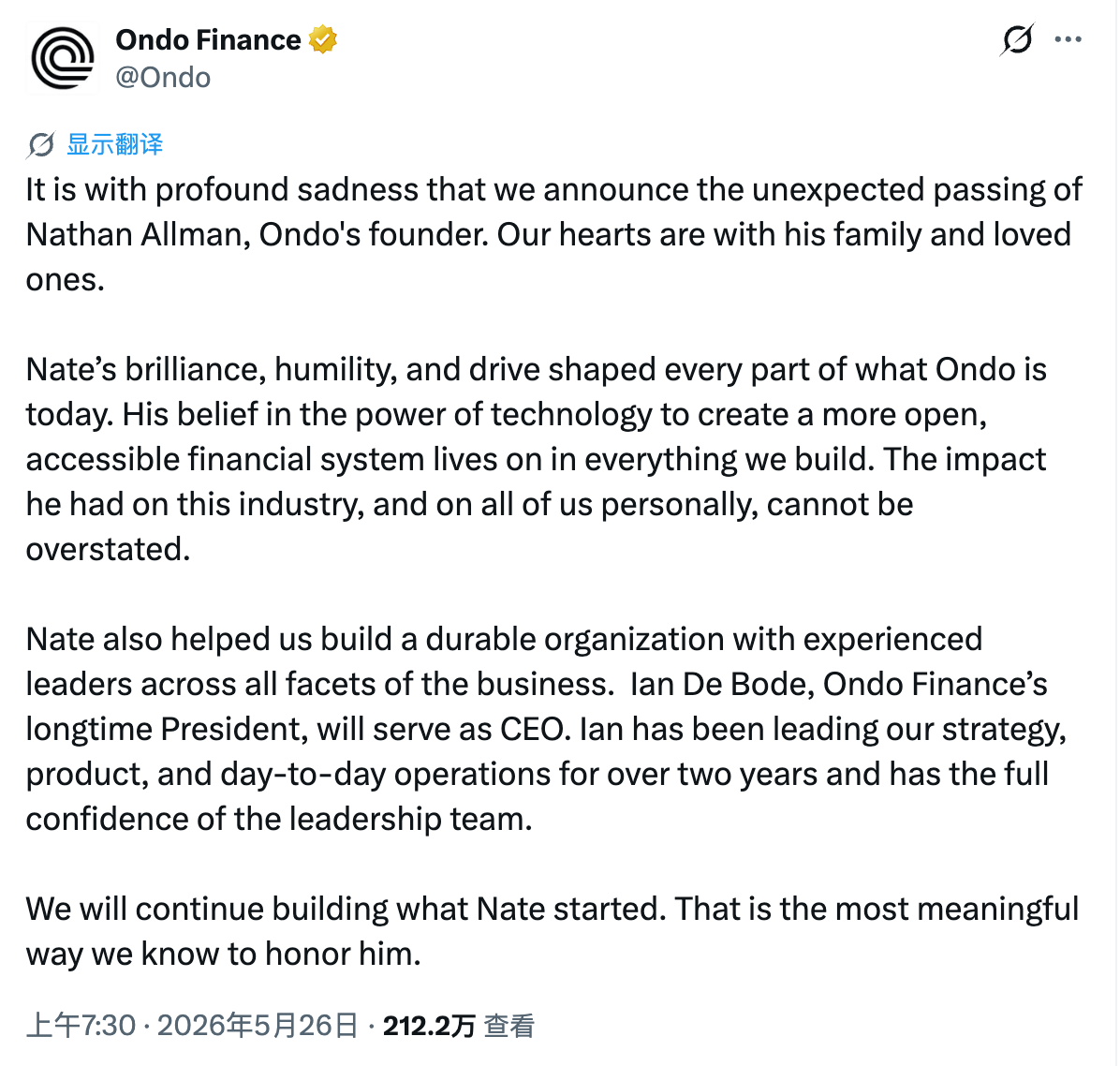
On May 26, Ondo officially released a statement confirming Nathan's death and announcing that longtime President Ian De Bode would succeed him as CEO. The company's framing of the transition was quite clear at the time: De Bode had been responsible for the company's strategy, products, and day-to-day operations over the past two years, had earned the full trust of the management team, and would lead Ondo in continuing to advance the cause Nathan had started.
From a business operations perspective, this appeared to be a smooth management transition. But the problem is that while a CEO can be replaced, the founder's equity cannot be inherited through a company announcement alone — and that is precisely the key to the company's long-term stability.
More critically, Nathan's death was so sudden that he left no will whatsoever regarding his affairs.
Parents Step In, the Fight for Control Begins
After Nathan's death, a court ruled that his mother Kathleen Allman and father Lawrence Allman were his legal heirs. According to subsequent litigation documents, Nathan's estate includes his controlling interest in Ondo, as well as a large amount of ONDO tokens — some already unlocked and some set to unlock over the coming years.
In June, a Hawaii court appointed Kathleen as the personal representative of Nathan's estate. She subsequently began to intervene in Ondo's corporate governance.
The conflict between the two sides soon became public.In July, Kathleen announced that she was restructuring Ondo's board of directors in her capacity as a shareholder, appointing herself as the company's chairwoman and interim CEO, while attempting to remove De Bode from his positions.Nathan's sister Tahnee Towill was also appointed to the board by Kathleen.
Kathleen then filed a lawsuit in the Delaware Court of Chancery, alleging that De Bode assumed the CEO role after Nathan's death without valid board authorization, and sought to further consolidate her own control.
One of the disputes concerns a compensation and equity incentive package that De Bode received after Nathan's death. According to court filings from Kathleen's side, the package included a $900,000 annual salary plus bonus, a $1 million signing bonus, and 26 million restricted ONDO tokens, with a total value exceeding $11 million. Kathleen's side argues that the arrangements are invalid and has asked the court to confirm that the relevant appointments and award arrangements have no legal effect.
De Bode denies the allegations, saying Kathleen's lawsuit lacks merit, and states that the company has the support of major stakeholders and investors.
At this point, what was originally a management transition has formally become a battle for corporate control.
De Bode Fights Back, a "Mole" Emerges Within the Family
The situation was already complicated enough, but in September, a new twist emerged in the fight. De Bode also gained an unexpected "ally."
On September 16, Nathan's half-sister Lani Clinton, along with Ondo early investor David Chen (previously proposed by De Bode for the board), jointly filed a petition with a Hawaii court seeking a limited guardianship over the share of Nathan's estate that Kathleen had inherited.
In the petition, Lani raised a series of allegations regarding her mother Kathleen's cognitive capacity, long-term alcohol consumption, and financial management behavior, arguing that Kathleen may no longer be capable of properly managing this portion of the estate — in addition to claiming her mother has a decades-long history of "pathological alcoholism," Lani also asked the court to subpoena her mother's medical records and have her assessed for dementia.
The petition also mentioned Kathleen's long-standing extravagant lifestyle, including having purchased or attempted to purchase a Zeelander yacht worth approximately $4 million in Florida; traveling by private jet; requesting that Ondo reimburse a six-figure flight cost from Hawaii to California; and staying in luxury accommodations costing about $4,000 per night...
Chen also disclosed a text message from Kathleen. Just nine days after her son's death, Kathleen had tried to ask the company for money: "Hi, I'm sure everything will work out over time, but my biggest concern right now is cash flow and liquidity! The sooner the better! For example, I currently have a $200,000 bill from a Newport pool builder. I really want to buy that... yacht and other things."
Since the estate Kathleen represents includes Ondo's controlling interest and a large amount of ONDO tokens, these allegations ultimately bear directly on control of Ondo.
It should be emphasized that the above content currently consists of one-sided allegations in litigation and is not a fact already established by a court. Kathleen's side currently denies the allegations, calling them entirely groundless.Kathleen also believes that this lawsuit is merely a further move by De Bode's camp in the battle for corporate control, and that De Bode and Chen are colluding in an attempt to replace her with a trustee more obedient to them.
Thus, a corporate governance dispute that originally revolved around the CEO appointment has begun to turn into two intertwined legal fronts:on one side, the fight for control of Ondo in Delaware; on the other, the dispute over the administration of Nathan's estate in a Hawaii court... and what both sides are actually fighting over is the same core asset — the Ondo equity and token interests Nathan left behind.
The Battle Is Not Over, and We Hope the Project Remains Well
As of now, this battle is still ongoing. According to a court order in early September, De Bode continues to serve as Ondo's acting CEO and retains his board seat; the new litigation that emerged in mid-September has further publicized the disputes within the Allman family.
Ondo is still advancing its asset tokenization business. More and more traditional assets — U.S. Treasuries, funds, equities, and others — are moving on-chain, and the industry itself continues to develop rapidly.
But for a project at the forefront of this sector, the founder's sudden death has already brought consequences far beyond a management change.Corporate control, estate inheritance, and family relationships are all interwoven, and where this will ultimately lead remains unanswered. But for all ONDO holders, we clearly do not want to see an excellent project in rapid development have its momentum held back by this unexpected estate dispute.