After the successful position swap, the Bankless founder once again shilled ZEC and NEAR


- Core Viewpoint: Bankless co-founder David Hoffman believes that ZEC and NEAR are respectively becoming new "Schelling points" in the store-of-value and smart contract sectors, achieving value re-rating by absorbing spillover buy pressure from Bitcoin and Ethereum. Meanwhile, legacy blue chips like BTC and ETH, lacking a 10x growth narrative, are facing the dilemma of the industry's value spilling over to traditional financial institutions.
- Key Elements:
- Hoffman liquidated his ETH position in June this year and rotated into tokens including ZEC and NEAR. After the swap, multiple tokens significantly outperformed ETH.
- ZEC's market cap surged from $200 million to $26 billion. The core logic is absorbing spillover buy pressure from the $1.7 trillion BTC market, similar to ETH's value re-rating path in 2021.
- NEAR is seen as the "Schelling point" in the smart contract space, competing for Ethereum's smart contract buy flow. However, the energy in this sector is less than that of Bitcoin buy pressure, and ETH's dominance is not as firmly established as BTC's grip on SoV.
- Hoffman believes BTC and ETH lack a solid narrative for another 10x gain, and the industry's innovation value (such as Hyperliquid, Ethena, etc.) could be captured by traditional institutions like Robinhood and Coinbase.
- If the total crypto market cap cannot jump from $3 trillion to $30 trillion, the value of emerging projects will struggle to settle into native blue chips, and the industry's total pie may be far smaller than expected.
Source: Bankless co-founder David Hoffman
Compiled by Odaily (@OdailyChina); Translator: Azuma (@azuma_eth)

Editor's note: This is the latest article from Bankless co-founder David Hoffman. In June of this year, Hoffman, a longtime ETH believer, publicly announced that he had sold all of his ETH and rotated into ZEC, NEAR, LIT, HYPE, and VVV. Several months later, the tokens he rotated into have all significantly outperformed ETH, with several of them consistently leading the market.
In his latest article, Hoffman lays out his logic for firmly betting on ZEC and NEAR, arguing that these two tokens will become new "Schelling points" in the value storage and smart contract directions respectively, with enormous room for further appreciation.
The following is the original content from Hoffman, compiled by Odaily.
The "Bitcoin Bid" Trophy
- "How on earth did ZEC pump this hard?"
- "Where is this relentless buying pressure even coming from?"
- "How can an asset go from a $200 million market cap to $26 billion without anyone manipulating it?"
In the crypto industry, every so often an asset emerges that wins the "Bitcoin Bid" trophy.
As everyone knows, Bitcoiners hold their BTC extremely tightly. The Bitcoin community and the power of its narrative have built an incredibly strong "Schelling point" around "BTC and BTC only," and this narrative has genuinely worked — its success is currently reflected in a market cap of $1.7 trillion.
- Odaily note: The core meaning of a "Schelling point" is that, without communication, people tend to converge on the most obvious, most natural option.
This line of defense is nearly impregnable. Bitcoiners who defect to other assets are shamed, mocked, and isolated. There is only one iron rule in the Bitcoin community: no shitcoins; and if there is a second iron rule, it is that everything other than Bitcoin is a shitcoin.
Yet Bitcoiners are only human. Faced with temptation, envy, and greed, they too cannot help themselves. Bitcoiner in the streets, shitcoiner in the sheets.
Usually, believers only defect in isolated cases — no one notices, no one cares. But every once in a while, enough people rush toward the same asset at the same time that the defection becomes highly contagious.
ETH experienced exactly this in 2021. It also explains why ETH was able to complete such a stunning revaluation at the time — its market cap surging from a bottom of $12 billion all the way to a peak of $554 billion.
Just listen to what Su Zhu said in October 2021: "It's gotten to the point where I know people who have literally flown around the world to access their cold wallets and pull out Bitcoin to buy Ethereum. If your public persona on Twitter is a 'Bitcoin maximalist,' you obviously can't surrender publicly because you'd lose followers; but I'm certain these people have been privately stacking massive amounts of ETH."
ZEC in 2026 Is ETH in 2021
ZEC has built a sufficiently strong "Schelling point" for absorbing the "Bitcoin Bid." There is $1.7 trillion worth of BTC circulating in the market, and it only takes a tiny fraction of Bitcoiners recognizing ZEC's value — whether because of its own characteristics (privacy, quantum resistance) or simply to hedge their BTC exposure — for that to be enough.
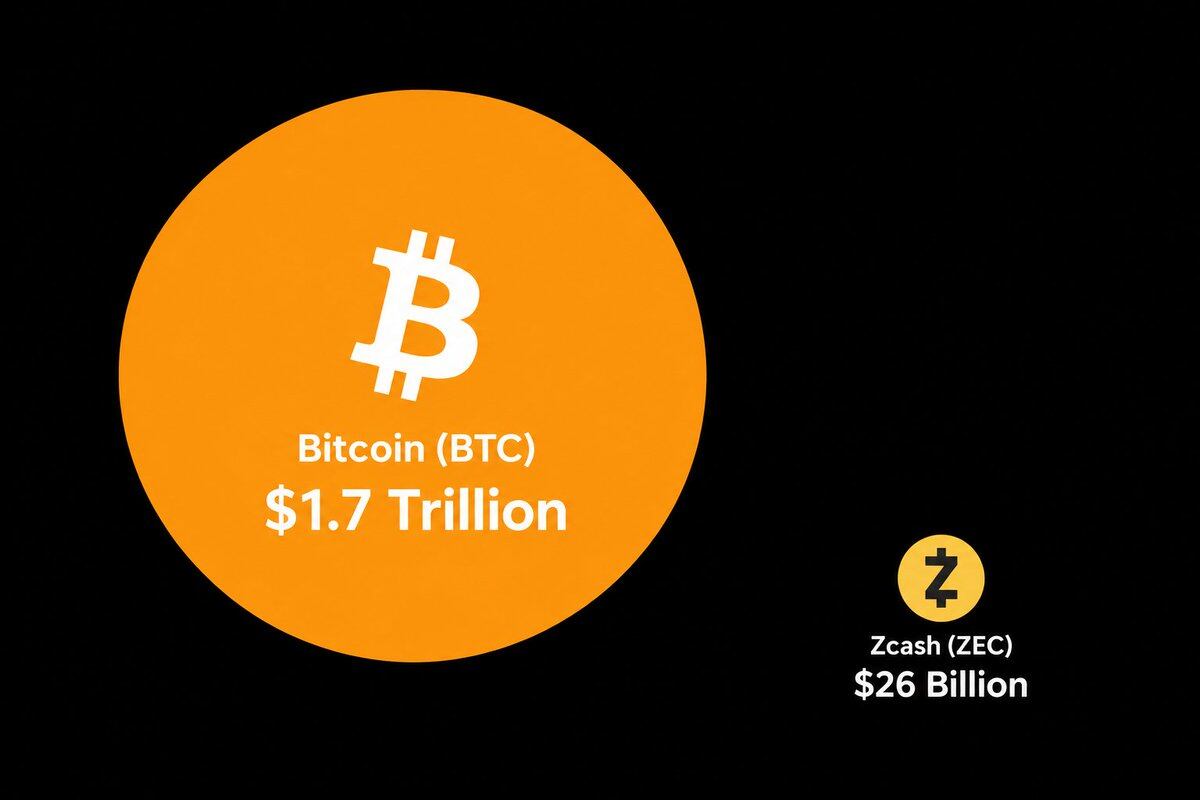
That is why ZEC is Up Only. Compared to a $1.7 trillion behemoth, a $26 billion asset is still as cheap as pocket change. As long as ZEC can continue to persuade even a small subset of Bitcoiners to buy a little "just in case," it will keep rising — and ironically, "just in case" is precisely the phrase Bitcoiners most commonly use when pitching BTC to the world.
How much ZEC has risen in dollar terms doesn't matter. What truly matters is ZEC's size relative to BTC, because the core source of buying pressure driving ZEC is fundamentally the spillover of wealth from BTC.
Feel free to correct me if I'm wrong, but I believe there are virtually no capital allocators in the market who would skip BTC, ETH, and every other crypto asset and buy ZEC purely for ZEC's own merits.
NEAR: A Brand-New "Schelling Point" in Smart Contracts
I believe a similar phenomenon is now playing out with NEAR. NEAR has already won the 2026 "smart contract bid" trophy.
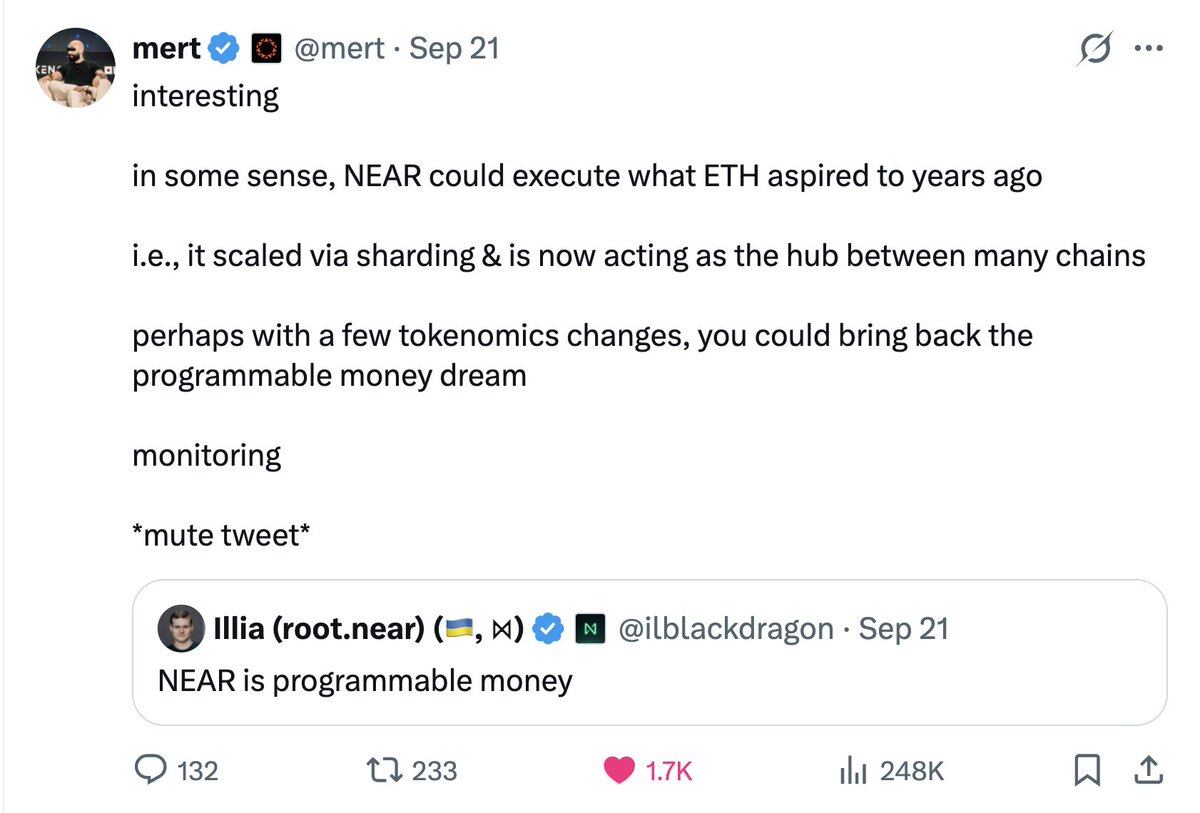
The "smart contract bid" that NEAR is competing for is clearly less powerful than the "Bitcoin Bid" that ZEC is absorbing. In the crypto world, the store-of-value (SoV) narrative has always ranked first, with smart contract public chains a distant second.
Moreover, ETH's grip on smart contract hegemony is far less secure than BTC's reign over the store-of-value throne. The impact SOL has had on ETH is something no asset has ever inflicted on Bitcoin; and compared to the exclusivity of Bitcoin maximalists, Ethereum's community culture has always been looser, more inclusive, and more pluralistic.
As a result, the buyer base NEAR attracts may be more fragmented than the Bitcoiners ZEC appeals to. Nevertheless, the underlying logic is identical.
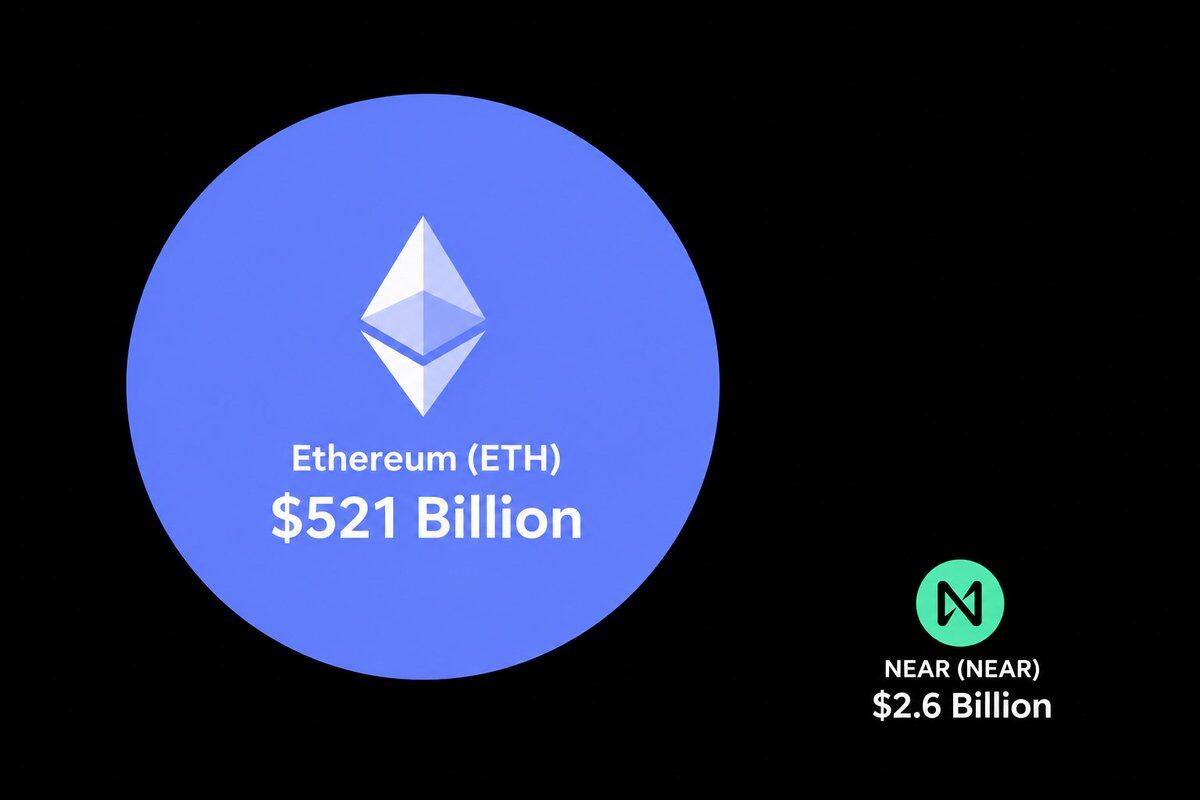
Fewer and fewer people are willing to buy the mega-cap legacy blue chips, for the simple reason that there isn't enough return. And by 2026, these two old blue chips are carrying too much technical baggage and have fallen behind architecturally.
The Curse of the Blue Chips
Unfortunately, this market dynamic leaves the entire crypto industry with a problem — someone has to absorb these blue-chip assets.
Bitcoin needs to complete its metamorphosis from a highly volatile digital currency into a mature gold substitute, but judging by recent performance, BTC doesn't seem to be playing that role well; by contrast, real gold — no matter how many flaws it has — is still gold.
And after Tom Lee, who else is going to buy ETH? I still see no solid basis or new narrative that could send it up another 10x.
If the top two assets by market cap cannot achieve 10x growth from here, how is the entire industry supposed to move forward? Progress will inevitably happen — Hyperliquid, Venice, Lighter, Ethena, and Morpho have all delivered stunning innovation. But unless total crypto market cap can jump from $3 trillion to $30 trillion, the value created by this new generation of startups will most likely be captured by institutions outside crypto, rather than accruing to our native blue chips.
Compared to BTC and ETH, Robinhood, Coinbase, Apollo, and traditional brokerages are clearly better positioned to capture the dividends of this new wave. As for whether BTC and ETH can extract substantive value from it, that remains highly doubtful.
If this dynamic persists, we may always get new localized winners, but the overall pie of the crypto industry will likely remain far smaller than our grand ambitions once envisioned.
I hope I'm just being impatient, and I sincerely hope total crypto market cap can truly break through the $10 trillion mark this cycle! To the Zillions!