SEC's Five-Year "Innovation Exemption" Lands: Who Gets a Ticket Aboard Tokenized US Stocks?


- Core Viewpoint: The SEC has issued a five-year "innovation exemption," opening a compliant path for on-chain trading of tokenized US stocks for the first time. However, what is exempted is the trading venue, not the tokens themselves. Issuer authorization and licensed compliance become key barriers to entry.
- Key Elements:
- The exemption order was issued under Section 36(a)(1) of the Securities Exchange Act, effective immediately through September 2031. It is a temporary conditional exemption that can be modified or overturned early.
- Only TSV trading venues and liquidity providers are exempted. Tokenized issuers still need to comply with existing securities laws, and the status of transfer agents and clearing agencies has not been addressed.
- Strict restrictions are imposed: limited to AMMs and public chains, prohibition of leveraged lending, trading pairs restricted to three types of assets including compliant stablecoins, and caps on underlying assets and trading volume ratios.
- Issuers have a 30-day objection right over third-party tokenized stocks, pushing the industry from a "third-party wrapping" model toward an "issuer-authorized" model.
- The biggest beneficiaries are licensed tokenization platforms such as Securitize and Ondo, as well as infrastructure layers including stablecoins and Uniswap.
- The offshore "tracking certificate" model is hit hardest. The SPV debt structures of Robinhood and Kraken would need to be fundamentally reworked to enter the framework.
Original | Odaily (@OdailyChina)
Author | jk
On September 17, the U.S. Securities and Exchange Commission (SEC) released the long-awaited "Innovation Exemption," opening a compliant path at the federal level for the first time for on-chain trading of tokenized U.S. equities. After the Robinhood Chain hype subsided, this belated exemption provides a framework for the compliance of tokenized stocks.
On the day the news was announced, related tickers such as Securitize (SECZ), Ondo, and Uniswap rose in response. But a closer reading of the terms reveals that this exemption is far from "fully opening up tokenized stocks." Who does it actually benefit? And who does it shut out? Odaily takes readers through the details.
1. What Is the SEC's Innovation Exemption?
The full title of the document is the "Temporary Conditional Exemptive Order Regarding Distributed Ledger Trading Venues and Liquidity Providers for Tokenized NMS Stocks." The SEC issued it under its exemptive authority pursuant to Section 36(a)(1) of the Securities Exchange Act. The order took effect immediately, has a five-year term running until September 17, 2031, and was simultaneously opened for public comment.
To be clear from the outset: it is an exemptive order, not a final rule that has gone through the full "notice-and-comment" process. The SEC can amend it early, and a future Commission could overturn it. SEC Chairman Paul Atkins himself emphasized that the exemption must be followed by more durable rulemaking. If Democrats come to power in the future and nominate another crypto-skeptical chairman like Gary Gensler, this exemption could be overturned at any time.
The exemption has two core components:
- The first targets "Tokenized Securities Venues" (TSVs). U.S. entities operating permissioned AMM liquidity pools on public blockchains to trade eligible tokenized U.S. stocks are not deemed to be "exchanges" and therefore do not need to register as national securities exchanges or ATSs.
- The second targets liquidity providers (Covered Firms). Institutions that use their own capital to provide liquidity for tokenized stocks in TSV pools are not deemed to be "dealers" and do not need to register as broker-dealers.
In exchange, the SEC imposed a series of conditions:
- Tokens must carry the same shareholder rights as common stock, including dividends, voting rights, and rights to liquidation residuals.
- There is a cap on the number of stocks a trading venue can list: Tier 1 stocks (S&P 500, Russell 1000 constituents, etc.) are capped at 75, and Tier 2 stocks at 250.
- There is a cap on the on-chain trading volume share of any single stock: 0.25% for Tier 1 and 2.5% for Tier 2.
- For third-party unauthorized tokenized stocks, listed companies have a 30-day objection right and can disallow their issuance.
Commissioner Hester Peirce summarized the order's positioning in one sentence: it has nothing to do with DeFi; it deals with a specific, controlled on-chain trading model, not a blanket loosening of decentralized finance. SEC crypto task force officials expect the first TSVs to appear as early as the fourth quarter of this year.
2. Seven Easily Overlooked Details
Most coverage focuses on the keywords "five years," "permissioned AMM," "shareholder rights," and "issuer objection." But what determines who can actually enter is often the less conspicuous provisions below.
1. What Is Exempted Is the Trading Venue, Not the Token
The exemption applies only to TSVs and liquidity providers; the party issuing tokenized stocks itself enjoys no exemption. Tokenizers must still comply with the SEC's "Staff Statement on Tokenized Securities" issued in January this year and the issuance rules of the Securities Act. All offers and sales still require registration or an exemption.
The exemptive order also does not address the status of transfer agents and clearing agencies. So what this order lowers is the threshold for "trading"; the threshold for "tokenization" has not been lowered at all. Companies that already hold all the necessary licenses in this segment naturally become the suppliers for all TSVs. In other words, you must first obtain all the licenses before you can do tokenized stocks.
2. The "Issuer Objection Right" Only Targets Third-Party Tokens
The 30-day objection procedure applies only to stocks tokenized by unaffiliated third parties: the TSV must notify the issuer in writing at least 30 calendar days before listing, and if the issuer objects in writing within that period, the stock cannot be listed. According to CoinDesk citing SEC officials, an objection can be as simple as saying "I object." Stocks tokenized by the issuer itself or by parties commissioned by it do not go through this procedure.
In other words, the "list first, see you in court if there's a problem" playbook no longer works here. The previous AMD-related stock dispute now has a legal basis supporting the issuer.
3. Only AMMs, Only on Public Permissionless Chains
The trading mechanism is limited to AMM liquidity pools. Venues may provide request-for-quote (RFQ) and other non-deterministic trading indications, but standalone on-chain central limit order books (CLOBs) appear not to be covered. Smart contracts must also be public and auditable, deployed on public, permissionless distributed ledgers.
"Permissioned" is reflected only at the pool access level: on-chain whitelists determine who can trade. The underlying chain must be a public chain. This means existing CLOB exchanges such as Coinbase and Bullish cannot directly use the exemption, and private chain and consortium chain solutions are also excluded.
4. Strict Limits on Trading Pairs, No BTC Pairing
Tokenized stocks can only be paired with three types of assets: another tokenized stock; non-security crypto assets such as payment stablecoins issued under the GENIUS Act; and tokenized money market funds. TSVs cannot list pure crypto trading pairs like "AAPL/BTC." This provision makes compliant stablecoins the "legal settlement currency" under the exemption framework.
5. Leverage Prohibited, Lending and Restaking Prohibited
Margin financing and margin trading are prohibited within a TSV, as are lending or restaking of pool assets. Currently, tokenized stocks issued by Coinbase on Base can be used as collateral in Aave and Morpho, but within the TSV framework, this kind of composability is non-compliant. The DeFi narrative for on-chain stocks will be significantly diminished as a result.
6. Volume Caps Calculated on a Consolidated Basis Across Affiliates; Three-Month Suspension for Exceeding Limits
Both the cap on the number of listed securities and the cap on trading volume share are calculated on a consolidated basis across affiliated TSVs, so they cannot be circumvented by splitting into multiple venues. The denominator for the trading volume share is the prior month's average daily share volume reported by SIP. A first breach requires no action; each subsequent breach requires the stock to be suspended from trading for three months.
To put it in perspective: a TSV's trading volume in a Tier 1 stock like Apple can account for at most one four-hundredth of the entire market.
There are also several other noteworthy points:
- Venues may only conduct secondary trading and cannot conduct primary issuance on a TSV.
- Third-party tokenizers must distribute proxy materials and issuer communications to holders free of charge.
- Trade data must be made publicly available free of charge within 10 minutes.
- Liquidity providers may not hold or custody customer assets.
- TSVs must be U.S. entities and comply with OFAC sanctions regulations.
3. Who Benefits, Who Is Hit Hardest?
Comparing each company's existing products against the provisions one by one, they can roughly be divided into three categories. One overall conclusion is that no existing product can enter the exemption framework as-is. The only differences are how far they are from the standard and how high the cost of restructuring is.
Category 1: The Biggest Beneficiaries Are Licensed Tokenizers and Underlying Infrastructure
The biggest beneficiaries are companies that already hold transfer agent and broker-dealer/ATS licenses and adopt an issuer-authorized or custodial beneficial interest model.
Securitize is the most typical beneficiary: it has SEC-registered entities across transfer agency, broker-dealer, ATS, investment advisory, and fund management, and has gone public on the NYSE via SPAC. In the second quarter of this year, Computershare, the world's largest transfer agent, and Continental Stock Transfer, the third largest, both chose to partner with Securitize to promote issuer-authorized tokenized stocks for listed companies. The tokenized shares remain linked to the issuer's official shareholder register, satisfy the "same rights" requirement, and are not subject to the objection procedure. It is also among the first partners for Uniswap v4 permissioned pools. In the trading days after the exemptive order was released, SECZ shares rose sharply, and several brokerages raised their target prices.
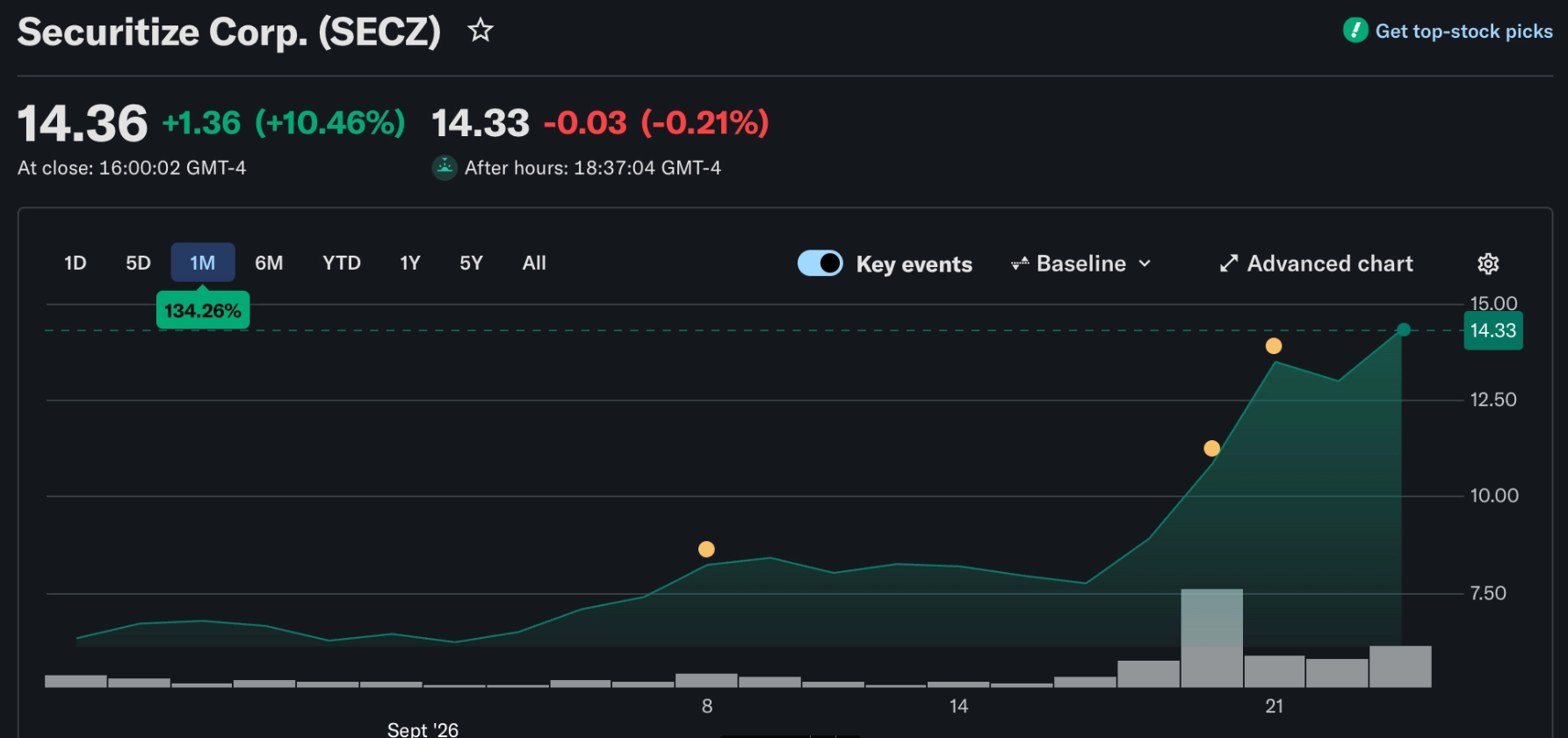
SECZ shares nearly doubled in a week. Source: Yahoo
Ondo's U.S. business line is likewise highly compliant. After acquiring Oasis Pro last year, Ondo obtained broker-dealer, ATS, and transfer agent licenses. In July this year, it received FINRA authorization to offer tokenized NMS stocks to U.S. institutions and retail investors. Its custodial tokenized securities issued on Ethereum keep the underlying stocks within the U.S. regulated custody chain, and holders can vote through Broadridge. In September, it also became the first tokenized platform member of DTCC Fund/SERV. Ondo's weakness is that its more than 440 tokens far exceed the cap on the number of listed securities, and most lack issuer authorization, so it needs to select securities carefully and also faces objection risk.
The Superstate and Galaxy combination is another example. Last September, GLXY went on-chain on Solana in the form of SEC-registered Class A common stock itself, with transfers updating the official shareholder register in real time. Superstate also participated in designing Uniswap's permissioned pool standard.
Other beneficiaries include the infrastructure layer that "sells shovels":
- Stablecoins: Payment stablecoins are explicitly listed as eligible trading pairs. USDC is well positioned thanks to its GENIUS Act-compliant status and Circle's newly launched Arc chain. But it will face competition from tokenized money funds and other compliant stablecoins.
- Uniswap: The v4 Permissioned Pools launched in July this year verify whitelists at the protocol layer and are the most readily available technical foundation for TSVs. But Uniswap Labs itself is not a TSV and still needs a U.S. entity to take responsibility for the pool.
- Public chains: The requirement for a "public permissionless ledger" favors Ethereum and its L2s (Base, Arbitrum) and Solana.
Category 2: Partially Compliant
Companies in this category have product structures that are basically on the right track, with underlying real stocks held 1:1 in custody, but voting rights pass-through, U.S. user access, or trading venue form still need to be completed.
Coinbase launched its first batch of tokenized stocks such as AAPLc and NVDAc on Base in August this year. The issuer is an SPV registered in the Abu Dhabi Global Market, the underlying stocks are custodied by SEC-registered broker-dealer Alpaca, and the SPV holds them in trust for holders, who enjoy beneficial interests rather than creditor claims. Dividends are passed through (with a 5% distribution fee), but voting is limited to holders who complete KYC, and the SPV "may" vote on their behalf, which still falls short of "same voting rights." The product is issued under Reg S, is not open to U.S. persons, and DEX trading on Base is permissionless. Coinbase needs to set up a segregated U.S. TSV entity, deploy whitelisted pools, implement voting pass-through, and resolve the compliance path for U.S. issuance. Among large exchanges, its restructuring cost is the lowest.
Dinari holds both transfer agent and broker-dealer licenses and last year became the first tokenized stock platform to obtain U.S. broker-dealer status. dShares uses a custodial beneficial interest structure, with dividends automatically mapped, but voting rights pass-through has not been officially confirmed, and the company still says it is not yet open to U.S. users. It currently operates an order book network rather than an AMM, so it needs to connect to or build its own TSV.
Bullish has taken a different path. In May this year, it tokenized its own BLSH complete shareholder register on-chain, managed by transfer agent Equiniti, representing issuer-authorized real shares. It is acquiring Equiniti for $4.2 billion, with closing expected in January 2027, while also applying for U.S. broker-dealer and ATS licenses. Once both the acquisition and the licenses are in place, Bullish could become the one with the greatest medium- to long-term potential, but for now it is still in a transition period.
Category 3: Offshore "Tracking Certificate" Models Hit Hardest
The hardest hit are offshore structured note products that turn holders into creditors of an issuing SPV. Such products fall squarely within the exemption order's exclusion for "separate securities providing synthetic exposure."
Robinhood launched a new generation of Stock Tokens on the Arbitrum-based Robinhood Chain, with about 200 already available. The issuer is a Jersey SPV, the product is a tokenized debt security, and holders have only economic exposure, no legal shareholder rights, and currently no voting rights either. Its prospectus also provides that the underlying stocks may be lent out, with voting rights waived during the lending period, which directly conflicts with "same rights." This month, the AMC CEO publicly demanded the delisting of unauthorized AMC tokens, a dispute that can be seen as a preview of the issuer objection right. Robinhood CEO Vlad Tenev subsequently said physical redemption and voting features are "coming soon," but that remains only a plan. To enter the exemption framework, Robinhood would need to change its underlying structure from debt notes to custodial beneficial interests, essentially a complete rebuild.
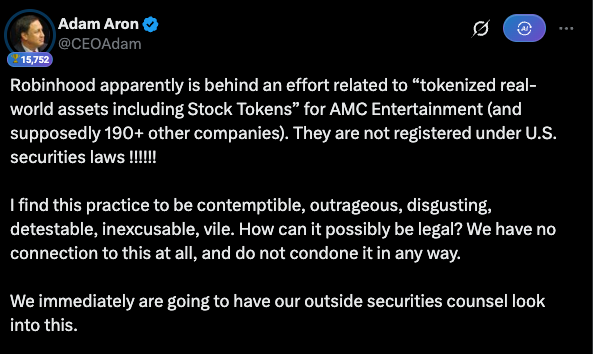
AMC CEO posted opposition to his company's stock being tokenized. Source: X
Kraken's xStocks is the largest tokenized stock product. According to Crypto Briefing, cumulative volume has exceeded $35 billion, covering more than 700 assets. But Kraken's legal documents state: xStocks holders have no voting rights and no legal claim to the underlying stocks. Its issuer is likewise a Jersey SPV and it is likewise not open to U.S. users. Its massive offshore scale can hardly be directly monetized in the U.S., and Kraken will need to use its U.S.-licensed entities to build a separate custodial beneficial interest product line.
Ondo's offshore business, Ondo Global Markets, also falls into this category. Its product is a BVI-issued structured note, and holders are creditors. Although it connects to Broadridge to provide a "voting preference" expression, the issuer has no legal obligation to follow it.
Conclusion
In summary, this exemptive order exempts the trading venue, not the token.
The resulting landscape will most likely involve a three-layer division of labor: licensed tokenizers handle minting and connecting to shareholder registers, permissioned AMMs handle on-chain matching, and compliant stablecoins handle settlement. Given the 0.25% cap on trading volume share, trading venues themselves will find it difficult to generate large-scale revenue in the short term. Value is more likely to accrue first to transfer agents, custody, stablecoins, and pool infrastructure.
The issuer objection right will also push the entire industry from "third-party packaging" toward "issuer authorization." The head of research at RWA.xyz expects that most products will shift to the issuer-authorized model within the next 12 months.