What are computing power futures?


- Key Insight: The article introduces Bitget's launch of the industry's first pre-market perpetual contracts for computing power targeting retail users (H100 USDT and B200 USDT) on September 8, 2026, which financialize GPU rental price indices into tradeable assets, enabling ordinary traders to directly participate in price discovery and risk hedging in the AI computing power market.
- Key Elements:
- Computing power futures are derivatives indexed to GPU rental prices, using a standardized index to price and trade "future computing costs," similar to how crude oil futures provide price discovery for oil supply and demand, without involving physical GPU delivery.
- Bitget's new contracts are pegged to GPU rental price indices for NVIDIA H100 and Blackwell B200, quoted in "USD per GPU hour," supporting up to 10x leverage, USDT settlement, and 7×24-hour trading, significantly lowering the barrier to entry.
- The index is published by professional data firm Silicon Data, with data sourced from real quotes by multiple cloud service providers, standardized across factors such as specifications, lease terms, and regions, reflecting the global supply-demand dynamics of mainstream high-end GPUs.
- The contracts adopt a pure cash settlement mechanism—upon closing, profits and losses are settled in USDT based solely on the difference between the contract price and the index price, with no physical delivery required. This fits the crypto-native trading environment, enhancing liquidity and operational convenience.
- Compared to traditional commodity futures and crypto perpetual contracts, computing power futures combine the infrastructure-like attributes of crude oil futures with the flexibility of crypto trading, allowing ordinary traders to precisely express their views on the rise or fall of AI's underlying computing costs.
Computing power is becoming the "new oil" of the AI era. In the industrial age, whoever controlled oil held the pulse of economic growth. In the AI era, what truly drives everything is computing power. Large model training, real-time inference, generative applications... behind every second of intelligence are hundreds of high-end GPUs running nonstop. As computing power becomes increasingly scarce and its price swings grow more volatile, a brand-new financial instrument has emerged—computing power futures.
It is quietly turning AI's most critical factor of production into a tradable, hedgeable, and strategically positionable asset.
What Are Computing Power Futures?
Simply put, computing power futures are derivatives indexed to GPU rental prices. Instead of settling physical machines, they rely on a standardized index that allows the market to price and trade "how expensive computing power will be in the future."
Just as crude oil futures enable global price discovery for oil supply and demand, computing power futures allow the market to begin pricing the true cost of AI infrastructure.
When training a single large model can burn through tens of millions—or even hundreds of millions—of dollars in computing costs, this price volatility is no longer a "technical detail" but a real business risk and investment opportunity.Computing power is the new oil of the AI era. And computing power futures are the key step toward turning this "new oil" into a tradable asset.
Bitget Puts the "New Oil" into Ordinary People's Hands
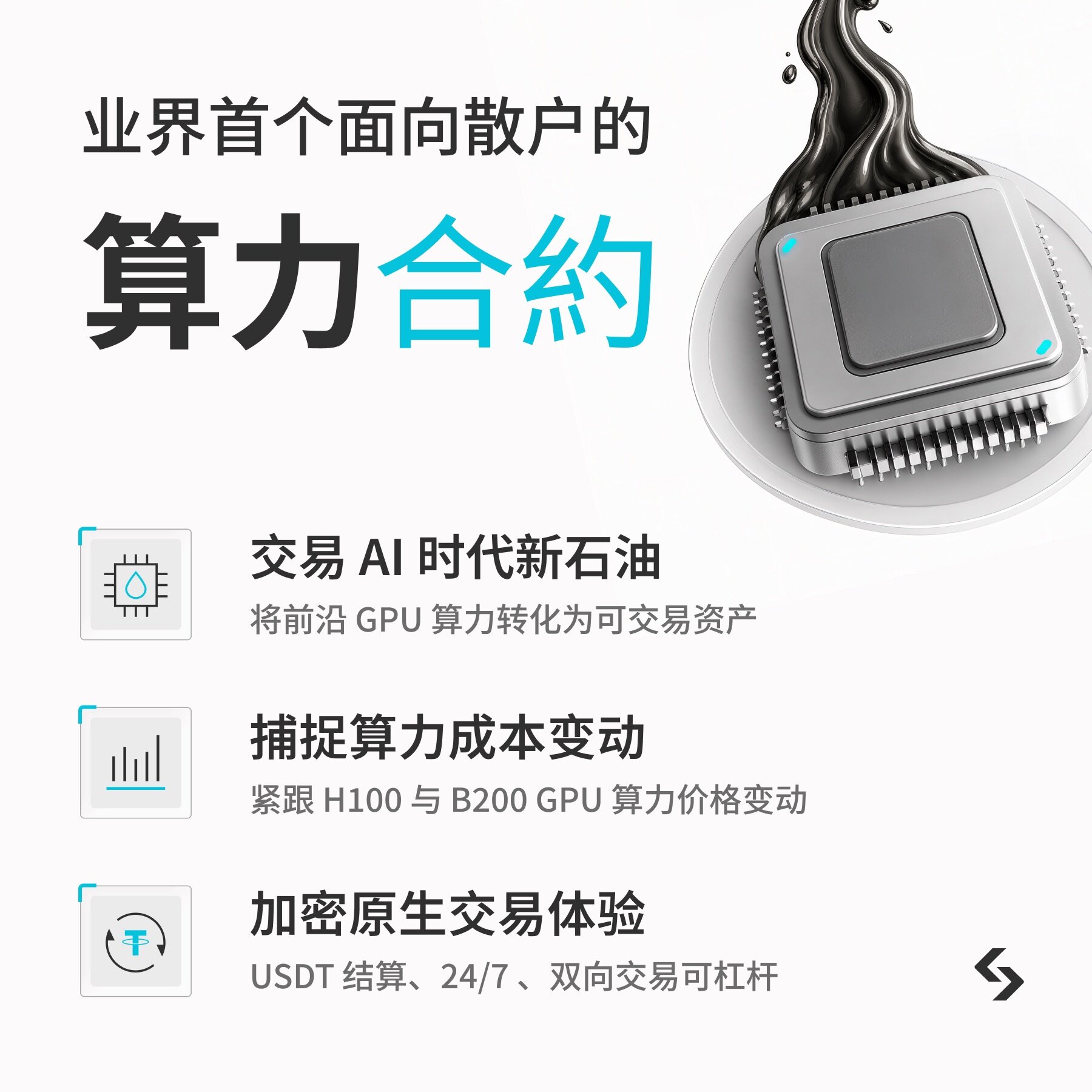
On September 8, 2026, Bitget officially launched the industry's first pre-market perpetual contracts for computing power aimed at retail users—H100 USDT and B200 USDT.
These two contracts are pegged to GPU rental price indices for NVIDIA H100 and the next-generation Blackwell B200 respectively, quoted in "USD per GPU hour." You don't need to buy any graphics cards or rent any servers—you can directly go long or short on global AI compute rental fluctuations, with up to 10x leverage, USDT settlement, and 7×24 hour trading.
What was previously a pricing game reserved for cloud providers, supercomputing centers, and major AI companies is now easily accessible to everyday traders. This isn't simply "another new contract listing"—it's the first true financialization of the core means of production in the AI era.
What Are the H100 / B200 Indices Actually Tracking?
Published by professional data firm Silicon Data, these two indices are currently the market's most recognized benchmarks for GPU rental prices:
- H100 Index: reflects the standardized average hourly rental cost of the H100, the current mainstream training and inference card
- B200 Index: reflects the standardized average hourly rental cost of NVIDIA's latest-generation Blackwell B200
Data is sourced from real quotes across multiple cloud service providers and computing power suppliers, with standardization applied to factors such as specifications, lease duration, and region. It aims to represent genuine market supply-demand dynamics rather than any single platform's internal pricing.
Trading these two contracts is essentially trading "whether global high-end computing power is expensive or not."
What Does Cash Settlement Mean?
Unlike many traditional commodity futures, computing power futures usepure cash settlement. Upon expiration or position closure, no one will ship a stack of graphics cards to your doorstep, nor will you be asked to take over servers in a data center. The system simply settles profit and loss in USDT based on the difference between the contract price and the index price. This means:
Lower barriers to entry, simpler operations, better liquidity, and a better fit for the crypto-native 7×24 hour trading environment. What you're truly trading is a "price view," not a "physical asset."
Compared to Oil and Crypto Futures, What Makes It Unique?
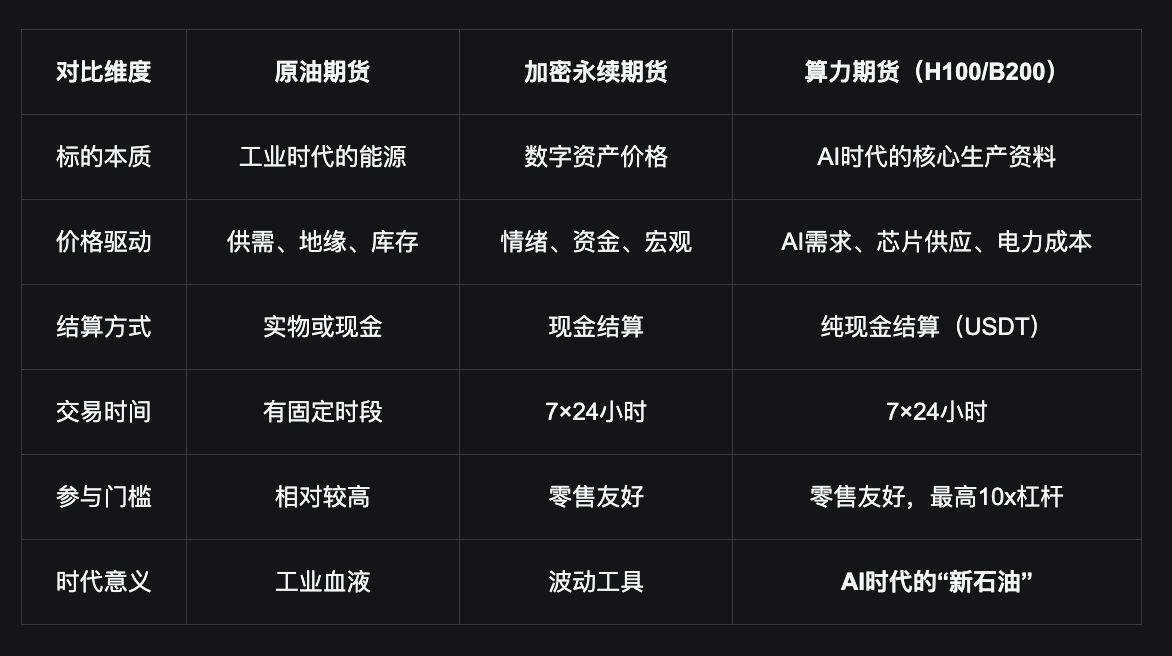
It combines the "infrastructure asset" quality of oil futures with the flexibility and efficiency of crypto perpetuals. In short: it lets ordinary traders directly participate in pricing the most fundamental cost layer of AI for the first time.
What Exactly Are You Trading with Computing Power Futures?
What you're trading:
- Expectations of global high-end GPU rental price movements
- Changes in AI computing power supply-demand dynamics
- Cash profit and loss settled in USDT
- Your judgment on "whether future computing power will be expensive"
What you're not trading:
- Physical H100 or B200 GPUs
- Data center racks or electricity
- Any physical assets requiring maintenance or delivery
- The delivery pressure of traditional futures
You're buying a view, not a machine.
FAQ
Q: Why should ordinary people pay attention to computing power futures?
Because AI has permeated nearly every industry. Rising computing costs ultimately pass through to AI service prices, tech company profits, and even related concept assets. Directly trading computing power prices is more precise than indirectly speculating on related narratives.
Q: How is this different from directly buying NVIDIA stock?
Stocks are influenced by valuation, earnings, and sentiment; computing power futures track GPU rental supply and demand more purely. The two are correlated but not perfectly synchronized.
Q: Is the risk high?
Leverage always carries risk. We recommend managing position sizes wisely and treating computing power futures as a tool for expressing your views, not as gambling.
Q: Will more related products emerge in the future?
Very likely. As the AI computing market continues to mature, more GPU models and longer-duration contracts are likely to appear. This is only the beginning.
Conclusion
From oil to computing power, humanity has always turned its most critical factors of production into tradable assets. Now that computing power has become the "new oil" of the AI era, those who participate in its price discovery early are often the first to see the direction of the trend.
With theH100 andB200 computing power perpetual contracts listed on Bitget, this opportunity has, for the first time, truly been placed in the hands of retail traders.