Walsh's Debut Reverses Expectations: In a Multi-Asset Era, Macro Factors Are an Unavoidable Exam for Web3 Players


- Core Thesis: Federal Reserve Chairman Walsh's debut sent hawkish signals, shifting market expectations from rate cuts to discussions of rate hikes, leading to declines in both stock and crypto markets. This event highlights the deep interconnection between crypto assets and global macro finance, requiring crypto investors to learn traditional financial knowledge to understand policy impacts.
- Key Elements:
- Following Walsh's first meeting, the dot plot showed 9 officials expect at least one rate hike this year, while 6 expect two or more – a complete reversal from the rate cut expectations just three months ago.
- Market reaction was severe: The Nasdaq fell over 1%, and Bitcoin dropped from above $65,000 to around $64,000, a decline of nearly 3%, reflecting the direct impact of macro policy on crypto assets.
- The correlation between crypto and traditional finance has significantly strengthened since the approval of Bitcoin spot ETFs in 2024. Institutional entry has integrated crypto assets into the global macro risk asset landscape.
- Crypto investors, lacking traditional financial fundamentals (such as the concepts of "hawkish" and "dovish"), often misjudge policy directions, leading to incorrect investment decisions.
- A clear industry education gap exists: Existing traditional finance learning resources are dense with jargon and have high barriers to entry, failing to meet the needs of investors from the on-chain world.
- Bitget, in collaboration with industry partners, has launched the "TradFi 101 Q&A," systematically explaining traditional finance through 100 specific questions in a short-video format to fill this gap.
Original author: Jessy
Warsh's debut signals a complete reversal of the Fed's stance
On June 17, Kevin Warsh chaired his first FOMC meeting as the new Chairman of the Federal Reserve.
In the meeting minutes from March, most officials were still betting on one or two rate cuts within the year. Many crypto investors had high hopes for Warsh, viewing him in the public eye as a Trump appointee who would likely push for accommodative monetary policy after taking office.
When the meeting concluded and the dot plot was released, the result was unexpected: among the 18 officials who submitted projections, 9 anticipated at least one rate hike within the year, with 6 of them expecting two or more hikes.
Just three months ago, the Fed was discussing "how many cuts". Yet for this debut by Warsh, the conversation turned to "how many hikes".
Warsh simply said, "Look at the data."
The three major U.S. stock indices collectively plunged, with the Nasdaq falling over 1%. The crypto market reacted even more sharply. Bitcoin, which had been rebounding above $65,000, immediately dropped to around $64,000 following the meeting outcome, a decline of nearly 3%.
Scrolling through various financial media analyses, some crypto investors tried to find explanations for "look at the data," only to fall deeper into the "terminology fog." A barrage of specialized jargon was thrown at them: one moment it was about CPI hitting new highs month-over-month and PPI pressures from the production side not fully transmitted; the next, it was about May's non-farm payrolls significantly exceeding expectations, with the previous two months' data requiring "upward revisions." What frustrated crypto investors most was the Fed's updated Summary of Economic Projections (SEP), filled with terms like PCE, core PCE, and shifts in the median dot plot…
Faced with dense professional interpretations, instead of gaining clarity, many felt a strong sense of helplessness. In the eyes of financial media, these data points are interwoven with clear causality. But for most people, these acronyms and their logical impacts resemble an entirely new language—each character is recognizable, but strung together, they fail to make any sense.
To truly understand this meeting, one seems to need a grasp of the entire TradFi (Traditional Finance) system—how inflation, interest rates, and the Fed's decision-making mechanism operate. Yet today, a crypto investor is forced, just like traditional financial market investors, to keep a close watch on Fed meetings, geopolitical situations, the U.S. dollar index, and the ebb and flow of global liquidity. After all, as the integration of crypto and traditional finance grows ever tighter, crypto is no longer an isolated island but a part of the global asset landscape, rising and falling with the U.S. dollar, U.S. Treasuries, and risk appetite.
In a Multi-Asset Era, Crypto Investors Need to Learn TradFi Even More
In earlier years, crypto market fluctuations were not closely tied to the tides of the global economy. In recent years, with the ICO boom and the prevalence of meme coins, crypto investors have been more accustomed to tracking on-chain capital flows, the buy-and-sell activities of whales, and following the latest industry technology hotspots to find investment targets.
Information that traditional financial investors need to monitor, such as Fed meetings, non-farm payroll data, and CPI, was not particularly important for crypto investors.
However, starting from 2024, the correlation between cryptocurrency price movements and the macro economy has become increasingly tight. In January of that year, the Bitcoin spot ETF was officially approved for listing in the U.S., followed six months later by the Ethereum spot ETF. For the first time, Wall Street money could openly and massively buy Bitcoin and other virtual currencies. After traditional asset management giants like BlackRock and Fidelity entered the scene, crypto assets, like stocks and bonds, were placed on the same balance sheet, rising and falling according to the same macro logic. As the bond between crypto and macro finance deepens, everyone has to start learning TradFi-related knowledge.
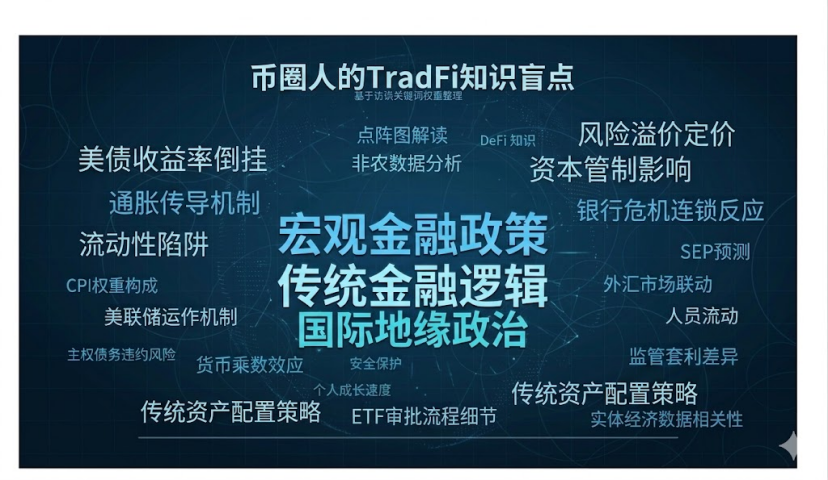
For most crypto traders, this is no easy task. For instance, before the June 17 meeting, many crypto players, unfamiliar with the terms "hawkish" and "dovish," automatically categorized Warsh as dovish—after all, he was a Trump nominee, presumably in favor of easing. But hawkishness and dovishness are not political stances; they reflect central bank officials' judgments on current data: high inflation leads to a preference for rate hikes to control prices (hawkish), while a weak economy leads to a preference for rate cuts to stimulate growth (dovish). When Warsh took office, inflation was at 4.2%, and he couldn't simply ignore the data. Misunderstanding a single term led to a flawed judgment.
Financial Education Should Be Simpler
If one wanted to learn the true meaning of relevant concepts discussed after the meeting, a quick search would yield either lengthy, thesis-like analyses or professional textbooks filled with a jumble of English acronyms. But what ordinary investors seek in learning materials is actually quite simple: an explanation in plain language of what something is and why it matters.
The barrier to entry for traditional financial education has always been high. Terminology is densely packed, and the expression style is academic, as if assuming the reader already possesses a certain financial foundation to qualify for further reading. However, for many transitioning from the on-chain world, what they precisely lack is the "foundation" shaped by traditional academic finance education.
Yet, the best education often stems from the simplest questions. For example, what is a stock? Why do companies go public? Why does gold rise when war breaks out? What does an interest rate cut actually mean? What exactly is an ETF? These questions may sound basic to the point of being "naive," but the process of learning new knowledge is precisely about understanding these "naive" questions first, before one can grasp more complex logic.
The author noticed an investor education series—"TradFi 101: 100 Questions Explained". Initiated by Bitget in collaboration with industry partners, its approach closely mirrors the "foundational" financial learning I had in mind.
Currently, TradFi is undoubtedly becoming more deeply intertwined with Crypto. Major exchanges have already listed RWA for traditional financial assets like U.S. stocks and gold. The barriers between crypto and traditional finance are rapidly dissolving, making cross-asset trading a clear development trend. However, most platforms in the industry focus solely on expanding trading categories and enriching product tracks, with few willing to address the most critical pain point for investors—the vast majority of native crypto players lack a complete and accessible knowledge base of traditional finance. Launching a systematic financial education initiative at this stage may not be a quick path to traffic or revenue, but it is a difficult yet correct thing to do.
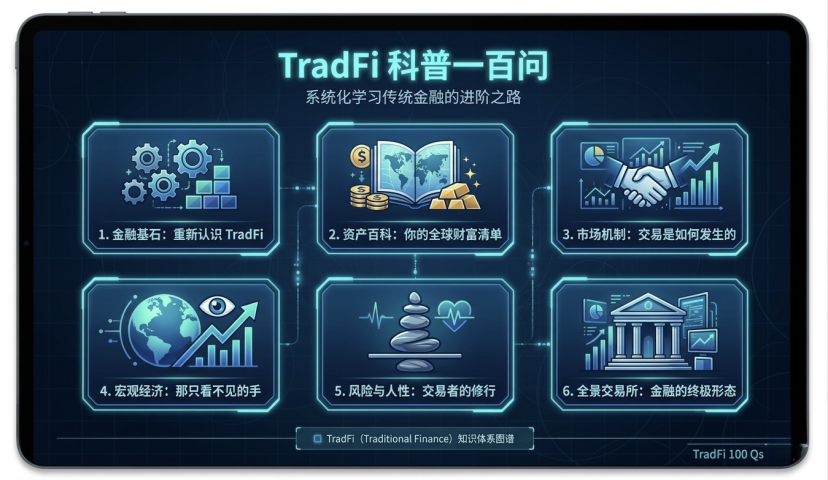
According to the official introduction, "TradFi 101: 100 Questions Explained" breaks down traditional finance learning into 100 specific small questions, grouped into six modules: starting from the most basic "Rediscovering Money and Markets," to "What Are Assets Like Stocks and ETFs," then "How Order Books, Leverage, and Market Makers Work," followed by macroeconomics, trading psychology, and finally depicting the deep integration of TradFi and Crypto. Accompanied by animated videos, it decomposes the content of a thick finance textbook into a series of lively short videos.
The crypto industry has long left behind its primitive era of only watching on-chain data. The institutional capital brought by ETFs and the real-world assets unlocked by RWA have fully placed Crypto within the global liquidity cycle. The future financial market will undoubtedly be bidirectional: traditional financial assets will move on-chain, and crypto assets will be included in the global major asset allocation list.
The boundary between TradFi and Crypto is becoming increasingly blurred. The ability to freely switch between them and understand each other's language will be the true advantage for the next generation of investors.