SpaceX Races Toward 10GW: The AI Compute War Is Entering Musk's "Comfort Zone"


- Core Thesis: The competitive paradigm in AI infrastructure is shifting from "how many GPUs you own" to "how many sellable tokens and how much revenue you can generate per MW of power." Leveraging extreme engineering and construction speed—where securing compute capacity early translates directly into massive economic value—SpaceX plans to approach 10GW of compute capacity by the end of 2027, potentially becoming one of the world's largest AI compute suppliers. At its core, this competition is an industrial war defined by time, power, and engineering capability.
- Key Elements:
- High-Value Inference Revenue Density: SemiAnalysis models show that at frontier model API inference pricing, OpenAI/Anthropic could generate over $100 billion in potential annual revenue per 1GW of compute, while leasing an equivalently sized GB300 cluster costs approximately $12 billion annually; the GB300 NVL72 carries potential revenue of roughly $99.7 million/MW/year, an improvement of about 36% over GB200.
- Shift in Compute Evaluation Metrics: Industry benchmarks are moving from GPU count and FLOPS toward tokens/sec, tokens/W, and tokens/MW, ultimately landing on Revenue/MW; NVIDIA's DSX platform has already adopted "token performance per MW" as a core metric for AI Factories.
- SpaceX's "Time" Business Model: Colossus 1 (~300MW) was built in 122 days; Colossus 2 (~200MW) took roughly 6 months; on-site power generation equipment at Southaven expanded from approximately 495MW in February to roughly 1.7GW by July; capitalizing on rapid delivery capability, SpaceX can charge a premium of $30–50 million/MW/year on a portion of its compute capacity.
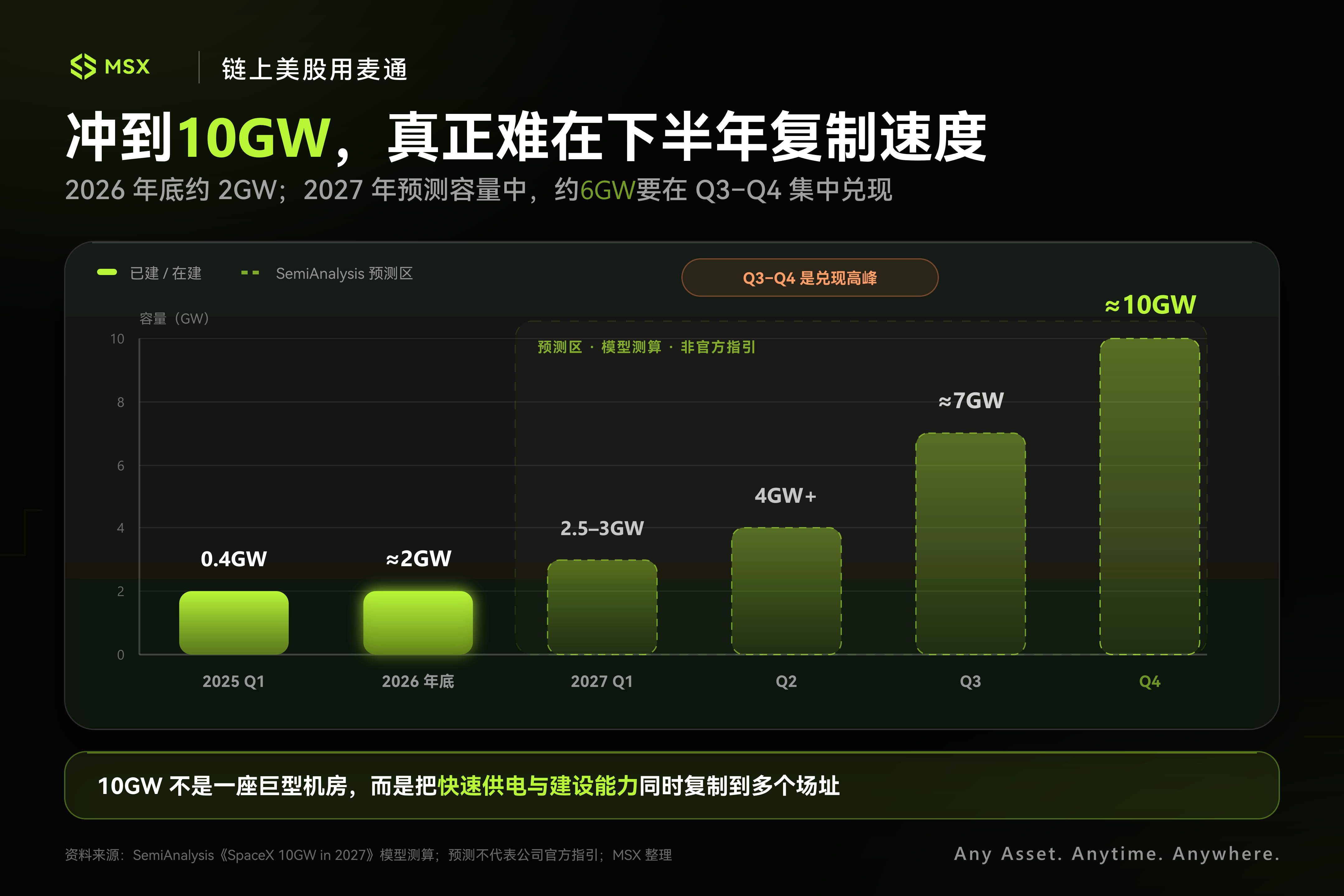
- SpaceX Expansion Path: Expected to reach approximately 2GW by the end of 2026 and approach 10GW by the end of 2027; simultaneously advancing three tracks—Retrofit upgrades, Greenfield builds (such as the MiniHard project reaching 450–500MW in ~5 months), and on-site natural gas power generation—to reduce dependence on traditional grid connectivity.
- Microsoft as the Largest Potential Offtaker: Under the new Microsoft-OpenAI agreement, OpenAI has committed to purchasing $250 billion in Azure services, with Microsoft retaining model licensing rights through 2032; SemiAnalysis estimates that revenue density in high-value inference scenarios (nearly $100 million/MW/year) is roughly 7x that of pure infrastructure leasing (~$14 million/MW/year), driving Microsoft to lock in over 10GW of new capacity for 2026 (approximately $300 billion in committed obligations).
- Microsoft Scenario Analysis: If Microsoft secures 3GW of compute from SpaceX and monetizes it at an efficiency of nearly $100 million/MW/year, it could theoretically correspond to roughly $300 billion in exit ARR, pushing Azure's growth rate into triple digits (Azure's current annual revenue has surpassed $100 billion, up 43% year-over-year); this is a model-based projection, not company guidance or a signed contract.
- NVIDIA Extends Into Capital: The report speculates that NVIDIA may support SpaceX through vendor financing; subsequently, on August 10, NVIDIA announced an AI compute financing platform exceeding $500 billion with institutions including Apollo and BlackRock—demonstrating that competition has expanded from chips to systems, construction solutions, and capital supply.
Original Report: SemiAnalysis "SpaceX 10GW in 2027 – Why It’s Real, Will Drive $300B ARR for SpaceX, and Why Microsoft Will Be the Largest Offtaker," August 7, 2026
Compiled and Organized: DaiDai, MSX Mattong
Editor: Frank, MSX Mattong
With the same 1GW of AI computing power, one business model might generate only tens of billions of dollars in annual revenue, while another could exceed $100 billion. What would that mean?
The answer could be a complete game-changer for the entire AI infrastructure industry.
Over the past two years, the market has been accustomed to measuring the AI arms race by GPU counts and training cluster sizes. Whoever holds more H100s and GB200s, and whoever operates larger training clusters, is considered to have stronger AI infrastructure.
But in its latest report, SemiAnalysis proposes a more radical framework, arguing that what will truly matter in the future will shift from how many GPUs you own to how many sellable tokens each megawatt of power can ultimately produce, and how much revenue that generates.
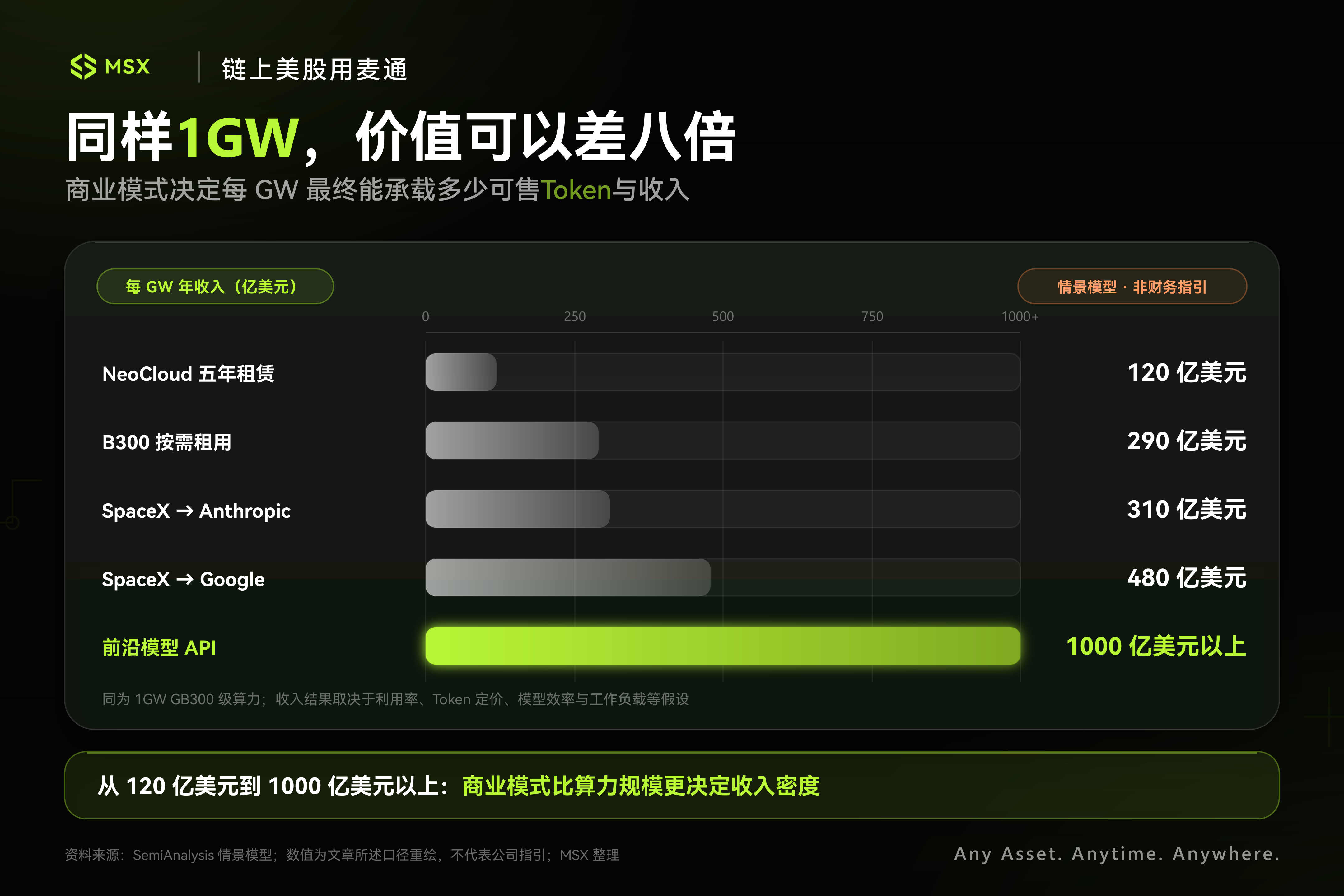
According to its Tokenomics Model and Inference Simulator, under specific assumptions for frontier models, GB300 clusters, real-world Agentic Coding workloads, and API pricing, OpenAI and Anthropic's potential annual revenue per 1GW of inference compute could exceed $100 billion. By comparison, the report estimates the annual cost of leasing an equivalent GB300 cluster at approximately $12 billion.
These numbers are extremely aggressive and highly dependent on model demand, token prices, utilization rates, latency requirements, and software/hardware efficiency. However, they explain an increasingly realistic question: why have all the tech giants suddenly begun scrambling for power with such intensity?
- In February of this year, SpaceX officially acquired xAI, bringing Grok, Colossus, and SpaceX's infrastructure capabilities under one roof.
- Six months later, Musk made a startling announcement during SpaceX's first earnings call: 6–8GW of new AI compute capacity would be built and delivered in 2027, with upside potential reaching 10GW.
- SemiAnalysis, meanwhile, projects that SpaceX's total compute capacity could approach 10GW by the end of 2027.
If this prediction holds, SpaceX's ambitions may extend far beyond building rockets, launching satellites, and selling Starlink — it aims to become one of the world's largest AI compute providers.
This also means that, as securing compute capacity months or even a year in advance begins to generate enormous economic value, the scarcity in AI infrastructure is shifting from a competition over chips to an industrial war over power, engineering, and time.
And compressing complex engineering to its limits is precisely the game Musk knows best.
1. From GPU to Revenue/MW: How Much Is 1GW of AI Compute Worth?
The most important contribution of SemiAnalysis's report is a fresh calculation of the Revenue/MW equation.
For the same GB300 cluster, if GPUs are merely rented out via the traditional NeoCloud model, the economic value remains primarily determined by equipment costs, depreciation, and lease pricing.
But if these GPUs ultimately serve the most advanced frontier models, selling inference tokens directly through APIs, Coding Agents, Copilots, and similar products, the revenue capacity per megawatt could be an entirely different order of magnitude.
SemiAnalysis calculates that when running frontier model API inference on GB300 clusters, the potential revenue for OpenAI and Anthropic can exceed $100 million per MW per year — that is, over $100 billion per GW per year.
This calculation is not a simple extrapolation based on theoretical GPU FLOPS. SemiAnalysis incorporates variables such as model architecture, memory bandwidth, serving configuration, throughput, TTFT, input tokens, cache reads, cache writes, and output tokens into its model, while also using the AgentX Trace derived from real Agentic Coding workloads.
This signals a clear shift in how AI infrastructure is evaluated.
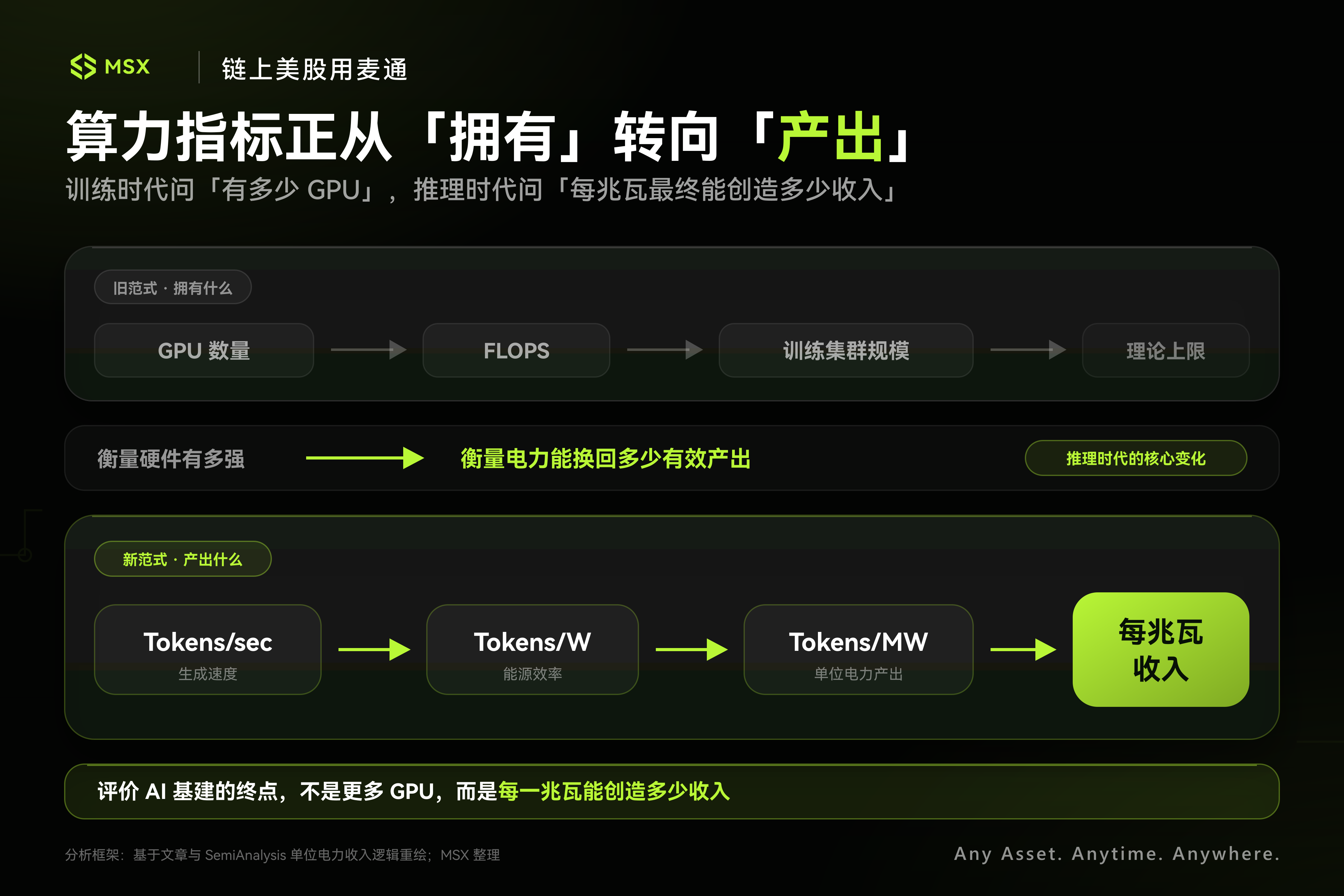
In the early days, the market compared GPU counts, then FLOPS and training cluster scale. In the era of大规模推理, the more critical metrics may gradually become tokens/sec, tokens/W, tokens/$, tokens/MW, and ultimately Revenue/MW.
This is also why the significance of GB300 goes beyond simply being "faster than GB200."
According to the report's model, in the same Fable 5 inference scenario, the GB200 NVL72 corresponds to approximately $73.4 million per MW per year in potential revenue, while the GB300 NVL72 can increase this to approximately $99.7 million. This means that the real value created by next-generation hardware lies in producing more high-value tokens within the same power budget.
NVIDIA itself is redefining AI infrastructure with similar language.
The DSX platform released in May of this year has already established "token performance per megawatt" as one of the core metrics for AI Factories, extending from chips, networking, and software to power, cooling, and data center operations.
As inference demand expands from ordinary chat to Agentic Coding, AI Workers, multi-agent collaboration, and continuously running tasks, this shift will become even more pronounced.
Training typically has well-defined phases and cycles, whereas inference demand more closely resembles "number of users × number of agents × token consumption per task × runtime." Once agents move from "answering questions" to "working continuously," the ceiling on token consumption is reopened.
From this perspective, the most important variable to watch in the next phase of the AI compute war may no longer be how large training clusters can become, but rather how many tokens these compute resources can ultimately produce that users are willing to pay for.
2. What SpaceX Is Selling Isn't GPUs — It's Time
The question then arises: if frontier inference truly commands such high Revenue/MW, why don't OpenAI, Microsoft, and Google simply build out all their own data centers?
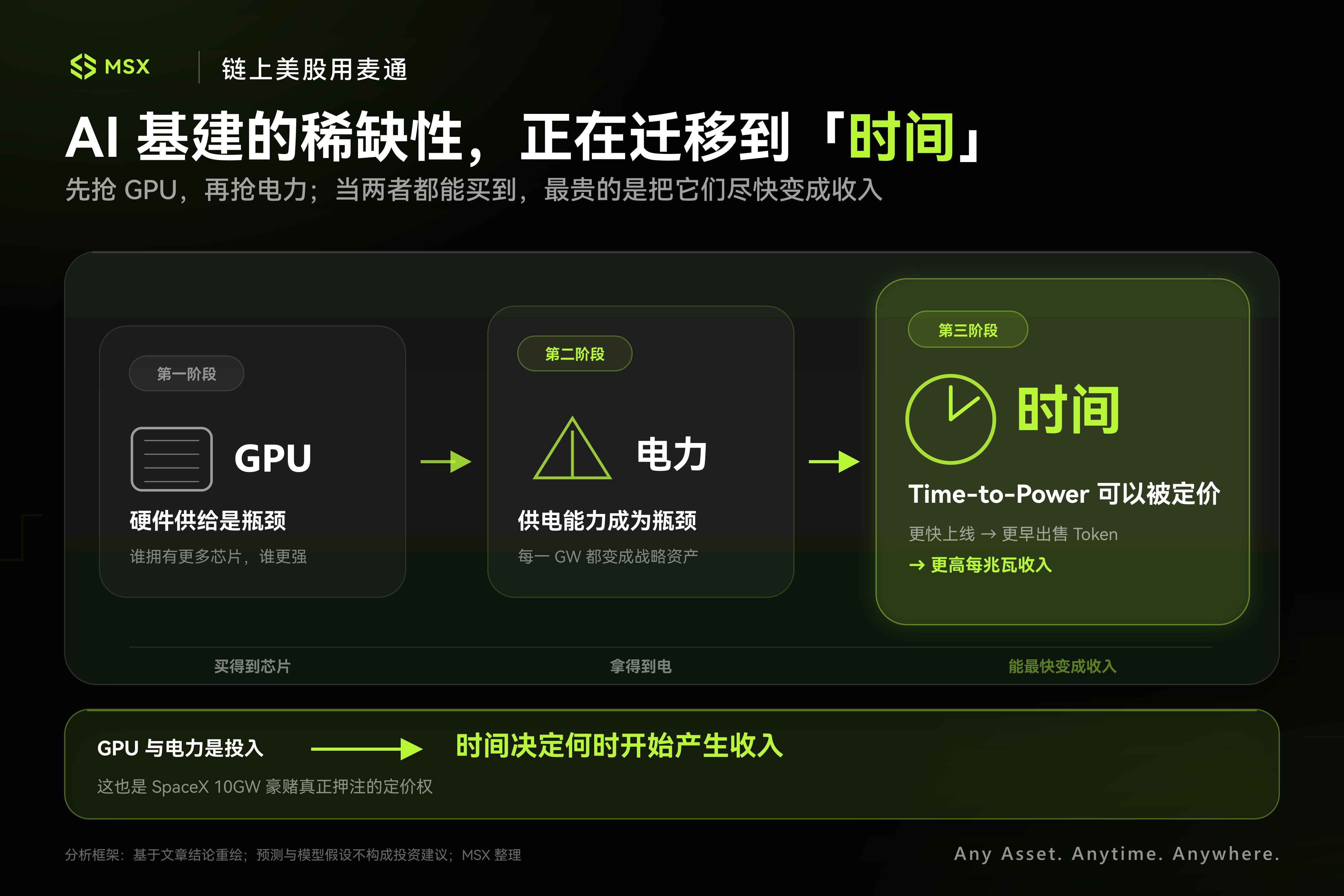
Because GPUs can be bought with money, but power and time are not so easily acquired.
Large-scale AI data centers — from land acquisition and grid interconnection to substations, transmission infrastructure, equipment delivery, and final deployment — are becoming increasingly lengthy infrastructure projects.
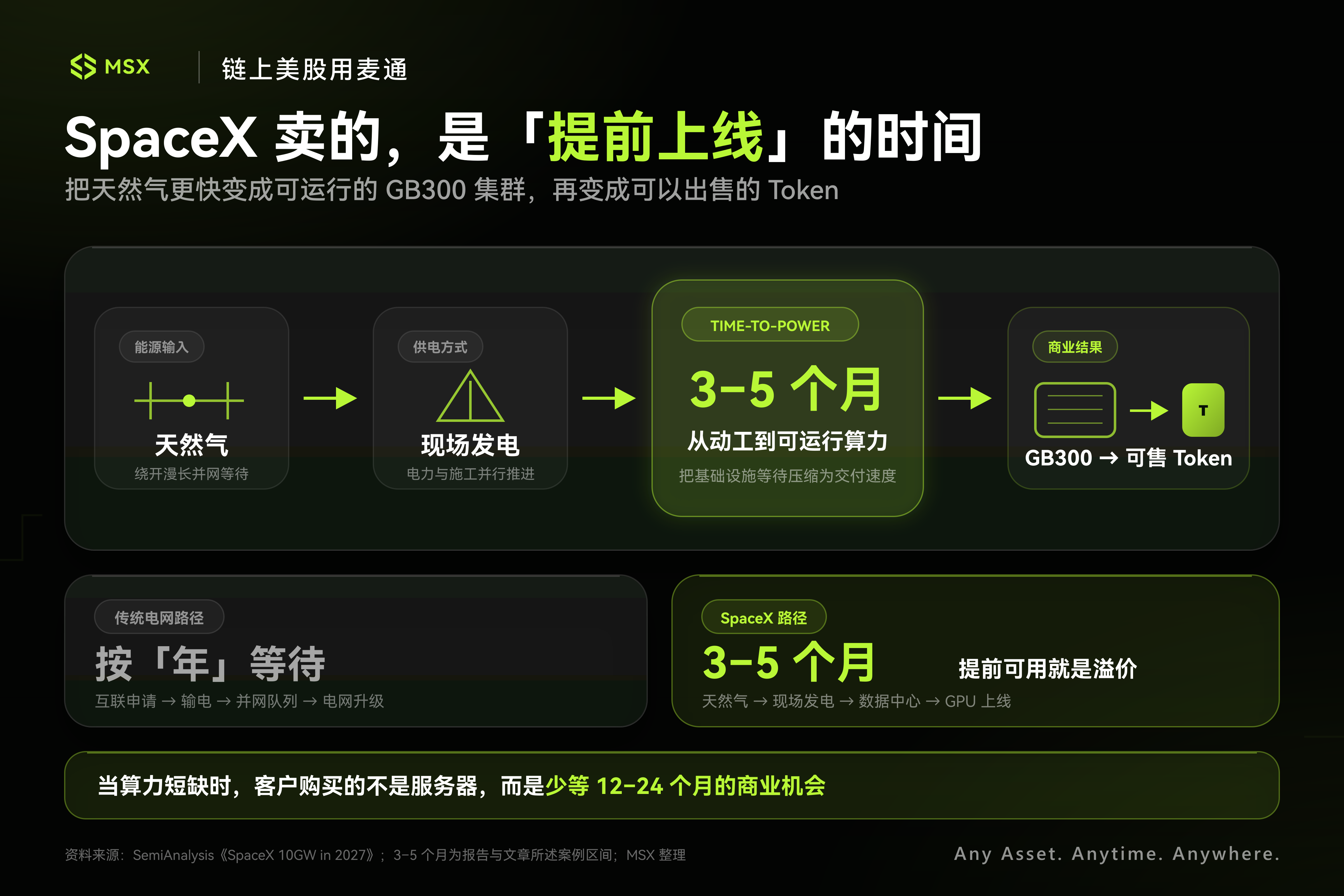
And what SpaceX/xAI has truly demonstrated over the past two years is not the ability to build GPUs that others don't have, but rather the ability to compress all these stages to the extreme — for instance, according to SemiAnalysis's tracking, Colossus 1 delivered approximately 300MW of compute in 122 days, while Colossus 2's approximately 200MW took about six months.
Even more striking is the power side. According to SemiAnalysis's tracking of the Southaven project, on-site power generation equipment expanded from 27 turbines at approximately 495MW in February 2026 to 69 turbines at approximately 1.7GW by July. Another project, MiniHard, which follows a closer Greenfield model, is projected by the report to reach 450–500MW in about five months from the start of vertical construction in March.
This is precisely what makes SpaceX's current expansion worth watching.
Colossus initially relied heavily on Retrofit, rapidly converting old industrial buildings into AI data centers. MiniHard is beginning to validate the Greenfield new-build model. Combined with On-site Generation, SpaceX is attempting to run all three paths simultaneously.
On-site natural gas power generation is particularly notable. If SpaceX were to fully wait for traditional public utility grids to complete Transmission, Interconnection, and Utility Upgrades, multi-GW projects would struggle to come online at the speed Musk desires.
Therefore, SemiAnalysis concludes that to achieve several GW of new capacity by 2027, SpaceX must rely heavily on on-site natural gas power generation, reducing its dependence on traditional grid interconnection timelines.
This gives rise to a new business model: What SpaceX is selling is not just GPUs, but compute capacity that others would have to wait a year or two for, delivered in a matter of months.
SemiAnalysis estimates that this scarcity of "massive scale + near-term availability" could allow SpaceX to charge $30–50 million per MW per year for some of its compute, highlighting the key difference between Value-Based Pricing and traditional Cost Plus Pricing: customers aren't paying for what a server should cost, but for the commercial value that "securing compute early" can generate.
As a result, Time-to-Power is becoming a competitive metric as important as GPU performance.
SemiAnalysis projects SpaceX's compute capacity to reach approximately 2GW by the end of 2026, accelerate significantly through 2027, and approach 10GW by year-end.
Overall, the key thing to watch in 2027 is whether SpaceX can replicate the "speed" it has already demonstrated once, and turn it into industrial-scale capability.
3. Who Will Pay for "Time": Microsoft, NVIDIA, and the New AI Infrastructure War
If SpaceX can truly deliver multiple GW of compute quickly, the next question is: who will buy it?
SemiAnalysis's answer is unequivocal: Microsoft. This is also the most important implication of the report for public company investment:
- Under the new agreement signed between Microsoft and OpenAI in 2025, OpenAI made an additional commitment to purchase $250 billion in Azure services.
- Entering 2026, the two parties further adjusted their partnership. According to Microsoft's April disclosure, Microsoft will no longer pay Revenue Share to OpenAI, but OpenAI's Revenue Share payments to Microsoft will continue at the original rates through 2030, with an aggregate cap.
- Meanwhile, Microsoft's license to OpenAI's models and product IP has been extended to 2032.
This presents Microsoft with a very interesting dilemma.
It can either provide data center capacity to OpenAI as infrastructure, or leverage its access to OpenAI's models to embed that compute into products like Azure Foundry, Copilot, APIs, and Agent offerings.
SemiAnalysis estimates that the former model corresponds to only about $14 million per MW per year in revenue, while the latter, high-value inference scenario could theoretically approach $100 million per MW per year.
If this holds, the nearly seven-fold gap in revenue density between the two models is precisely why SemiAnalysis believes Microsoft will aggressively scramble for compute again.
According to its Datacenter Model tracking of leases, self-built facilities, NeoCloud contracts, PPAs, and ESAs, Microsoft has already secured over 10GW of new capacity so far in 2026, corresponding to over $300 billion in Binding Commitments (though it's worth noting that this figure comes from SemiAnalysis's model estimates, not official Microsoft disclosures).
The more critical issue is that much of this capacity won't be operational until late 2027 or even 2028.
At the end of the day, what Microsoft lacks isn't long-term planning — it's large-scale compute that can go online right now.
Therefore, SemiAnalysis goes further and runs an extremely aggressive scenario: if Microsoft were to secure 3GW of compute from SpaceX and monetize it at an efficiency approaching $100 million per MW per year, it could theoretically correspond to approximately $300 billion in Exit ARR, potentially pushing Azure growth into triple-digit territory.
It's important to emphasize that this is not Microsoft guidance, nor is it a signed SpaceX contract. Rather, it's a scenario model SemiAnalysis uses to illustrate the revenue elasticity of incremental compute. Microsoft's latest FY2026 Q4 results show Azure and other cloud services revenue growing 43% year-over-year, with Azure's full-year revenue surpassing $100 billion for the first time.
But the questions this model raises are still worth the market's reconsideration: When evaluating Microsoft's AI CapEx, one may no longer just ask "how much money was spent," but also "how much revenue can each MW generate once it goes online."
NVIDIA represents another dimension of change.
SemiAnalysis suggests NVIDIA could use Vendor Financing to help SpaceX alleviate the substantial upfront cash pressure of its massive capital expenditures. Currently, there is no public information confirming that NVIDIA has implemented such financing for SpaceX, so this is better understood as a projection within the report.
However, on August 10, following the report's release, NVIDIA promptly announced the establishment of AI Compute Infrastructure Financing Platforms with Apollo, BlackRock, Blackstone, Brookfield, Goldman Sachs, and KKR, planning to mobilize over $500 billion in third-party capital over the long term and establish dedicated financing pools for NVIDIA customers.
This at least demonstrates a larger trend: NVIDIA is extending its capabilities from GPUs, CUDA, Networking, and Rack-scale Systems further into AI Factory design, construction, and even capital layers.
For AI data centers requiring hundreds of billions of dollars in capital expenditure, what determines which technical roadmap a customer adopts may no longer be just "which GPU is faster." Whoever can simultaneously provide chips, networking, systems, software, construction solutions, and cheaper, more abundant capital will be better positioned to lock in the next round of AI infrastructure buildout.
Thus, the AI compute war is increasingly resembling an industrial war.
The competition radiates outward from GPUs: beyond chips lie networking and storage; beyond networking lie cooling and power; beyond power lie natural gas, turbines, land, and capital. Ultimately, everything converges on a single metric — who can turn one megawatt of electricity into tokens that generate sustained revenue at the lowest time cost.
A Final Note
SemiAnalysis's projections for SpaceX are undoubtedly aggressive.
10GW, $300 billion-level ARR, Microsoft's 3GW offtake, and over $100 million per MW per year in inference revenue all rest on a series of high-growth assumptions.
If any single link — agent demand, API pricing, GPU utilization, construction speed, power supply, or even financing conditions — falls short of expectations, the final outcomes could deviate dramatically from the model.
Therefore, what truly deserves attention in this report isn't whether SpaceX will reach 8GW, 10GW, or some other number by the end of 2027. Rather, it reveals a paradigm shift in AI infrastructure competition that is already underway:
The market once fought over GPUs, then over power. Now, when all the tech giants are willing to build power plants, sign PPAs, and purchase natural gas and turbines, the hardest resource to acquire will ultimately become "time."
Getting 1GW of power a year early versus getting the same 1GW a year later might have been merely a difference in construction progress in the traditional data center era. But in a world where 1GW of frontier inference compute could theoretically correspond to hundreds of billions of dollars in annual revenue, it represents a completely different level of economic value.
This also imbues the engineering capability Musk has repeatedly demonstrated with new significance.
If this logic holds, then SpaceX's "10GW bet" was never really about 10GW itself. It's about converting engineering speed into commercial pricing power.
And in this war over time, Musk may well possess the most difficult advantage to replicate.