






Intel CEO Lip-Bu Tan's Latest Interview: After Missing Mobile, Cloud, and AI, the Next Wave Cannot Be Missed Again


- Key Takeaways: Intel CEO Lip-Bu Tan believes that competition in AI hardware has shifted from single-point chip performance battles to system-level competition determined collectively by compute, memory, interconnect, packaging, manufacturing, and organizational capabilities. Intel needs to rebuild through vertical integration and platform capability, while also repairing the organization's ability to perceive and respond to external innovation, ensuring it does not miss the next wave of technology.
- Key Elements:
- Semiconductor value is returning to the technology foundation. AI has turned compute, power, and bandwidth into direct constraints on application expansion, making hardware the core infrastructure that determines model costs and commercialization boundaries, triggering a repricing of capital.
- The bottleneck in AI competition has spilled over from GPUs to full-stack systems including CPUs, memory, high-speed interconnect, advanced packaging, and cooling; air cooling is shifting to liquid cooling, electrical interconnects to photonic technology, and traditional packaging to glass substrates—cluster efficiency requires systematic, coordinated solutions.
- The core value of Intel's vertical integration model (products + advanced packaging + wafer foundry) lies in cross-layer collaborative optimization of customer workloads; however, this presupposes simultaneous improvement in product competitiveness and manufacturing execution—otherwise, it may amplify cost risks.
- AI is shifting from training to inference and agent-based applications, redefining the relationship between CPU and memory; general-purpose computing demand has not disappeared, and memory bandwidth and power consumption have become key constraints on system performance. Intel is exploring CPU-memory stacking and novel memory architectures.
- Lip-Bu Tan is bringing Cadence's transformation experience (humility, listening, rapid response, elevating customer relationships from vendor to partner) into Intel as a key method for repairing the organization's ability to absorb external information and make fast decisions.
Video Title: Intel CEO Lip-Bu Tan on the Comeback of American Chip Industry
Video Author: TechSurge: Deep Tech VC Podcast
Compiled by: Peggy, BlockBeats
Editor's Note: Against the backdrop of generative AI driving a new wave of compute investment, industry discussions are shifting from "who has the most powerful chip" to "who can organize a more complete computing system." As GPU demand, advanced process nodes, and data center capex have become consensus, a more fundamental question is emerging: What determines the efficiency of next-stage AI infrastructure—the performance of a single chip, or the synergy between compute, memory, interconnect, packaging, and manufacturing?
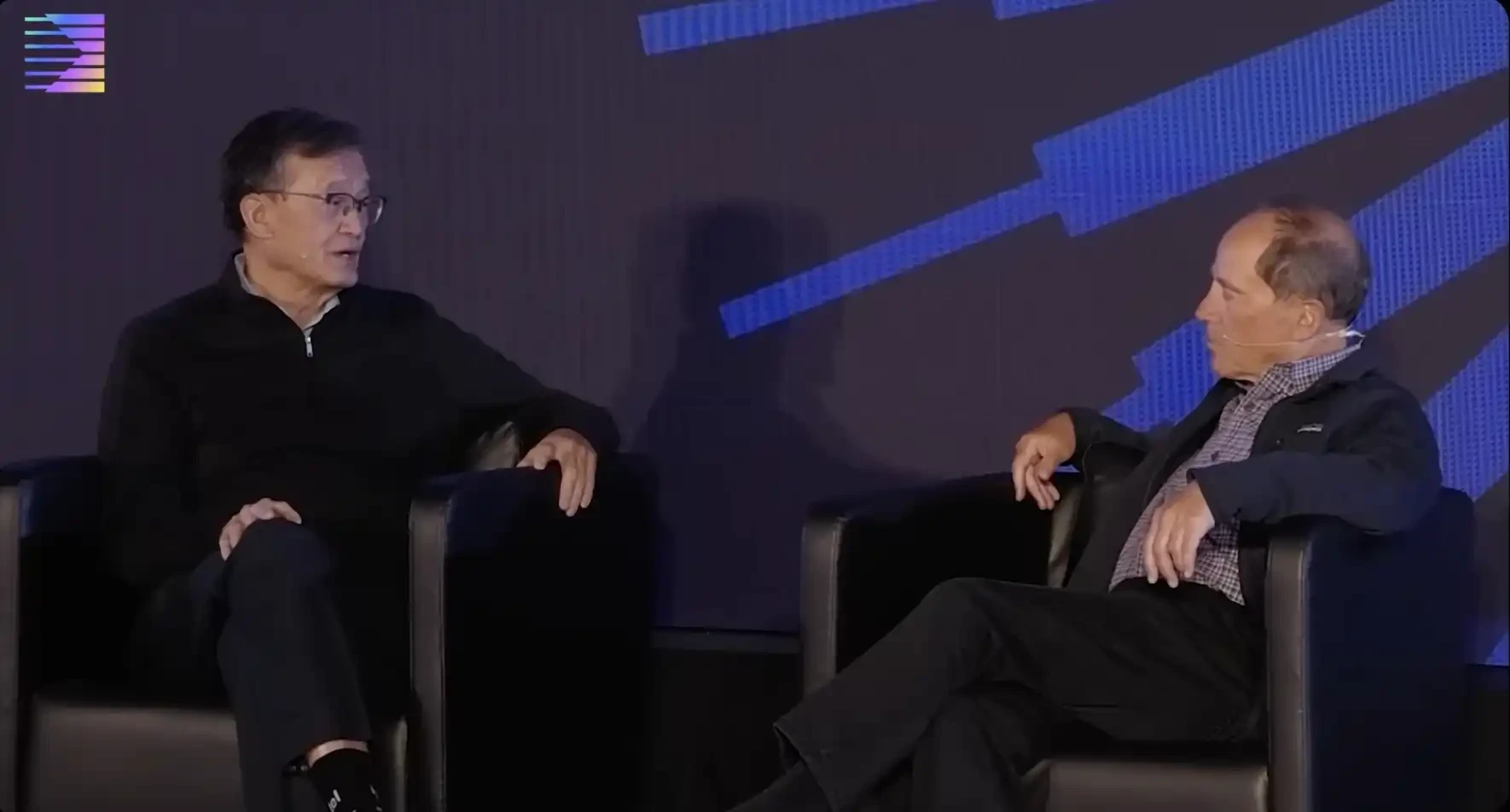
On the Tech Surge podcast by Celesta Capital, host Michael Marks sat down with Intel CEO Lip-Bu Tan. The conversation spanned his early semiconductor investment experiences, the transformation of Cadence, and Intel's product, manufacturing, and platform strategy in the AI era.
In this conversation, Tan does not simply offer a product roadmap for Intel's recovery. Instead, he breaks down semiconductor competition into a set of more fundamental structural questions: Why has hardware re-emerged as a capital focus? How are AI bottlenecks spilling beyond chips into infrastructure? Can vertical integration recreate system-level value? And how can a large company that has missed multiple technology migrations regain its ability to sense frontier shifts?
First, the value of semiconductors is returning from single products to the technology foundation. Over the past 20 years, software commanded higher valuations and more venture capital, while semiconductors—due to long R&D cycles, heavy capital requirements, and limited exit paths—were once considered unsuitable for venture investing. Today, AI has turned compute, power, and bandwidth into direct constraints on application scaling. Chips are no longer just vehicles for running software; they are the infrastructure that determines model costs and commercialization boundaries. This means hardware's return is not merely a valuation rotation, but a repricing of capital driven by shifts in technological bottlenecks.
Second, AI competition is expanding from single accelerators to systems engineering. The previous round of AI investment centered primarily on GPUs and model training. But as workloads shift toward inference, agents, and physical AI, bottlenecks are spilling over into CPUs, memory, high-speed interconnect, advanced packaging, and cooling. The transition from air cooling to liquid cooling and even microfluidic cooling, from electrical interconnect to photonics, and from traditional packaging to glass substrates and new materials all reflect the same change: cluster efficiency can no longer be solved by improving single-chip performance alone. This also means that the next round of hardware value may not be concentrated solely in top GPU companies, but distributed across the weak links of the entire computing system.
Third, the key to Intel's commitment to vertical integration lies not in how many businesses it retains, but in whether it can reorganize dispersed capabilities into a platform. In the past, the separation of design and manufacturing drove the rise of the fabless model and specialized foundries. Intel's simultaneous operation of both products and wafer foundry added organizational and capital allocation complexity. Tan still emphasizes the combination of CPU, GPU, software, advanced packaging, and wafer foundry because product optimization in the AI era increasingly depends on cross-layer collaboration. The potential value is not just in-house manufacturing, but in co-optimizing architecture, packaging, and process according to customer workloads. The corresponding risk is that if product competitiveness and manufacturing execution cannot both improve, vertical integration may continue to amplify costs.
Fourth, the relationship between CPU and memory is being redefined by AI. Historically, CPUs were Intel's most stable core business, while memory was viewed more as a cyclical commodity with volatile prices. As AI moves from training to inference, general-purpose compute demand has not disappeared—CPUs still need to handle data processing, task scheduling, and agent execution. Meanwhile, memory bandwidth, capacity, and power consumption have become critical constraints on system performance. Tan's mention of CPU-memory stacking and new memory architectures may not signal Intel's return to the traditional memory market, but rather that compute and memory need to be re-coordinated at the architecture and packaging levels.
Fifth, what Intel truly needs to fix may not be a specific product generation, but its ability to absorb external information and respond quickly. The management approach Tan established at Cadence was to listen directly to employees and customers, transforming the company's relationship with clients from "supplier" to "partner" sharing a common roadmap. For Intel, reconnecting with customers, universities, AI labs, venture capital firms, and startups is likewise about repairing this sensing capability. When a large tech company misses a technology wave, it is usually not because it fails to see the new direction entirely, but because external changes cannot be converted quickly enough into internal resource allocation and product decisions.
If this conversation could be compressed into one judgment, it would be this: AI hardware competition has shifted from single-point performance races to system-level competition determined collectively by compute, memory, interconnect, packaging, manufacturing, and organizational capability. In this sense, the subject of this article is no longer just whether Intel can complete a corporate transformation, but whether a traditional chip giant can rebuild its capacity to participate in the next generation of computing platforms.
The following is the original content (slightly edited for readability):
TL;DR
Lip-Bu Tan believes semiconductors have re-emerged as the core of the tech industry, and AI competition has expanded from individual chips to the full stack of packaging, memory, interconnect, cooling, and software.
He brings his Cadence transformation playbook to Intel: stay humble, listen to customers, respond quickly, and upgrade customer relationships from "supplier" to "partner."
Intel will maintain its vertically integrated model combining product design, advanced packaging, and wafer foundry, delivering greater value to customers through platform-level capabilities.
CPUs remain central to Intel's competitiveness rebuilding, with agentic AI, inference, edge computing, and physical AI potentially driving a new wave of demand.
Tan revealed that Intel is researching CPU-memory stacking and new memory architectures, but is not yet ready to announce specific plans.
After missing the mobile internet, cloud computing, and AI waves, Intel will reconnect with universities, venture capital firms, and startups to avoid falling out of sync with frontier innovation again.
Interview Highlights
Global semiconductor sales are approaching $1 trillion ahead of schedule.
In a conversation on Celesta Capital's Tech Surge podcast, Intel CEO Lip-Bu Tan said AI is making hardware the core of the tech industry once again. But this opportunity is no longer limited to GPUs—it extends to CPUs, memory, advanced packaging, high-speed interconnect, photonics, and cooling systems.
For Intel, this is not just another product cycle but a rebuilding of platform capabilities.
Tan candidly acknowledged that Intel missed major waves including mobile internet, cloud computing, and AI. His self-imposed goal now: "Going forward, I'm not going to miss any major wave."
Semiconductors: From "Sunset Industry" Back to the Center of AI Competition
Tan has been investing in chips since 1987, with cumulative investments in nearly 550 companies. But for a long time, semiconductors were not a favored sector for venture capital firms.
He recalled that when visiting top VC firms 20 years ago, the entire partner team would often show up at the start of a meeting. But once he started talking about semiconductors, half of them would politely make excuses to leave, leaving only a few who would continue listening "out of sympathy."
At the end of the meeting, they would typically ask him: "Do you have any software or services startups in your portfolio?"
At the time, mainstream VCs viewed semiconductors as a sunset industry, with capital continuously shifting toward software and internet services. Even some of Tan's own investors thought his continued doubling-down on chips while others were exiting was bordering on madness.
But Tan believed chips were always the foundational layer of the tech industry. Without chips and platforms offering the right performance, power, and cost, many upper-layer applications simply could not exist.
This conviction also led him to remain a contrarian investor.
He mentioned that a co-investor once challenged him: "Can you name a semiconductor company with a market cap above $1 trillion?" Today, that question no longer holds, because semiconductor companies have already appeared among the world's most valuable tech firms.
But Tan's attention is not limited to giants like Nvidia. In his view, semiconductors constitute a vast technology system, and many key innovations come from small, overlooked companies: some are reducing Chiplet energy consumption, others are solving high-speed interconnect problems, and still others are betting on photonics, advanced packaging, and new cooling materials.
Real investment opportunities often lie in these underappreciated bottlenecks.
Investing in SambaNova: AI Inference Cannot Rely Solely on High-Power GPUs
His assessment of AI hardware is a microcosm of Tan's investment approach.
Having invested early in graphics chip companies like S3, he recognized the high power consumption problem of GPUs early on. He also judged that as AI moved from model training to real-world deployment, the market for inference and agentic AI could be far larger than the training market.
Around nine to ten years ago, he backed two different computing architecture paths based on this view.
The first was Cerebras' wafer-scale chip solution. Tan believed the technology was extremely difficult to execute, but the problem founder Andrew Feldman was trying to solve deserved support, so he invested starting from Series A.
The second was SambaNova's RDU—the Reconfigurable Dataflow Unit. Its dataflow architecture sought to reduce power consumption while maintaining compute performance, offering an alternative path for AI computing beyond GPUs.
In 2017, with Tan's push, Celesta made its first $2 million investment in SambaNova, at a company valuation of approximately $12 million. He subsequently participated in multiple SambaNova funding rounds and helped bring in new investors.
Tan said SambaNova is now advancing a Series F round, with expected funding between $800 million and $1 billion. He was referring to the financing amount, not the company's valuation.
He emphasized that investing in startups cannot rely solely on betting on a single founder—you need to find a complete team capable of continuously adjusting direction. Because markets change, roughly nine out of ten companies he invests in will alter their original business plans during development.
What truly deserves long-term support is a team that can adapt to change, build the right culture, and ultimately create a world-class company.
Transforming Cadence: Turning Suppliers into Customer Partners
When Tan took over Cadence, the stock price had fallen to around $2.42.
He initially agreed to serve only three months as interim CEO while the company searched for a permanent leader. But those three months ultimately became 15 years. During that period, Cadence completed a transformation of both corporate culture and product strategy, and the stock rose significantly from its low.
Tan distills the core of this experience into three words: humility, listening, and responsiveness.
Shortly after becoming CEO, he told employees at an all-hands meeting: "This is my first time as CEO. If you have any good ideas, feel free to send them to me." From then on, he received roughly 300 emails per day and replied to each one personally. For suggestions worth exploring further, he would walk directly to the employee's desk to discuss.
This approach helped him uncover information silos within the company and allowed management to once again hear real feedback from the product front lines.
Customer relationships also needed to change. Tan recalled that some Cadence customers were furious at the time, demanding refunds and explicitly stating they no longer wanted to use the company's products. Other customers complained that when they reported product issues, no one responded—until contract renewal approached, and the company's team would suddenly appear.
Tan therefore pushed Cadence to establish a rapid response mechanism. Later, one customer told him that within less than 24 hours of filing a complaint, someone had already arrived at their office to resolve the issue.
One of Cadence's main competitors once told him: "The same customer treats me as a supplier, but treats you as a partner."
In Tan's view, this captures the key difference between the two types of relationships. Only after a customer regards a company as a partner will they share product roadmaps and real needs. The company can then combine feedback from other customers to offer more valuable advice.
He is now bringing this approach to Intel, though Intel's business is far more complex: the company must rebuild product competitiveness while also driving its foundry business to success.
Intel Isn't Just Making Chips—It's Rebuilding a Computing Platform
When asked why Intel should still handle chip design, manufacturing, and sales simultaneously, Tan's answer is that combining products, advanced packaging, and wafer foundry creates greater value for customers.
In theory, Intel could move further toward an outsourced model and stop manufacturing chips itself. But Tan still believes in vertical integration because future computing competition is no longer just a comparison between individual chips—it's about the coordination of the entire system.
However, this path only works if Intel first has sufficiently competitive products.
Tan acknowledged that Intel once held an extremely strong market position in CPUs and computing, but made many mistakes over the years and gradually lost some of that advantage. Rebuilding Intel requires re-attracting top CPU architects, GPU architects, system architects, and software talent to build full-stack capabilities from chip to system to software.
CPU remains the core of this strategy.
As AI moves from training to inference and further into agentic AI, demand for general-purpose CPUs may increase again. Tan said he now frequently receives calls from CEOs of other companies asking Intel to supply more CPUs. Intel needs to increase supply on one front while also developing new CPU architectures to meet future workload requirements.
This wave of demand extends beyond traditional servers and data centers to PCs, edge computing, and physical AI. Intel also needs tighter connections to frontier research institutions, AI labs, and the software development ecosystem, driving chip and system design backward from real application needs.
AI Bottlenecks Spill Over: Interconnect, Packaging, and Cooling All Need Reworking
Tan believes that as AI computing scales up, bottlenecks are spreading from the chip itself to the surrounding infrastructure.
First is high-speed interconnect. As AI clusters grow larger, single-chip performance can no longer determine overall efficiency—data transfer between chips, servers, and racks becomes more critical.
Based on this judgment, he invested in companies like Credo Semiconductor and Astera Labs, and also positioned in photonic interconnect. Some related companies were later acquired by Marvell, Credo, and others.
Second is cooling. As CPU and other AI chip power consumption continues to rise, cooling approaches are moving from air cooling to liquid cooling, and further into microfluidic cooling.
Advanced packaging follows the same logic. Intel already has packaging technologies like EMIB-T, and Tan is also paying attention to new materials such as glass substrates and synthetic diamond to improve packaging, insulation, and heat dissipation for high-performance chips.
These technologies do not all need to become separate in-house businesses at Intel.
Tan's approach is that technologies developable internally will be pursued by Intel itself; those unsuitable for internal development can first support external startups' growth, and later be brought into Intel's platform through collaboration, integration, or acquisition.
What Intel needs to build is not a set of scattered products, but a larger platform covering compute, interconnect, packaging, and manufacturing.
Returning to Memory? Intel Exploring CPU-Memory Synergy
Intel was founded in 1968 and originally started in the memory chip business, not microprocessors.
When asked whether Intel might re-enter the memory market, Tan did not announce a specific plan, but released a noteworthy signal: Intel is researching CPU-memory stacking and new memory architectures.
In the past, he did not like investing in memory chips because traditional memory products had strong cyclical and commodity characteristics. But as AI computing imposes new requirements on bandwidth, capacity, power, and packaging, memory is shifting from standardized components to a critical part of system performance.
Tan said new technologies are making the memory industry different. Exploring new memory architectures has become one of the projects he is focused on.
He also mentioned that he has hired former SK Hynix CEO Lee Seok-hee. As for whether this hiring decision signals Intel will expand its memory business again, he said the company is not yet ready to announce specific plans.
But from an overall strategic perspective, what Intel is thinking about is not simply returning to the traditional memory market, but whether CPU, memory, packaging, and manufacturing can form a new system architecture.
After Missing Mobile, Cloud, and AI, Intel Bets on the Next 15 Years
Taking the helm at Intel was not a purely career-driven decision for Tan.
He said that at his age, he could have fully retired. But Intel is both an iconic company and holds significant importance for the semiconductor industry and the United States, so he wanted to participate personally and make a real impact.
This also defines his time horizon.
When he joined Intel, he told the board he was not someone focused only on the short term. He thinks about where Intel will be 10 or 15 years from now—how to build a larger platform, and how that platform can genuinely benefit the entire industry.
This long-term orientation also shapes his understanding of competitive relationships.
Tan has known Micron CEO Sanjay Mehrotra, Nvidia CEO Jensen Huang, and other industry figures for many years. Today, these companies have both competitive and investment/partnership relationships. Nvidia has become an investor in Intel, and the U.S. government and SoftBank have also joined Intel's shareholder list.
But Tan said he does not simply view these people as competitors. The market is large enough—the more important question is how to collectively create an even bigger market.
For Intel, the real challenge is not briefly leading in one product cycle, but re-ent


