






Refusing an NVIDIA offer at a $6 stock price, he claims he can make more money trading stocks


- Key Point: An anonymous investor known as Serenity (@aleabitoreddit), by deeply researching "bottleneck points" in the AI hardware supply chain, has accurately predicted surges in multiple small-cap stocks. His research has been cited by Reuters and Bloomberg, attracting over 150,000 global investors to follow his trades. However, his identity and performance lack audit verification, presenting risks.
- Key Elements:
- Serenity's tweet drove the FTSE 250 component stock Raspberry Pi (RPI) up nearly 90% in two days. His prediction closely aligned with the company's subsequent 58% revenue growth, validating the accuracy of his research.
- His investment logic focuses on AI supply chain "bottleneck points" (e.g., Indium Phosphide, CPO light sources), avoiding popular large-cap stocks and identifying opportunities from the underlying materials. This approach led to successful predictions in cases like AXT (1000% gain) and SIVE (73% single-day surge).
- Serenity is completely anonymous. He claims to have been an AI scientist and a member of the RISC-V Foundation, but all performance data (e.g., 630% annual return) is self-reported with no third-party audit. Furthermore, his holdings are highly concentrated in low-liquidity small and mid-cap stocks.
- Currently, he does not sell courses or charge fees, making his core research publicly available for free. However, the culture of copy-trading among 150,000 followers across three continents could lead to retail investors following trends at inopportune moments, posing risks.
From retail traders to hedge fund managers across three continents and 150,000 people, everyone is copying the trades of a "Twitter stock guru."
His recent public bullish call on a stock sent it soaring nearly 90% in just two days.
On February 17, 2026, a small FTSE 250 stock on the London Stock Exchange named Raspberry Pi surged 27% in the first hour of trading. It gained nearly 90% over two days and maintained over 50% gains within a week.
This UK hardware company, with a market cap of just over £500 million, had seen its stock price languish below its IPO price for the past six months.
No analyst predicted it would become one of the hottest UK stocks at the start of 2026.
Reporters from Reuters, Bloomberg, the Financial Times, and The Register subsequently investigated, all tracing the catalyst to the same source.
One day prior, an account on X with 58,000 followers posted a tweet titled "Fun Trading Idea, Long $RPI."
The account name is Serenity, handle @aleabitoreddit, using a female profile picture.
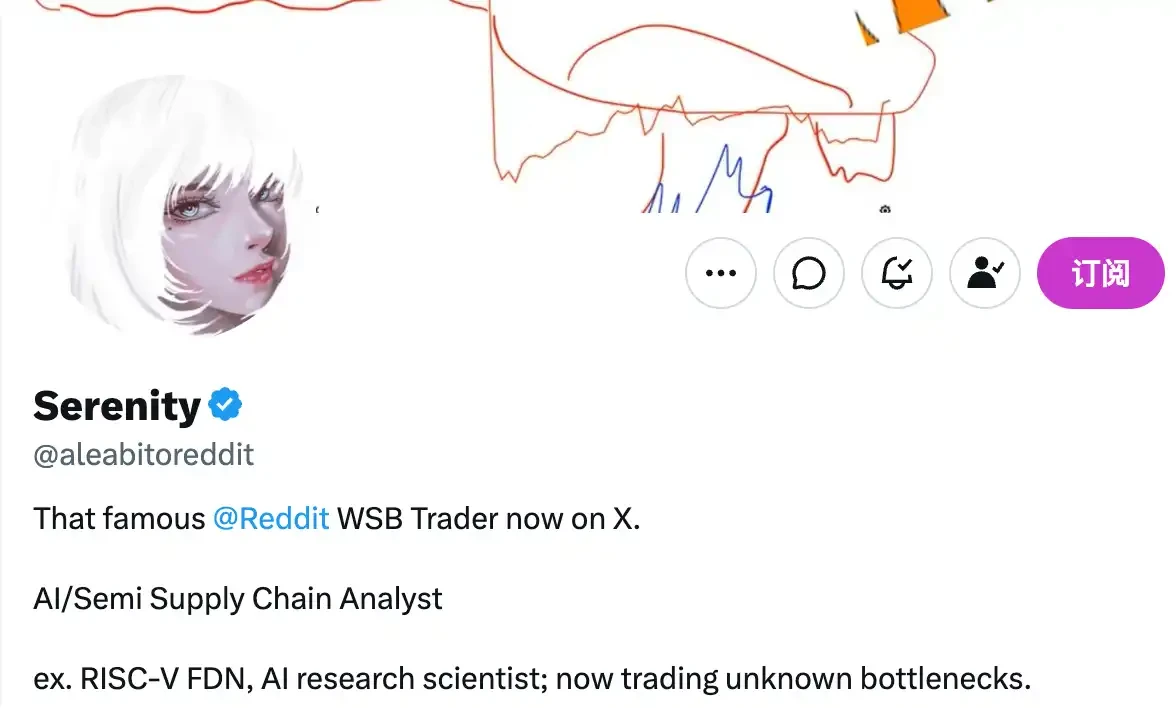
The Bloomberg article began, "It all started on Monday when an X user named aleabitoreddit posted a thread titled 'Fun Trading Ideas.'"
The Reuters piece directly quoted Serenity's thesis on Raspberry Pi. When asked about the stock's unusual movement, a Raspberry Pi spokesperson replied, "The company has no information beyond what is already publicly available."
But the story doesn't end there.
At the end of March, Raspberry Pi published its full-year financial results. Revenue grew 58%. Two months earlier, Serenity's prediction was 55%.
The consensus estimate from sell-side analysts compiled by Bloomberg was only 14% at the time. On the day of the earnings release, RPI's stock price surged another 44.76% in a single day, followed by another 27.43% the next day.
This is why, over the past year, a growing number of Silicon Valley investors have added this Twitter account to their daily must-read list.
A single tweet triggered a 50% market cap swing in a FTSE 250 constituent stock over a week, and two months later, an earnings report validated his prediction.
And the person repeatedly causing this market commotion? No one knows his real name.
The Banned User
Serenity's account bio describes him as an "AI Semiconductor Industry Chain Researcher," "Nature Paper," and "RISC-V Foundation Member."
He once joked that in 2018, Nvidia tried to recruit him to lead its AI team, when Nvidia's stock price was around $6.
He declined.
To understand the Serenity account, the story begins four years ago with a ban.
In early 2022, the moderators of r/wallstreetbets, the infamous U.S. retail investor forum, banned an account named AleaBito.
The reason was that this account posted about a stock whose name sounded like a pyramid scheme.
AXTI, with a market cap just over $200 million, specializing in indium phosphide substrates, was trading at $12. The moderators, annoyed by the perceived pump, banned the account immediately.
AXTI later surged to $70. In a recent review, Serenity called this his most legendary trade, with an unrealized gain of 1000% on that single stock.
After the ban, he switched platforms entirely. Moving from Reddit to X, he adopted a new name: Serenity.
A man kicked out of a forum named himself "Serenity," and his bio simply stated: "The famous WSB trader, now on X."
He claims to be a former AI research scientist, a RISC-V Foundation member, a Nature paper author, and that he declined an offer from Nvidia to lead its AI team.
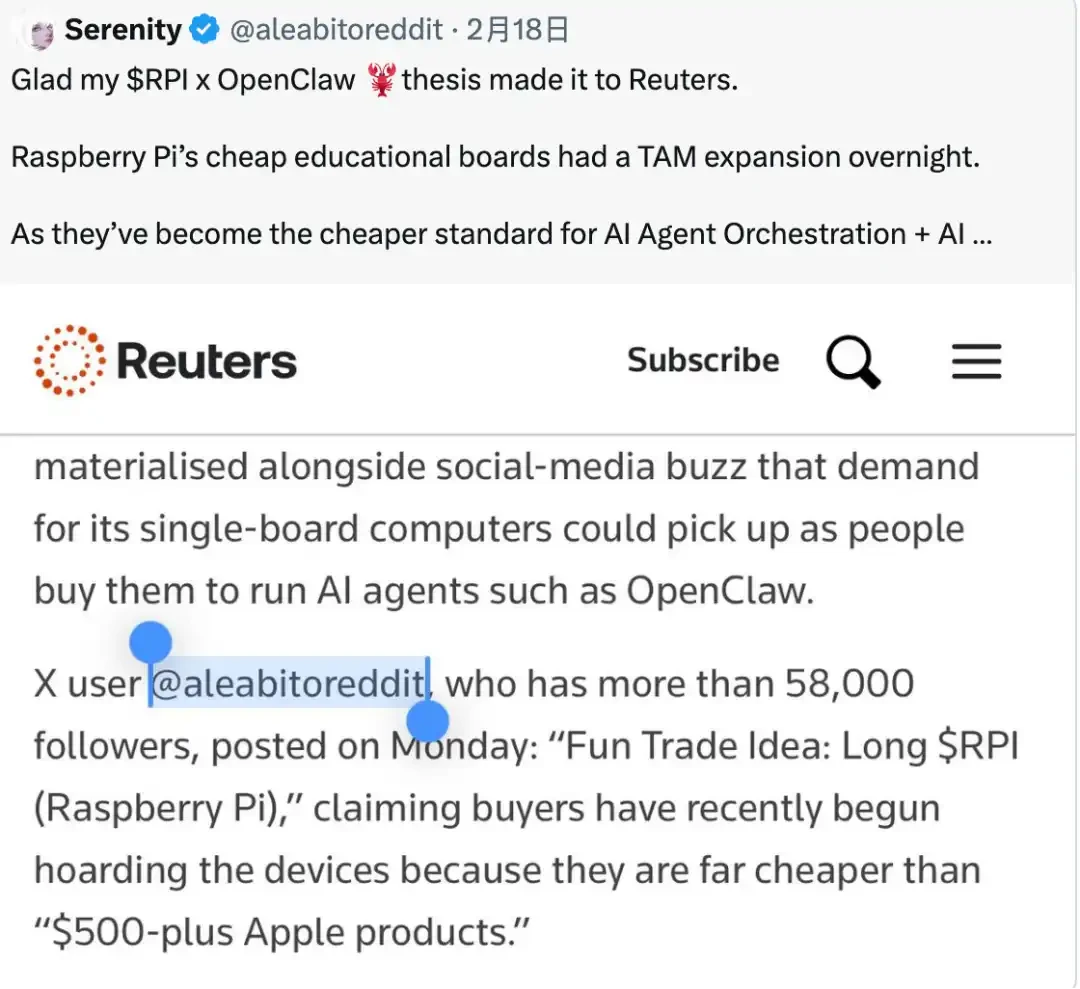
His research analysis has been cited by Reuters.
Serenity's follower count has grown rapidly this year, with communities across U.S., Taiwan, and European stock markets translating his posts. Copy-trading groups have emerged on platforms like moomoo, Xueqiu, and PTT in the Chinese-speaking community.
Some have built dashboards to track his portfolio changes, while others manage hedge funds based on his moves. His only paid product is an Excel spreadsheet, which he jokingly calls "$1 Ideas." All core research is free and public on X.
The Consistent Winner
The RPI call is just one example among his track record. Serenity has a string of similar cases, each following the same trajectory: post a tweet, get criticized, then get validated.
First, AXTI. The very stock that got him banned from WSB.
Indium phosphide substrates, the bottom-layer material for AI data center optical modules. In February 2025, China imposed export controls on indium phosphide. By January 2026, licensing was further tightened, forcing AXT to lower its quarterly revenue guidance.
Overnight, this small Fremont, California-based company transformed from a micro-cap stock into a national-security-level strategic asset. He called this stock two years earlier.
Second, SIVE. Sivers Semiconductors, listed in Stockholm, Sweden, makes CW lasers for CPO external light sources, a core component for next-gen 1.6T co-packaged optics.
After his public entry, the stock surged 73.78% in a single day, its market cap jumping from $130 million to $230 million. On April 15, 2026, Jabil announced a partnership with SIVE to develop 1.6T LRO optical modules with a 2.5x efficiency advantage. A month later, on May 19, $6.6 million in CHIPS Act Year 2 funding arrived.
Third, Soitec. The French semiconductor company, a near-monopoly player in SOI substrates for CPO, even Japan's Shin-Etsu needs its licenses.
He explicitly changed his view in March this year, building a position around €43, calling it a "hidden monopoly for long-term holding." Soitec's stock price jumped 16% that day.
There's also a string of Taiwanese stocks. FOCI (3363, microlenses and fiber arrays), Win Semiconductors (3105, GaAs foundry), TSEM (Tower Semiconductor).
While these stocks were already discussed in Taiwanese retail circles, he was likely the first in the English-speaking world to systematically link them to the CPO narrative.
Performance-wise, he self-reported a 630% return in the year before joining X, with YTD returns exceeding 500% at one point this year before some recent pullbacks.
Of course, these figures are unaudited and should be taken as a reference.
But one thing is verified. Reuters and Bloomberg have directly cited his online handle in their reports.
150,000 followers across three continents translate his posts, and hedge funds copy his trades.
The Chokepoint Thesis
To understand Serenity's investment logic and what he got right, one must first grasp the dominant narrative on Wall Street over the past three years.
From 2023 to 2026, retail investors worldwide were chasing the same targets: AI stocks.
Nvidia, AMD, Microsoft, Google, Meta.
Every sell-side report, every YouTube influencer, every financial headline was calculating whether these companies would beat expectations next quarter.
Serenity went the opposite way. He researched downstream, layer by layer, searching for the "screws" holding Nvidia together.
He coined a term for this: chokepoints.
This concept can be explained with an analogy.
Indium phosphide substrates are to AI optical modules what the Strait of Hormuz is to global oil. 20% of the world's oil passes through that strait; whoever controls it, controls everyone.
Let's use a more everyday example. In Tokyo's Ginza district, the most expensive item on a high-end kaiseki bill is the fatty tuna belly. But the entire restaurant is far more dependent on the shiso leaf under the sashimi.
90% of Japan's high-quality shiso leaves come from a few family farms in Izu. A typhoon hits, the farms shut down, and all the kaiseki restaurants in Ginza close for the day.
Chokepoints are exactly this. No one mentions them until they break, and then everyone is doomed.
Serenity's working style is the opposite of mainstream Wall Street analysts.
Sell-side analysts look down from large companies; he works backward from chokepoints. He draws his own supply chain maps, starting from the Nvidia H100 cluster, layer by layer, digging down to the narrowest bottlenecks. He uses AI to challenge his own ideas, often saying, "I let Gemini challenge my thesis," feeding his research to AI to act as the opponent.
Using stocks from the US, Taiwan, Europe, and Japan, he drew a complete map of global AI-era chokepoints.
Each node is a potential Strait of Hormuz. For every geopolitical event, every earnings report, every export control, he can find the corresponding coordinate on his map and vote with his portfolio.
Recently, he has extended his radar to rare earths and humanoid robots. The investment logic remains consistent: find the narrow bottlenecks, find the monopolies, find the links whose failure breaks the entire system.
This is something most Wall Street sell-side analysts cannot do. They are siloed by department: TMT analysts don't cover materials, materials analysts don't cover optics, and optics analysts don't cover geopolitics.
His most common saying is, "Your earliest thesis gets attacked the most."
A Retail God or Just a Glorified Gambler?
At this point, a change in tone is necessary.
Consider everything about Serenity that is unverifiable. His identity is completely anonymous, with no photos, real names, or institutional background to be found.
"Rejecting Nvidia's AI team offer at $6 stock price," "Nature paper," "RISC-V Foundation member" – all self-reported.
Performance is self-reported, unaudited, and lacks third-party reconciliation. His portfolio is highly concentrated, mostly in small and mid-cap non-consensus stocks with low liquidity. Retail traders copying him can easily enter at the wrong time.
Among financial KOLs of the past decade, those with unverifiable identities, self-reported performance, and a culture of copy trading have mostly not ended well.
However, a few things about Serenity are different.
Currently, he doesn't sell courses, manage paid signal groups, offer training, or charge high subscription fees. Core research is free on X. He doesn't accept advertisements, chase traffic, or operate an MCN.
For now, he doesn't qualify as a scammer. But he shouldn't be treated as a god either.
Of course, an anonymous person banned from a forum, who gets over 150,000 people, including Wall Street hedge funds, to work for him for free – validating his theses, spreading his research, translating his posts.
That, in itself, is quite legendary.


