CLARITY Act still pending, U.S. bipartisan political maneuvering enters the fray


- Key Takeaway: The U.S. Senate Banking Committee passed the CLARITY Act on a party-line vote of 15:9. However, facing strong Democratic opposition, the bill’s likelihood of securing the required 60 votes for passage in the full Senate is extremely low, facing severe political challenges.
- Key Elements:
- The core disagreement over the bill has been resolved: stablecoins cannot pay rewards similar to deposit interest, but rewards based on real activities or transactions are permitted, leaving room for crypto enterprises to operate.
- The committee vote result showed clear partisan division: all 13 Republican members voted in favor, only 2 Democratic members supported (seen as "hostage votes"), and 9 Democratic members opposed.
- Democrats submitted over 100 amendments that were rejected, including an ethics amendment prohibiting senior government officials from having financial interests in the crypto industry, further escalating bipartisan tensions.
- Republicans need support from at least 7 Democratic senators for passage (Republicans hold 53 of 100 seats), but current voting results reveal weak cross-party consensus.
- Political time pressure: Republicans are pushing for passage before July 4th. Otherwise, as congressional power shifts in 2027, the potentially hostile stance of Democrats towards crypto could make the bill’s passage even more unlikely.
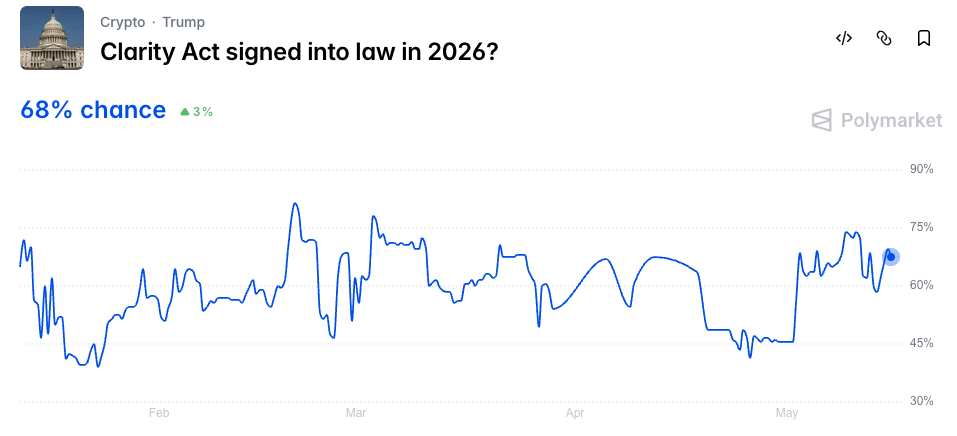
- Prediction markets show Polymarket estimates a 68% probability of the bill being signed into law by 2026, but the actual difficulty of passage may be higher.
Original by Odaily (@OdailyChina)
Author: Golem (@web3_golem)

On May 14, the U.S. Senate Banking Committee finally passed the CLARITY Act after hours of deliberation, advancing the bill to a full Senate vote.
The committee's approval is significant for the CLARITY Act, as the bill had been stalled in the deliberation phase for over four months since January, due to disagreements between the banking and crypto industries over stablecoin yield regulations. In the latest version of the bill, this core disagreement has been resolved: stablecoins are still prohibited from paying rewards resembling bank deposit interest, but they are permitted to offer rewards based on real activities or transactions, leaving room for stablecoin enterprises to operate.
However, clearing this major obstacle does not guarantee smooth passage for the CLARITY Act in the future. Besides addressing the diverging interests of the banking and crypto industries, the bill is also entangled in the political tug-of-war between the U.S. Republican and Democratic parties. The outcome of this political game will determine whether the CLARITY Act can secure enough votes in the full Senate.
The CLARITY Act Forces Its Way Through
The U.S. Senate Banking Committee ultimately approved the CLARITY Act by a vote of 15 to 9. Given the voting result and support rate, the bill essentially forced its way through the committee.
The current Senate Banking Committee comprises 24 members, including 13 Republicans and 11 Democrats. Republicans hold the majority on the committee, so theoretically, even if all Democrats opposed the bill, Republicans could still force it through with a 13-11 vote based on their seat advantage. However, this would be the worst-case scenario, as it would essentially mean no consensus between the two parties on the CLARITY Act. In that case, even if the bill advanced to a full Senate vote, it would be highly unlikely to garner enough votes to pass.
Therefore, more important than the committee's approval result itself is the number of Democratic votes the CLARITY Act received in the Senate Banking Committee. This serves as a strong signal, reflecting the bill's bipartisan support rate and the difficulty of passing it in a subsequent full Senate vote.
The final committee vote of 15:9 on May 14 is not much more optimistic than the worst-case scenario of 13:11. The voting lines were clearly drawn: all 13 Republican committee members voted in favor, only 2 Democratic members crossed party lines to support it, while the remaining 9 Democratic members voted against it. The supportive Democratic members were Ruben Gallego of Arizona and Angela Alsobrooks of Maryland.
Before the CLARITY Act deliberation began, the market anticipated that the votes of five swing Democratic committee members would be crucial. How many of their votes Republicans could secure would influence the smoothness of subsequent proceedings. These members were:
- Mark Warner: From Virginia, a member of the Securities Subcommittee and the Digital Assets Subcommittee. He voted in favor of both the GENIUS Act and SAB 121.
- Angela Alsobrooks: From Maryland, co-led the stablecoin yield compromise with Thom Tillis and has been the most active Democratic representative in negotiating the bill's text within the party.
- Ruben Gallego: From Arizona, the lead Democratic member of the Digital Assets Subcommittee. He voted in favor of the GENIUS Act.
- Catherine Cortez Masto: From Nevada, a member of the Financial Institutions and Consumer Protection Committee. She has reservations about the law enforcement-related provisions in the Blockchain Regulatory Certainty Act (BRCA) and has been urging amendments to address these concerns.
- Raphael Warnock: From Georgia, a member of the Senate Economic Policy Subcommittee. He has been a strong advocate for strengthening anti-money laundering (AML) and combating illicit finance, and voted in favor of the GENIUS Act.
In the end, only 2 of these 5 Democratic committee members voted in favor, and even those two votes were essentially "hostage votes." Alsobrooks explicitly stated after the vote that her support was meant to keep the dialogue going in the full Senate. She warned that if the underlying issues are not ultimately resolved, she and Gallego could change their votes during the floor vote.
The current U.S. Senate has 100 members: 53 Republicans, 45 Democrats, and 2 Independents. Given that the two Independents (Bernie Sanders and Angus King) have long caucused with Democrats, the actual party split in the Senate is 53:47, with Republicans holding the majority.
Although Republicans used their seat advantage to force the bill through the committee, for the CLARITY Act to secure the 60 votes needed to pass a full Senate vote, Republicans would need support from at least 7 Democratic senators, assuming no Republican defections.
Based on the committee vote result, securing at least 7 Democratic votes will be challenging, as they failed to gain the full support of any Democratic committee member. Galaxy stated before the Banking Committee's deliberation that if the CLARITY Act passes only with party-line or near-party-line votes, its chances of reaching the 60-vote threshold in the Senate would be significantly diminished, dimming its prospects for passage in 2026.
The Political Tug-of-War Between U.S. Parties Over the CLARITY Act
During the Banking Committee's deliberation on the CLARITY Act, the two parties fiercely debated numerous amendments. The Senate submitted over 100 amendments to the committee, with Democratic Senator and committee member Elizabeth Warren alone submitting over 40. However, many Democratic-proposed amendments were voted down by Republicans using their seat advantage. This failure to address multiple demands contributed to the final 15:9 vote forcing the bill through.
Among these, the ethics amendment became a core battleground for Democrats. Democrats had consistently pushed to include such a provision in the bill. During the hearing, Democratic committee member Chris Van Hollen again proposed an amendment banning senior government officials, including the President and Vice President, from holding commercial interests in the crypto industry, while also strengthening transparency requirements. In his speech, he specifically highlighted President Trump and his family's ties to World Liberty Financial.
However, Republican committee member Bernie Moreno opposed the amendment, arguing it was "outside the scope of the Banking Committee's review." The amendment ultimately failed on a party-line vote of 11 in favor and 13 against. Democrats' insistence on pushing the ethics amendment was not merely about clean governance. At its core, it reflects the view that the crypto industry is becoming a new capital alliance for Republicans, and that the current CLARITY Act would pave the way for a future financial coalition aligned with the Trump camp.
Although crypto lobbying groups (such as Fairshake Super PAC and its affiliates) have shifted their funding strategies in recent years, moving away from solely funding one party to specifically supporting and courting pro-crypto lawmakers, the majority of their political contributions still flow to Republicans. Democrats understand that if the CLARITY Act passes without ethical restrictions, high-ranking Republicans could legally amass significant wealth by holding and promoting crypto assets.
Increasing the compliance burden for officials holding crypto assets is, in essence, also reducing the penetration rate of cryptocurrencies as a "compliant safe-haven asset" among the elite class. Beyond traditional banks, unions and other core middle-class groups are also solid Democratic constituencies. Therefore, pushing the ethics amendment is also a Democratic strategy to use the moral high ground of "anti-corruption" for political mobilization, aiming to win over traditional middle-class voters uneasy about crypto volatility.
Of course, Democrats also recognize that outright opposition to the crypto industry could alienate younger voters. Hence, besides the progressive wing of the Democratic Party, led by Elizabeth Warren, which fiercely opposes and obstructs crypto, there are moderate, swing younger Democratic lawmakers who are more open to it.
Beyond the ethics amendment, Democrats had other demands concerning AML regulations and the Blockchain Regulatory Certainty Act (BRCA). However, these amendments were also rejected by Republicans using their seat advantage. Thus, the committee's passage of the CLARITY Act was not about resolving issues between the two parties but rather a result of Republicans forcing the bill forward. All unresolved problems will now accumulate for the full Senate vote.
This means that the AML and ethics amendments rejected in committee today are almost certain to become ultimate bargaining chips for Democrats during the floor vote. Without substantial concessions or bartering, this bill, crucial for the crypto industry, will highly likely face a brutal obstruction.
Future Prospects for the CLARITY Act
The motivation behind Republicans' rush to advance the CLARITY Act is clear. Republican Senator Cynthia Lummis has repeatedly stated that if the act fails to pass this year, it could be delayed until 2030 or later.
This is because the power balance might shift in the 120th Congress (convening in January 2027). A new committee structure and new political motivations will all impact the legislative process of the CLARITY Act. If Democrats secure majorities in the new Senate and House, and crypto-"hostile" Democrats like Elizabeth Warren or Sherrod Brown chair the Senate Banking Committee, the probability of the CLARITY Act passing becomes even slimmer.
Therefore, Republicans must pass the CLARITY Act through the Senate before the environment becomes more complex. Considering the Senate's August recess and the subsequent midterm election season, this requires Republicans to schedule a floor vote before July. The White House target is for President to sign the bill into law before July 4th (the 250th anniversary of U.S. Independence).
However, considering the final Senate Banking Committee vote on May 14 and the Democrats' tough stance, passing the CLARITY Act smoothly in the full Senate may require extraordinary "political skill" and coordination from Republicans.
As of May 15, Polymarket estimates a 68% probability that the CLARITY Act will be signed into law in 2026. The actual probability might be much lower...