Q1 Earnings Report, CLARITY Act, and Walsh Transition: Circle Faces Three Major Tests This Week


- Core Thesis: Circle (CRCL) will face three pivotal events this week: its Q1 2026 earnings release, the Senate vote on the CLARITY Act, and the Federal Reserve leadership transition. These events will directly impact CRCL's short-term price movement and could redefine its long-term valuation narrative.
- Key Factors:
- Market expectations for Q1 earnings: revenue of $715 million and EPS of $0.178, with a focus on distribution cost ratios and the growth trend of non-interest income.
- The distribution contract with Coinbase is set to expire in August; the outcome of renewal negotiations is critical to Circle's profitability.
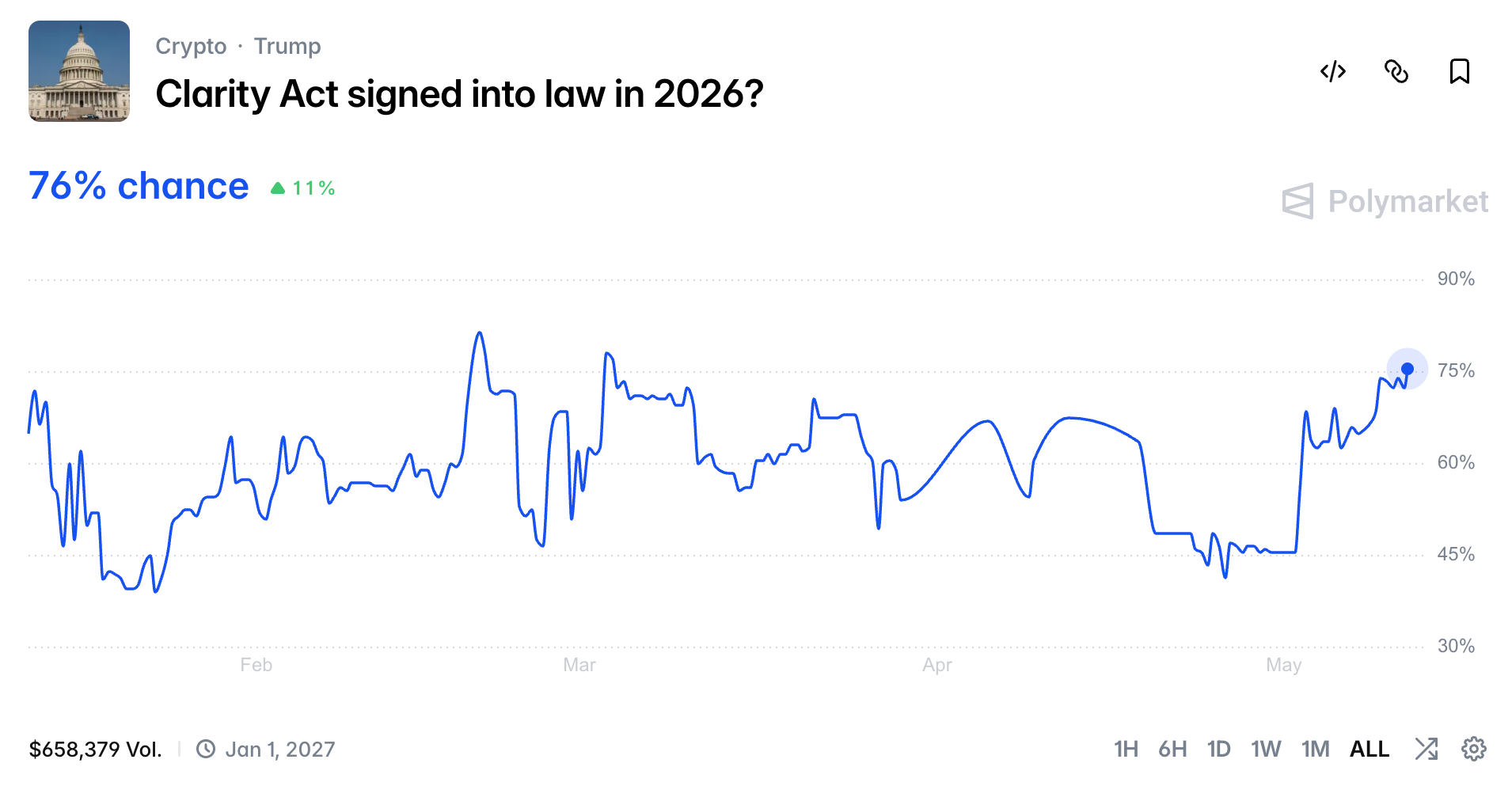
- The CLARITY Act aims to establish a federal regulatory framework for digital assets, with Polymarket estimating a 76% probability of passage this year.
- A key point of contention in the bill is the distribution of stablecoin yields. The latest compromise proposal would prohibit returns on static reserves but allow active rewards.
- Following the Fed leadership change, incoming Chair Walsh advocates for a "balance sheet reduction + rate cut" strategy. In the short term, rate cut expectations could negatively impact Circle, which relies on US Treasury bond income.
- Walsh himself is a cryptocurrency holder, opposes a CBDC, but supports bringing assets like USDC under regulatory oversight. In the long term, this could provide a policy tailwind for Circle.
Original by Odaily (@OdailyChina)
Author: Azuma (@azuma_eth)

Circle (CRCL) is set to face three major tests this week: the Q1 earnings report on May 11, the Senate vote on the CLARITY Act on May 14, and the Federal Reserve leadership change on May 15. Each of these events will directly impact CRCL's price trend and could even redefine its valuation logic.
Below, Odaily will analyze the progress and expectations for each of these three events and forecast their potential impact on CRCL (Editor's note: The following content does not constitute investment advice).
Event 1: Q1 2026 Earnings Report
Today at 20:00 Beijing time, Circle will release its Q1 2026 financial results before the US stock market opens, followed by an earnings call.
There are three main points of interest in this earnings report.
- First is Circle's comprehensive Q1 revenue and profit data. The current market consensus for Circle's Q1 revenue is $715 million, with an expected earnings per share (EPS) of $0.178.
- Second is the proportion of Circle's distribution costs (primarily paid to Coinbase) relative to total revenue. This indicates Circle's reliance on distribution platforms like Coinbase. This ratio has shown a slight downward trend over the past few quarters, with Q1 expected to continue this trend.
- Third is the growth of non-interest income, i.e., revenue generated through payments, enterprise services, and on-chain operations. This is the most crucial long-term metric for Circle, representing its ability to establish a secondary revenue stream beyond U.S. Treasury yields.
Regarding the distribution contract with Coinbase, analysts are sure to question Circle about this during the earnings call, making Circle's response critical. In August 2023, Circle signed a three-year contract with Coinbase stipulating that Coinbase would receive all interest income generated by USDC held on its platform, while interest income from USDC held off-platform would be split 50/50 between Coinbase and Circle.
This contract is set to expire in August of this year. However, last week Coinbase's CFO emphasized that the contract is "renewed every three years, forever." If Circle continues to renew under the original terms, it would certainly be disadvantageous. However, given Coinbase's current financial pressures and its strong dependence on Circle — contracts are negotiated, and this could become a favorable factor for Circle in seeking modified revenue-sharing terms.
- Odaily's Note: Refer to the article Q1 Net Loss of $394.1 Million: Coinbase Can Only Cling to Circle's Leg.
Personally, I am cautiously optimistic about tonight's earnings report. I expect solid performance, but the key focus will be Circle's stance regarding the August contract renewal.
Event 2: CLARITY Act Faces Senate Vote
On May 14, U.S. local time, the U.S. Senate Banking Committee will hold a vote on the CLARITY Act. This is a crucial step for the CLARITY Act to pass through the Senate and become formal law.
The CLARITY Act aims to establish a regulatory framework for digital assets, clearly defining their classification and delineating the regulatory responsibilities of the Securities and Exchange Commission (SEC) and the Commodity Futures Trading Commission (CFTC).
On July 17 of last year, the CLARITY Act passed the U.S. House of Representatives by an overwhelming majority (vote count approximately 294–134). However, it faced resistance upon subsequent transfer to the Senate due to disagreements among various parties.
Disputes primarily revolved around stablecoin yields, regulatory approaches to DeFi, and ethical standards concerning the Trump family. Notably, conflicts over stablecoin yields saw fierce exchanges between the banking and crypto industries, with Coinbase even temporarily leaving the negotiating table, stalling the bill's progress (see recommended reading: Why Are Banks Determined to Block Stablecoin Yields?).
A key turning point has recently occurred:Senators Thom Tillis and Angela Alsobrooks have reached a compromise, proposing to ban yields on static stablecoin reserves but allow rewards for actively used stablecoins.
On the prediction market Polymarket, the probability of the CLARITY Act becoming law this year is currently as high as 76%, indicating that the market is relatively optimistic about the bill's subsequent progress.
If the CLARITY Act becomes formal law, it will establish a clear, functional federal regulatory framework for the U.S. digital asset market, addressing longstanding issues of regulatory ambiguity and inconsistent enforcement. This would be a significant positive for all industry participants, including Circle. My personal outlook on this is relatively optimistic.
Event 3: Federal Reserve Leadership Change
On May 15, Federal Reserve Chairman Jerome Powell's term as Chair expires (he will remain as a Board member until 2028). His successor will be Kevin Warsh.
On April 29, the Senate Banking Committee voted to approve Warsh's nomination. Although it has yet to be confirmed by a full Senate vote, this is expected to happen within the next few days.
Unlike Powell,Warsh advocates an unconventional combination of "balance sheet reduction + interest rate cuts." He supports controlling inflation through quantitative tightening (QT) while simultaneously cutting rates to provide liquidity for the real economy, believing QT targets the financial sector while rate cuts benefit industry.
For Circle, which currently relies heavily on U.S. Treasury yields as its primary revenue source, a shift towards a rate-cutting cycle would be a direct negative for CRCL. Concurrently, QT could tighten financial market liquidity in the short term, putting pressure on the stock market.
However,Warsh himself is a cryptocurrency holder, making him the first Federal Reserve Chair in history to have directly invested in the crypto space. He also places a high value on the "digital upgrade of U.S. financial competitiveness." Warsh has explicitly opposed the Fed issuing an official CBDC, arguing that its credit is deeply tied to national sovereignty. If USD credit is damaged, the CBDC would also collapse. Therefore, he hopes to bring private stablecoins like USDC under the Fed's regulatory framework, treating them as "shadow dollars."
Thus, from a long-term perspective, Warsh taking office could provide some policy tailwinds for Circle's business operations, thereby aiding its expansion.
In terms of expectations, the outlook might lean towards pessimism in the short term but could shift to neutral or optimistic in the long term.