Coinbase Layoffs 14%: Bear Market or AI as the Main Cause?


- Core Viewpoint: On May 5, Coinbase announced a 14% workforce reduction (about 660 employees), primarily to cope with the market downturn and drive an AI technology transformation. The goal is to reshape the company into a leaner organization centered on AI, but the move has also sparked market skepticism about its real revenue pressures.
- Key Elements:
- Coinbase laid off approximately 660 employees, offering compensation packages including at least 16 weeks of base salary, equity vesting, and health insurance, with additional support for employees on work visas.
- CEO Brian Armstrong emphasized two main reasons for the layoffs: responding to the crypto market downturn, and the fact that AI technology has significantly boosted individual engineer productivity, necessitating proactive organizational restructuring.
- Coinbase plans to compress its organizational hierarchy to a maximum of 5 layers below the CEO/COO, build small, agile teams around AI talent, and require management to engage in front-line work.
- Using AI as a justification for layoffs has become a trend in Silicon Valley, with companies like Amazon, Block, Snap, and Meta making similar adjustments. However, some critics argue this masks genuine business and revenue pressures.
- Coinbase faces significant revenue headwinds: since the market peaked in Q2 2025, revenue growth has slowed, net profit has contracted for three consecutive quarters, and the company recorded a $670 million loss in Q4 2025.
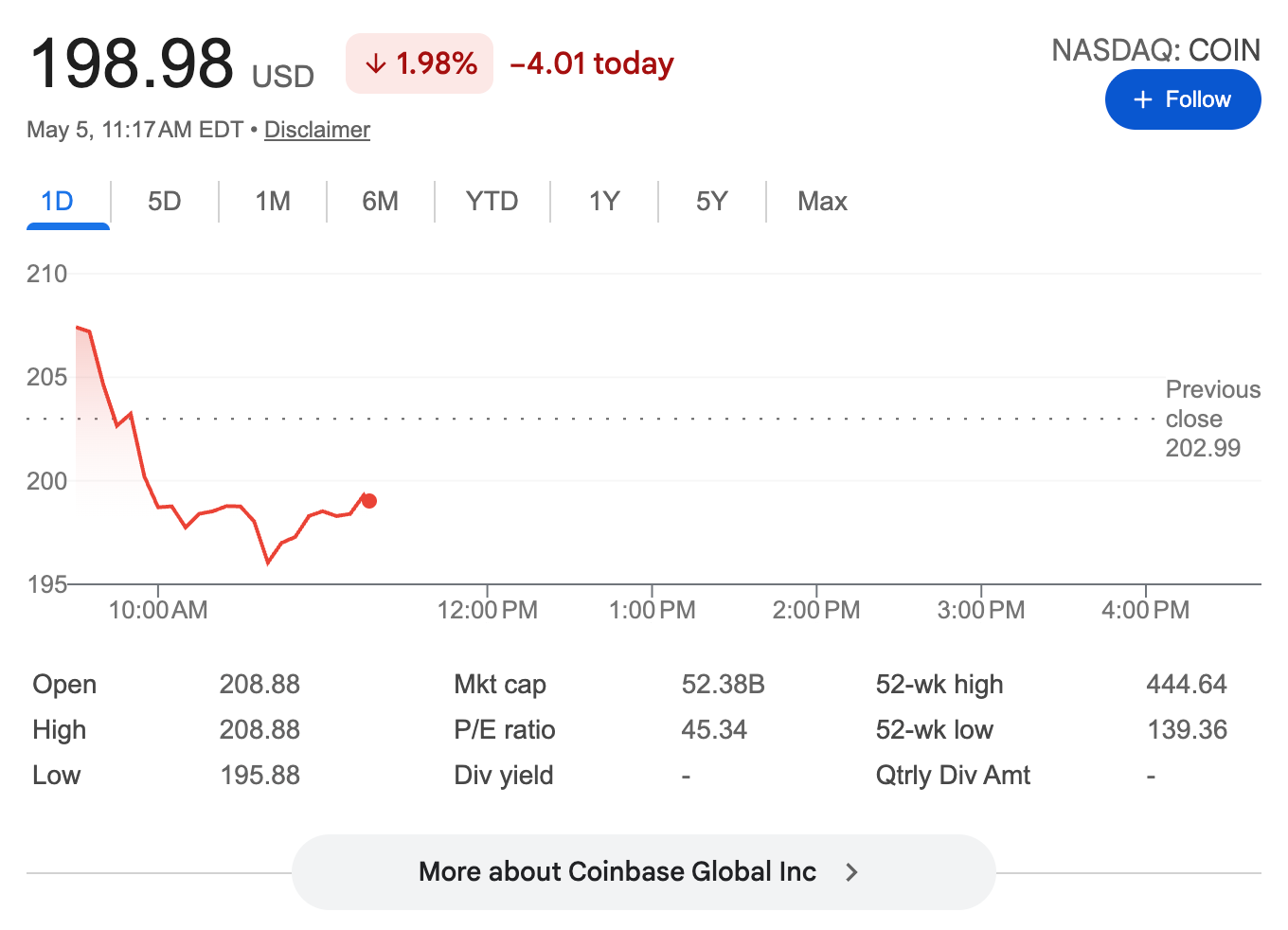
- The layoffs are expected to save approximately $225 million in annual salary expenses, which should help alleviate financial pressure. However, the market reaction has been tepid, with COIN shares falling 1.98% on the day.
- Coinbase is scheduled to report its Q1 2026 earnings on May 8. Market expectations are pessimistic, and the report will directly reveal its true financial performance.
Original by Odaily Planet Daily (@OdailyChina)
Author: Azuma (@azuma_eth)

On the evening of May 5, Beijing time, Coinbase, the leading compliant exchange in the crypto world, officially announced a 14% reduction in its workforce,预计 will cut approximately 660 employees. Layoff notices have been sent via email. All US employees affected by the layoffs will receive at least 16 weeks of base pay (with an additional 2 weeks per year of service), the next scheduled equity vesting, and six months of COBRA health insurance. Employees on work visas will receive additional transition support.
In the layoff announcement, Coinbase co-founder and CEO Brian Armstrong cited two main reasons, with a particular emphasis on explaining the second point.
First, the market environment — Coinbase's business performance remains cyclical, fluctuating with market cycles. To navigate the current downtrend, the company needs to immediately adjust its cost structure, entering the next growth phase leaner, faster, and more efficiently.
Second, the AI technology revolution — Armstrong emphasized that AI is changing how companies operate. An engineer proficient in AI can now accomplish in days what once took a team weeks; non-technical teams are also beginning to deliver production-grade code. This shift is accelerating daily, and all companies, including Coinbase, face the same challenge. Rather than waiting idly, it's better to proactively and intentionally restructure, rebuilding Coinbase into a lean, fast, AI-centric company.
- Odaily Note: Armstrong's statement that "non-technical teams are also beginning to deliver production-grade code" has sparked some controversy on X. Given that Coinbase directly custodies user assets and has a history of information security incidents, some professionals have criticized the company's rigor in this regard.
Looking ahead, Coinbase aims to fundamentally change how the company operates — rebuilding Coinbase as an "agent," with humans coordinating at its edges. Specifically, Coinbase will compress organizational layers (no more than 5 layers below CEO/COO), require management to participate in front-line work, and build smaller, more agile teams centered around AI talent.
AI-Driven Layoffs Become a New Silicon Valley Trend
Laying off employees under the guise of "AI-driven productivity gains" is no longer new.
In October last year, Amazon cut up to 30,000 jobs across its logistics, payments, gaming, and cloud computing divisions. CEO Andy Jassy had previously signaled the layoffs, stating: "As the company increasingly uses AI for tasks previously performed by humans, Amazon's workforce may shrink."
In late February this year, Jack Dorsey's fintech company Block (also founder of Twitter) announced the elimination of 4,000 positions, reducing its total headcount from over 10,000 to under 6,000, to promote a leaner, flatter, and AI-centric organizational structure. Block CFO and COO Amrita Ahuja revealed that after the layoff announcement, numerous corporate executives reached out to Block, seeking to replicate this "playbook."
In mid-April, Snap also cut about 1,000 jobs. CEO Evan Spiegel stated, "AI will enable our teams to reduce repetitive work, increase efficiency, and better support our community, partners, and advertisers."
Following suit, Reuters reported that Meta is also planning to initiate the first round of its large-scale layoffs this year on May 20, reducing its global workforce by approximately 10% (total employees around 79,000), or roughly 8,000 people. Insiders revealed that Meta plans further layoffs in the latter half of the year, though the specific timing and scale are not yet finalized. The company's executive team may adjust plans based on ongoing observations of AI capability development.
- Odaily Note: See details in "Jack Dorsey's Company: 4,000 White-Collar Workers Being Phased Out by AI"; "Back at the AI Poker Table, Is Zuckerberg's First Move to Lay Off Staff?".
But is AI the real primary reason these companies choose to lay off employees? The answer may not necessarily be yes. Multiple industry leaders have weighed in, suggesting that many companies laying off staff under the guise of "AI-driven productivity gains" are merely masking underlying business prospects or revenue pressures.
During the NVIDIA GTC 2026 conference, Jensen Huang sharply criticized companies using AI efficiency as an excuse for layoffs: "Those leaders who respond to AI with layoffs simply can't think of a better way; they have nothing new in mind. Even with the most powerful tools, they won't use them for expansion."
Tech journalist Derek Thompson also commented after Coinbase's layoff announcement: "AI is indeed very good at writing code... But many layoff plans would have happened anyway; they are now just being whitewashed by AI. Macro history shows that churn in the tech industry often accelerates during economic downturns. Therefore, struggling companies are forced to be among the first to do more with less."
Compared to some other companies that performed well in revenue when announcing layoffs (like Block), Coinbase's situation seems more easily explained by this logic.
Coinbase's Real Revenue Pressure
The nature of Coinbase's core business dictates that its revenue performance is highly correlated with the cyclical fluctuations of the cryptocurrency market.
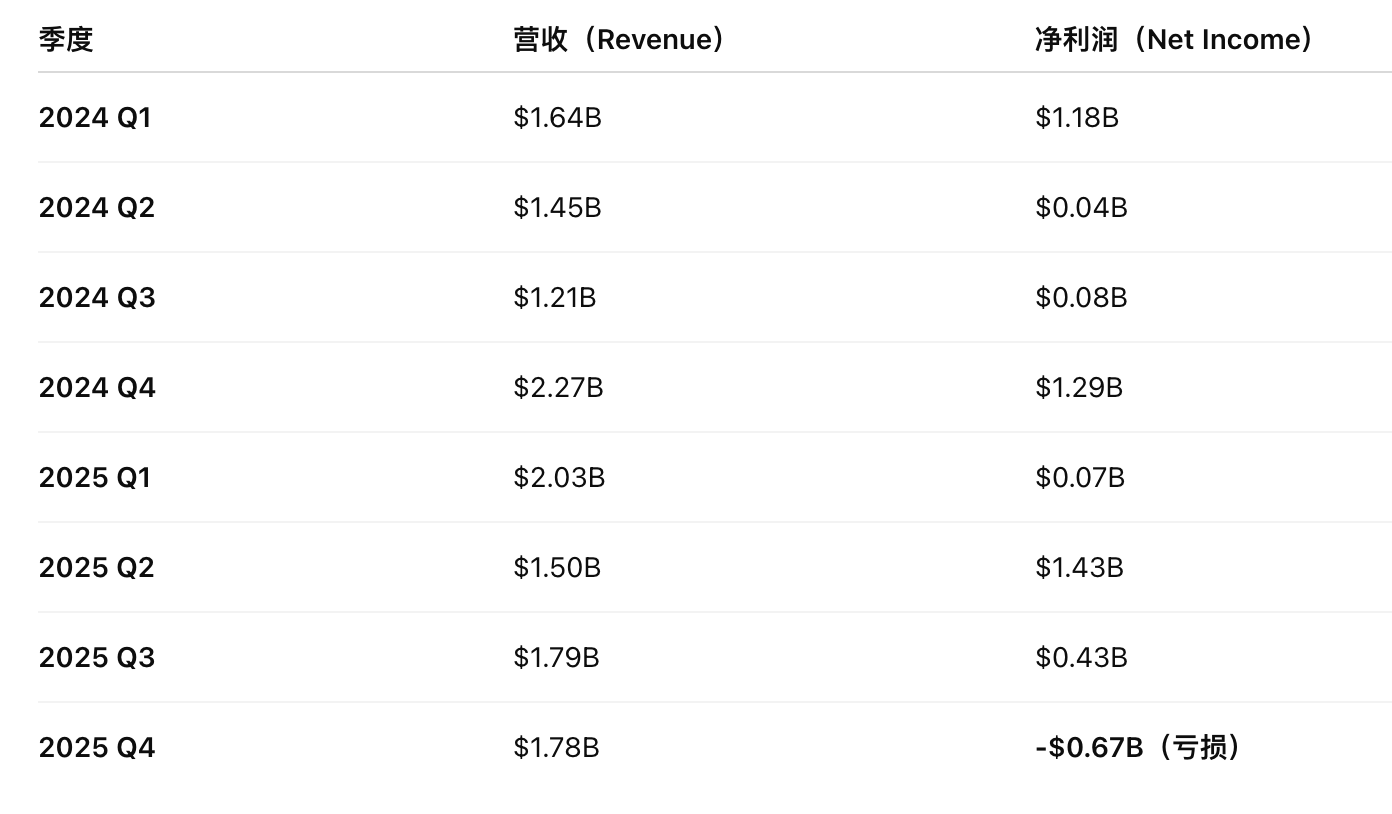
As shown in the chart above, since the crypto market peaked around Q2 2025 and entered a bearish phase, Coinbase's revenue and net profit data have shown a clear reversal — revenue growth has slowed or even declined; net profit has compressed significantly for three consecutive quarters, with Q4 2025 recording a substantial loss of $670 million (mainly due to impairments on crypto assets).
As of now, although BTC has recently reclaimed the $80,000 level, there are no signs of a short-term cyclical shift in the market. Against this backdrop, Coinbase has ample and direct motivation to undertake "cost reduction and efficiency improvement."
According to Dragonfly investor Omar Kanji's estimate, with a 14% workforce reduction, Coinbase could save approximately $225 million in annual salary expenses. This would undoubtedly significantly alleviate Coinbase's current revenue pressure.
See You at the Q1 Earnings Report on Friday
As of 23:20 Beijing time on May 5, COIN stock was trading at $198.98, down 1.98% on the day. The market doesn't seem particularly impressed by this layoff announcement.
After the US stock market closes on May 7 local time (May 8 Beijing time), Coinbase will officially release its financial performance report for Q1 2026, followed by a video webcast and earnings call at 5:30 PM ET on May 8. However, given the state of the crypto market during Q1, it's hard to be optimistic about this earnings report.
What Coinbase's actual revenue situation truly looks like right now will be answered in just a few days with the most authentic figures.