ArkStream Capital 2026 Q1 Report: Structural Purge of the Crypto Industry Amid Geopolitical Conflict and Liquidity Ebb


- Core Thesis: In Q1 2026, the crypto market experienced a systemic sell-off under the combined pressures of geopolitical conflict, trade wars, and a hawkish Fed. Bitcoin fell from $93,000 to $63,000, debunking the 'digital gold' narrative. The altcoin market has sunk into a liquidity drought, with capital further polarized by a siphon effect from the AI industry. The market cleansing is far from over.
- Key Factors:
- Macro Headwinds: The Trump tariff policy, the US-Iran military conflict, and the collapse of Fed rate cut expectations (compressed from 2 cuts to near zero) constitute a triple systemic risk, putting comprehensive pressure on risk assets and creating a premium for policy uncertainty.
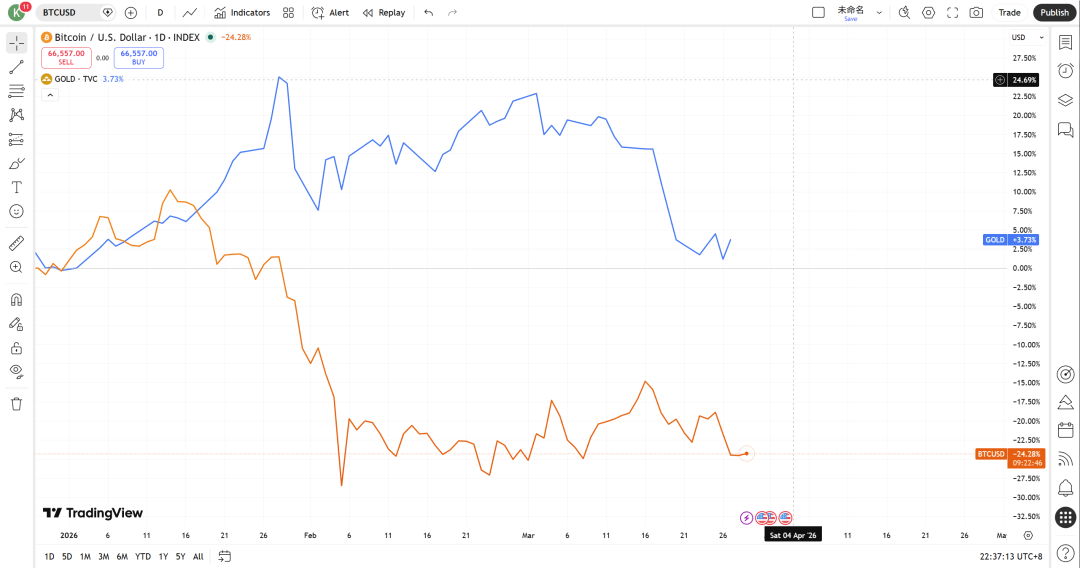
- Bitcoin Narrative Failure: Data shows Bitcoin is highly correlated with the Nasdaq but has an extremely low correlation with gold. In extreme risk events, it acts as a 'liquidity relief valve' rather than a safe-haven asset. ETF investors are facing approximately 23% unrealized losses, exacerbating sell-offs.
- Structural Altcoin Atrophy: Altcoins have dropped 60%-80% from their cycle highs. BTC Dominance remains elevated (56%-59%). All capital from ETFs and DAT products is locked into BTC. Mid-to-small cap altcoins, lacking innovation and capital inflows, are caught in a cycle of value regression and speculative exhaustion.
- AI Siphon Effect: The AI industry has entered a stage driven by economics (API costs down 80%). Its stock sector yields far exceed those of Crypto+AI tokens, leading to a continuous capital diversion. Most Crypto+AI narratives remain stuck in a phase of speculation.
- VC Investment Dilemma: Project unlock schedules place VCs in a 'subordinated' position. Primary market investment losses are widening, and exit difficulty is rising. Exchange listing strategies exacerbate a prisoner's dilemma, making shorting small-to-mid cap alts one of the few hedging strategies with a positive expected value.
Preface
In the first quarter of 2026, global financial markets entered the most severe risk repricing cycle since 2022. The continuous escalation of geopolitical conflicts, the full-scale return of trade protectionism, and the repeated swings in major economies' monetary policies have collectively created a highly uncertain macro environment with low liquidity preference. The crypto market experienced a systemic sell-off this quarter, with Bitcoin dropping from approximately $93,000 at the beginning of the year to the $63,000 range, a maximum drawdown exceeding 38%; the altcoin market was even more devastated, with many tokens falling 60%-80% from their cycle highs.
The deterioration of the market environment was not random but a result of multiple overlapping structural pressures. On one hand, the Trump administration's aggressive tariff policies and the US-Iran military conflict pushed geopolitical risks to new highs, putting general pressure on risk assets. On the other hand, the crypto market's own narrative fatigue and fragile liquidity structure were fully exposed during the downward channel. Bitcoin's "digital gold" narrative failed to function as a safe haven in a wartime environment, instead behaving as a high-beta risk asset. Altcoins, lacking new capital inflows and fundamental support, fell into a continuous value regression.
Meanwhile, the rapid evolution of the AI field is profoundly reshaping the intersection of technology and finance. The continuous iteration of large model capabilities, the explosive growth of open-source AI Agent frameworks, and the initial integration of AI with Crypto payment scenarios provide noteworthy new variables for the industry's medium-to-long-term development.
The following analysis will delve into the core variables of Q1 across four dimensions: the macro environment, Bitcoin and capital structure, AI development trends, and the divergence in the altcoin market, concluding with ArkStream Capital's framework-based outlook for the subsequent direction.
Macro Environment: Geopolitical Conflicts and Trade Wars Create Systemic Pressure
Accelerated Fragmentation of the Global Trading System
The primary analytical framework for understanding the policy actions of Q1 is the US midterm elections in November 2026. The Republican Party's slim majority in both the Senate and House faces serious challenges. Historically, the party in power almost invariably loses seats in midterm elections. Under this pressure, the Trump administration's series of aggressive actions in Q1, including tough tariffs, the Greenland sovereignty narrative, and military strikes against Iran, all fundamentally serve the same political logic: consolidating the Republican base and creating a narrative of a "strong president" during an election year through aggressive diplomatic and economic policies. This implies that at least until the November vote, policy unpredictability and aggressiveness are unlikely to cool down substantially, and the political uncertainty premium faced by risk assets will persist throughout the year.
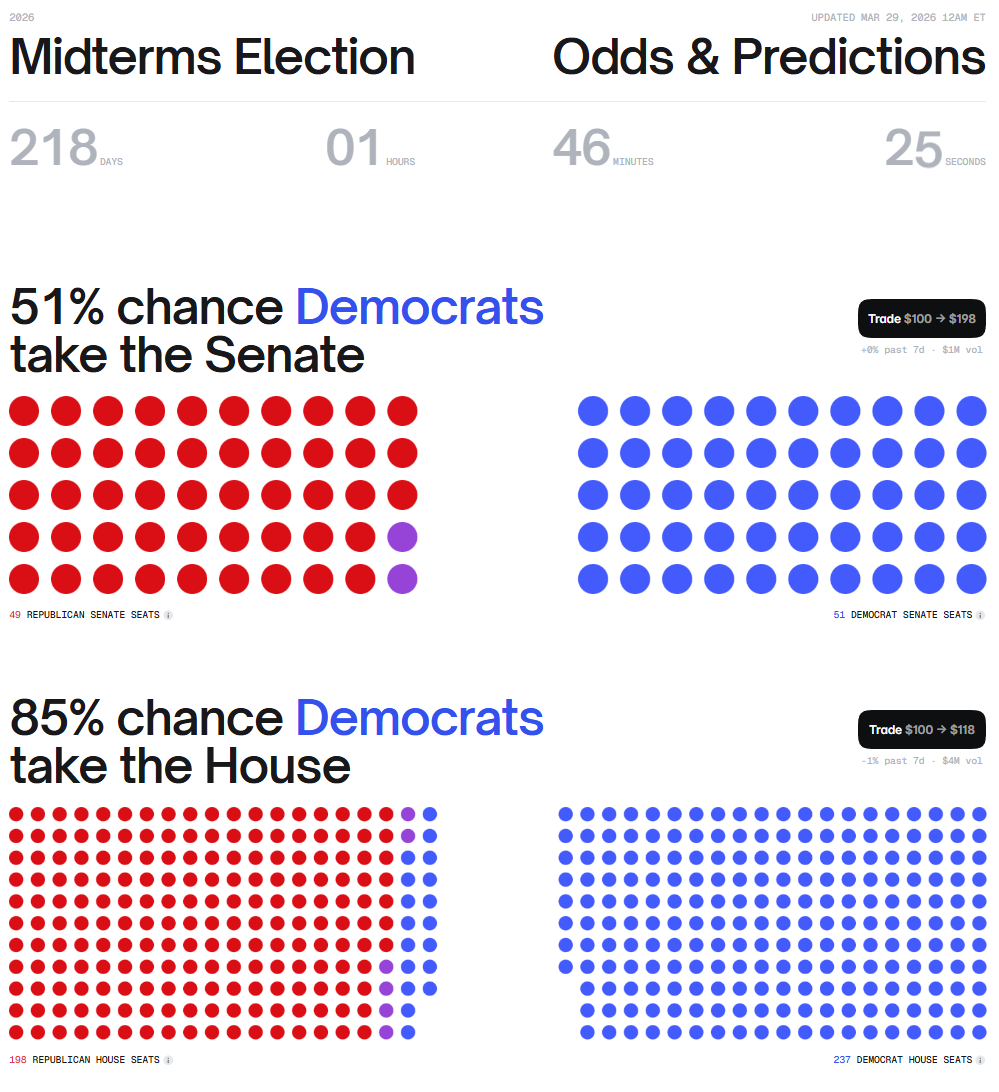
Projected Seat Distribution for the 2026 US Midterm Elections in the Senate and House
https://polymarket.com/predictions/midterms
Driven by this political logic, the global trade order experienced its most severe shock since the establishment of the WTO in Q1. In mid-January, the Trump administration announced tiered tariffs of 10%-25% on eight countries (Denmark, Norway, Sweden, France, Germany, the UK, the Netherlands, and Finland), using the Greenland sovereignty dispute as leverage. At the end of January, a bill imposing a 500% punitive tariff on countries purchasing Russian oil (directly targeting BRICS nations like China, India, and Brazil) gained bipartisan support and entered the voting process. After the Supreme Court struck down the tariff's legal basis under IEEPA on February 20, Trump immediately invoked Section 122 of the Trade Act of 1974 to re-impose a 10% global temporary tariff (valid for 150 days).
The repeated escalation of tariff policies impacts markets in three dimensions: Cost side, import tariffs directly push up commodity prices and inflation expectations, compressing the Fed's room for rate cuts; Supply chain side, retaliatory measures from trade partners exacerbate global supply chain uncertainty, dampening corporate capital expenditure appetites; Risk premium side, the inherent unpredictability of the policy itself becomes the biggest pricing challenge, systematically raising the implied volatility of various risk assets. ArkStream Capital believes the market-suppressing effects of the latter two are far more difficult to quantify than the tariff rates themselves and are harder for the market to price in fully.
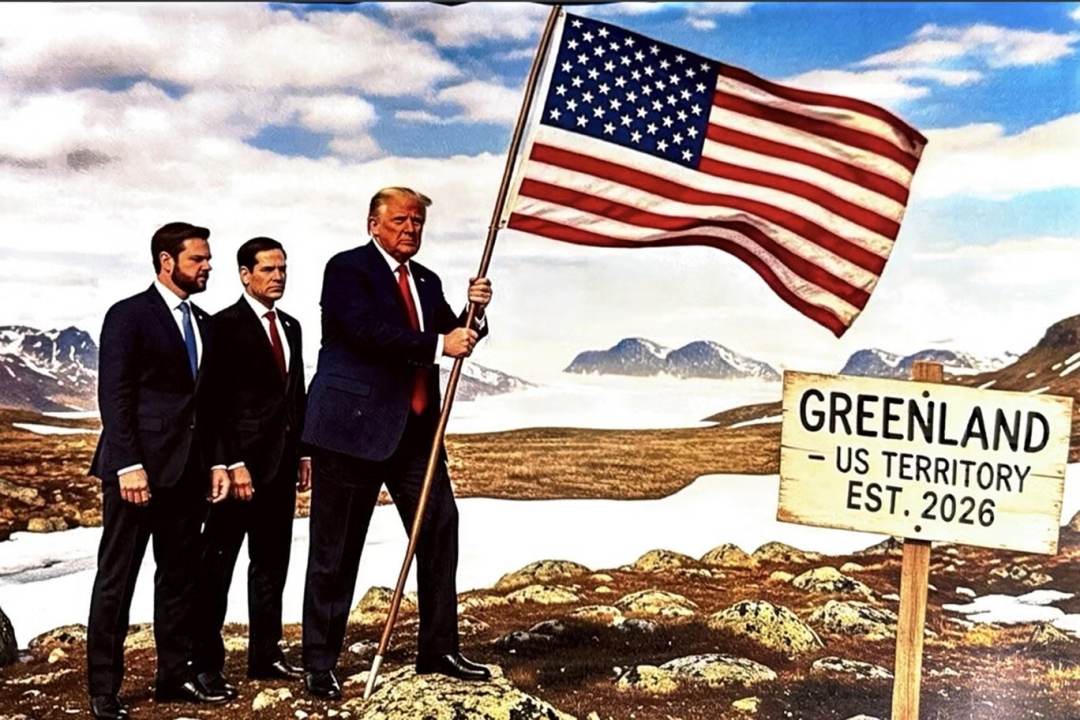
📊 [Chart Placeholder] News screenshot or map related to the Greenland sovereignty dispute
https://truthsocial.com/@realDonaldTrump/posts/115925897257210763
The fundamental difference between this round of trade conflict and past tariff disputes is that the conflict landscape has expanded from bilateral to multilateral. Moreover, the repeated changes in legal basis indicate that policymaking itself has deviated from the institutionalized track, entering a new phase of "instantaneous executive power." Its suppressive effect on risk assets far surpasses the direct economic impact of the tariff rates themselves.
Tail Risk of US-Iran Military Conflict
On February 28, the United States and Israel launched coordinated military strikes against Iran. Oil prices surged within hours, and global financial markets shifted into risk-off mode. As traditional markets were closed for the weekend, the crypto market, as the only 24/7 major asset class, bore the brunt of the safe-haven selling pressure. Bitcoin dropped from $65,500 to $63,000 within an hour, liquidating over $515 million in leveraged positions.
This event once again verified a fact: Under the current institutional participation structure, crypto assets act more as a "liquidity relief valve" during extreme risk events rather than a safe haven. When traditional markets are closed, the crypto market becomes the only channel for global funds to release risk. Its price behavior reflects liquidity structure more than fundamental logic.
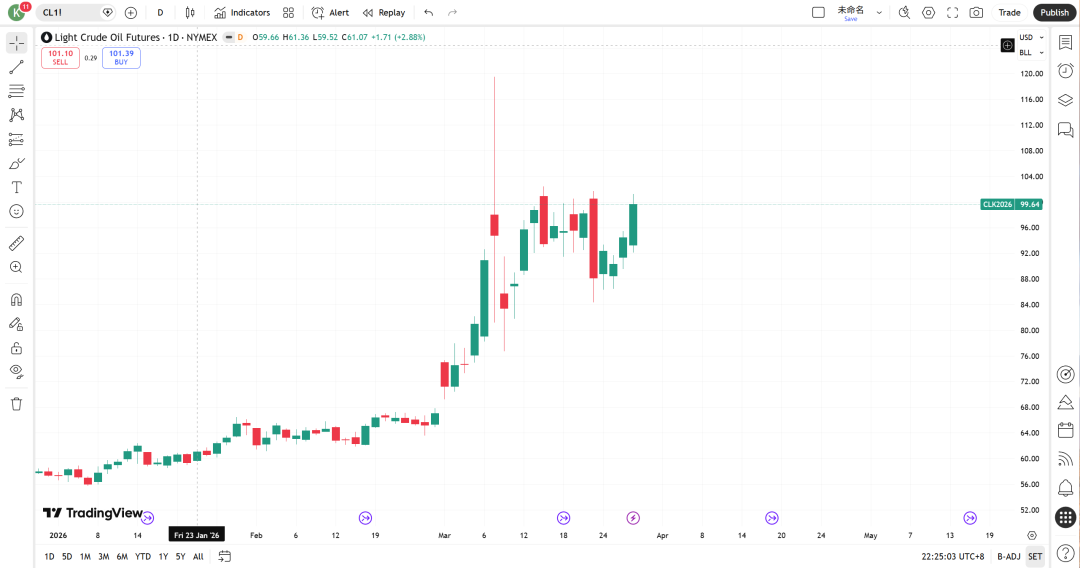
Crude Oil Price Trend in Q1
https://www.tradingview.com/chart/WZsS9J3A/?symbol=NYMEX%3ACL1!
The impact went far beyond price levels. Within hours of the attack, the Iranian leadership announced it would block the Strait of Hormuz, one of the most critical arteries for global oil transportation, through which nearly 20% of the world's seaborne oil trade passes. This super tail risk superimposed an energy supply shock onto already high global inflation, directly impacting European and Asian economies heavily dependent on imported photovoltaic energy. Even though a surface-level ceasefire was achieved through negotiations days later, the pricing of tail risk has not been fully eliminated. Any escalation of the conflict could trigger a market reaction far exceeding the initial shock.
For the crypto market, this shock absorbed two layers of pressure: first, rising oil prices pushed up inflation expectations, further compressing the Fed's room for rate cuts; second, investor anxiety before market openings could only be released through the crypto market. Meanwhile, Iran's highly uncertain subsequent situation is a key macro variable for geopolitical risk signals in Q2. If the conflict escalates further under the political logic of a midterm election year, the suppression of risk assets may be more than a repeat of Q1.
The Fed: Reversal of the Rate Cut Path and Delay of the Liquidity Inflection Point
Macro-wise, BTC, as a marginal market within the financial industry, has historically shown significant correlation with the Fed's interest rate policy.
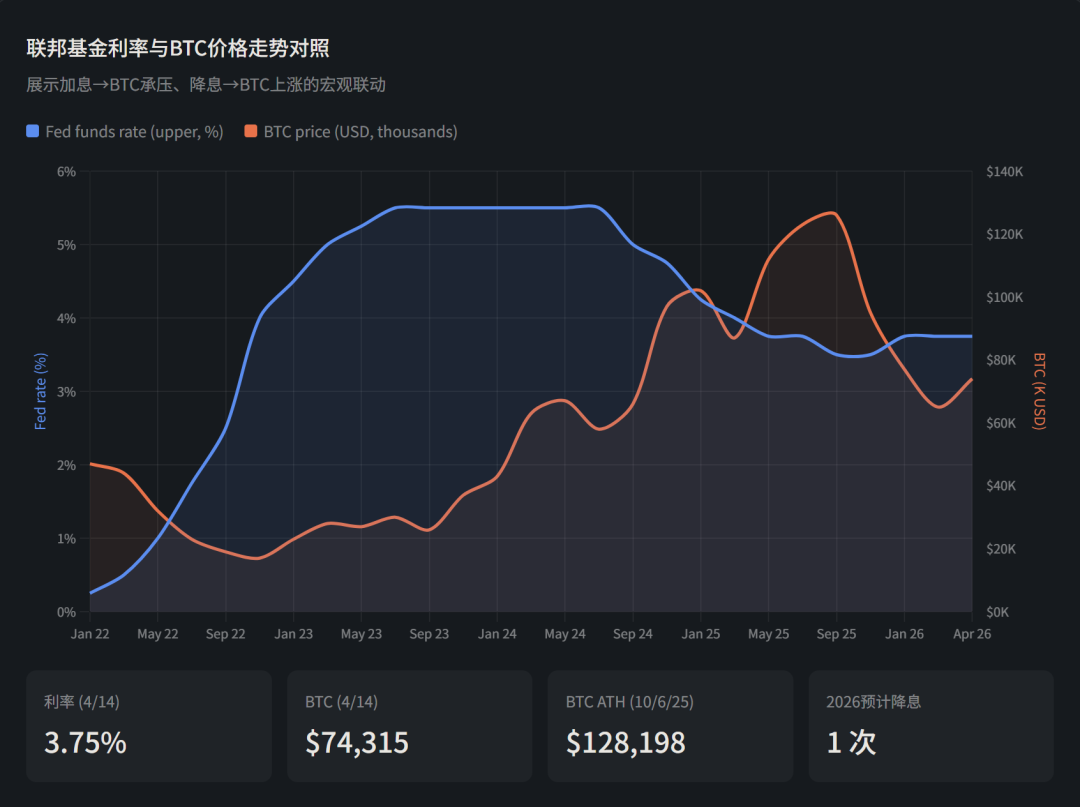
Fed Interest Rate vs BTC Price (2022–2026)
Starting from 2022, there have been roughly four distinct cycles.
2022-2023: Hiking Cycle → BTC under Pressure
The Fed began aggressively hiking rates from near zero in early 2022, eventually reaching 5.5%. During the same period, BTC plummeted from ~$47K to $16K. High interest rates increased the opportunity cost of holding non-yielding risk assets like BTC, leading to capital outflows.
Late 2023 - Early 2024: Pause in Hikes → BTC Bottomed Out and Recovered
While rates were maintained in the 5.25%-5.50% range, the market began pricing in expectations of rate cuts. BTC rebounded from $16K to above $60K. Furthermore, in January 2024, the SEC approved 11 spot BTC ETFs, marking Bitcoin's formal entry into the mainstream financial system.
September 2024 - October 2025: Rate Cutting Cycle → BTC Surged
The Fed cut rates for the first time in September 2024 by 50 basis points, followed by three consecutive cuts totaling 100 basis points that year. In 2025, three more cuts were completed, bringing the cumulative reduction to 1.75%. During this period, BTC surged from $66K to an all-time high of $128,198.
End of 2025 to Present: Rate Cut Pause + Geopolitical Conflict → BTC Correction
The Fed maintained rates at 3.50%-3.75% during its January and March 2026 meetings. The reason is that rising oil prices pushed up inflation expectations, with PCE and core PCE forecasts both revised up to 2.7%. Combined with heightened tensions in the Middle East, BTC fell from $126K to its current level around $74K.
Current Rate Cut Expectations
Rate cuts reduce the opportunity cost of holding BTC and increase market liquidity, historically strongly correlated with BTC price increases. The Fed's dot plot indicates one rate cut is expected in 2026, which is not a positive signal for BTC's price.
During Q1, the Fed's policy path underwent a gradual hawkish turn. Expectations for rate cuts were progressively compressed from two at the start of the year to nearly zero.
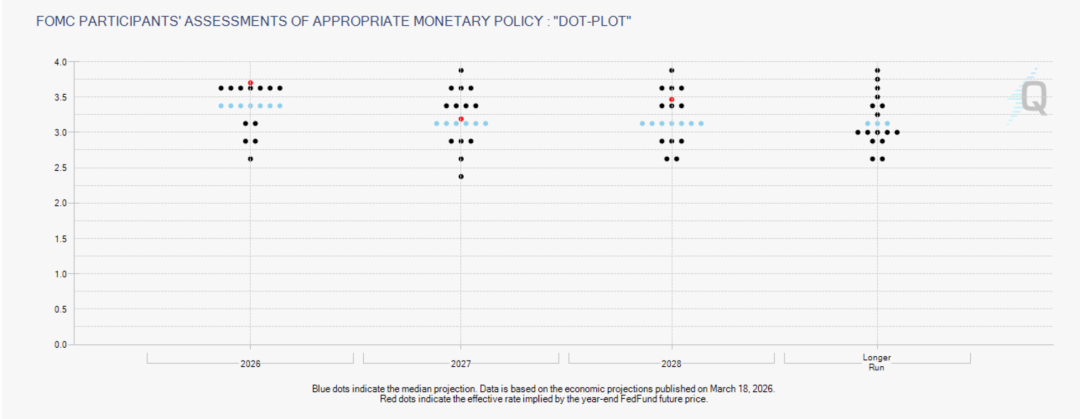
Dot Plot
https://www.cmegroup.com/markets/interest-rates/cme-fedwatch-tool.html
The FOMC meeting on January 28 maintained the federal funds rate at 3.5%–3.75%, the first pause after three consecutive rate cuts in 2025. Powell reiterated in his post-meeting statement that "more data is needed to confirm inflation is sustainably declining," with cautious but neutral language. However, the minutes released on February 18 revealed much deeper internal divisions than the statement suggested. The minutes showed several officials explicitly mentioned the possibility of a rate hike scenario, the first such language in the minutes since 2023, causing cracks in market confidence regarding rate cuts.
On January 30, Trump announced the nomination of former Fed Governor Kevin Warsh to succeed Powell as Chair (formally submitted to the Senate on March 4), with an expected start in May. Warsh, the youngest and one of the most hawkish members during his tenure as a Fed governor from 2006 to 2011, resigned in opposition to QE2. Notably, his public stance has softened somewhat in recent years, advocating that AI-driven productivity gains have a structural deflationary effect, thus supporting lower rates. However, his most prominent label remains "balance sheet reduction before rate cuts." Warsh has frequently criticized the Fed for maintaining an overly large balance sheet, blurring the lines between monetary and fiscal policy, advocating for substantial balance sheet reduction before considering rate cuts; even if the nominal rate falls slightly, the liquidity tightening from aggressive balance sheet reduction could offset the effects of rate cuts (some analysts estimate reducing the balance sheet by ~$1 trillion is roughly equivalent to a 50bp hike). Market interpretation of his nomination was generally hawkish, with some institutions labeling it an "intriguing choice for a president who wants low rates." Following the announcement, precious metals fell first (gold down 1.9% for the week), the dollar strengthened, and the market began repricing what a Fed led by such a chair would mean.
Entering February, the situation became more complex. The US-Israeli military strikes against Iran on February 28 (see Section 1.2) sent oil prices surging past $100/barrel, fundamentally changing the inflation landscape. The cost-push inflation from tariffs had yet to be digested when a supply-side energy shock was superimposed, creating dual inflationary pressure. The policy space for rate cuts was severely compressed, and the market began to seriously discuss a previously absurd possibility: the next step might be a rate hike, not a cut.
The March 18 FOMC meeting put this into black and white. The meeting voted 11:1 to keep rates unchanged (the January meeting was 10:2, with Miran and Waller dissenting; in March, Waller switched to favor, with only Miran dissenting, a hawkish convergence signal in itself). The post-meeting statement specifically added language about the "uncertainty regarding the economic impact of developments in the Middle East," formally incorporating war factors into the Fed's decision-making framework. The updated Summary of Economic Projections (SEP) and dot plot released a clear hawkish signal: the 2026 inflation forecast was raised to 2.7%, the median dot plot maintained one rate cut for the year (consistent with December, with Powell explicitly stating "the median has not changed"), but 14 of the 19 committee members expect only 0-1 rate cuts this year, a clear hawkish skew in distribution. The CME FedWatch tool shows market expectations for rate cuts this year compressed from two at the start of the year to at most one, with the probability of zero cuts rising significantly.
The unemployment rate forecast remained at 4.4%, GDP growth was slightly revised up, presenting an overall picture of growth resilience + inflation stickiness, a stagflationary prototype. Bitcoin promptly fell from $74,000 to $70,900, with ETF net outflows of $129 million on the day. Some market analysts pointed out that Warsh's first move upon taking office might not be a rate cut but a hike.
Looking back at the entire first quarter, the collapse of rate cut expectations was not an event but a process. From the rate hike discussions emerging in the January minutes, to the hawkish personnel expectations from the Warsh nomination, to the secondary inflationary shock from the Iran war, to the March dot plot compressing the year's rate cuts to one, the two rate cuts expected by the market at the start of the year were stripped away layer by layer. The "Higher for Longer' narrative re-dominated. The market generally believed earlier that the "rate inflection point was confirmed, and the liquidity inflection point was just a matter of time," but the evolution in Q1 presented a more extreme answer: not only is the liquidity inflection point far off, but the rate inflection point itself faces the risk of being overturned. If Warsh's advocated combination of rate cuts and balance sheet reduction materializes, it means that even if the nominal rate falls, the actual liquidity environment might become tighter, and the suppressive effect on risk assets should not be underestimated.
Against this macro backdrop, global risk assets are under broad pressure: the S&P 500 is down over 5% year-to-date, the Nasdaq has fallen even more; gold ETFs have absorbed over $160 billion in funds; Bitcoin ETFs saw net outflows of $3.8 billion in February alone. The signal of capital migrating from digital gold to physical gold is extremely clear. ArkStream Capital will continue to monitor the evolution of rate cut expectations and geopolitical situations, which are the core variables for determining the subsequent window for the liquidity inflection point.
Bitcoin and Capital Structure: Narrative Disproof, ETF Divergence, and Institutionalization Process
Stress Test for Digital Gold
One of the most noteworthy structural changes in Q1 is the significantly enhanced correlation of Bitcoin with the Nasdaq index during periods of stress. During the market stress test, Bitcoin not only failed to provide a hedging function, but instead showed a nearly synchronous downward trend with tech stocks.
From a behavioral finance perspective, this is not surprising. Since the ETF approval, institutional investors have incorporated Bitcoin into the same risk budget framework as growth tech stocks. When macro risk appetite contracts, deleveraging and position reduction are systematic and do not treat different asset classes differently. This jump in correlation marks a new phase in Bitcoin's identity transformation within the institutionalization process: it is evolving from an independent alternative asset into a high-beta subset within the global risk asset portfolio.