王纯细数Zcash黑历史,炮轰ZEC“德不配位”


- 核心观点:Zcash(ZEC)在三个月内暴涨近400%至1200美元上方,但这一涨势被业内视为“叙事驱动”而非价值重估;F2Pool联合创始人王纯公开炮轰ZEC“德不配位”,指出其存在不公平启动、治理混乱及安全漏洞等系统性缺陷。
- 关键要素:
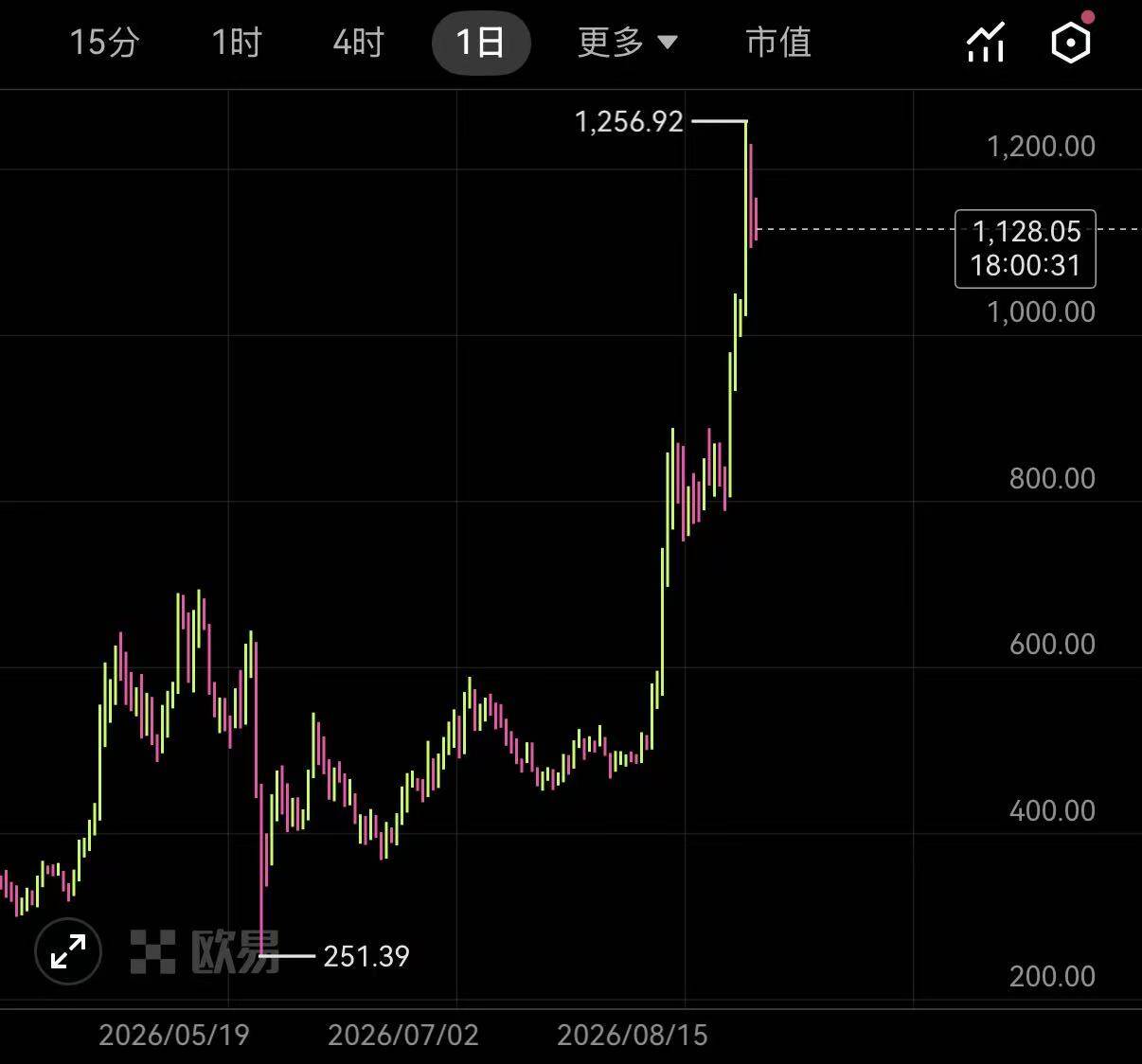
- ZEC于9月6日突破1000美元,最高触及1256.92美元;自6月Orchard漏洞曝光时的251.39美元低点计算,最高涨幅接近400%。
- 王纯批评Zcash团队连EST与EDT时区都分不清,质疑其专业性,并称拉黑该公司是“最正确决定之一”。
- Zcash启动即不公:前四年每区块奖励20%作为“创始人奖励”,累计约210万枚ZEC(占总供应量10%);2020年起又以“开发基金”名义延续该抽成机制。
- 隐私功能非强制属性:Zcash同时支持shielded和transparent交易,多数交易所及钱包仅支持透明地址,批评者认为“可选隐私”削弱了其核心叙事。
- 2026年1月,核心开发公司ECC全员离职,与治理机构Bootstrap公开冲突后“整队出走”,暴露高层治理彻底崩塌。
- 2026年5月曝光的Orchard隐私池漏洞潜伏约四年,理论上可无限铸造假ZEC,且因隐私属性无法验证是否被利用,直接导致6月币价腰斩。
- 链上最大ZEC空头Garrett Jin以3倍杠杆做空4511万美元ZEC,均价576.3美元,虽浮亏2220万美元仍持续加仓看空。
Original by Odaily Planet Daily (@OdailyChina)
Author: Azuma (@azuma_eth)
Zcash (ZEC) is in the midst of an epic, explosive rally.
OKX market data shows that ZEC broke through the $1,000 mark on September 6, reaching a high of $1,256.92. As of 14:00 today, it has eased slightly but is still quoted at $1,128.05. Calculated from the low of $251.39 in early June when the Orchard vulnerability surfaced, ZEC has surged nearly 400% in just three months.
However, despite ZEC's meteoric rise in the secondary market, not everyone in the court of public opinion is convinced.
Wang Chun Lashes Out at Zcash
Around midday today, Bitcoin super OG and F2Pool co-founder Wang Chun (@satofishi) fired off multiple tweets, dredging up Zcash's checkered past and bluntly stating, "Blacklisting that team remains one of the best decisions I've ever made."
- Odaily Note: Regarding Wang Chun, he is now more widely known for being the "first astronaut heading to Mars." In May of this year, SpaceX officially announced that Wang Chun would board the Starship for its first crewed interplanetary mission to Mars. The mission plans a two-year deep-space flight, passing Mars (without landing) after leaving the Earth-Moon system, before returning to Earth. For details, see The Post-80s Kid from Tianjin Set to Become the First Person to Go to Mars.
First, at 12:52, Wang Chun retweeted a post from six years ago where he criticized the Zcash team for not understanding daylight saving time, questioning their professionalism.
Six years ago, a member of the Zcash team emailed me, consistently confusing EST (Eastern Standard Time) and EDT (Eastern Daylight Time). Communication became impossible to move forward, so I simply blacklisted their entire company. Looking back six years later, it's still one of the best decisions I've ever made. Remember the BlockFi blunder? They were supposed to send users $701.4 but mistakenly transferred 701.4 Bitcoin instead. Someone who can't tell EDT from EST will likely mix up BTC and USD too.
Then, at 13:17, Wang Chun commented on ZEC again, this time with even more aggressive language, arguing that ZEC's market cap is undeserved.
Zcash's recent surge is purely narrative-driven. A large market cap doesn't mean a token deserves its current position; ranking next to Solana and Hyperliquid on the market cap charts doesn't mean Zcash can do what those two do.
Its launch was unfair from the start. For the first four years, 20% of every block reward was deducted as a "Founders' Reward." That money went to founders, employees, advisors, and early investors, totaling 2.1 million ZEC—10% of the 21 million total supply cap. Bitcoin only rewards miners, but Zcash also had to feed a company and its backers. When the first cut was supposed to end, another 20%-style levy resurfaced under the guise of a "development fund." A token that writes self-enrichment clauses directly into block rewards has no right to be packaged as a clean, neutral currency.
That levy didn't buy a real economic ecosystem. Privacy is its marketing pitch, yet using privacy features is optional. For exchanges and simple wallets, transparent addresses have always been the path of least resistance. For most of Zcash's history, the vast majority of tokens were exposed in the open. "Optional privacy" is just a marketing gimmick; "default privacy" is what the underlying protocol should be. Meanwhile, team governance has been mired in internal boardroom strife: Electric Coin Company (ECC), the Foundation, Bootstrap, brand ownership, wallet control, and who gets a slice of the pie. In January 2026, the entire ECC team resigned en masse, claiming they had been pushed out. This isn't a trivial matter; this is the project's real operating ecosystem. A core team that can't even coexist under one roof with its own nonprofit board can hardly be called "decentralized"—it's a sign of a collapsed upper-level structure.
Then came the security mess the market is now trying to gloss over. In May 2026, a critical vulnerability in the Orchard pool was publicly disclosed. The bug had been dormant for roughly four years. In theory, it could mint fake ZEC out of thin air without leaving clear on-chain traces. And because the pool is private, no one can prove whether any counterfeit coins were ever created. The "Ironwood" upgrade in July shut down the old pool and forced tokens through a migration checkpoint. That's cleaning up a mess, not a justification for a top-ten market cap ranking. A currency that can't verify its supply like Bitcoin, and even had to undergo emergency fixes after a four-year vulnerability, doesn't qualify as "sound money."
The conclusion is obvious: an unfair launch, team levies disproportionate to product strength, years of high-level infighting, and a massive hole lurking in a privacy pool for four years—these aren't the track record of a top-ten network, but the true portrait of a story coin. You can dislike Solana and Hyperliquid for your own reasons, but they at least carry real application demand. Zcash, on the other hand, is carrying nothing more than an exchange listing and a short-squeeze frenzy. These are fundamentally different. Confusing the two is as absurd as transposing 701.4 assets in a transfer, or treating EST (Eastern Standard Time) and EDT (Eastern Daylight Time) as the same hour.
A Look Back at the Checkered Past
In short, setting aside the timezone-related professionalism issue, Wang Chun's tweets raised four main points of contention about Zcash.
The 20% "Insider Cut"
The earliest criticism of Zcash centered on its launch mechanism, which diverged sharply from Bitcoin's. After its mainnet launch in 2016, 20% of every block reward during Zcash's first four years did not go to miners but was allocated as a "Founders' Reward" to founders, early employees, advisors, investors, and related parties like Electric Coin Company (ECC). This allocation ultimately totaled approximately 2.1 million ZEC, or 10% of the maximum total supply.
What's more noteworthy is that after the Founders' Reward expired in 2020, the 20% block reward levy didn't completely disappear. The Zcash community introduced a new Dev Fund via ZIP 1014, which continued to allocate 20% of block subsidies to Bootstrap, the Zcash Foundation, and Major Grants from 2020 to 2024.
While the use of funds and governance structure differed from the original Founders' Reward, critics argue this still means Zcash has long maintained a "developer levy" mechanism distinct from Bitcoin's.
A "Privacy Coin" That Lets You Choose Not to Be Private
Zcash's second controversy stems from its core product positioning—privacy.
Zcash does not mandate privacy protection for all transactions; instead, it supports both shielded transactions and transparent transactions. Users can choose whether to use privacy features based on their wallet or exchange's support; indeed, some wallets and exchanges still only support transparent transactions. Zcash's official documentation explicitly reminds users that to keep their transaction and financial history private, they need to use wallets or services that enable shielded transactions by default.
This creates a contentious product positioning—Zcash does possess unique privacy technology, but privacy is not a mandatory attribute at the protocol level. For users, not using privacy features is often more convenient; for exchanges and wallets, transparent addresses are easier to support and monitor.
Wang Chun's "optional privacy" criticism isn't fundamentally denying Zcash's privacy technology; rather, it questions whether Zcash, when a significant portion of network transactions remain publicly visible, can sustain its current valuation on the "privacy currency" narrative alone.
Core Team's Public Feud Ends in a Split
If the first two issues stem from Zcash's historical design, the ECC turmoil earlier this year directly exposed fractures at the project's governance level.
In January 2026, the entire team at Electric Coin Company (ECC), Zcash's core development firm, departed en masse. ECC CEO Josh Swihart stated at the time that the team was forced out due to serious disagreements with the Bootstrap board, the nonprofit organization responsible for governing ECC. Bootstrap, for its part, attributed the conflict to governance arrangements and legal constraints on nonprofit organizations.
The turmoil didn't ultimately halt Zcash—the former ECC team subsequently formed a new company to continue Zcash development, and in late February, Bootstrap announced a resolution: ECC would gradually wind down operations while relevant technical assets were transferred.
But from an external perspective, a project whose core development team and governance body clash publicly, culminating in an "entire team walkout," hardly aligns with the image of a highly decentralized, maturely governed protocol. This became one of Wang Chun's key pieces of evidence for arguing ZEC is "undeserving of its position."
The Orchard Vulnerability Lurking for Four Years
What truly put Zcash's "sound money" narrative to the test was the Orchard vulnerability exposed in May of this year.
On May 29, security researcher Taylor Hornby discovered a critical flaw in the zero-knowledge proof circuit of the Orchard privacy pool. According to Zcash's disclosure, the vulnerability theoretically could have allowed an attacker to manufacture unlimited quantities of fake ZEC undetectably. Even more problematic, because Orchard inherently possesses privacy attributes, even after the vulnerability was patched, there's no cryptographic way to prove whether anyone exploited it to create counterfeit coins during the exposure window.
Zcash swiftly implemented emergency measures, temporarily suspending Orchard-related operations and re-enabling the patched circuit via the NU6.2 upgrade, completing the entire emergency remediation process within days.
The crux of the issue is that for an asset built on narratives of scarcity, privacy, and "digital cash," "theoretically infinitely inflatable, with no way to prove post-hoc whether it actually happened" is an extremely severe trust problem in itself. This was the direct cause of ZEC being beaten down to lows around $250 in early June, and it remains the project's most difficult "historical stain" to circumvent.
Another Big Player Is Heavily Shorting
Beyond Wang Chun's commentary, another major player is expressing bearish views on ZEC with real capital.
Garrett Jin, known as the "1011 insider whale agent," is currently the largest on-chain ZEC short seller. Earlier this morning, Garrett Jin closed out a Bitcoin long position with a notional value of $106.18 million and instead increased his short position on ZEC.
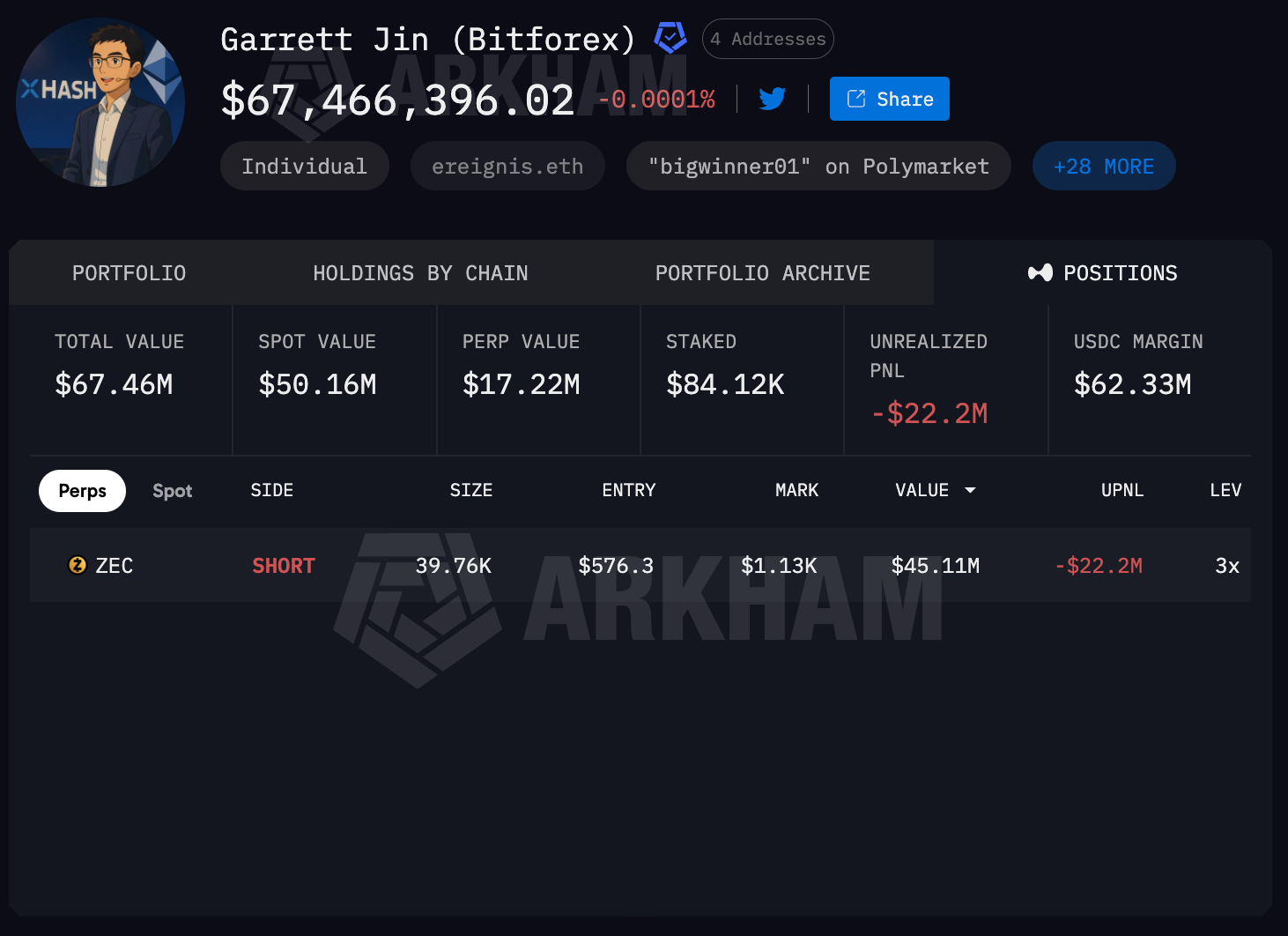
Currently, Garrett Jin is shorting $45.11 million worth of ZEC with 3x leverage, at an average entry price of $576.3, sitting on an unrealized loss of $22.2 million—yet Garrett Jin appears extremely resolute, having added to his short positions multiple times as ZEC's price continued to climb.
How Much Longer Can ZEC Keep Rising?
Of course, neither Wang Chun nor Garrett Jin can alone dictate ZEC's price through mere bearish sentiment or short positions. In fact, having rallied from $250 to over $1,200, ZEC has already demonstrated that the return of the privacy narrative, capital chasing momentum, and short squeezing can completely outweigh fundamentals in the short term. As long as market sentiment continues to heat up, ZEC certainly shouldn't rule out further upside.
But the problem is, after this nearly 5x rally, ZEC can no longer be easily explained away as "undervalued." When the short-squeeze行情 gradually ends (maybe after one more squeeze on Garrett Jin?), and profit-taking pressure intensifies, the market will ultimately have to return to fundamentals: Beyond the privacy narrative, what else does Zcash have to support a higher valuation? Particularly the issues mentioned earlier—launch mechanism, optional privacy, governance rifts, and the Orchard vulnerability—none of these problems have automatically disappeared because the coin price went up.
Therefore, rather than predicting whether ZEC's next stop is $1,500 or $2,000, perhaps the more telling observation will be: once hot money recedes and shorts are no longer forced to cover, how much premium is the market actually willing to leave on ZEC? That will also determine whether this explosive rally represents a genuine revaluation of an established privacy coin, or just a super-cycle driven by narrative and liquidity.