






2021年,Robinhood 关闭了 AMC 的买入键;2026年,它却无限增发 AMC 股票代币


- 核心观点:Robinhood Chain 上的股票代币 Meme 币虽能在短期内推动真实股价,但由于授权参与人(AP)的申购赎回机制可灵活增发供应,轧空逻辑失效,市场影响有限且难以持续。
- 关键要素:
- AMC 事件中,发行代理在三天内将代币化股票供应量扩大 19 倍(从 152,106 股增至 2,895,758 股),有效稀释了买盘压力。
- 链上资金确实能触及真实市场,例如 AMC 周末约 760 万美元的真实股票买入,最高占盘前成交量的 7.6%,但相比其日均 1.5 亿美元的成交规模仍属微小。
- AP 机制是一个负反馈循环:其买入旨在消除溢价,一旦成功便自动停止,无法形成轧空所需的螺旋式正反馈。
- 真正的风险窗口出现在美股休市期间(如长周末),此时申购通道关闭,流通盘近乎“冻结”,代币价格可与真实股价脱锚(AMC 代币曾一度达到股价的 7 倍)。
- Meme 币本质是“注意力资产”,其价格波动主要受企业 CEO 的关注度影响,而非公司基本面;Aron 的敌意帖子曾引发最大幅度价格波动。
- 关键风险因素是日历(闭市期),而非公司基本面;冷门标的长周末叠加低流通供应,是脆弱性最高的时刻。
Original Author: Mario Chow
Source: IOSG Ventures
In January 2021, retail investors were able to squeeze GameStop's short sellers because the float was locked up—shorts couldn't conjure up more shares to cover. It ultimately took Robinhood shutting off the buy button to end it.
Five years later, a batch of meme coins has emerged on Robinhood's own chain—but their quote asset isn't the U.S. dollar. It's tokenized stock of real listed companies. $BONER is priced in Hims & Hers, $MEME in AMC, and $AI in Nvidia. The accompanying narrative is still a short squeeze: pump the coin, drive up the tokenized stock price, and force the institution maintaining the peg to buy real shares in the secondary market.
We reconstructed the complete mint-and-burn records for all tokenized stocks on this chain. Here's the summary in one sentence:
The on-chain price can indeed be pushed—and quickly. But the issuer will then fix it, usually within a single morning.
Below are four specific findings.
The money did reach New York. Over that AMC weekend, Robinhood's issuance agent bought and custodied approximately $7.6 million in real AMC shares in the secondary market, accounting for as much as 7.6% of pre-market volume at its peak. So it's simply wrong to claim this system never touches the real market.
But the float is now live, and that's where the market-manipulation logic breaks down. The same agent expanded the supply of tokenized AMC 19-fold in three days—from 152,106 shares to 2,895,758. The Hims round grew from 468 shares to 130,876. The issuer keeps printing underneath your feet; you can't lock up any float. In 2021, Robinhood prevented retail from buying. In 2026, it sells freely—and makes a spread on top. This latter defense is far more effective.
So what you get is a needle, not a squeeze. And the needle isn't small: AMC spiked as high as +22% in pre-market, Farmmi jumped +321% intraday, and both gave back most of those gains within a week. A squeeze persists because covering forces more covering. These two faded because the mechanism responsible for transmitting capital is inherently self-terminating.
There's also a scale problem almost nobody has quantified. Even targeting the cheapest instrument, engineering a genuine squeeze would require a $3.4 billion meme coin—thirteen times larger than the biggest project in this chain's history—to yield roughly 9% upside.
And it's worth clarifying exactly what buying these coins gets you. It's not exposure to the company. What these coins truly price is whether the company will notice you. The largest price move in this entire episode came from a CEO's post on a Thursday evening—and Adam Aron's attitude was far from friendly: he called the tokens disgusting and retained securities counsel. The token still hit seven times the stock price overnight. The real return here is corporate attention, and it pays out whether the attention is friendly or hostile. The short squeeze is the version of the return that gets marketed—and that version doesn't survive arithmetic.
The genuinely valuable asset in the tokenized-stock pipeline isn't the meme coins, nor the launchpad—it's the subscription-redemption channel. That's the whitelist.
The Weekend AMC Came Back
Thursday, September 3, 5:18 PM New York time, 78 minutes after the close. AMC CEO Adam Aron posted that Robinhood's tokenized AMC was "contemptible, outrageous, and disgusting," adding that he had retained outside securities counsel.
Crypto Twitter saw something else. Within six hours, two meme coins named after the tweet—$CINEMA and $MEME—were trading in pools priced in tokenized AMC. The NYSE was already closed. And the token, which theoretically should equal exactly one share of AMC, traded at $18.04.
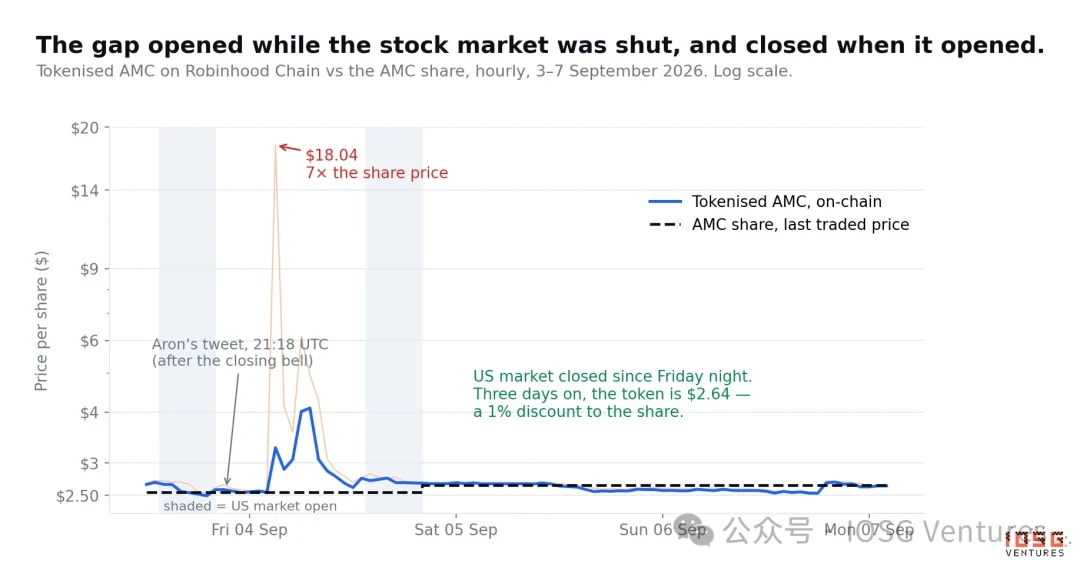
The real stock closed that day at $2.54. Sevenfold, overnight. The underlying was a company whose entire investment thesis is "survived the last mania."
At the next day's open, the gap vanished—but the process looked nothing like most people assume. The stock hit $3.11 in the first fifteen minutes of pre-market, up 22%, then slid all the way back to close at $2.65. Section 6 will break down that hour. It's the most misread hour of the entire episode.
That's precisely why the AMC case is so useful. Everything the squeeze theory says should appear, did: a real meme stock ticker, a real CEO, a real crowd, a real depeg, and real buy orders hitting the tape. The stock still ended the week where it started.
Stock Tokens on Robinhood
Three things need introducing first, because none of them existed eighteen months ago.
Robinhood Chain is a public chain operated by Robinhood itself. The hundred most active pools turn over roughly $1.65 billion per day, the vast majority of it in ordinary crypto assets.
Stock tokens, issued by Robinhood Assets (Jersey) Limited, track a single U.S. listed stock. Legally they are not shares but debt instruments that pay you the economic return of one share, backed by real stock held at a broker custodian. In practice, one token equals one share of exposure, and licensed intermediaries (Authorized Participants, or APs) can subscribe and redeem at fair value. It's the same machine as an ETF.
Launchpads refer to sites like long.xyz, where anyone can deploy a meme coin and a trading pool with one click. What changed in August was the quote asset: meme coins used to be denominated in USD; now they're denominated in tokenized stock. You don't buy $BONER with dollars—you buy it with tokenized Hims & Hers.
That single substitution is the whole story, because it means buying a meme coin is buying stock. Your $ETH and $USDG get converted into stock tokens on the way in; the pool accumulates stock; even fees accrue in stock rather than cash. A crowd of meme-coin buyers becomes, mechanically, a bid for a listed company's shares.
Seven of these stock-denominated venues now rank among the chain's hundred most active pools, with combined daily volume of roughly $73 million. This is no longer a niche game.
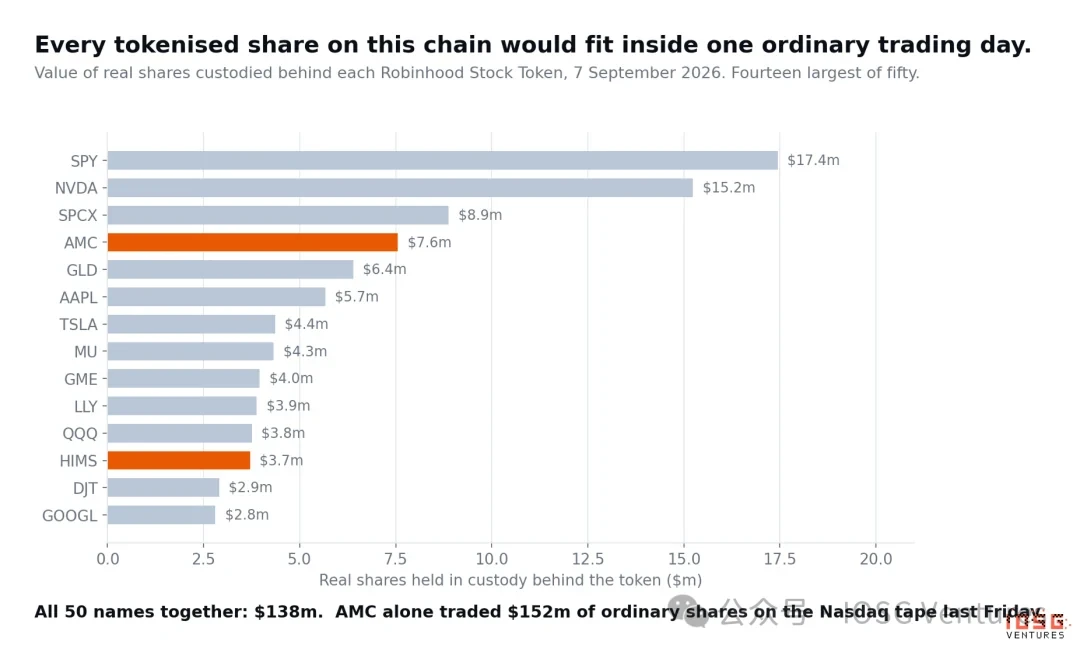
There's one number worth remembering, because it explains most of what follows: across all fifty tokenized stocks on this chain, the backing consists of roughly $138 million in real shares. AMC alone traded about $150 million on Nasdaq last Friday. The entire on-chain stock market doesn't match one mid-cap stock on a busy afternoon.
The GameStop Analogy, and Where It Fails
The squeeze narrative was built in GameStop's image, so let's get 2021 right first.
GameStop worked because of one hard constraint: short sellers had sold roughly 138% of the float. More shares had been borrowed and sold than existed. Retail bought and held, shorts had nowhere to cover, and the stock went from $17 to $483 intraday on January 28. It ended only when brokers restricted buying—Robinhood being the most famous—triggered by a $3 billion clearinghouse margin call. The float was dead. The only leverage anyone had was the kill switch.
Now replay that scene on Robinhood Chain.
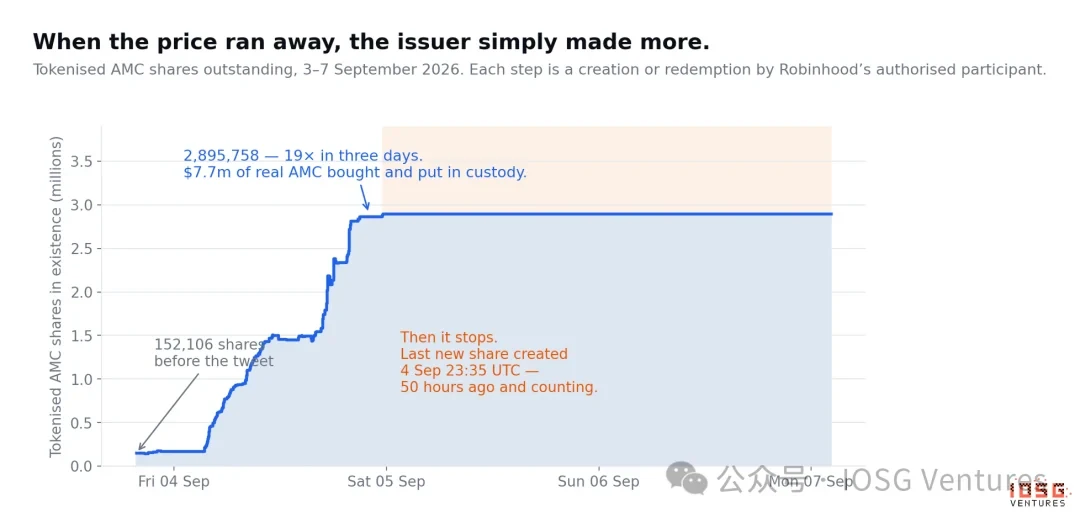
When tokenized AMC ran to seven times the stock price, Robinhood's issuance agent didn't shut down. It went out, bought real AMC shares, placed them in custody, and minted tokens against them. Over three days it created 3.05 million shares, burned 310,000 through redemptions, and the tokenized float went from 152,106 to 2,895,758 shares. Seventy-two hours. Nineteen-fold.
Hims is the same story at a slower pace. When $BONER launched on August 20, Robinhood Chain had just 468 tokenized Hims shares. Now there are 130,876—a 280x expansion, backed by roughly $3.6 million in real Hims & Hers shares bought and custodied. We tested it on September 3: over four days, $BONER's share of tokenized supply fell from 81% to 47%, while its actual token holdings increased. It didn't lose its position—the position got diluted around it.
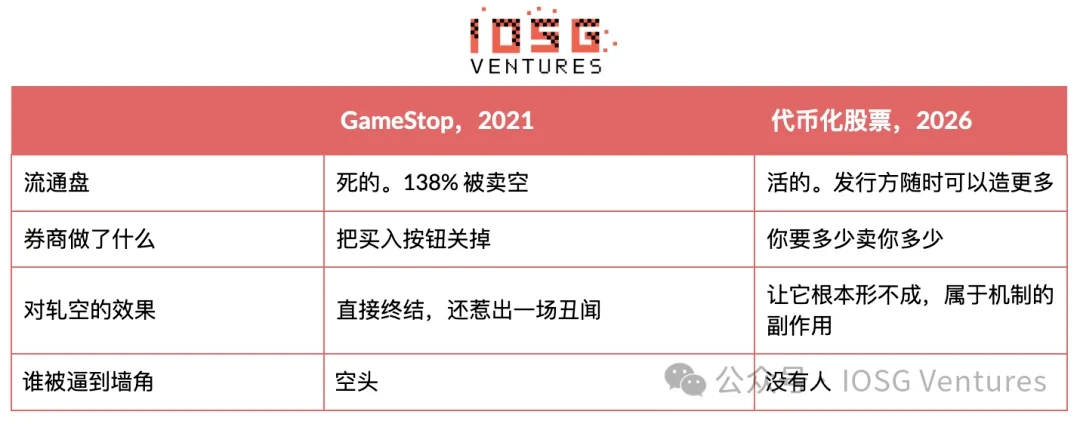
To be clear, though: the subscription-redemption channel wasn't built to stop squeezes. Its purpose is to keep the token tracking the stock—which is the entire reason to hold a tokenized stock rather than a meme coin, and the same machine every ETF uses. The inability to corner the market is just a side effect of a mechanism doing its day job. And the outcome is far better than 2021's shutdown, because nobody got locked out of selling.
What Meme-Coin Buyers Are Actually Betting On
Let's walk the chain from the retail side. The first half holds up; skipping past it would be dishonest.
You buy $MEME with dollars. The router converts dollars into a stablecoin, then into tokenized AMC, and finally into the meme coin. Your money, on the way in, is physically a bid for tokenized stock. When enough buyers pile in, the token prices above the real share price. A premium appears, and the AP has a profitable arbitrage: it buys real AMC on the NYSE, delivers to the custodian, receives newly minted tokens, and sells them into the pool at the premium.
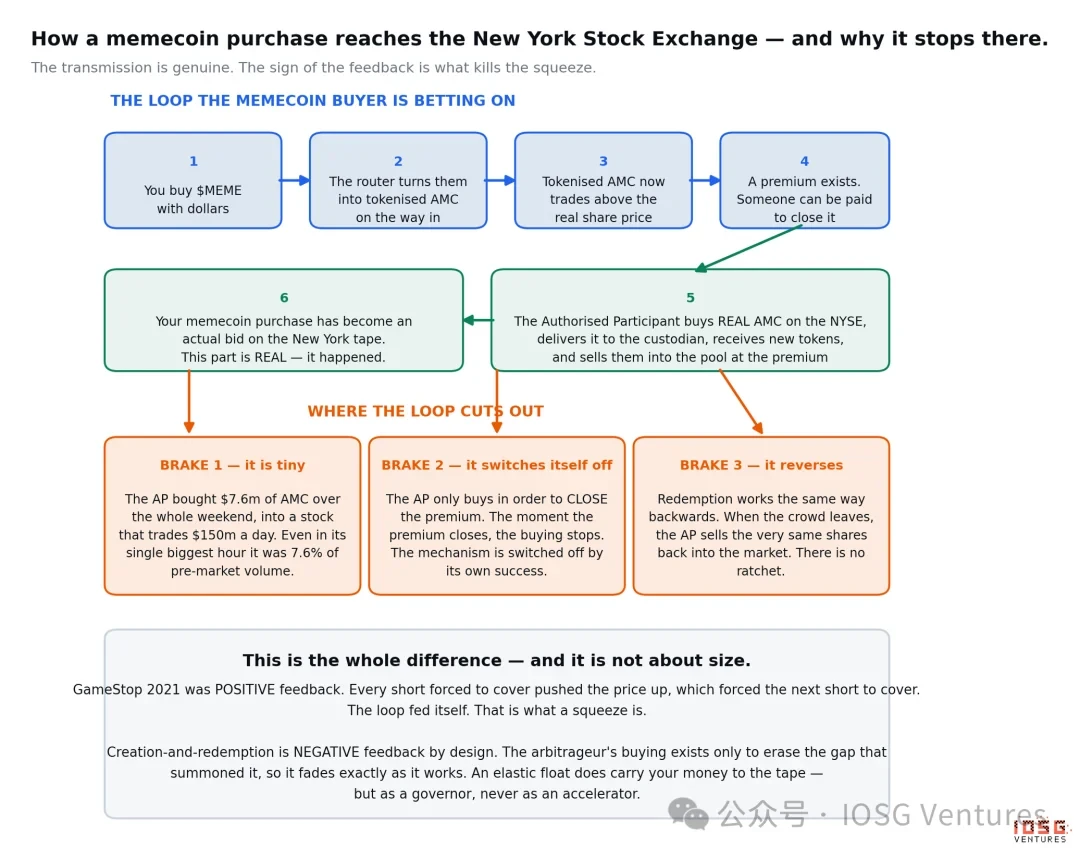
Retail's core judgment was correct. The crowd's money did land on the New York tape as real buy orders. This isn't speculation—it's $7.6 million of AMC over one weekend, with 7.6% of pre-market volume at the densest stretch.
Then the "flywheel" narrative adds another loop: forced buying pushes the stock up, the rising stock validates the story, more people pile into the coin, and the AP has to buy even more. That's the ideal script. It breaks in three places.
First, scale is too small. $7.6 million against a stock doing $150 million a day. In steady state, the AP's footprints are roughly a tenth of a percent of volume.
Second—and this is the killer—the mechanism switches itself off. The AP buys for one reason: to eliminate the premium. Once the premium is gone, the reason to buy is gone. It's switched off by its own success.
Third, it's reversible. Redemption is subscription in reverse. When the crowd dissipates, the AP sells the same shares back into the market.
Put those three together, and the answer to what changed from 2021 to now is clear. And it has nothing to do with size.
GameStop was positive feedback: every forced cover pushed the price higher, forcing the next short to cover. The loop fed itself. That's the definition of a squeeze.
The subscription-redemption mechanism is, by design, negative feedback: the arbitrageur buys only to flatten the very spread that summoned him, so he is disappearing even as he operates. A live float does deliver your money to the tape—but it's a governor, never an accelerator.
A dead float turns buying pressure into a spiral. A live float turns the same pressure into a decaying impact cost. Both can move the stock. Only one can keep pushing.
More bluntly—and this is the sentence most worth remembering in this entire piece: a crowd can indeed push the on-chain price up, and fast. What they cannot do is hold it there, because the moment the stock market opens, the AP plugs the gap. The ceiling isn't set by how large the crowd is. It's set by how many hours until the channel reopens.
The one thing the issuer cannot print is time. See Section 7.
Who Sits at the Table
Don't look at this as a machine. First ask who sits at the table and what each seat gets paid—the picture gets much easier to read.
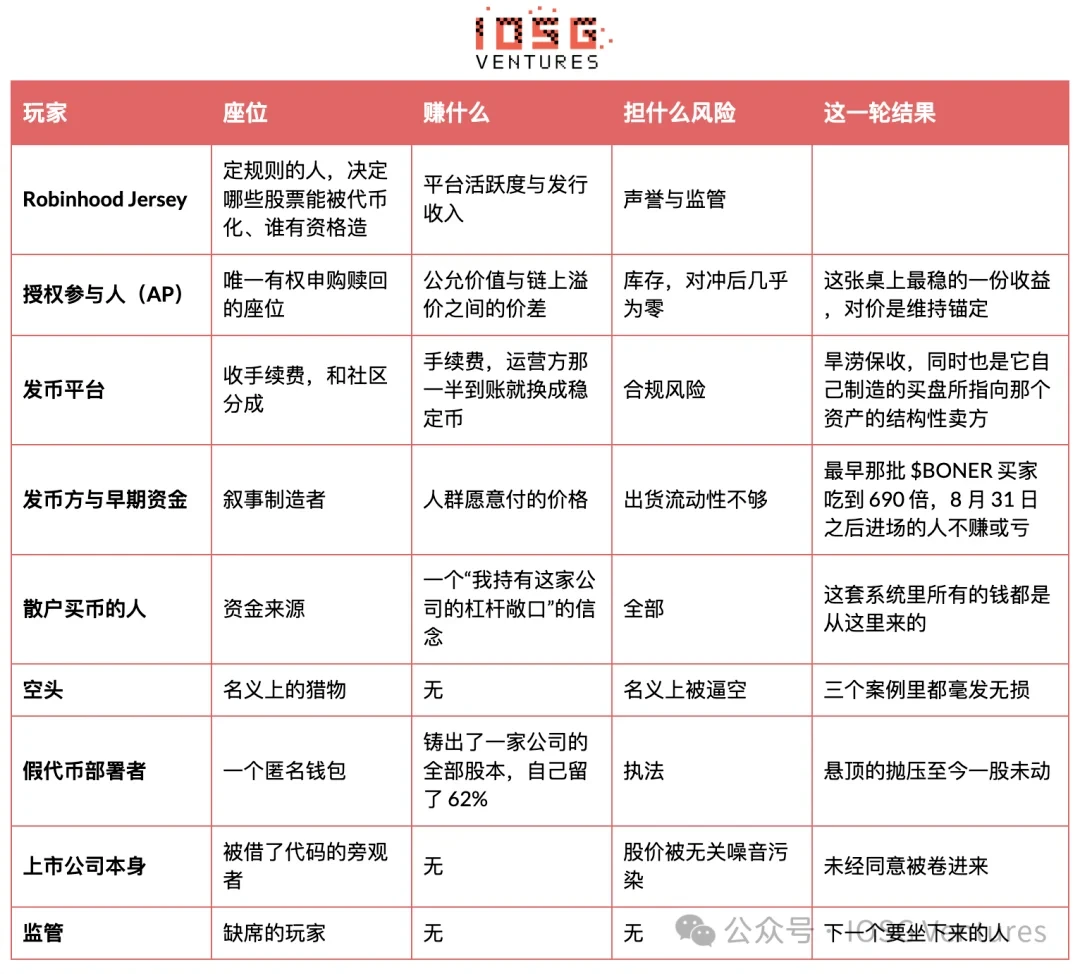
One thing is worth stating directly: the Authorized Participant is the most reliably profitable seat at this table. It mints tokens at fair value, sells them into a premium manufactured by the crowd, then buys them back after the crowd disperses. Over that AMC weekend, it bought and custodied roughly $7.6 million in real stock at prices of its own choosing, selling into a market willing to pay seven times fair value. There is nothing improper here. This is a role with compensation—and it's precisely that compensation that gets someone to do this work at 4 AM. The peg holds because this trade pays. The only thing that matters to us is this: where does sustainable revenue live? It lives here. Not on the launchpads, and not on the coins.
The GameStop Analogy, and Where It Fails
The real question isn't "is this a short squeeze?" It's: can the quote asset be subscribed and redeemed?
Everything else follows from that—because it determines whether a premium is a depeg destined to be arbitraged away, or simply the price of a different asset.
Real Robinhood stock tokens have a Jersey prospectus, a custodian holding real shares, their own series and ISIN codes per underlying, and a whitelist of intermediaries authorized to subscribe. On the block explorer, their names end in • Robinhood Token, and the exchange-rate field has a value.
The fakes need 63 lines of Solidity and about $400 in gas. Fixed supply. No issuer. No oracle. The so-called prospectus says the token is "an operational obligation of the issuer"—meaning nothing on-chain verifies it, and nothing could.
The two look identical on the block explorer, get quoted on the same platforms, and display in the same wallets. The entire difference lives in one nullable field.
Did It Ever Actually Move the Real Stock?
This section needs care, because looking only at closing prices makes the skeptic's job too easy. By the close, AMC rose 4.3% that day—looks like nothing happened. But if you measure from the last pre-event price to the high, including pre-market and after-hours, it's a different story.
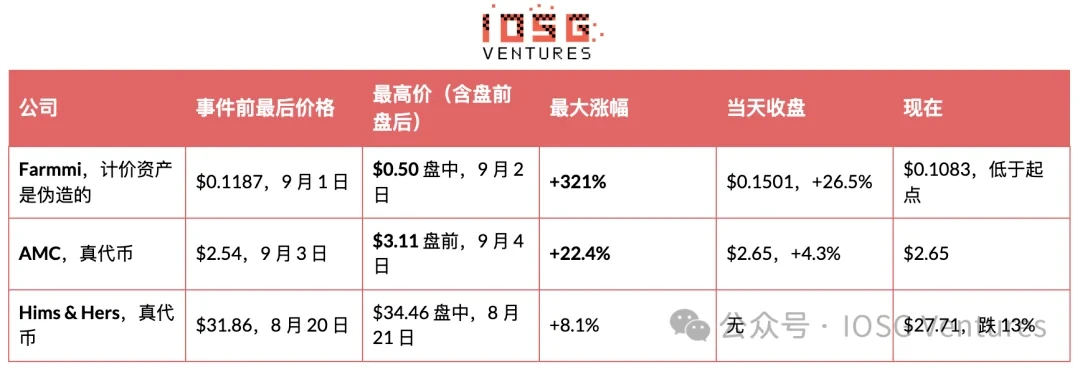
So the honest statement isn't "meme coins couldn't move the stock." It's: they moved it hard, and never once held it.
The September 4 pre-market session is the clearest window into how this mechanism operates, and it's worth watching minute by minute. Compare the on-chain price against Nasdaq's pre-market book rather than the prior close: when pre-market opened at 4:00 AM ET, the token was $4.09 while the last real trade was $2.54—a 61% gap. Fifteen minutes later, the stock printed $3.11 on 8.35 million shares of pre-market volume, while the token was already heading down. Roughly half of that convergence came from the stock moving toward the token, not the token falling back to the stock. That is precisely the transmission the positive-feedback narrative predicts.
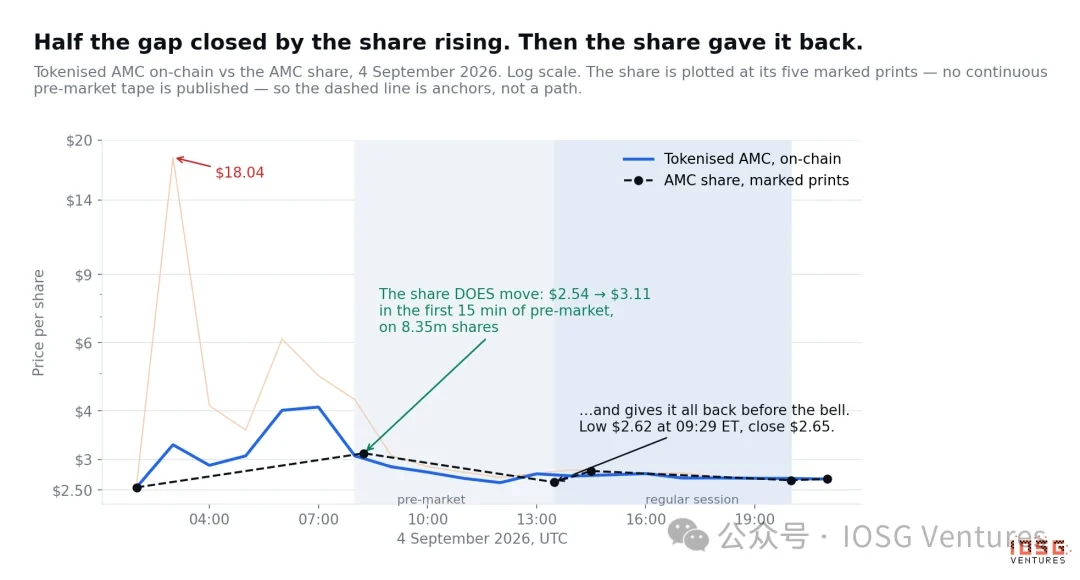
Then it stopped. By 9:29 AM ET, the stock had drifted back to $2.62; the token sat at $2.61. The buying that appeared at 4:15 AM had no second wave, because the premium it was chasing was already gone. The stock closed at $2.65.
Place the three episodes in their own histories and the pattern inverts expectations: AMC traded 57.2 million shares that Friday—1.9 times its normal volume, yet only the fifteenth-busiest session in six months. On July 20, AMC moved 186.8 million shares with no meme-coin involvement whatsoever. Hims volume never left its normal range. Farmmi, meanwhile, traded 872.6 million shares on September 2 against a normal daily volume of 45,000—roughly a factor of nineteen thousand.
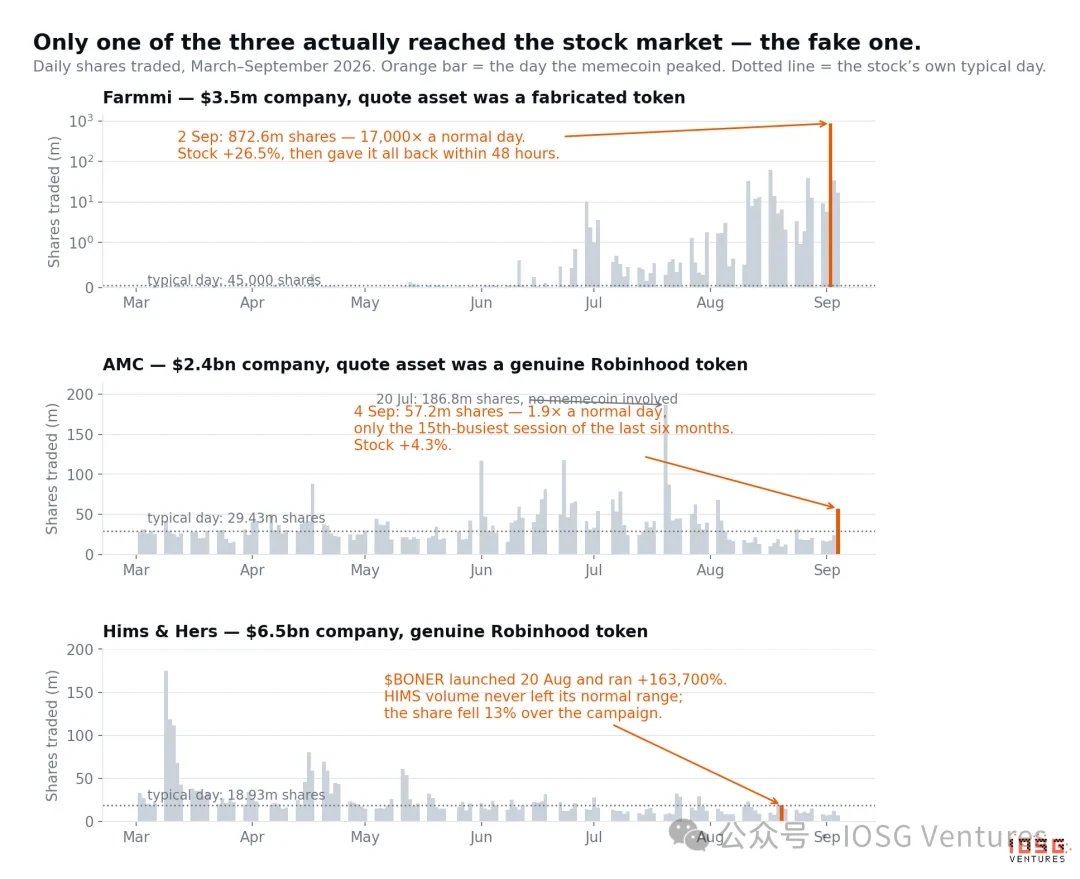
This pattern runs counter to intuition. The on-chain venue's biggest impact on the tape came precisely when the company was so small that the on-chain crowd was nearly its entire market—and that only happens when the quote asset





