






a16z New Article: From Crypto Mining Farms to AI Cloud, Why Does the "New Cloud" Burn More Money as It Grows?


- Core Thesis: AI infrastructure has proven its ability to generate rapid growth, but the next phase will be determined by whether companies can convert that growth into higher capital efficiency. The entire AI industry is shifting from computing power expansion to sustainable commercial returns.
- Key Elements:
- New cloud companies (such as CoreWeave) have pivoted from cryptocurrency mining operations, repurposing legacy assets like electricity and data centers into AI computing supply, achieving asset value revaluation—yet high revenue growth coexists with earnings uncertainty.
- CoreWeave generated $2.6 billion in revenue over roughly 25 quarters, faster than AWS's 40 quarters, but its capital expenditures, chip depreciation (exceeding half of revenue), and debt interest expenses have risen in tandem with scale. The market is waiting to see these translate into sustainable free cash flow.
- Software value is diverging based on AI impact: Atlassian's cloud business grew revenue 31% year-over-year, and customers using its AI assistant Rovo spent at nearly twice the growth rate of non-users, showing AI can act as a growth accelerant rather than universally eroding SaaS moats.
- AI applications are shifting from "stacking tokens" to optimizing them: Databricks' intelligent router matches models to task complexity, consistently reducing average task costs by over 30%. This efficiency gain may expand the addressable scope of demand (a Jevons paradox dynamic).
- Token spending is highly concentrated: the top 10% of enterprises by spend allocate roughly 50 times more AI spend per capita than the median company. Boston Consulting Group analysis shows companies in the top two quintiles of token usage experience significantly faster revenue growth, with value capture and consumption reinforcing each other.
- Frontier lab talent competition is intense: Anthropic compensates engineers far above companies like Google and Tesla. The two labs draw from overlapping talent pools but with different focuses—Anthropic recruits more heavily from SaaS companies, while OpenAI sources more from consumer internet and ad-tech firms.
Original title: Charts of the Week: Head In The Neoclouds
Original author: Moses Sternstein, a16z
Editor's note: As generative AI drives a new wave of compute investment, the market discussion around AI infrastructure is shifting from "are there enough GPUs" to "who can provide compute sustainably." Now that model training, inference demand, and data center expansion have become consensus, a more fundamental question is emerging: can the rapid growth in compute demand truly translate into stable profits and cash flow?
In the "Charts of the Week" published by a16z New Media, author Moses Sternstein examines neocloud companies such as CoreWeave, Nebius, and Applied Digital, discussing the growth, valuations, and profitability contradictions of the AI compute market, while extending the analysis to horizontal SaaS, model routing, and talent competition at frontier labs.
In this article, the author does not simply judge whether AI demand is strong, but rather breaks down the current AI trade into a set of more fundamental structural questions: how existing infrastructure is being repriced, why revenue growth has not correspondingly improved market expectations, and why the competitive focus of the AI industry is shifting from pure expansion to efficiency and returns.
First, there is the rediscovery of infrastructure value. In the past, land along railroad tracks, natural gas pipelines, and cable television networks all served specific industries before being repurposed into telecommunications and internet infrastructure. Today, a similar asset revaluation is happening again. Some neocloud companies originally served cryptocurrency mining and already possess operational experience in power, data center facilities, cooling systems, and high-density computing. When AI demand exploded, these capabilities were quickly converted into scarce compute supply. The significance lies in the fact that AI infrastructure competition does not start entirely from scratch—early advantages often come from recombining legacy assets, energy resources, and engineering capabilities.
Second, there is the coexistence of high revenue growth and profitability uncertainty. The early revenue growth rates of neocloud companies like CoreWeave have at times surpassed those of cloud giants like AWS at their inception, yet the capital markets have not granted them the same level of recognition. The reason is that neoclouds are not typical asset-light software businesses. GPU procurement, power access, data center construction, chip depreciation, and debt interest all rise in tandem with scale—sometimes even faster than revenue growth. This means revenue expansion only proves that AI compute demand is robust, but it does not automatically demonstrate that the business model has a sufficiently high return on capital. What the market is truly waiting for is whether these companies can convert orders and revenue into sustainable free cash flow.
Third, software value is being redifferentiated based on AI impact. Previously, the market worried that generative AI would broadly erode SaaS companies' moats, but Atlassian's performance shows that AI can also serve as a tool to increase customer spending and product stickiness. Meanwhile, cybersecurity and observability software continue to command valuation premiums because AI expands potential risks and increases enterprises' reliance on mature solutions. This means the so-called "SaaS apocalypse" will not occur uniformly. Whether AI replaces products, compresses prices, or expands demand is becoming the new standard for software valuation divergence.
Fourth, AI applications are shifting from "stacking tokens" to optimizing tokens. Previously, enterprises tended to directly call the most capable models or give engineering teams a budget to experiment on their own. Today, companies like Databricks are using intelligent routing to match models of different prices and performance levels based on task complexity, reducing costs while maintaining results. Declining token unit prices do not necessarily mean contraction in total AI spending: when unit costs decrease and application scenarios multiply, total token consumption and overall market size can still continue to rise. Efficiency and demand are not mutually exclusive—they may form a mutually reinforcing cycle.
If this article were to be compressed into a single judgment, it would be this: AI infrastructure has already proven it can generate rapid growth, but the next phase of victory will depend on whether companies can convert growth into higher capital efficiency. In this sense, the subject of this article is not just whether CoreWeave and its peers can become the next generation of cloud giants, but whether the entire AI industry can move from compute expansion to sustainable commercial returns.
The following is the original content:
Head In The Neoclouds
At the dawn of the 20th century, the Southern Pacific Railroad held numerous dormant construction rights along the cleared land connecting America's cities and towns. The railroad's right-of-way was far wider than the tracks themselves, leaving plenty of developable corridors along the route.
So the railroad company laid a communications network along its tracks, naming it the "Southern Pacific Railroad Internal Networking Telephony." By the 1970s, the company began commercializing this network, opening it up to a broader set of users.
Then two things happened simultaneously: on one hand, the monopoly structure of the long-distance telephone market came to an end; on the other, fiber optic cables became commercially viable. The original communications corridors were converted into fiber optic lines, and this network later became known by its English acronym "Sprint." Assets that once served the railroad thus became the infrastructure backbone of the telecommunications revolution.
Railroad companies were not the only ones converting existing physical networks into larger-scale commercial technology infrastructure.
In the 1980s, the Williams Company converted idle natural gas pipelines into fiber optic conduits, founding WilTel. That company was later sold and eventually renamed WorldCom. By the 1990s, the one-way coaxial cables laid for cable television underwent a massive, costly upgrade, ultimately becoming the infrastructure for Comcast and Charter to deliver broadband internet services to consumers.
This brings us to another category of companies: those that also sit on ready-made infrastructure, and whose assets are now being substantially repurposed and repriced to meet the demands of an emerging technology—these are the "neocloud" companies.
To put it simply, most neocloud companies originally operated energy-intensive and compute-intensive cryptocurrency mining businesses, and then the AI wave arrived. Suddenly, whoever had access to power, infrastructure, and experience in building and managing high-compute workloads—and in CoreWeave's case, a large stockpile of GPUs—found themselves in one of the hottest races in the market today.
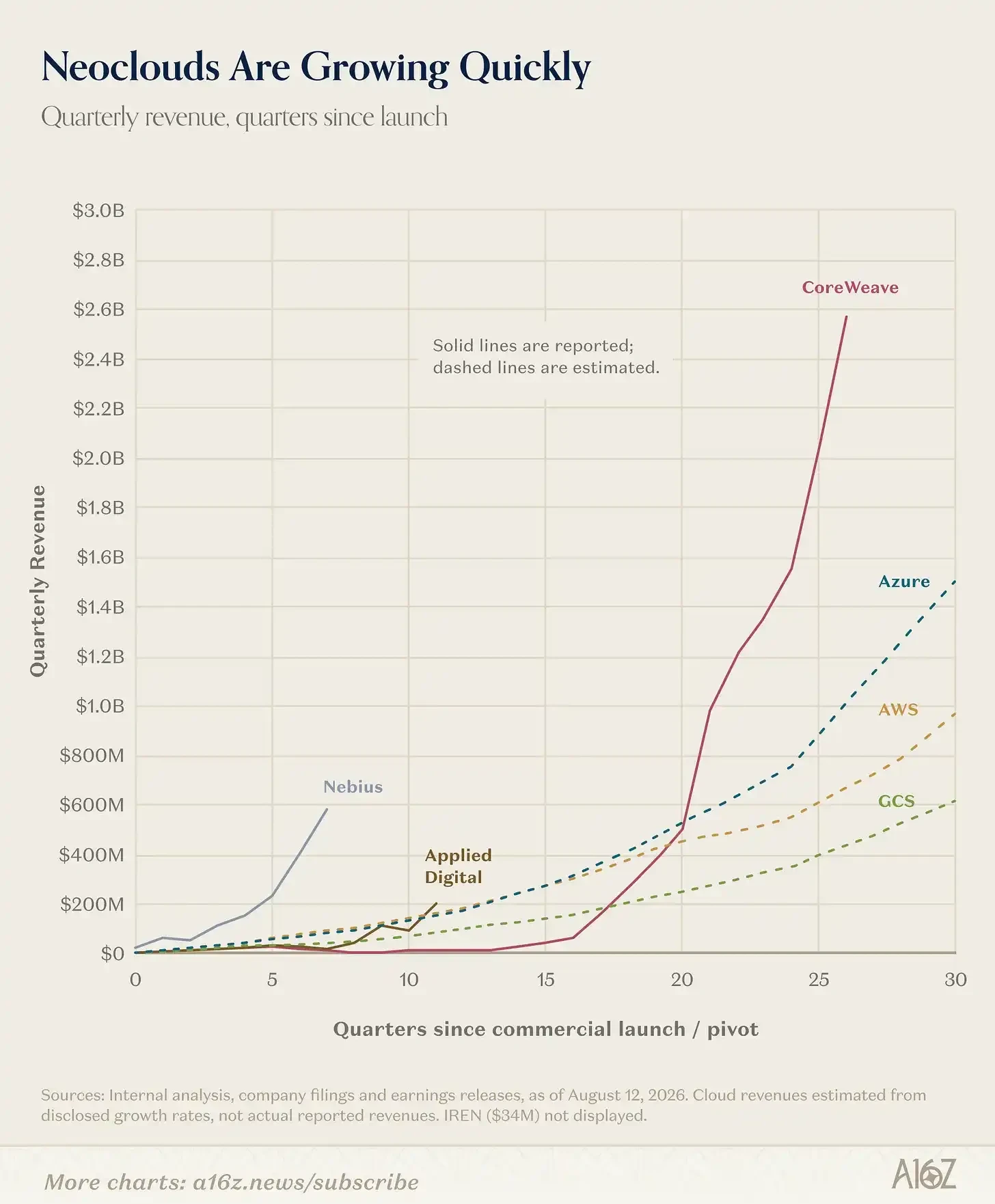
Of course, this is not a strictly apples-to-apples comparison. But looking at the three largest publicly traded neocloud companies, their revenue growth rates are indeed remarkable.
We can only estimate the early cloud revenue of the hyperscalers, but the general trend is quite clear: neocloud companies are growing extremely fast, and notably faster than the three major cloud providers did in their early stages.
It should be noted that in the overall compute sales market, neocloud companies are still relatively small players.
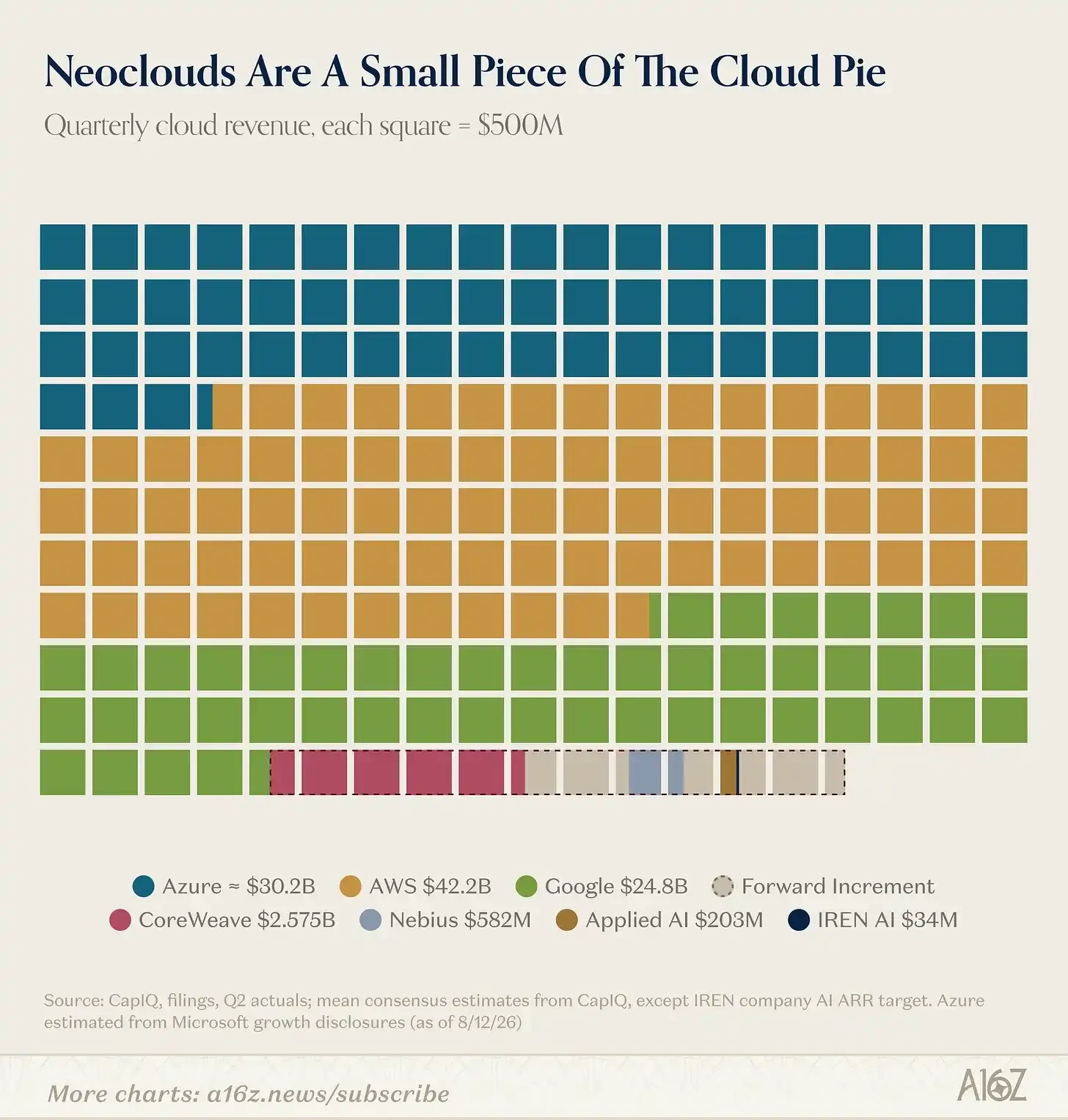
They also still have a long way to go before reaching the scale of the hyperscalers.

The hyperscalers generate revenue every quarter that is orders of magnitude higher than the neocloud companies. But at the same time, CoreWeave reached $2.6 billion in revenue in roughly 25 quarters—a milestone AWS only achieved in its 40th quarter after launch. Again, these companies are growing remarkably fast.
With such high growth rates and riding the AI industry tailwind, one would expect investors to be quite excited. To some extent they are, but the reality is more complicated.
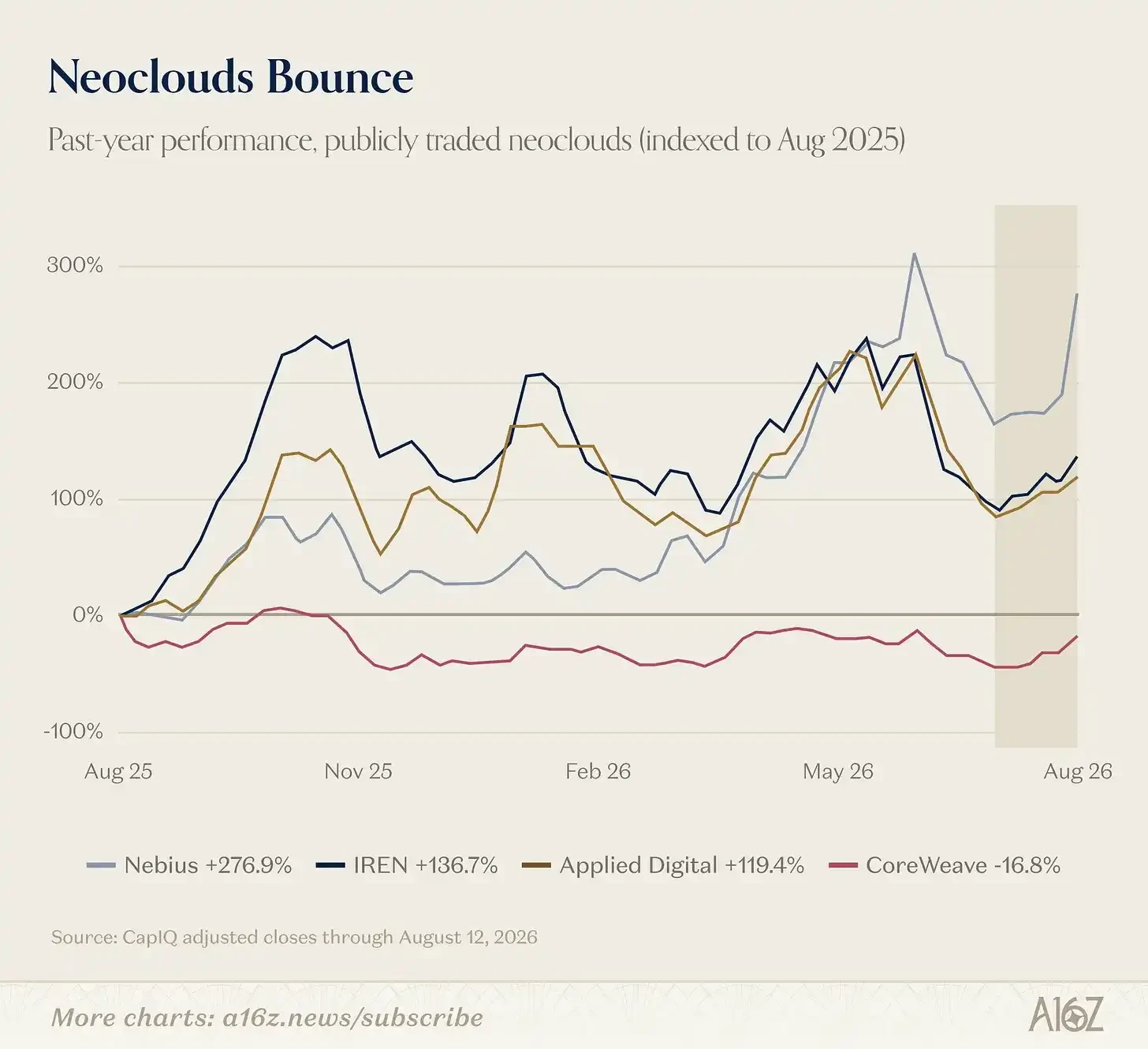
Although these companies' most recent earnings reports were generally solid, CoreWeave's stock has still fallen about 16% over the past year; only Nebius is somewhat closer to its previous highs.
So the story is still broadly positive, but it's clearly less compelling for the largest neocloud company.
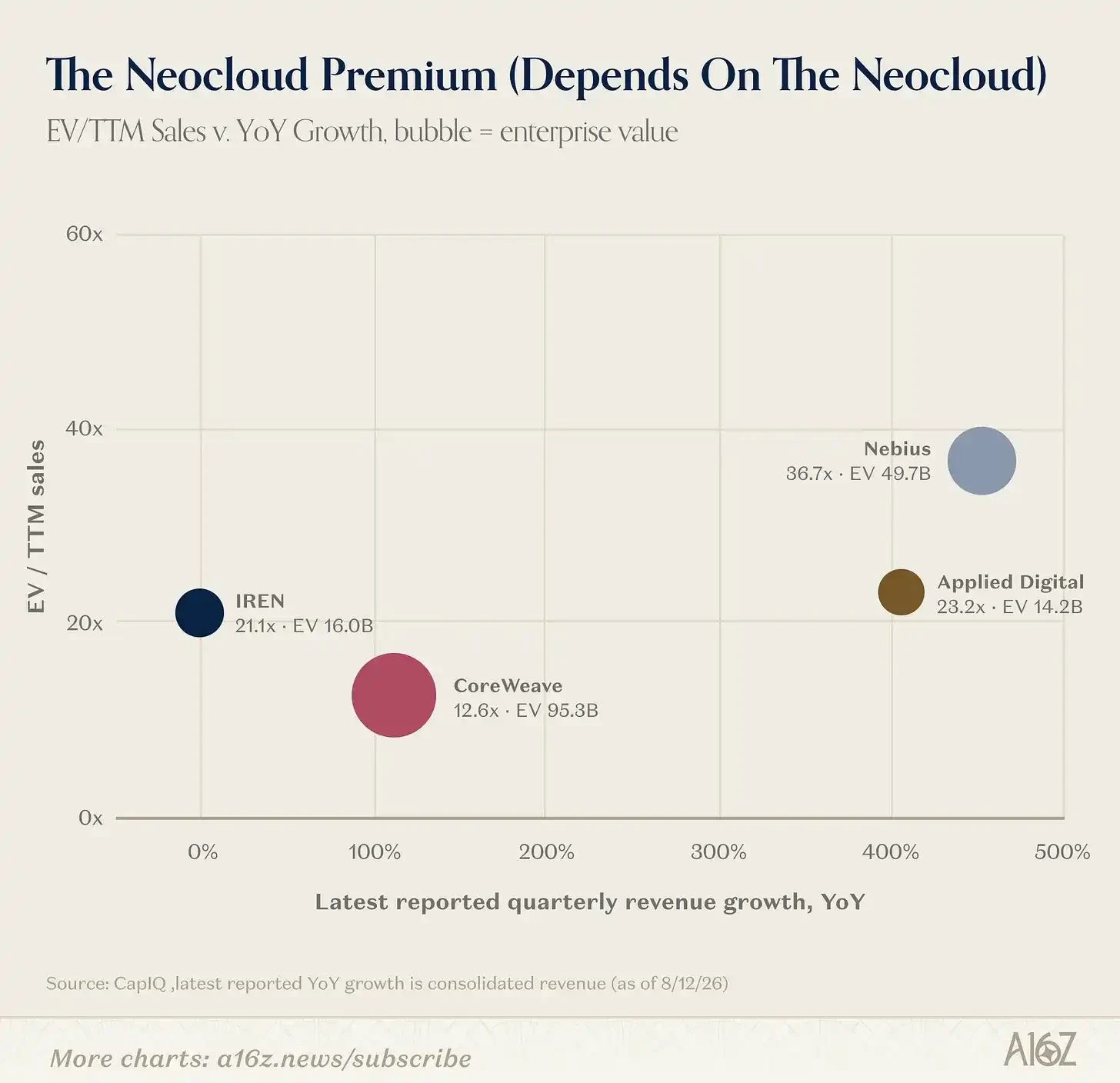
The relatively muted recent market performance is partly because much of the growth expectations may already be priced into valuations.
For capital-intensive businesses like neoclouds, price-to-sales ratio is not the most appropriate valuation metric, but it remains intuitive for illustration. Nebius and Applied Digital, which are smaller and growing faster, command valuation premiums far higher than the much larger CoreWeave. CoreWeave's revenue is still doubling, but it no longer matches the 400% to 450% growth rates of the leaders.
If there is a real problem with neocloud companies, it is not growth—it is long-term profitability. Neocloud companies need continuous investment in chips, power, and physical infrastructure to scale, and none of these costs are cheap:
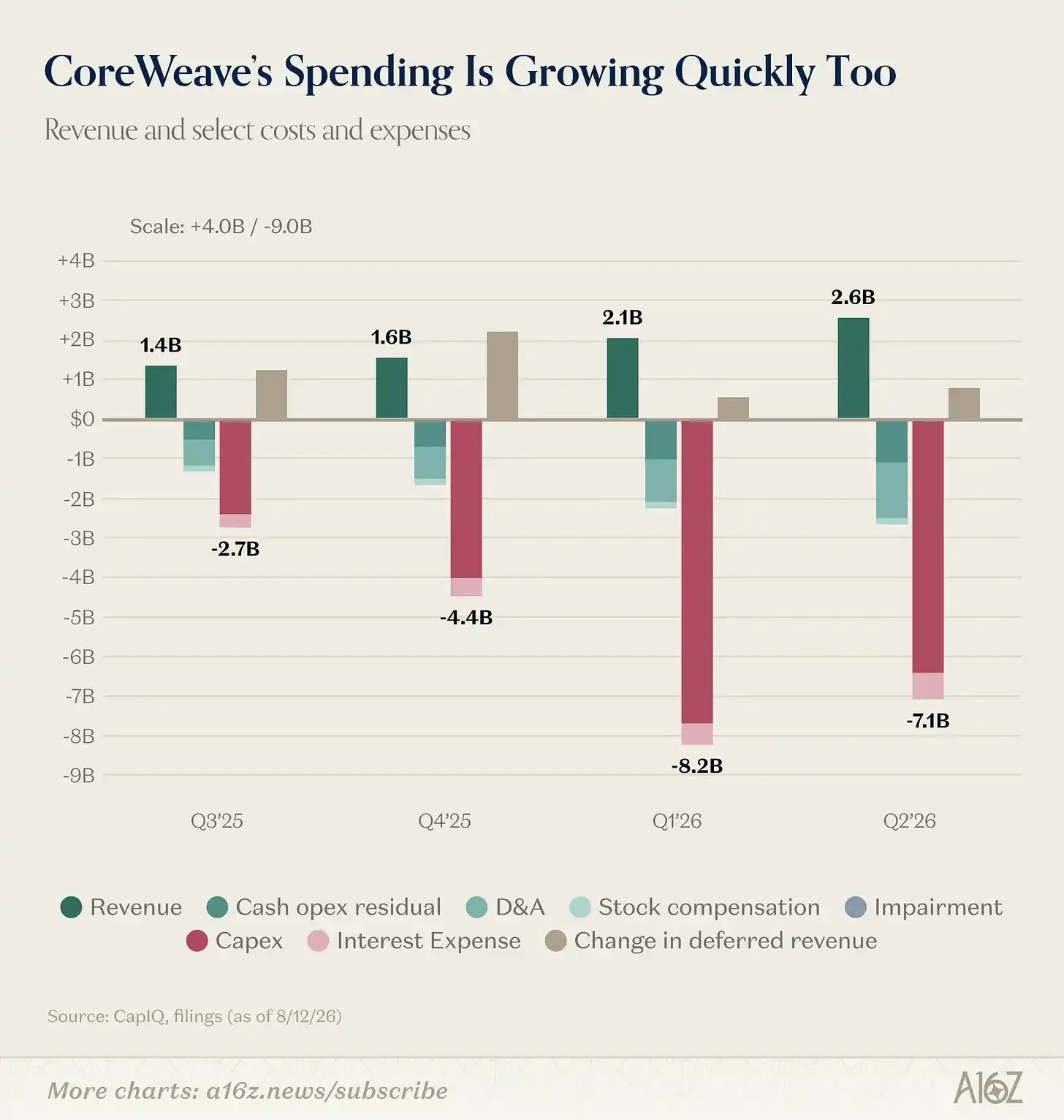
Take CoreWeave as an example: its revenue growth is indeed impressive, but its capital expenditures are even more staggering. Other massive costs include chip depreciation—which already exceeds half of revenue—and rising interest expenses from the debt taken on to build expensive infrastructure ahead of demand.
This article is not intended to make a judgment on whether neocloud companies will ultimately succeed, or whether their current stock prices are justified. Beyond the buzz around the topic, the real point here is that neocloud companies perfectly encapsulate the tug-of-war between bulls and bears in the overall AI trade.
On one hand, they sit in a vertical market—compute—that is far larger than anyone previously expected and continues to expand, achieving growth rates rarely seen in history. On the other hand, the costs of building such businesses are also at historic highs, requiring massive and continuously depreciating fixed infrastructure.
Horizontal SaaS Returns?
Here's a brief update on the shifting market landscape of the "SaaS apocalypse." One company that was hit hardest in the earlier software selloff has had a pretty good month.
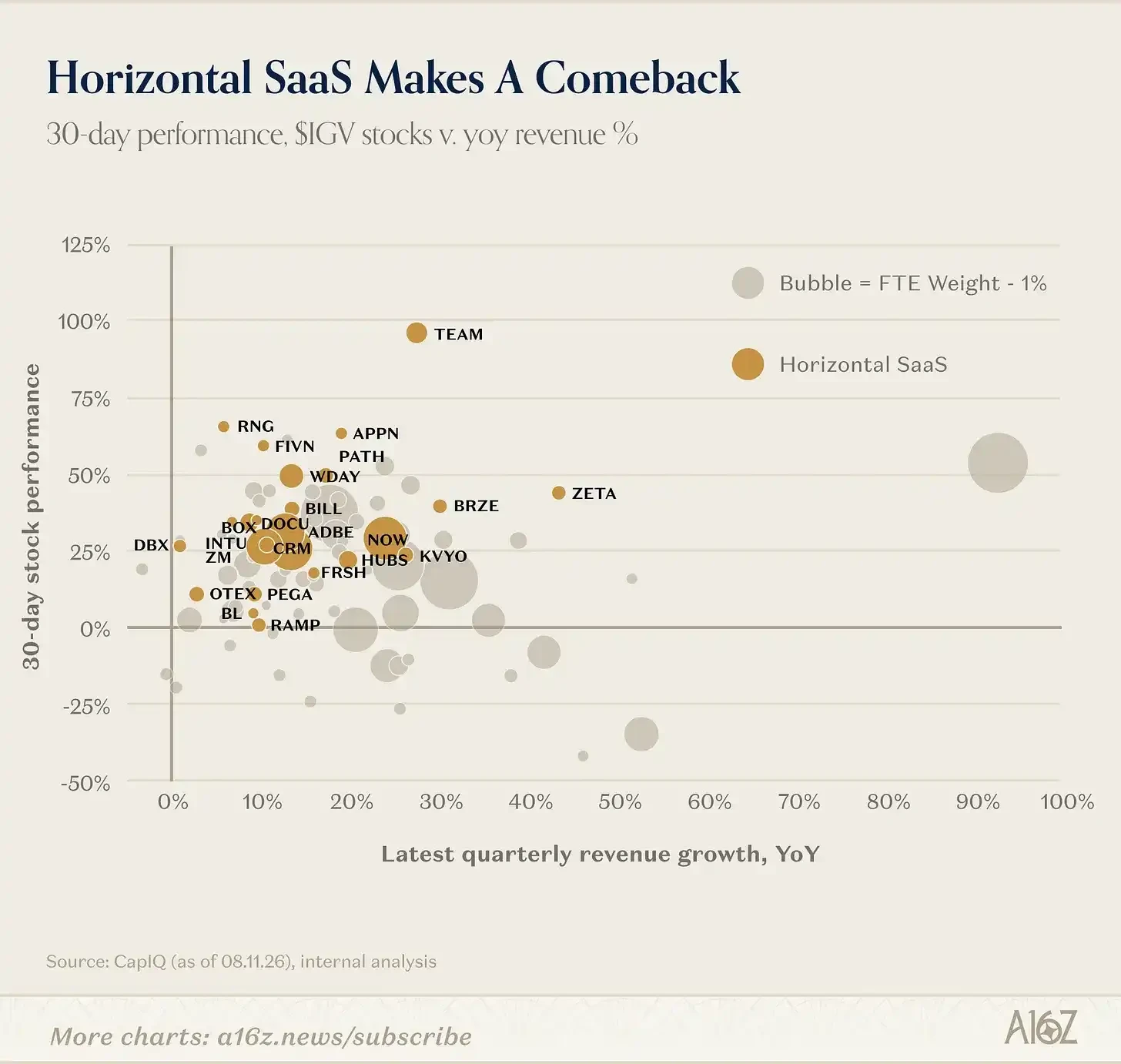
Over the past 30 trading days, horizontal software companies have ranked among the top performers in the IGV software ETF—although they have given back some of those gains since the data set was collected.
Overall, the fundamentals of these companies remain solid. Atlassian in particular has not fallen into decline under AI pressure as the market had previously expected.
The productivity software company delivered a "beat and raise" on both results and guidance: cloud revenue grew 31% year-over-year, and the growth rate of its revenue backlog was even higher. But perhaps the more critical signal is that AI is becoming a growth driver rather than a headwind. Atlassian stated that its AI assistant Rovo has seen broad adoption; meanwhile, customers using Rovo are spending at nearly twice the growth rate of non-Rovo users.
That's good news for Atlassian, good news for Rovo, and good news for horizontal SaaS.
That said, the overall valuations of horizontal SaaS companies still sit slightly below other software categories.
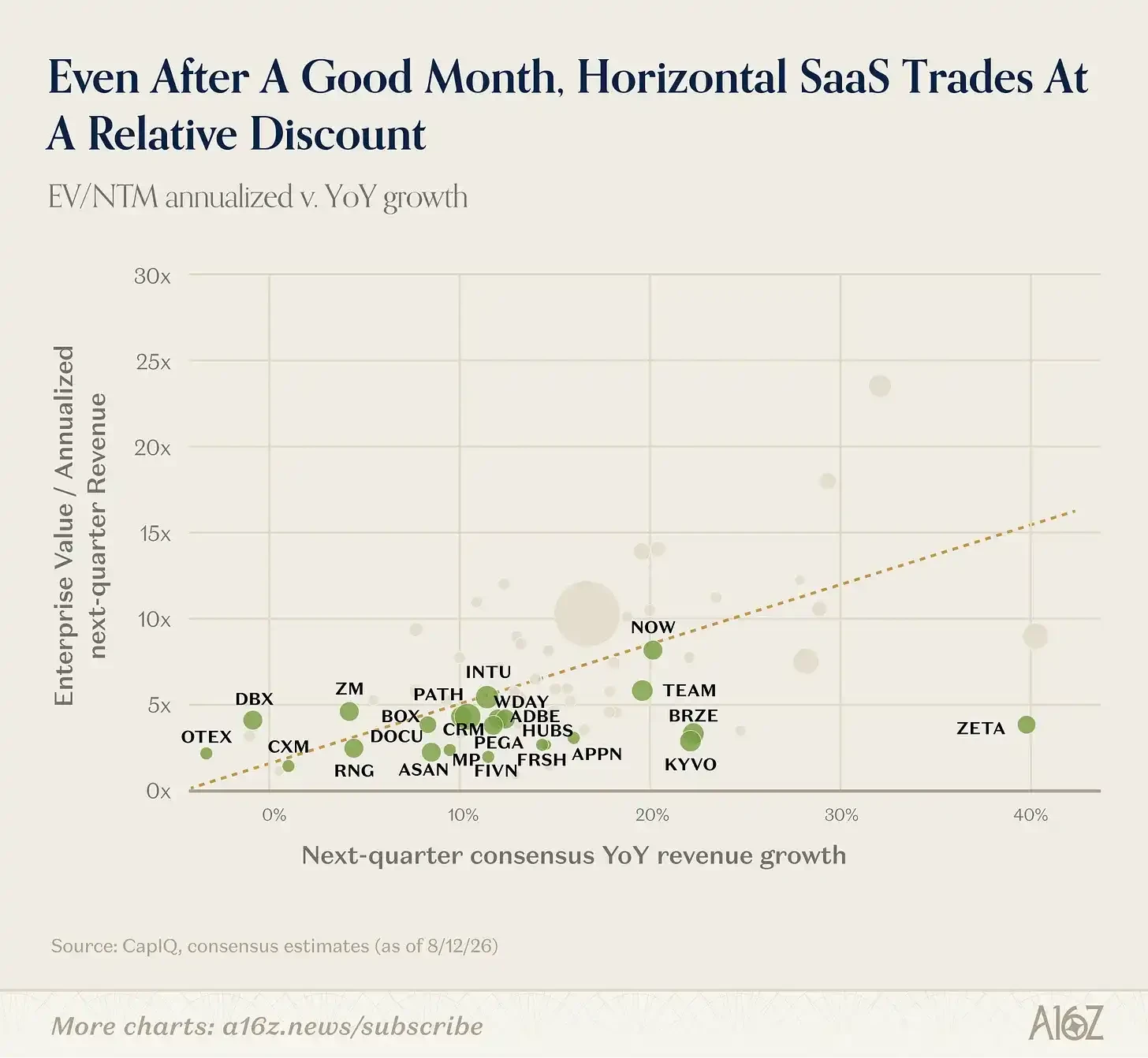
With few exceptions, horizontal SaaS companies—including Atlassian—trade at forward price-to-sales ratios generally below what the "growth-valuation multiple" trendline would suggest.
Again, horizontal SaaS has simply had a relatively good "month." One month of performance is nowhere near enough to convince the market that the "SaaS apocalypse" has been called off.
Of course, if your software business is in cybersecurity or observability, that's a different story—for these companies, the so-called "SaaS apocalypse" never happened at all.
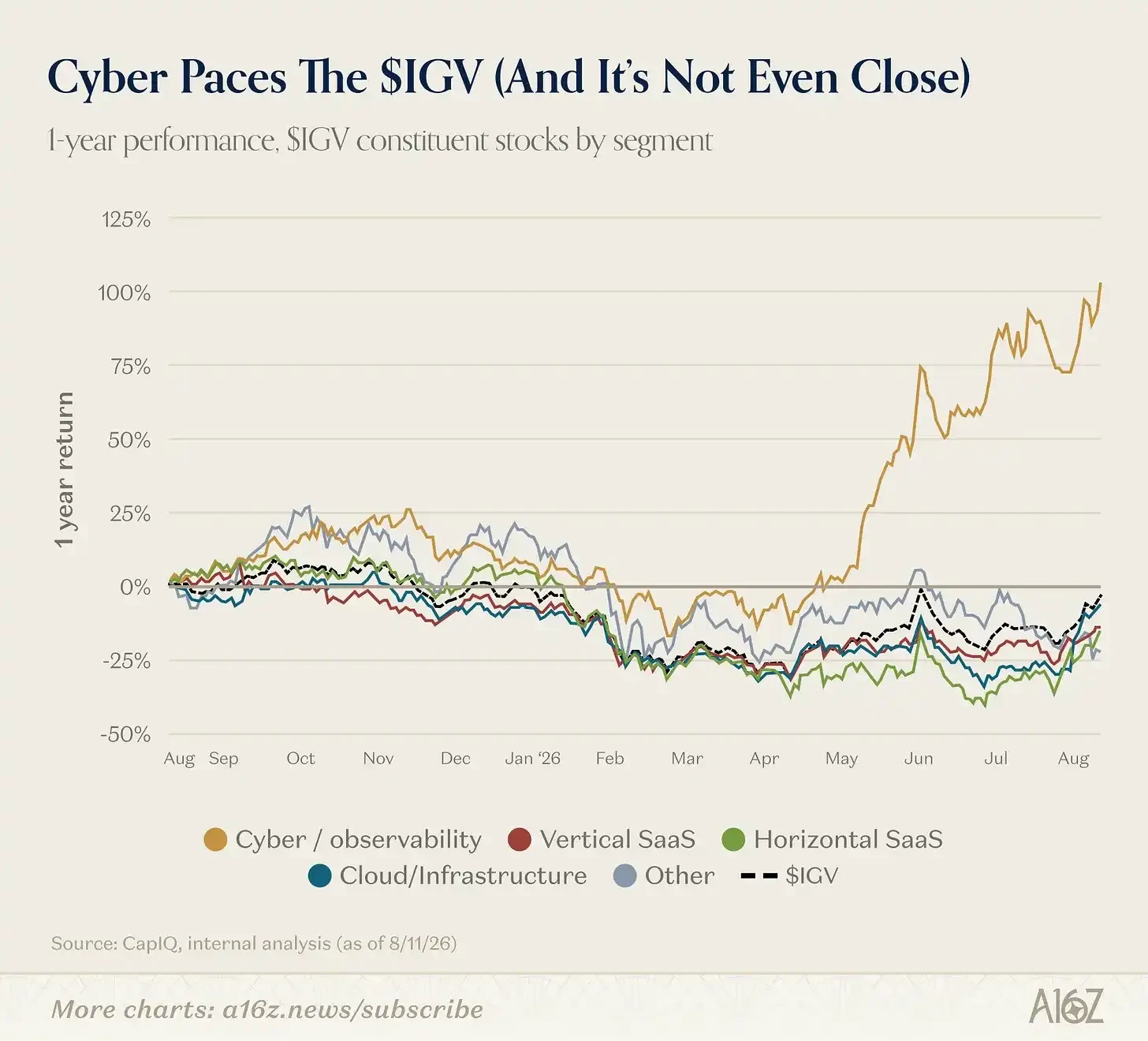
The cybersecurity sector continues to significantly outperform other categories within the IGV software ETF. In this space, AI has actually become a tailwind: there is a broad market perception that AI raises awareness of cybersecurity threats, and no enterprise customer is going to cobble together its own security solution through "vibe coding."
Whether this logic ultimately holds, of course, remains to be seen over time. But at least for now, the situation for traditional software companies is far from uniform.
Investors are paying close attention to whether AI will be additive or erosive for each company, and they are constantly revising their views with each new batch of data—which is only appropriate.
Toward the Efficiency Frontier of Token Spend
The market landscape around model usage, token consumption, and token spend management continues to evolve in various interesting ways.
Take Databricks, for example.
On questions like "Which model should we use?" and "Which model is best?", Databricks did not take a winner-take-all approach, nor did it simply hand engineers a budget and let them decide how to spend it. It asked a different question: "What if we developed a system that automatically routes the right tasks to the right models?"
Databricks is certainly not the only company doing this, but it has built a "Smart Router," and the results have been quite satisfying.
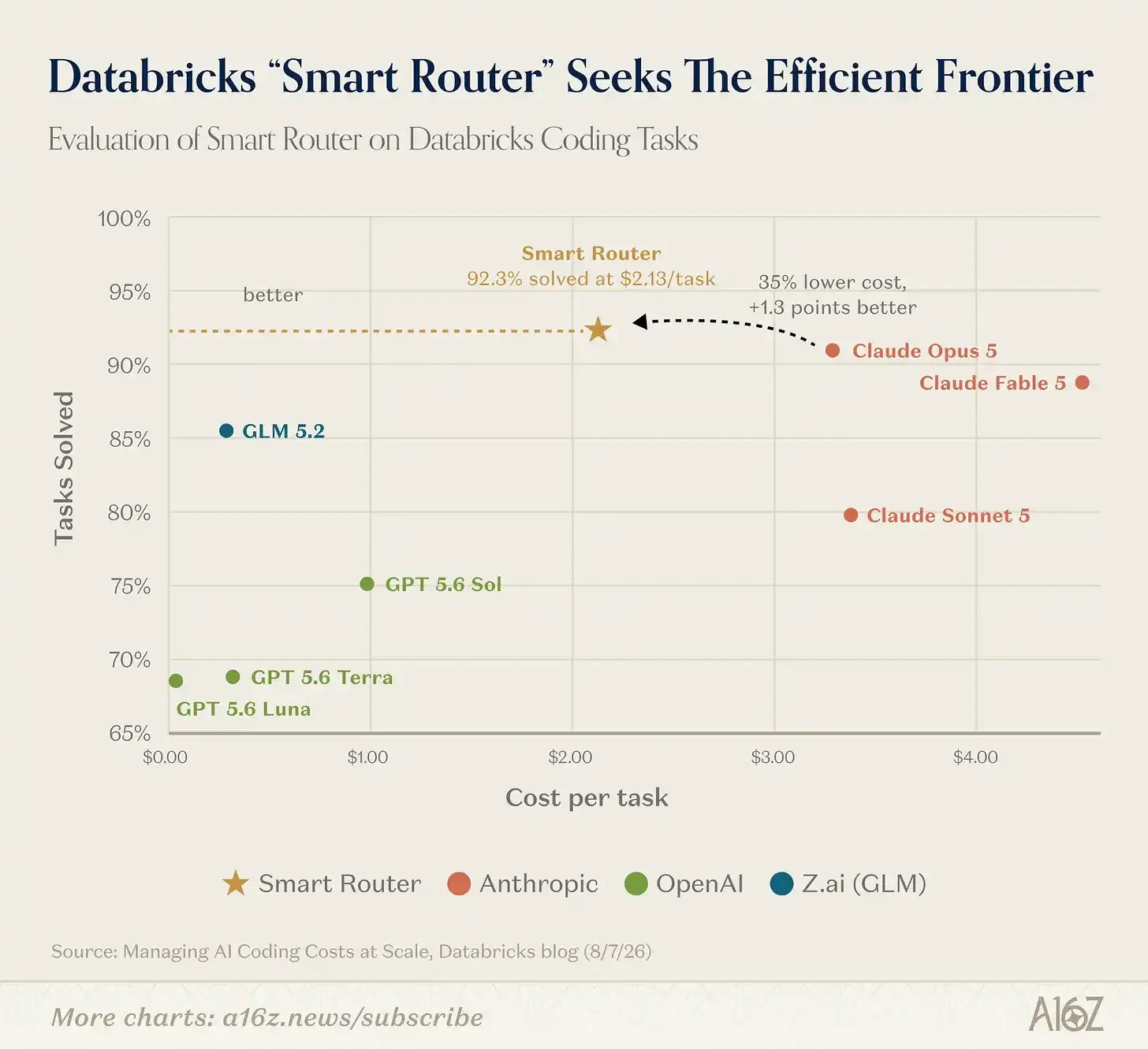
Reportedly, Databricks' router can call upon more capable, higher-priced models when necessary, and use weaker, lower-cost models when circumstances permit, thereby "consistently reducing average task costs by over 30%."
Overall, pursuing the "efficiency frontier" of token spending is hard not to view as a positive. It means demand continues to grow, and use cases are expanding not just at the cutting edge of performance but also toward less capable models—those second-tier models that, in the original pessimistic narrative, were expected to be rapidly淘汰.
As we've mentioned before, efficiency gains expand the reach of demand—this is exactly the kind of Jevons-paradox-style dynamic the market wants to see.
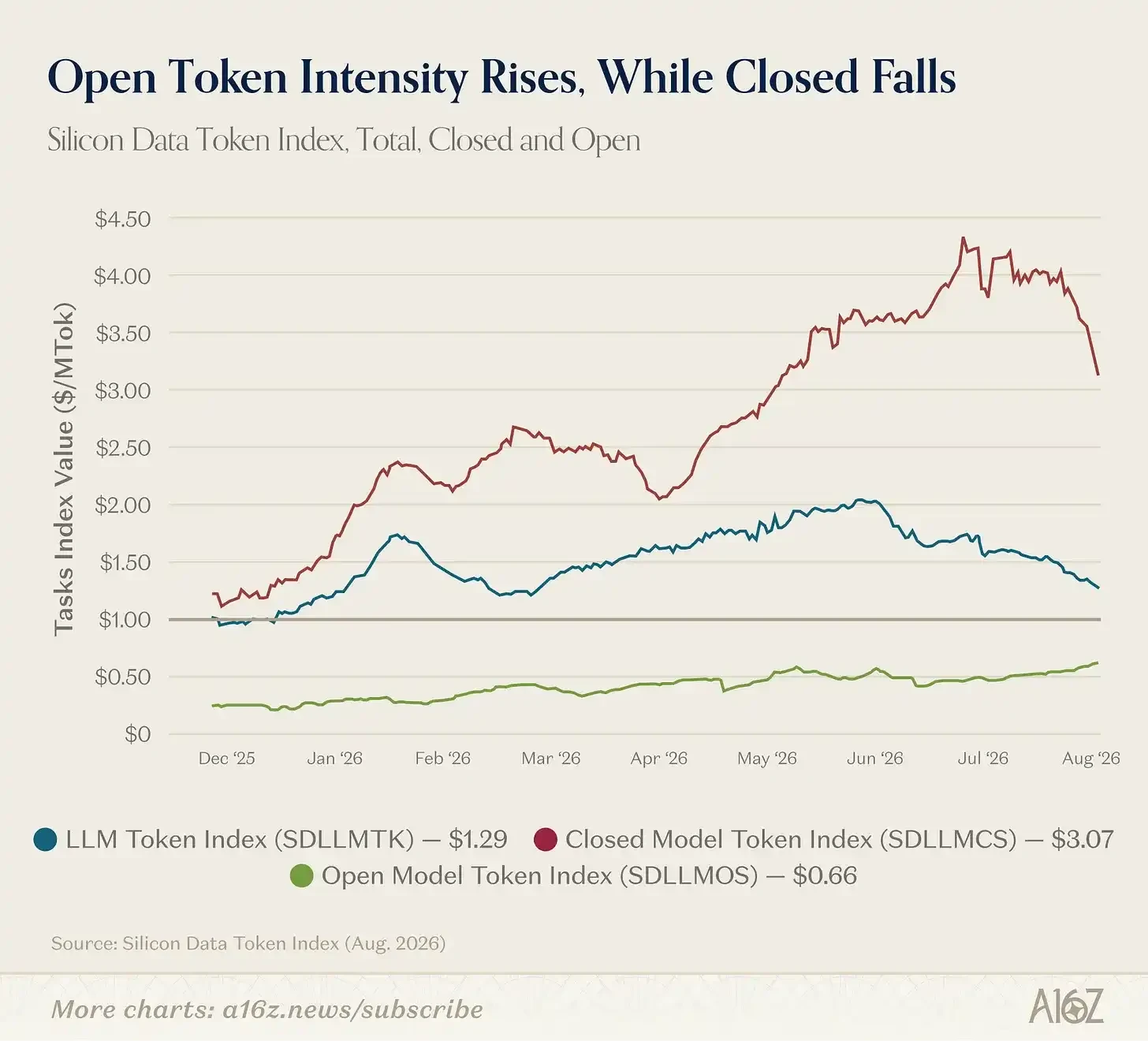
Silicon Data's Token Price Intensity Index shows that overall price intensity is declining, particularly as lower-priced open models capture a greater share of an expanding market.
It's worth clarifying once again a frequently misunderstood concept: these indices measure the cost intensity of token spend, not the absolute dollar amount. It depends on both the volume of tokens consumed and the blended cost per token. This means that even if the price per token falls, total token consumption and total spend in dollars can still continue to rise.
What truly matters is that overall demand is still growing, and pricing and model selection moving toward the efficiency frontier only further drives that growth. In particular, it's worth noting that "AI demand" or "AI adoption" is not a single, homogeneous concept. There remains a massive gap between heavy users and everyone else. This clearly shows that "always use the best model" may work for some companies, but it certainly doesn't work for all.
Today, the market is rapidly developing more alternatives to choose from. Overall, this is a good thing.
According to data from enterprise spend management platform Ramp, all companies are increasing AI spending, but the gaps between the median company and the top 10%, as well as between the top 10% and the top 1%, are extremely wide.
Ramp's data tends to skew toward technology companies, so it should be interpreted with that in mind. But the data shows that companies in the top 10% of spending have per-capita AI spending roughly 50 times that of the median company.
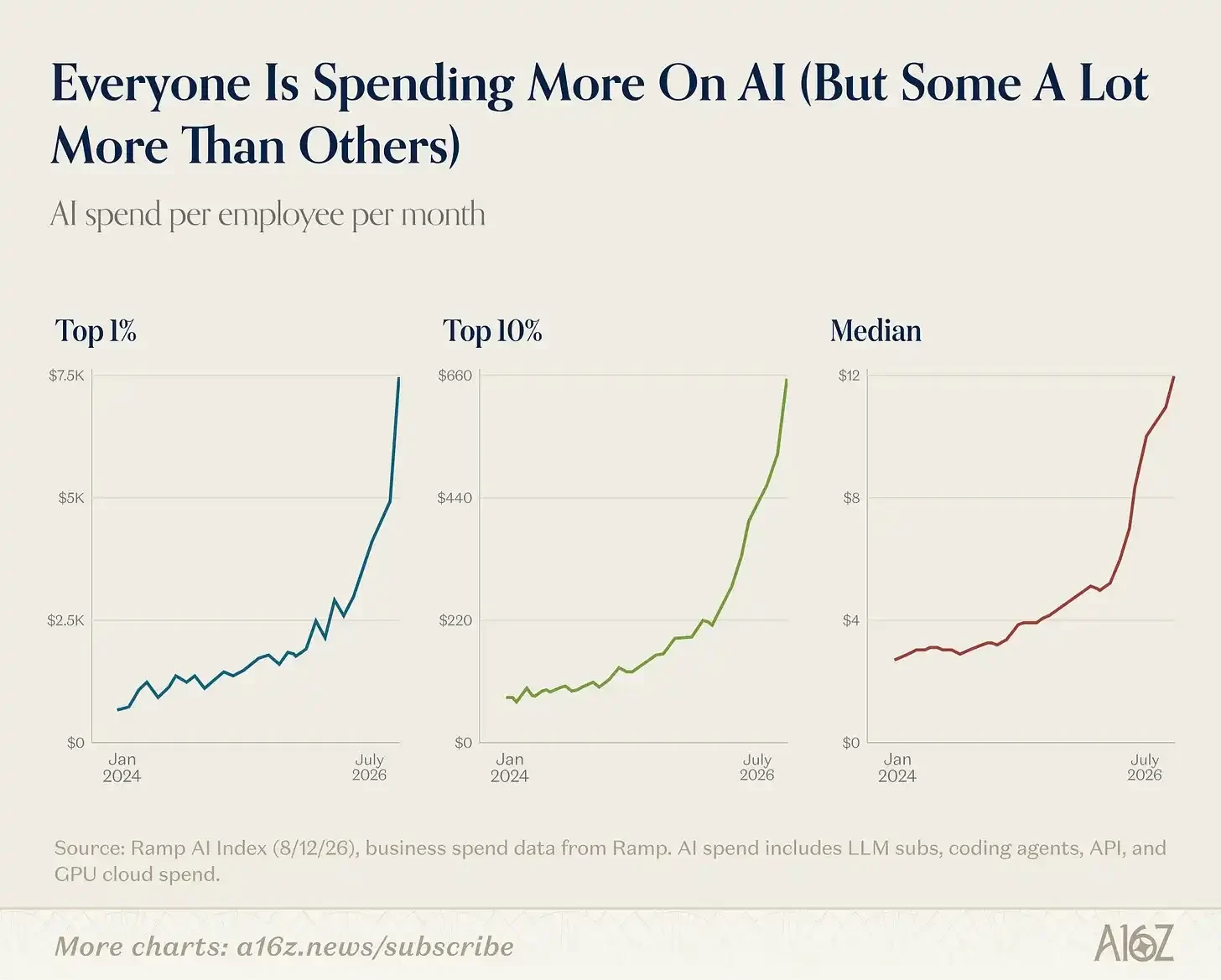
This distribution is likely not accidental. Companies that can unlock more value from AI spending are probably the very ones investing the most—even if not every company follows this pattern, a significant portion certainly does.
Boston Consulting Group's analysis of 107 public companies found that companies in the top two quintiles of token usage saw noticeably faster revenue growth than others.
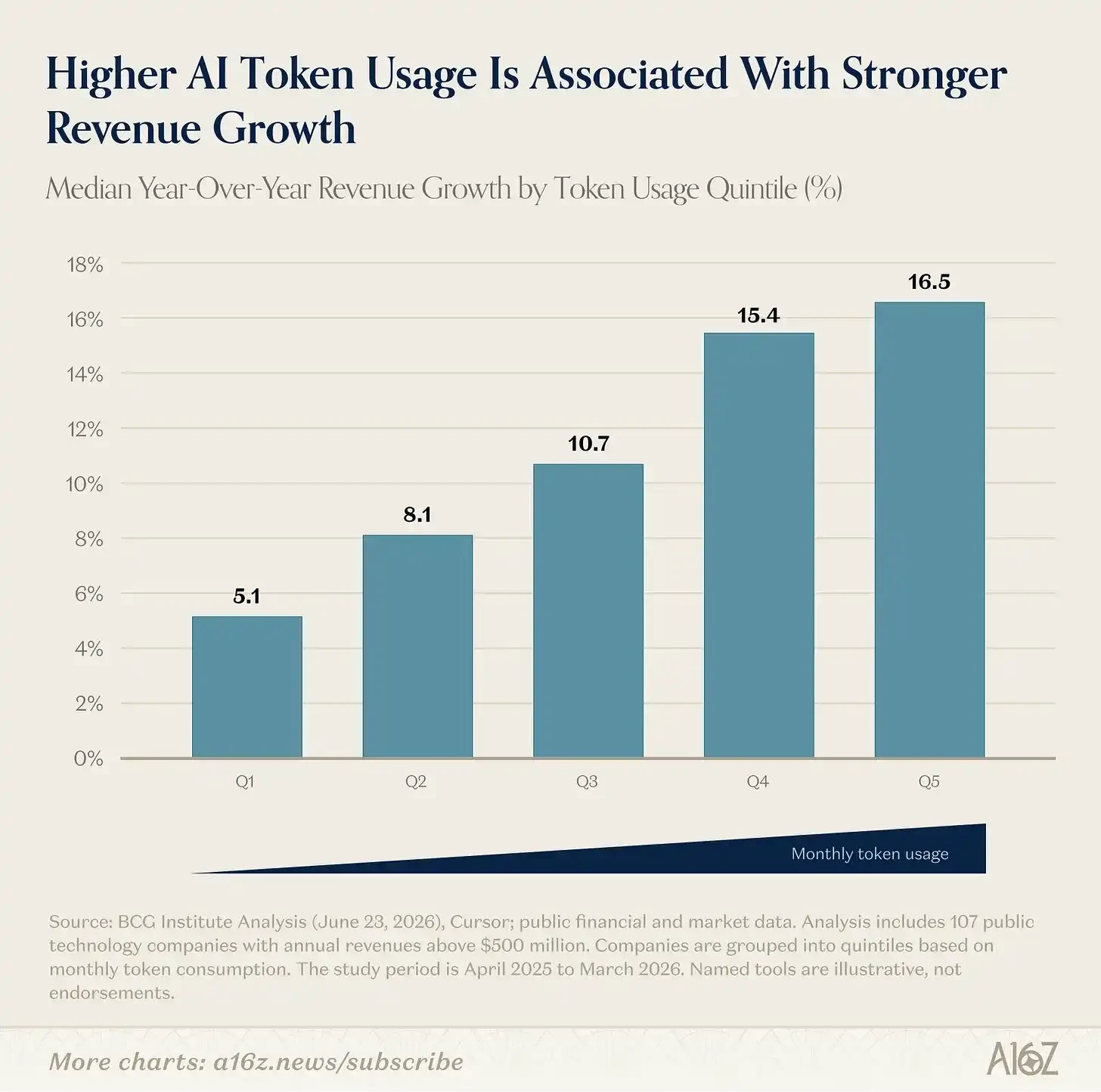
The core point here is that token demand and usage efficiency are mutually reinforcing: the more value companies capture, the more tokens they consume.
Of course, this process involves constant trade-offs between investment and return, and R&D always carries some upfront costs. But for the vast majority of companies, indiscriminate "token stacking" has never been an effective strategy.
So the fact that companies will increasingly not need to take this approach is clearly a good thing.
The Talent War at Frontier Labs
New Media recently had two outstanding team members join OpenAI, so let's close with a few interesting charts on talent hiring at frontier AI labs.
Dario Amodei recently said he worries that employees are putting money above mission. Judging from Levels.fyi data, that concern may not be entirely unfounded.


