






Today, the world finally sees why the "AI stock guru" collapsed


- Core Thesis: In Q2 holdings, the "AI stock guru" Leopold Aschenbrenner's fund, Situational Awareness LP, completely liquidated the put option hedges from Q1, pivoting to a highly concentrated pure long position in memory chips and AI infrastructure. Amplified by leverage, this led to significant losses during the July AI correction.
- Key Elements:
- As of June 30, the fund's 13F filing disclosed total holdings of approximately $20.2 billion, highly concentrated in SanDisk (SNDK, 28.0%) and Micron (MU, 27.5%), which together exceeded $11.2 billion, accounting for 55.5% of the portfolio.
- Q2 holdings also covered power (Bloom Energy), advanced manufacturing (TSMC), and AI cloud computing (Nebius, CoreWeave, etc.), overall pointing to a singular bet on the continued explosion of AI infrastructure.
- In Q1, the fund held over $8 billion in chip and memory put options as a hedge, but these were fully liquidated in Q2, shifting to direct shareholdings and unprotected long positions.
- Additions included TSMC ADR, Nebius, STMicroelectronics, and others, completing a full pivot from a "hedged portfolio" to "pure long."
- During the July AI sector correction, heavyweight holdings Micron fell approximately 35.9% and SanDisk fell approximately 55.3%. Amplified by leverage, this triggered a liquidity crisis, forcing the portfolio to be sold to Citadel at a discount.
Original: Odaily Planet Daily (@OdailyChina)
Author: Azuma (@azuma_eth)

In the early morning of August 15th Beijing time, Situational Awareness LP, the fund managed by Leopold Aschenbrenner — once dubbed the "AI Stock God" by the market — officially released its 13F quarterly holdings report.
- Odaily Note: The 13F is a quarterly disclosure document mandated by the U.S. Securities and Exchange Commission (SEC) for funds with assets under management exceeding $100 million. The SEC requires funds meeting this threshold to file within 45 days after the end of each calendar quarter, disclosing their holdings of U.S.-listed stocks, call/put options, convertible bonds, and specific ETF positions as of the end of the prior quarter.
However, just a few weeks ago, Situational Awareness LP had just weathered its darkest hour — due to a sharp pullback in AI-related stocks compounded by high leverage, the fund suffered significant losses, was forced to massively unwind its public market positions, and sold off most of its equity portfolio at a discount to Ken Griffin's Citadel.
- Odaily Note: For details, see Wall Street's "AI Stock God" Falls, Killed by Leverage.
While the temporary downfall of the "AI Stock God" is now an established fact, this belated 13F quarterly holdings report still carries significant meaning for the market — it fully presents the fund's static holdings position on the eve of its collapse (as of June 30th). In other words, the market finally has a zero-distance window into how Situational Awareness LP spiraled into massive losses.
In the following sections, Odaily will walk you through the holdings structure of Situational Awareness LP's Q2 13F report and analyze the changes from the previous quarter, unveiling the true story behind Situational Awareness LP's losses.
Who is the "AI Stock God"? (Feel free to skip if familiar)
In March of this year, we first introduced Leopold Aschenbrenner in our article "SBF's Protégé Turned $225 Million into $5.5 Billion in One Year."
Leopold Aschenbrenner worked at FTX's Future Fund starting in 2022 and remained with the team until FTX's collapse. In 2024, he authored a 165-page super thesis titled "Situational Awareness: The Decade Ahead" and founded the fund of the same name, Situational Awareness LP, where he serves as Chief Investment Officer.
Situational Awareness LP focuses on investment opportunities in the AI industry chain. In Q4 2024, its public holdings were "only" $225 million; by the Q4 2025 disclosure released in February of this year, that number had skyrocketed to $5.5 billion; and by the Q1 holdings disclosure in May, it had climbed to $13.7 billion...Although these numbers have lost their meaning now, the fund's total notional holdings value in today's Q2 report had reached $20.2 billion.
- Odaily Note: It's important to note that under the statistical methodology of U.S. 13F filings, the market value shown for options typically reflects the "notional value" of the underlying stocks, rather than the actual premium cost paid by the fund.
Thanks to explosive investment returns, Leopold Aschenbrenner and Situational Awareness LP gained widespread fame, becoming one of the most followed AI investment barometers across the internet. The market, eager to idolize, crowned him the "AI Stock God."
Q2 Holdings Analysis: $20.2 Billion, Nearly All-In on One Bet
As of June 30th, Situational Awareness LP disclosed 26 positions in its 13F filing, with total notional holdings of approximately $20.24 billion. Breaking down this "pre-collapse ledger" further, it's clear the fund was making a highly concentrated bet on the continued explosion of AI infrastructure at the time.
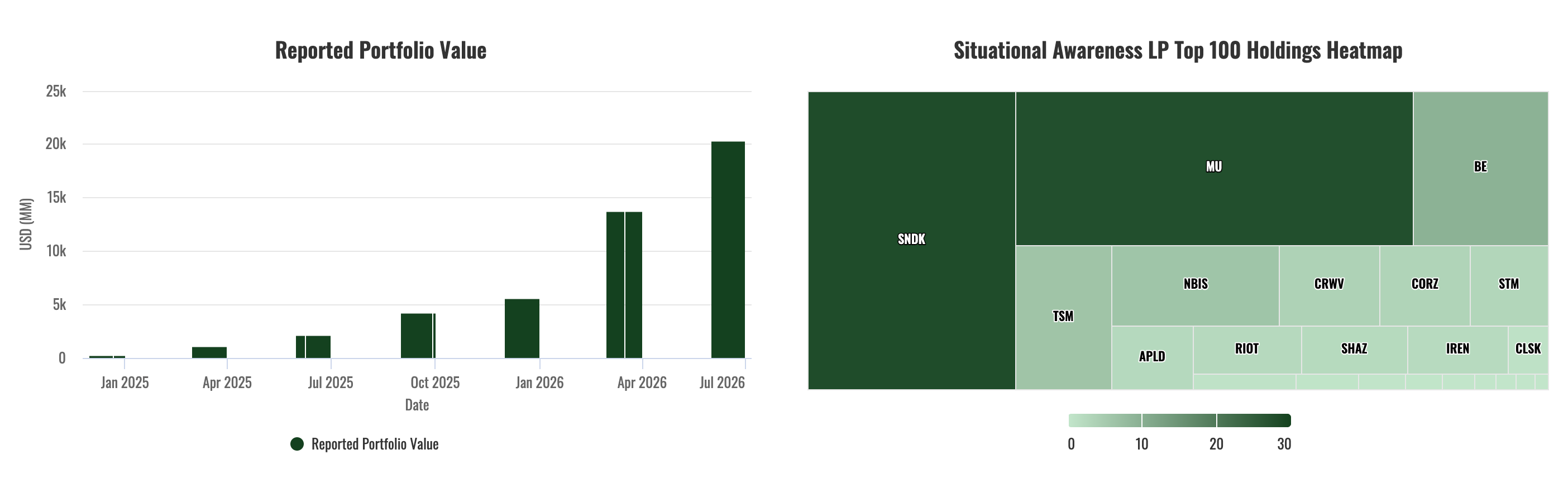
The most striking aspect of the holdings structure, undoubtedly, is the concentrated bet on SanDisk (SNDK) and Micron (MU) — with the former at approximately $5.674 billion (28.0% of the portfolio) and the latter at approximately $5.574 billion (27.5%). Combined, these two positions alone exceeded $11.2 billion, representing about 55.5% of the entire portfolio.
In other words, on the eve of the fund's collapse, Leopold Aschenbrenner had placed more than half of his public market positions into the single direction of memory chips.
Continuing to break down further, Situational Awareness LP's investment thesis becomes increasingly clear: Bloom Energy at approximately $1.899 billion, betting on the power demand behind AI data centers; TSMC at approximately $1.265 billion, targeting advanced process nodes; Nebius at approximately $1.233 billion, along with CoreWeave, Core Scientific, Applied Digital, IREN, and others, further covering AI cloud computing power, data centers, and energy infrastructure...
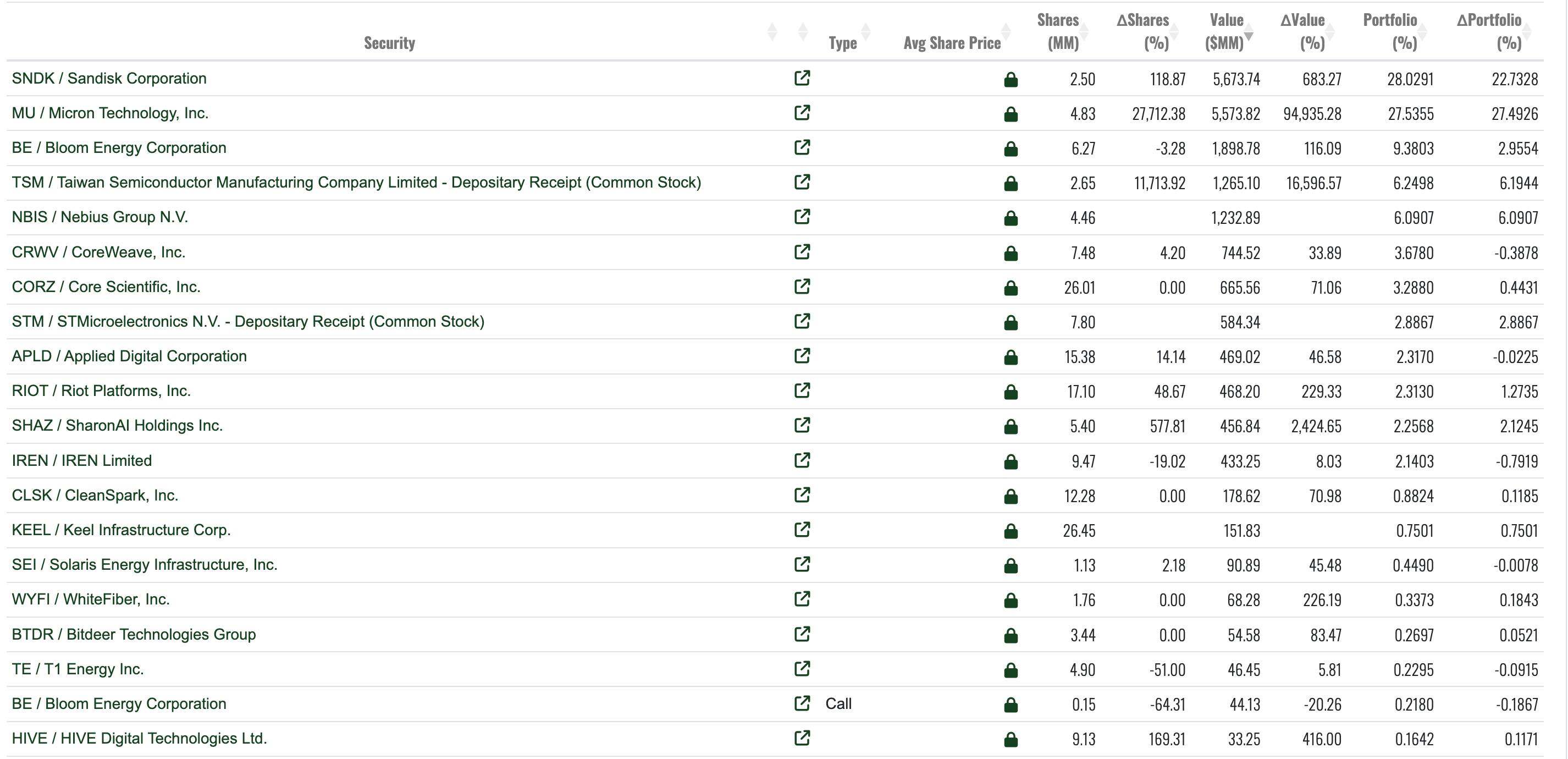
So on the surface, while Situational Awareness LP held more than 20 different stocks (including options), when reclassified by industry chain, the vast majority of positions pointed to the same core thesis — AI computing demand will continue to surge, and the entire chain of chips, memory, computing power, electricity, and data centers will continue to benefit as a result.
This also means that Situational Awareness LP was essentially going all-in on the sustained explosion of "AI infrastructure construction." In favorable conditions, this portfolio could indeed deliver upside elasticity far exceeding that of any single stock; but conversely, when AI infrastructure-related assets pull back simultaneously, the risks originally spread across different companies quickly begin to resonate.
Especially with leverage in play, the combination of "high concentration" and "high leverage" can rapidly trigger a liquidity crisis — which is exactly the story we witnessed a few weeks ago.
Highly Cautious in Q1, Fully Bullish in Q2
Before this quarter's 13F report was released, I had a lingering question.
In the Q1 holdings report disclosed in May, Situational Awareness LP had clearly expressed significant caution about the overheated short-term rally in chips and memory — at the end of Q1, Situational Awareness LP held put options on leading chip and memory stocks (covering SMH, NVDA, ORCL, AVGO, AMD, ASML, etc.) with a notional value exceeding $8 billion, representing over 60% of the fund's total notional holdings. Had it maintained those positions, the subsequent market downturn should have played right into Leopold Aschenbrenner's predictions. Why did it end in such a disastrous outcome?
It wasn't until today's new 13F report was released and I saw Situational Awareness LP's position changes that this question was finally answered — Leopold Aschenbrenner had personally cut the safety rope he had once tied.
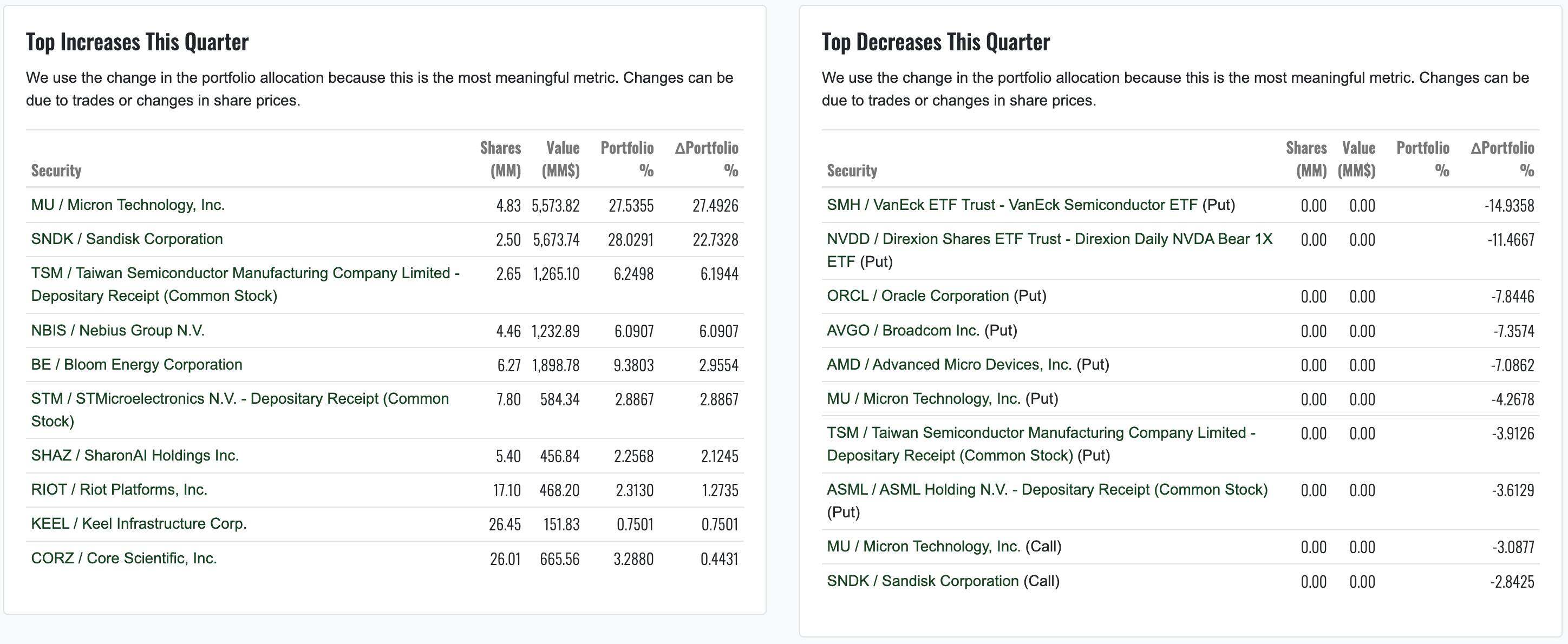
In the Q2 holdings report, Situational Awareness LP's "reduction list" is truly alarming — all chip and memory put options were completely liquidated.SMH Put (-14.94%), NVDA Bear ETF Put (-11.47%), ORCL Put (-7.84%), AVGO Put (-7.36%), AMD Put (-7.09%), TSM Put (-3.91%), ASML Put (-3.61%)...
These hedging positions that once formed the portfolio's risk floor were entirely abandoned in Q2. Meanwhile, the MU and SNDK options that existed as call options in Q1 were also closed out (-3.09%, -2.84%), replaced by direct stock holdings — MU jumped to become the second-largest position at $5.574 billion, while SNDK topped the list at $5.674 billion.
The "increase list" further reveals the flow of capital — in addition to the two memory stocks mentioned above, TSMC ADR (+6.19%), Nebius (+6.09%, new position), STMicroelectronics STM (+2.89%, new), SharonAI (+2.12%, new), and Keel Infrastructure (+0.75%, new) all entered the portfolio. From European wafer fabs to Russian-born AI cloud service providers, from power infrastructure to Bitcoin miners, Leopold Aschenbrenner completed a complete pivot in Q2 from a "hedged portfolio" to an "unprotected pure long."
The cost of this pivot became glaringly apparent in late July. When the AI sector experienced a systemic correction, those Q1 put options could have partially absorbed the shock, but by Q2 the fund had no downside protection whatsoever — a fund with tens of billions in assets, highly concentrated positions, and a uniformly directional bet, amplified by leverage, proved far more fragile than the market could have imagined.
While the 13F does not disclose leverage ratios, from this "clear the puts, max out the longs" rebalancing record, we can already see the most ill-fated move of Situational Awareness LP.
The Defeat Is Settled, But the Future Still Holds Promise
The rest of the story is now well known.
Entering July, the AI and memory sectors faced systemic selling pressure, and the positions Situational Awareness LP had bet on were hit hard, including its two heavyweight holdings, Micron and SanDisk. Based on June 30th closing prices, by July 29th — when rumors of Situational Awareness LP's liquidity crisis began to spread — Micron (MU) had fallen from $1154 to $739, a drop of approximately 35.9%; SanDisk (SNDK) had fallen from $2274 to $1016, a decline of 55.3%.
Amplified by leverage, these declines rapidly consumed all of Situational Awareness LP's safety cushion. In the end, Ken Griffin plucked the "AI Stock God's" former glory at a discount.
But fortunately, Leopold Aschenbrenner is still young, with a long life ahead. Most critically, he has held onto one key trump card — his portfolio of private company investments, including equity in Anthropic. For an investor just 25 years old, the first major defeat in the capital markets may have already occurred, but this does not necessarily mark the end of his investment career.


