






After three consecutive years of reducing stock positions, Buffett finally made his move


- Core Thesis: Berkshire Hathaway ended 14 consecutive quarters of net stock selling in the second quarter of 2026, shifting to a net purchase of nearly $19.8 billion, and made a multi-billion-dollar private investment in Google parent Alphabet, marking an adjustment in its investment strategy under new CEO Abel, transitioning from long-term观望 to active positioning.
- Key Elements:
- Financial Performance: Second-quarter total revenue reached $101.808 billion, up 10% year-over-year; net profit was $25.667 billion, doubling year-over-year and beating market expectations.
- Investment Shift: Purchased $23.47 billion in stocks while selling $3.69 billion, ending the net selling trend that had persisted since 2023.
- Heavy Stake in Google: Privately increased its Alphabet position by approximately $10 billion, making it one of the top five holdings, alongside Apple and Bank of America, accounting for 66% of the portfolio.
- Buybacks and Cash: Repurchased $4.527 billion, the highest since 2021; total cash and Treasuries stood at approximately $364.7 billion, down from the previous quarter.
- Strategy Logic: Previously criticized for "missing" the AI wave, the choice was to wait for valuation pullbacks, emphasizing investment discipline and long-term margin of safety.
Original by Odaily Planet Daily (@OdailyChina)
Author: Azuma (@azuma_eth)
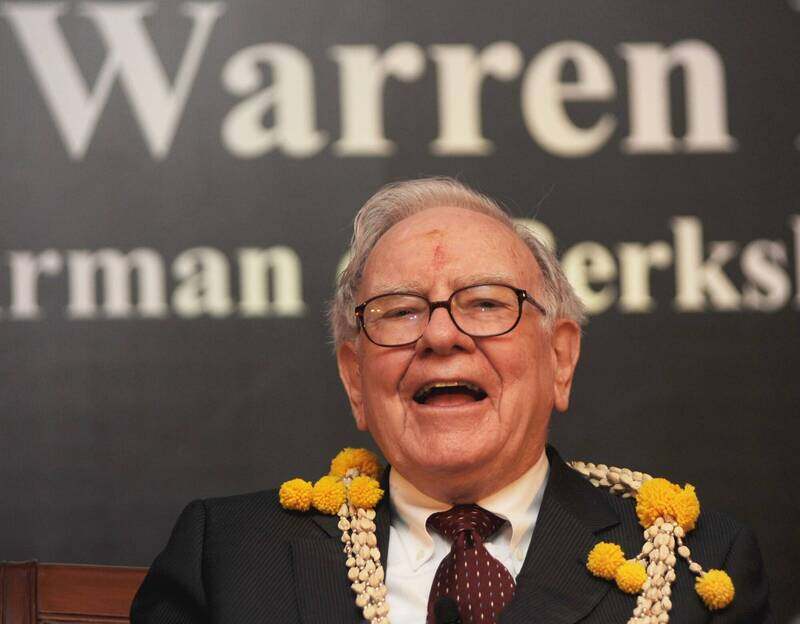
After the U.S. stock market closed on August 9 (Beijing time), Berkshire Hathaway released its Q2 2026 earnings report.
The report showed that Berkshire's total Q2 2026 revenue reached $101.808 billion, up approximately 10% year-over-year, with net income attributable to shareholders at $25.667 billion, more than doubling from the same period last year (up approximately 107%). Both operating profit and net income significantly exceeded market expectations.
But the more signal-worthy point in the report is that Berkshire Hathaway finally ended its stock-selling streak that had lasted over three years (14 consecutive quarters), shifting back to net buying.
Holding $400 Billion in Cash, Berkshire Finally Makes Its Move
According to the earnings report, Berkshire Hathaway purchased approximately $23.47 billion in stocks in Q2, while selling only $3.69 billion, resulting in net purchases of nearly $19.8 billion — ending the prolonged net-selling phase that had persisted since 2023.
What deserves even more attention from investors is where the money went. The report disclosed that Berkshire Hathaway's largest move last quarter was a private placement investment of approximately $10 billion in Alphabet (Google's parent company). This also officially propelled Google into Berkshire Hathaway's top five largest holdings — joining American Express, Apple, Bank of America, and Coca-Cola. As of the end of June, these five positions combined accounted for 66% of the equity portfolio, maintaining an extremely high concentration.

Although Buffett has long held a relatively cautious stance toward tech stocks, he previously revealed when initially building the Google position that the investment was a joint decision made in consultation with Greg Abel (Berkshire Hathaway's current CEO, who officially succeeded Buffett on January 1 this year). Buffett has also admitted that missing out on Google in the early days was a "historic mistake," and that this round of adding shares is based on value investing logic, focusing on the moat of Google's search monopoly and its stable cash flow.
This latest billion-dollar increase represents an investment decision made under the leadership of new CEO Abel — which may suggest that under the new landscape where Buffett has stepped back and Abel holds the reins, Berkshire Hathaway's tolerance and engagement with the tech frontier is on the rise.
Beyond returning to net buying in the market, Berkshire Hathaway also executed its first stock buyback in two years during Q2. The report disclosed that the company spent approximately $4.527 billion on buybacks last quarter, marking the highest quarterly figure since 2021; it added more than $3.3 billion in buybacks in July.
In March this year, Berkshire Hathaway officially announced the resumption of its share repurchase program. Abel said at the time that the buyback was driven by management's belief that the stock's "intrinsic value" exceeded its market price.
With the shift in investment and buyback pace, Berkshire Hathaway's long-accumulated cash pile has also begun to change. Over the past few years, one of the company's biggest labels has been that of a "cash machine." Due to a lack of large opportunities meeting Buffett's investment criteria, the company's cash and short-term Treasury holdings kept climbing, reaching a historic high of nearly $400 billion at the end of Q1 this year.
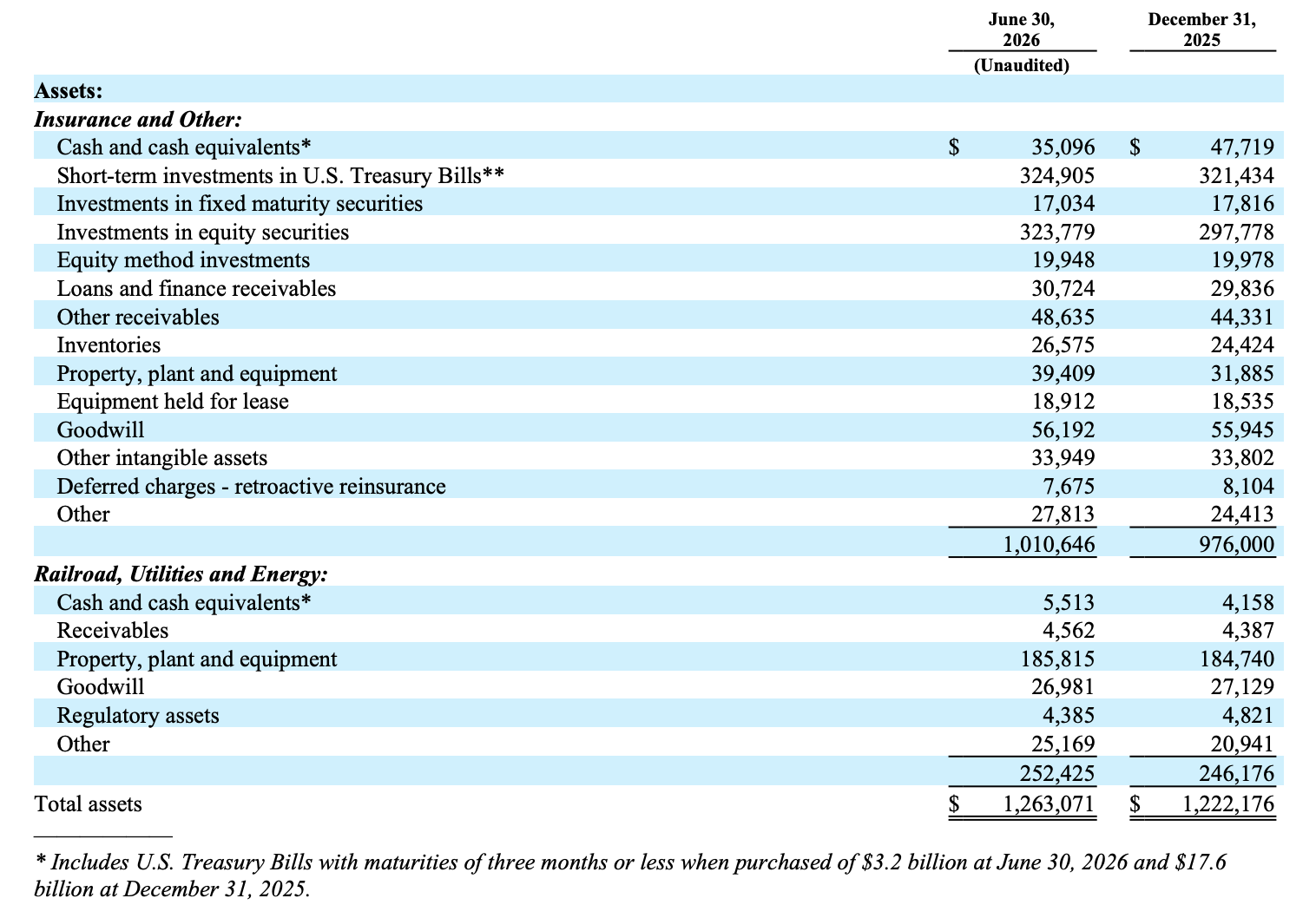
But with stock additions, share buybacks, and industrial acquisitions (primarily for petrochemical company OxyChem and homebuilder Taylor Morrison) unfolding in succession, Berkshire Hathaway's cash reserves have entered a downward trajectory. As of June 30, Berkshire held approximately $35.1 billion in cash and cash equivalents, alongside roughly $324.9 billion in short-term U.S. Treasuries, for a combined total of about $364.7 billion — a notable decline from $397.38 billion at the end of Q1.
Once Mocked as "Out of Touch," He Was Actually Watching Quietly from the Banks of a Raging Era
Let's rewind the clock to 2023 through early 2026.
Over the past few years, the AI technology wave has completely ignited global capital markets. Chip and semiconductor supply chain stocks represented by NVIDIA, SK Hynix, Samsung, and Micron have become the most crowded trading track.
The market has been flooded with an "All in AI" frenzy. Any fund manager not heavily positioned in semiconductors was deemed outdated, while Buffett and his Berkshire Hathaway — despite sitting on hundreds of billions in cash — chose to watch from the sidelines with almost cold indifference.
Then came the mockery. "Buffett is out of touch," "Value investing is dead," "The moat theory is obsolete in the face of the AI revolution," "The old man can't even beat me" — similar doubts were everywhere. People reveled in the multi-fold, even dozens-fold, gains of semiconductor stocks, compared Berkshire Hathaway's seemingly tepid stock performance, and hastily concluded that this 90-something old-school investing legend — and his designated successor Abel — had lost their judgment when it came to the tech revolution.
But Berkshire Hathaway's choice clearly had its own logic. In its Q2 2026 earnings report, Berkshire Hathaway reiterated its signature warning: "The amount of investment gains or losses in any given quarter is usually meaningless, offering virtually no analytical or predictive value."
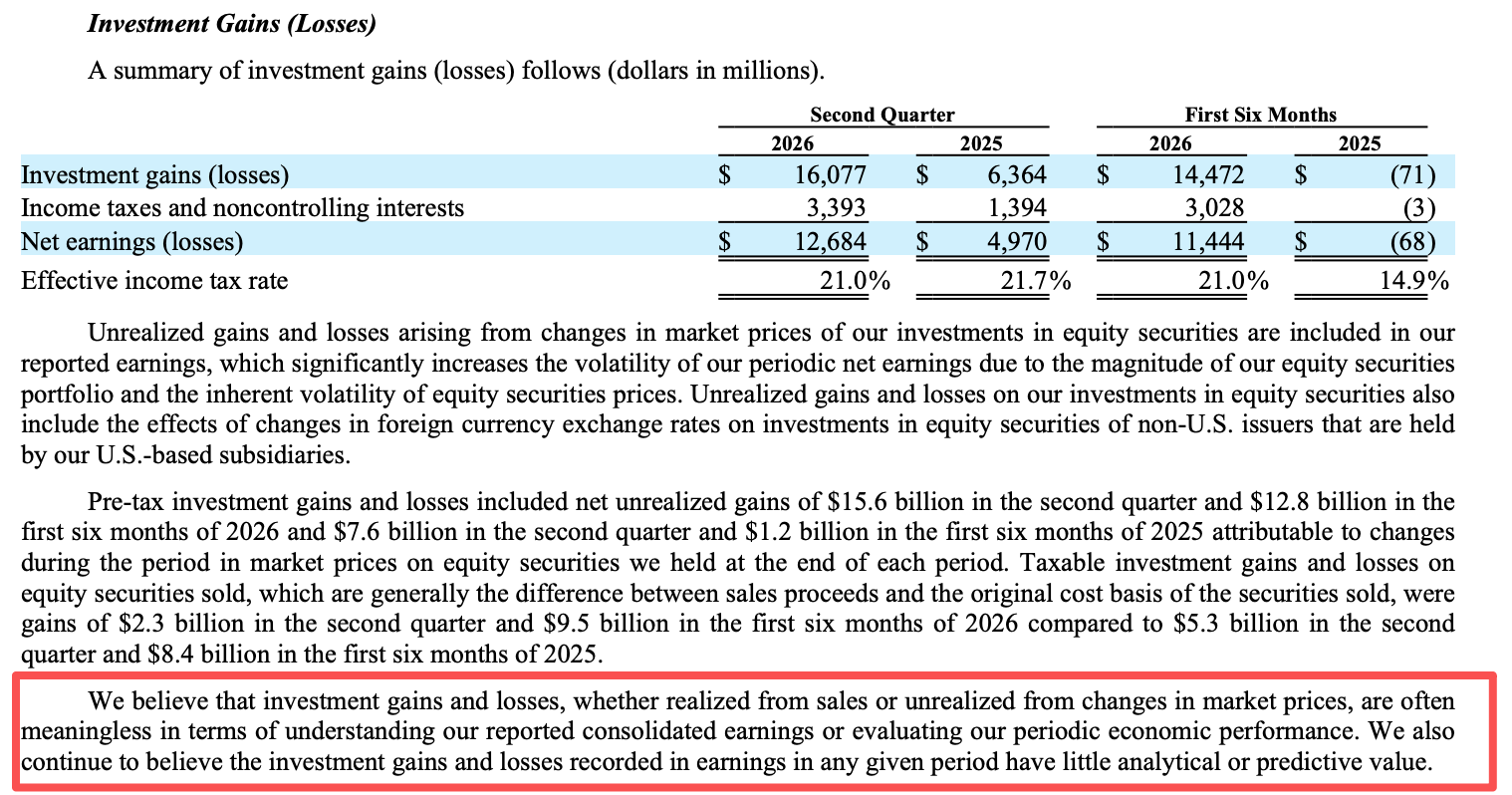
That statement may appear aimed at GAAP accounting rules, but it is actually a consistent stance toward short-term market speculation. In the eyes of Buffett and Abel, doubts likely remain over whether the semiconductor industry can escape its cyclical nature, and there is also uncertainty about when the explosive demand for AI hardware will translate into sustainable cash flows.
By the time the market entered its euphoric phase and semiconductor stocks had surged to lofty valuations, the market environment had completely fallen out of line with Berkshire Hathaway's discipline of "buying great companies at fair prices." So while the market was drowning in FOMO, Berkshire Hathaway chose the most unglamorous strategy — one that is nonetheless most true to its DNA: waiting.
Then, in recent months, as the semiconductor frenzy suddenly receded, the overheated names experienced sharp pullbacks. Those who once mocked Buffett for "missing the boat" suddenly realized that their paper gains from chasing semiconductor highs evaporated quickly in the correction. Meanwhile, the hundreds of billions in cash on Berkshire Hathaway's balance sheet not only provided an unparalleled margin of safety but also gave it the conviction to be greedy when others are fearful.
The $19.8 billion in net purchases in Q2 is precisely a validation of this discipline. It's worth noting that Berkshire Hathaway did not chase the market at its peak; rather, it made its large-scale moves only after market volatility brought quality asset prices back to reasonable ranges.
This is the truth Buffett has practiced for decades — investing isn't about who runs the fastest, but about who survives the longest and laughs last.


