






摩根士丹利依然看好海力士和三星,Q4存储行情将变化


- Core View: Morgan Stanley maintains an overweight rating on SK Hynix and Samsung Electronics, with target prices implying approximately 65%-74% upside, but judges that the memory industry will shift into the late-cycle phase in Q4 2026. The bullish thesis pivots to AI demand extending the earnings cycle and long-term agreements improving visibility.
- Key Factors:
- Morgan Stanley raised its 2027 cloud capex growth forecast from 14% to 29%, as AI compute remains in short supply and cloud providers have yet to scale back infrastructure investment.
- DRAM and NAND contract price sequential growth is expected to taper quarter by quarter from the 96% and 88% peaks seen in Q1 2026, falling to 6% and 3% respectively by Q4. PC DRAM's Q3 increase is projected to narrow from 45%-50% to 15%-20%.
- SK Hynix has completed roughly five-year LTA negotiations with about 10 customers. Samsung plans to place 60%-70% of capacity under rolling five-year agreements, though pricing under these deals adjusts with market conditions and cannot fully eliminate cyclical volatility.
- SK Hynix's 2026 EPS estimate was raised 13% due to one-off investment gains, while operating profit forecasts were cut 7%; Samsung's 2026 EPS was revised down 10%, reflecting weaker consumer business performance.
- Current DRAM gross margins are near 90%, an abnormally high level historically, and such high returns will attract new supply. CXMT is expected to supply HBM as early as 2027, posing a long-term risk.
TL;DR
- Morgan Stanley maintains "Overweight" ratings on SK Hynix and Samsung Electronics, with target prices of 2.6 million KRW and 381,000 KRW, respectively.
- Based on the share prices used in the report, these two target prices correspond to potential upside of approximately 74% and 65%, respectively, though this does not guarantee share prices will rise.
- The report raises its 2027 cloud capital expenditure growth forecast from 14% to 29%, with AI computing demand remaining a key structural support for the memory cycle.
- DRAM and NAND contract prices continue to rise, but month-over-month gains have retreated from highs; Morgan Stanley expects the industry to shift into the late-cycle phase in Q4 2026.
- Long-term supply agreements can improve order visibility but cannot fully eliminate cyclical fluctuations driven by prices, demand, and new supply.
Morgan Stanley's Asia tech report "Memory – A Small Wrinkle," released on August 6, continues to favor Korean memory leaders, maintaining its target prices for SK Hynix and Samsung Electronics. The target price for SK Hynix is 2.6 million KRW, while the target price for Samsung Electronics common stock is 381,000 KRW. Based on the baseline share prices used in the report, these represent potential upside of approximately 74% and 65%, respectively.
Such high target upside does not mean Morgan Stanley believes memory prices will continue rising at the previous pace. On the contrary, the report has already observed narrowing price gains, recovering channel inventory, and new capacity gradually entering the market, and expects the memory industry to transition into the late-cycle phase in Q4 2026.
Morgan Stanley remains bullish, primarily betting on three threads: continued upward revisions to AI capital expenditure, long-term supply agreements improving earnings visibility, and the recent valuation pullback in memory stocks already reflecting some peak-cycle concerns.
Earnings forecasts also reflect this caution. Morgan Stanley raised its 2026 expected EPS for SK Hynix by 13%, but mainly due to incorporating a one-time investment gain of 63.27 trillion KRW from Q2; meanwhile, its 2026 operating profit forecast was actually cut by 7%. Samsung Electronics' 2026 expected EPS was lowered by 10%, primarily reflecting weakness in consumer businesses such as smartphones.
Earnings forecast adjustments for 2027-2028 are relatively smaller for both companies. Based on the report's revised forecasts, SK Hynix's 2027 EPS would grow approximately 25% year-over-year, while Samsung Electronics would grow about 49%, broadly corresponding to the report's stated 25%-50% range.
Prices Still Rising, but the Memory Cycle Is Slowing
The most direct driver of the past memory stock rally came from product price increases. AI server demand has boosted demand for HBM, server DRAM, and enterprise SSDs, while capacity expansion has struggled to keep pace, driving DRAM and NAND prices significantly higher.
Morgan Stanley, citing TrendForce data, notes that the month-over-month growth in overall DRAM and NAND contract prices peaked in Q1 2026 at 96% and 88%, respectively. Q2 is expected to see gains of 61% and 58%, but Q3 is expected to fall to 16% and 13%, with Q4 further declining to 6% and 3%.
The report's latest channel checks show early Q3 DRAM contract price settlements up approximately 15% month-over-month, slightly below the prior 20% expectation, while NAND contract prices are up about 20%. PC DRAM contract prices in Q3 are expected to rise 15%-20% month-over-month, a notable narrowing from the 45%-50% increase seen in Q2.
Therefore, a more accurate description is not that "memory prices have peaked," but rather that prices are still rising while the pace of increases has slowed. Morgan Stanley expects the industry to gradually shift into the late-cycle phase by Q4 2026, when operating leverage from pricing weakens and the difficulty of further earnings surprises increases.
It's worth noting that narrowing price gains may not entirely stem from supply improvements. The report points out that some consumer DRAM price increases have slowed because buyers are approaching cost tolerance limits; meanwhile, AI-related customer demand remains robust, and suppliers are shifting some consumer-grade capacity toward products like enterprise SSDs.
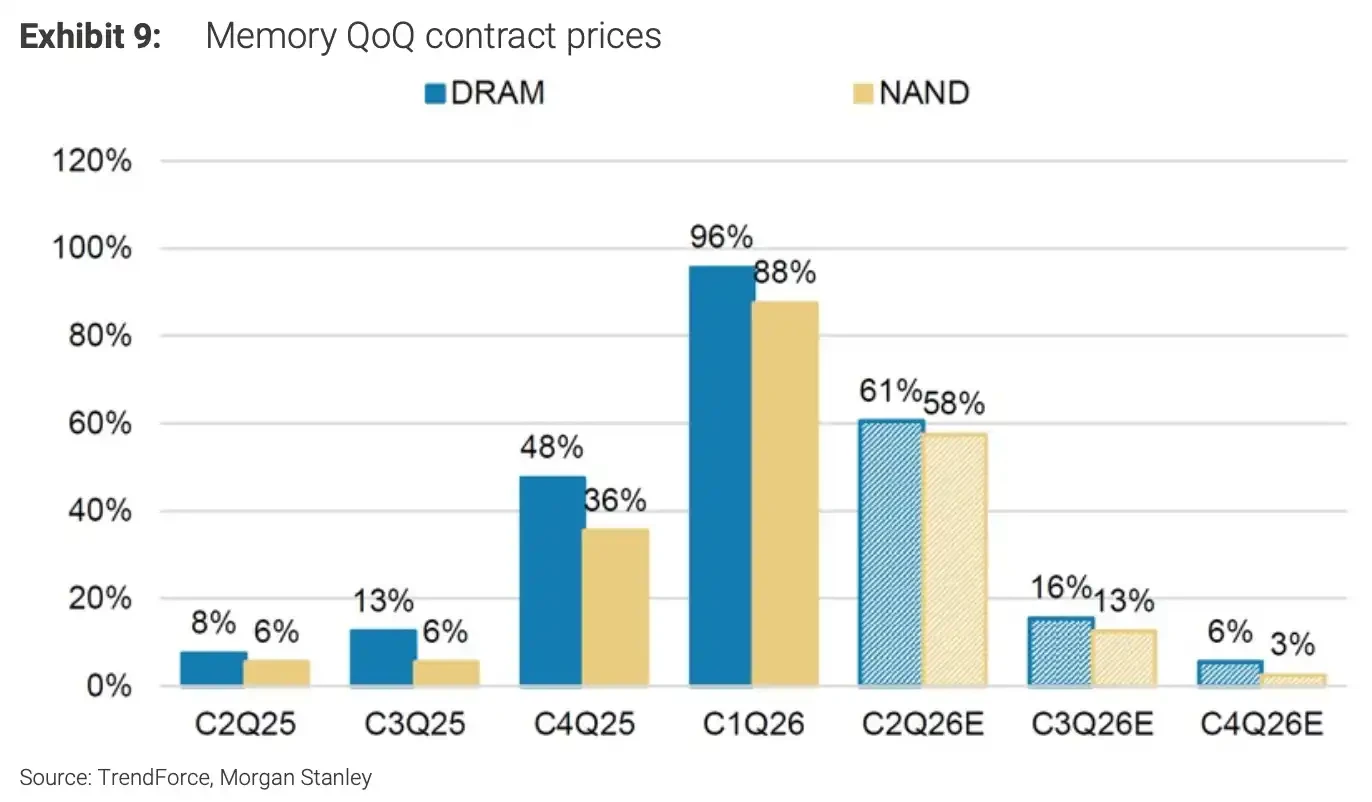
Month-over-month changes in memory contract prices. DRAM and NAND contract price gains are retreating quarterly from recent highs.
AI Computing Power Still in Short Supply; Cloud Capex Revised Higher
The first pillar supporting Morgan Stanley's bullish stance is that AI data center computing demand remains not fully satisfied.
The report cites earnings and management commentary from four major U.S. cloud companies: Alphabet and Microsoft report cloud demand still exceeding internal available capacity; Amazon expects 2026 capacity to remain insufficient for demand, with a significant portion of 2027 capacity already reserved; Meta expects industry compute supply to remain tight for the foreseeable future.
This information does not prove that all AI investments will ultimately generate expected returns, but it does indicate that major cloud providers have not yet significantly scaled back infrastructure buildout. Morgan Stanley's cloud capex tracking model has accordingly raised its 2027 year-over-year growth forecast from 14% a month ago to 29%.
This is critical for memory makers. AI servers require not just GPUs, but also HBM, server DRAM, and enterprise SSDs. As long as cloud providers continue expanding data centers, memory demand will not be determined solely by traditional consumer electronics cycles like PCs and smartphones.
However, "structural AI demand" and "cyclical price adjustments" can coexist. Morgan Stanley's core view is precisely that AI demand may extend memory companies' earnings cycles, but it will not make memory price and inventory cycles disappear entirely.

Cloud provider capex growth forecasts. The chart shows the 2027 cloud capex growth forecast raised from 14% to 29%.
Long-Term Agreements Improve Order Visibility but Cannot Lock In Future Profits
The second pillar comes from long-term supply agreements, or LTAs (Long-Term Agreements). Compared to traditional quarterly procurement, multi-year contracts allow suppliers to confirm a portion of demand in advance and plan capacity and capital expenditure accordingly.
SK Hynix's official Q2 results announcement states that the company has completed LTA negotiations with approximately 10 key customers and continues discussions with others. Morgan Stanley further relays from the company's earnings call that these agreements typically last around five years, though terms and pricing mechanisms vary by customer and product; some agreements include deposits, and prices adjust with market fluctuations.
SK Hynix has not disclosed the specific proportion of capacity or revenue covered by LTAs, only stating that agreements will be maintained at an "appropriate level" to both enhance downside protection and reserve capacity for new demand. Therefore, it would be inaccurate to describe its LTAs as having locked in the majority of future revenue.
Samsung Electronics' specific terms are primarily based on Morgan Stanley's compilation of its Q2 earnings call. According to the report, Samsung plans to include 60%-70% of capacity under long-term agreements, has already reached agreements with five global hyperscale data center customers, with another five in final negotiation stages. The agreements use a rolling five-year structure, require customer prepayments, and set price floors for certain mainstream products.
Potential customers listed in the report's tables—AWS, Microsoft, Google, Meta, and Oracle—are explicitly marked as based on media reports and should not be presented as officially confirmed counterparties by Samsung.
The significance of LTAs is primarily to improve demand visibility, support capacity investment, and reduce some price volatility, rather than to fully lock in future profits. Different contracts cover varying capacity, durations, price adjustment mechanisms, and default protections; if AI buildout slows, product specifications change, or market prices shift significantly, the protection these agreements provide has boundaries.

LTA comparison among major memory makers. The chart compares Samsung, SK Hynix, Micron, SanDisk, and Kioxia in terms of long-term agreement coverage, duration, and pricing arrangements.
High Target Prices Bet on Cycle Extension; New Supply Determines Upside
The market has already begun pricing in slowing memory earnings growth ahead of time. Morgan Stanley notes that DRAM-related stocks' forward 12-month P/E ratios typically lead forward 12-month EPS by about two months, and recent valuations have clearly pulled back, reflecting investors pricing in decelerating earnings growth.
This also explains why memory companies have strong current earnings yet their stocks may not continue to rise in tandem. Investor focus is shifting from 2026 existing profits toward 2027-2028 sustainability: whether AI capex can continue growing, whether LTAs can withstand a downturn cycle, and whether prices can hold after new capacity comes online.
High profits themselves also attract supply. Morgan Stanley notes that current DRAM gross margins are nearing 90%, unusually high from a historical perspective. If high returns prompt leading manufacturers to accelerate expansion or attract new entrants, existing margins may revert toward long-term averages.
Here it's important to distinguish between two metrics: the near-90% figure is the DRAM gross margin discussed in the report, while SK Hynix's Q2 76% is the company's overall operating margin—the two cannot be directly compared. SK Hynix officially disclosed Q2 2026 revenue of 79.3187 trillion KRW and operating profit of 60.5426 trillion KRW, representing a 76% operating margin.
Chinese manufacturers' capacity expansion is also listed as a long-term risk. The report states that new supply from ChangXin Memory Technologies (CXMT) and YMTC could ease shortages in certain products; CXMT's roadmap includes supplying HBM in the Chinese market as early as 2027. This is Morgan Stanley's description of the company's roadmap, and does not mean Chinese HBM has achieved mass production or can immediately replace high-end Korean products.
Additionally, the report expects major manufacturers to bring new capacity into production from 2027-2028. If AI demand continues growing rapidly, this new supply may not create near-term oversupply; but once cloud provider capex slows, supply release could accelerate price declines.
Therefore, the key assumptions behind the 2.6 million KRW target price are not that memory prices will rise indefinitely, but that AI demand can extend the earnings cycle, LTAs can reduce volatility, and the recent valuation pullback has already priced in a considerable portion of cyclical risk. What truly needs to be validated going forward is whether these long-term agreements can survive a price downturn, and whether memory companies can find new EPS growth drivers beyond 2028.
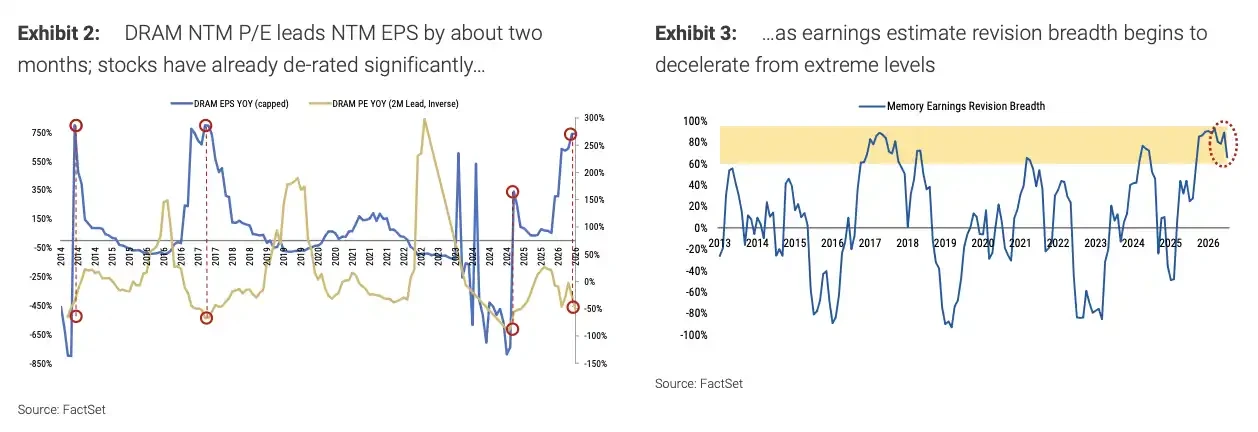
DRAM valuations and earnings expectations. The chart reflects that valuations typically lead changes in earnings expectations and should not be interpreted as a stable, mechanical causal relationship between the two.


