Tonight's US Nonfarm Payrolls Big Test: Will the "Weak July" Curse Repeat? All Three Previous Years Missed Expectations


- Key Takeaway: The US July nonfarm payrolls report will be released tonight, with market consensus expecting around 80,000 new jobs. However, leading indicators send mixed signals, and the forecast range is wide (40,000 to 157,000). The Fed's policy focus has shifted toward inflation — strong data would reinforce expectations of higher-for-longer rates, while weak data could fuel rate-cut pricing.
- Key Factors:
- Goldman Sachs predicts 75,000 new jobs, while Vanguard forecasts only 18,000, arguing that spring data was artificially boosted by weather conditions and World Cup hiring, leaving July facing downward correction pressure. ADP added only 44,000 jobs, intensifying downside concerns.
- Over the past three years, July nonfarm payrolls have averaged 66,000 lower than the three-month average, accompanied by significant downward revisions to the prior two months' data (averaging a downward revision of 112,000), creating a "weak July" curse.
- The World Cup effect is estimated to contribute 10,000 jobs, concentrated in leisure and hospitality. Initial jobless claims fell to 210,000 (188,000 for the week, the lowest since 1969), and layoffs decreased month-over-month to 33,000.
- Goldman Sachs expects the unemployment rate to rise back to 4.3%, driven by a reversal of June's sharp drop in labor force participation to 61.5% (the lowest since March 2021). Vanguard forecasts a year-end unemployment rate of 4.6%, while Citi expects it to break above 4.5% within months.
- Fed officials overall describe the labor market as "stable," focusing on inflation as the more pressing challenge. Even if wage growth reaches 3.6% year-over-year, it remains consistent with the 2% inflation target and does not pose a significant inflation risk.
- JPMorgan analysis shows the market is trading on a "good news is bad news" logic: if nonfarm payrolls exceed 150,000, the S&P 500 is expected to fall 50-175 basis points (10% probability); if the data falls in the 20,000-60,000 range, the index could rise 25-75 basis points (25% probability).
Original Author: Zhang Yaqi
Original Source: Wallstreetcn
The U.S. July nonfarm payrolls report will be released tonight Beijing time. Market consensus expects around 80,000 new jobs added, but multiple leading indicators are sending mixed signals, with some institutions forecasting figures well below consensus. Whether the "weak July" curse can be broken has become the biggest悬念 for the market.
The market's expectation range is exceptionally wide, from a high of 157,000 down to a low of 40,000. Goldman Sachs predicts 75,000 new jobs, slightly below consensus; Vanguard offers an extremely low forecast of just 18,000, arguing that spring employment data was inflated by weather, World Cup hiring, and early local government recruitment, leaving July facing substantial downward correction pressure. Meanwhile, ADP private sector employment rose by only 44,000, significantly missing expectations, further intensifying concerns about downside risks.
For the Fed, the current policy focus has clearly shifted to inflation rather than employment. Multiple officials have recently described the labor market as "stable." A strong jobs report would reinforce expectations of "higher rates for longer," putting pressure on rate-sensitive assets; conversely, weak data could push market pricing toward a path of gradual rate cuts.
The "Weak July" Curse: Three Consecutive Years of Misses
One of the most closely watched background factors for this report is the pattern of disappointing July employment data in recent years.
According to Goldman Sachs research, over the past three years, U.S. July nonfarm payroll gains have averaged 66,000 below the three-month average at the time and 35,000 below market consensus. These weaker-than-expected readings have also been accompanied by significant downward revisions to the previous two months' data, averaging 112,000 in downward adjustments.
Goldman Sachs economists Ronnie Walker and Jessica Rindels cite this pattern as a core basis for downside risk in their report. Their tracked alternative employment growth indicators averaged 65,000 in July, down from 79,000 in June.
Additionally, Barclays analysts caution that June's employment data itself carries significant revision risk—the figure was based on only about half the usual survey response rate, with the Bureau of Labor Statistics (BLS) relying heavily on model estimates rather than actual reported data. Barclays expects a sizable revision but notes the direction remains unclear.
World Cup Effect and Low Layoffs Provide Support
Not all signals point downward. Several data points offer阶段性 support to the labor market.
The World Cup hiring effect is a notable positive factor in Goldman Sachs' forecast. Data from Homebase shows that during the June-July survey reference week, employment growth in World Cup host cities was noticeably faster than in other regions. Goldman Sachs estimates this effect could contribute approximately 10,000 jobs to July's nonfarm payrolls, primarily concentrated in leisure and hospitality, professional and business services, and trade and transportation. However, the same data shows this effect began to fade after the July reference period ended.
Layoff data also shows positive signals. Initial jobless claims in early July fell to 210,000 during the BLS survey window, down from 224,000 in June; the week coinciding with the survey window dropped even lower to 188,000, the lowest level since September 1969. Challenger, Gray & Christmas reported announced corporate layoffs fell by 12,000 month-over-month in July to 33,000, the lowest since July 2024.
Government hiring is also showing signs of recovery. After roughly a year and a half of contraction, government employment has averaged 12,500 new jobs per month over the past four months, and government job openings have also rebounded recently.
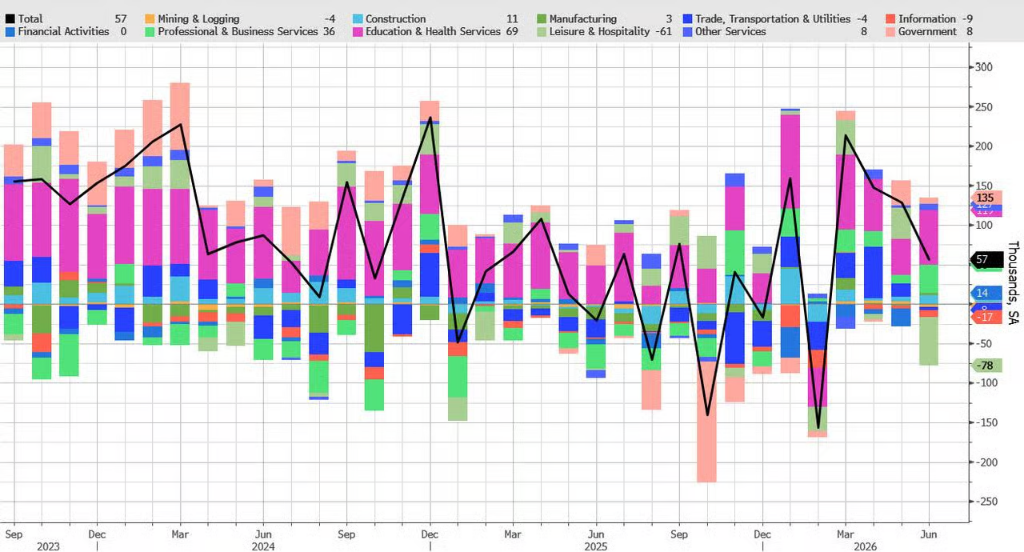
Labor Force Participation and Unemployment Rate: Potential Concerns
A core component of the jobs report is the trajectory of the unemployment rate and the underlying changes in labor force participation.
Goldman Sachs expects the July unemployment rate to tick up slightly from 4.2% to 4.3%, higher than the consensus forecast of unchanged. Goldman attributes this partly to a reversal of June's sharp decline in labor force participation—which plummeted to 61.5%, the lowest since March 2021 and the lowest non-pandemic reading since June 1976. The prime-age (25-54) participation rate recorded its largest single-month drop outside of April 2020.
Vanguard economists expect upward pressure on the unemployment rate as these workers who exited the labor force begin seeking jobs again, but at a slower pace than their willingness to return. They forecast a year-end unemployment rate of 4.6%.
Citi economist Veronica Clark points out that the labor market currently exhibits a "low hiring, low firing" equilibrium, a dynamic particularly不利 for new job seekers. She expects the unemployment rate to rise above 4.5% within a few months, at which point market focus will shift back to rate cut expectations. Citi's base case calls for a resumption of rate cuts in Q4 of this year.
Fed Stance: Inflation First, Employment Stability Secondary
The significance of this nonfarm payroll data for monetary policy guidance lies primarily in whether it strengthens or loosens the baseline expectation of "higher rates for longer."
Fed Chair Warsh described the labor market as "solid and stable," Logan called it "solid and slightly improving," Schmid views it as "broadly balanced," Paulson and Hammack say it has stabilized, and Barkin used the most cautious language, saying the market "doesn't feel tight." Officials overall view inflation as a more pressing policy challenge than employment.
Notably, Oxford Economics points out that even if July average hourly earnings rise 0.4% month-over-month, the annual rate would still be only 3.6%, remaining consistent with the Fed's 2% inflation target. Wage pressures are currently not viewed as a significant inflation risk. According to Bloomberg, analysts believe a strong jobs report could push real yields higher, especially given Warsh's earlier remark that "the market has already done some of the Fed's tightening work to a certain extent."
Good News Becoming Bad News?
JPMorgan's market intelligence division believes this nonfarm report will trade on a "good news is bad news" logic—a strong employment figure would reinforce "higher rates for longer" pricing, pushing yields up and pressuring rate-sensitive sectors; conversely, moderately weak data could drive yields lower, nudge market pricing in a slightly dovish direction, and potentially elicit a positive reaction from equity markets.
JPMorgan's detailed scenario analysis is as follows:
- If nonfarm payrolls exceed 150,000, the S&P 500 is expected to decline 50-175 basis points, with a 10% probability;
- If nonfarm payrolls are between 100,000-150,000, the index could move from -50 to +25 basis points, with a 25% probability;
- If nonfarm payrolls are between 60,000-100,000, the index could move from -25 to +50 basis points, with a 30% probability;
- If nonfarm payrolls are between 20,000-60,000, the index could rise 25-75 basis points, with a 25% probability;
- If nonfarm payrolls are below 20,000, the index could move from -125 to +50 basis points, with a 10% probability.
Options market pricing for this nonfarm report is relatively restrained, with contracts expiring August 7 implying a move of only about 0.7%, reflecting that the market has partially digested uncertainty amid the recent easing of geopolitical tensions. As of midday August 6, the 2-year Treasury yield had retreated to approximately 4.24% from a recent high of 4.35%.