






"ByteDance Employee Quits After Making 30 Million Yuan from Stock Trading: It All Started with Two Hard Drives on Pinduoduo"


- Core Insight: The author identified an anomaly - the continuous and unilateral price increase of large-capacity mechanical hard drives on Pinduoduo. Through layer-by-layer tracing, he deduced this was caused by supply constraints in the retail market due to massive procurement of enterprise-grade hard drives by AI data centers. Based on this, he bought Seagate stock, ultimately achieving substantial paper gains.
- Key Elements:
- After purchasing a hard drive on Pinduoduo, the author noticed its price kept rising unilaterally, rather than fluctuating with seasonal promotions. Using price comparison tools, he confirmed this was a widespread phenomenon across the entire product line.
- In-depth investigation revealed that the massive amounts of data generated by AI model training require low-cost, large-capacity mechanical hard drives (nearline) for long-term storage, rather than SSDs.
- Suppliers like Seagate prioritize higher-margin data center orders, squeezing retail supply. This was the root cause of the retail hard drive price hikes, and their financial reports showed record revenue and gross margins.
- By analyzing 13F reports, the author found that the number of institutions investing in Seagate grew orderly and consistently throughout 2024, confirming professional capital's consensus on the industry and boosting his confidence to increase his position.
- The author summarizes his trading methodology: start with abnormal price increases in everyday consumer goods, validate the trend with data, trace upstream to the core listed company in the supply chain, and finally confirm the direction using institutional holdings data.
Original Title: "Buying a Hard Drive on Pinduoduo Led Me to an Unexpected Investment in Storage & How Ordinary People Can Trade Using 'Everyday Information'"
Original Author: Leto Bao (X: @leto_bao)
All the information below was shared last year in the ByteDance US Stock Group, including trading targets, positions, and profit/loss, all verifiable.
Last August, I initially just wanted to buy two hard drives.
At the time, I was building a small quantitative trading platform and wanted to pull some tick-level market data locally for storage. Needing a place to store tens of terabytes of data, I ordered two large-capacity Seagate drives on Pinduoduo. Looking back, this hard drive purchase was the starting point of my foray into the storage sector over the past two years.

Hard Drive Prices Started Changing Daily
After the hard drives arrived, I bookmarked the link, planning to buy more if needed. A few days later, I checked again and the price had increased; a few more days passed, and it increased again. The same model, the same store, had adjusted prices several times within a week, and it was only going up, never down.
For a highly standardized industrial product with massive production capacity, the retail price shouldn't experience such a sustained, unilateral upward trend. I saw this as an anomaly worth investigating, not just a simple merchant price hike.
Using price comparison tools like Manmanmai and Keepa, I pulled up the price curve for this drive over the past few months and compared it with several other large-capacity models from Seagate and Western Digital. The conclusion was consistent: it wasn't an issue with a single model. The entire product line of large-capacity HDDs was rising, and it was a sustained, unilateral increase, not a short-term fluctuation caused by promotions.
At this point, it was basically confirmed that there was a larger underlying cause.
Following the Trail: AI Was Driving Hard Drive Demand
Digging deeper, the logic became increasingly clear.
The market focuses more on AI's demand for GPUs, but its demand for storage is equally immense. Large model training and inference generate massive amounts of data that needs long-term preservation. For long-term, low-cost data storage, the primary reliance is not on SSDs, but on large-capacity HDDs. The type of drives used in data centers are called nearline enterprise hard drives, which are being purchased in huge volumes by major cloud providers like Microsoft, Amazon, Google, and Meta.
Seagate was perfectly positioned for this wave of demand. Its flagship HAMR technology significantly increases per-drive capacity, directly meeting the needs of data centers. With limited production capacity, manufacturers prioritize more profitable enterprise orders, consequently squeezing retail supply. The price increase I saw on Pinduoduo was essentially the procurement demand of AI data centers trickling down to the consumer end.
I checked Seagate's financial reports from that time: the most recent quarter saw a 39% year-over-year revenue increase and record gross margins. The market was beginning to price the data storage sector as a component of the AI supply chain.
After confirming the logic, I bought 500 shares at just over $150, posting my rationale, cost basis, and position size in the company's internal US stock trading group.
What Gave Me Confidence to Add to My Position Was the Subsequent 13F
Being convinced myself wasn't enough; I needed to confirm whether institutional capital was making the same judgment.
There's a very useful public dataset in the US stock market: institutions managing over $100 million must disclose their US equity holdings quarterly via the 13F filing. This is essentially a legal, public record of institutional holdings accessible to anyone.
I didn't immediately add to my position. Instead, I wanted to observe the trend over a couple more quarters. A change in a single quarter could be coincidental; a consistent direction over several consecutive quarters is more credible. When the November 13F filings—covering the third quarter—were released, I plotted Seagate's institutional ownership over the past year, and the direction was crystal clear:
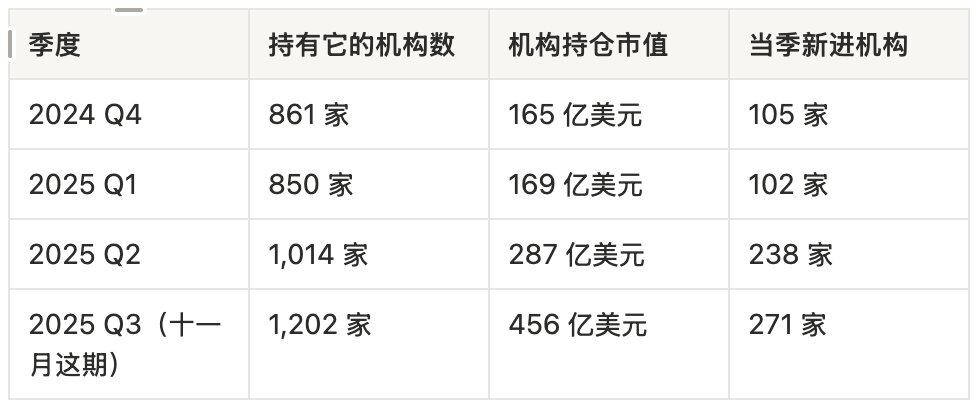
In the second half of 2024, the stock was largely ignored, with the number of holding institutions hovering around just over 800 and even slightly declining. A clear inflection point appeared in Q2 2025, and the trend accelerated in Q3: the number of holding institutions increased from over 800 to over 1,200, with the number of newly entering institutions also increasing each quarter.
It's important to note that the market value of holdings surged to $45.6 billion within a year, a large portion of which came from the stock price appreciation itself, not entirely from new capital inflows. However, "breadth" indicators like the number of institutions and new positions are more telling. Their quarterly increase suggests this wasn't just one or two funds betting on it, but a wave of professional capital steadily moving in.
Only after confirming this did I confidently add to my position significantly. I began seriously researching the storage sector, subsequently using LEAPS CALLS to increase my positions in $STX and $SNDK.
Looking Back Now
On the day I bought the hard drives, Seagate closed at just over $150. Today, it's around $965, a more than six-fold increase. Last year, it briefly surpassed Palantir to become the top gainer in the S&P 500. Just the initial 500 shares represent paper gains of roughly $400,000, not to mention the subsequent additions.
Even now, it feels a bit surprising that buying two hard drives led to a trade like this.
Summarizing This Approach
It's not actually that complicated:
· Anomalies encountered in daily life (price increases, shortages, queues) often signal changes earlier than news reports or earnings calls. Ordinary people sometimes pick up first-hand signals even before professional institutions.
· Don't stop at the impression that "things seem more expensive." Plot the price trend; you can usually tell if it's a trend or just noise.
· Then ask further: Is there a long-term, structural demand behind this? Find the publicly listed companies that directly benefit and are at a key position in the supply chain.
· Finally, use the 13F to verify institutional sentiment, and look at trends over consecutive quarters, not just a single one.
This method doesn't guarantee success every time, but it at least ensures that buying decisions are based on logic rather than gut feeling.
Finally, A Clear Statement on Risk
This was a successful case. I've also tracked price increase signals that ultimately turned out to be short-term fluctuations. I didn't post those in the group, but they are equally real, highlighting a clear survivorship bias.
The above is a personal review and does not constitute investment advice. Investment gains and losses are your own responsibility.
However, I do endorse this way of thinking: Pay attention to anomalies you encounter daily, dig one layer deeper for the reason, find the publicly listed company behind it, and then use the 13F to check if professional capital agrees. Next time something you regularly buy inexplicably rises in price, you can take the opportunity to think: Who is making money from this increase, and is that company already listed?


