CZ: Competitor Attacks Are 'Too Naive,' Greece Visa Denial in 'Lose-Lose,' and His Most Indispensable AI Is Kimi


- Core Thesis: In an interview, Binance founder Changpeng Zhao (CZ) reflected on his regulatory ordeal and prison experience, reconsidering his early 'act first, ask permission later' strategy, and emphasized that cryptocurrency remains his core focus. He predicted Bitcoin could reach $1 million by 2033 and criticized European regulations for hindering innovation.
- Key Elements:
- CZ reflected that, if given a second chance, he would have 'directly blocked all US users' and proactively traveled to the US to resolve charges, but the prison sentence exceeded expectations. He mitigated extortion risks by joining a prison group.
- CZ divides his career focus into four parts: Giggle Academy, Yzi Labs investments, providing regulatory advice to governments, and helping founders in the crypto ecosystem, emphasizing 'seizing the day' with a focus on short-term actions.
- Regarding European regulatory resistance, CZ cited sources suggesting ECB President Christine Lagarde may intervene to block Binance's MiCA application. He believes rejecting Binance is a 'lose-lose' situation but trusts that countries with forward-looking policies will benefit.
- He extensively uses free AI tools (such as Kimi) and believes AI can enhance industry security (e.g., vulnerability discovery), but human review of code is necessary, and he warns against complex leveraged financial products (like Strategy's STRC).
- On Bitcoin cycles, CZ predicts a 5x growth in the current cycle to $500,000-$600,000, and a potential 2x growth to $1 million by 2033. He also emphasized the role of diverse blockchain ecosystems (like BNB Chain) in driving innovation.
- CZ denied any hostility towards other exchanges (e.g., OKX), advocating focusing on one's own business. He also mentioned Binance US operates independently and was not involved in his legal dispute with the US.
- After his release, he donated $2 million to Prison Professor to support prisoner education and training (including cryptocurrency content) to break the cycle of crime.
Original Link: The Starting Block:CZ Interview
Compiled by: CryptoLeo (@LeoAndCrypto)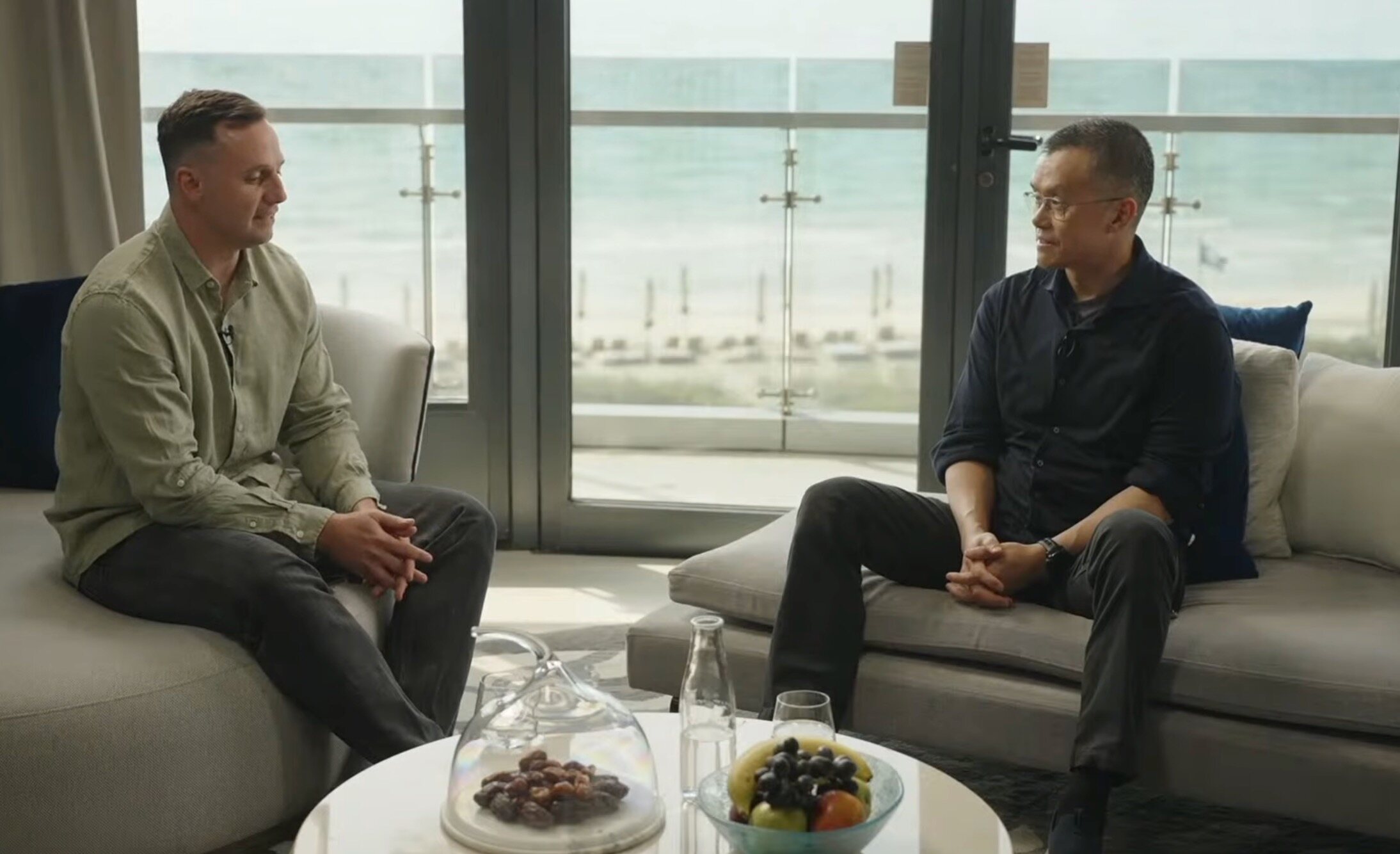
Editor's Note: Binance founder Changpeng Zhao (CZ) recently sat down with The Block podcast in Dubai, candidly addressing sensitive topics including the inside story of Musk's $500 million investment, the Greek regulatory incident, and his experiences in prison. He admitted to a past of "preferring to ask for forgiveness rather than permission," reflecting that if he could go back, he would "directly block all US users." He asserted that crypto is the future of money, predicting Bitcoin could reach $1 million by 2033. He also revealed that his most-used AI is the free version of Kimi, simply because his "paid quota ran out." From a workaholic logging 21-hour days to an industry driver living in the moment, CZ's transformation and steadfastness are fully captured in this exclusive dialogue.
1. Seizing the Day Over a Decade, Crypto Remains Core and Future
Q: Let's start with you and Musk. You've never met him, but you invested $500 million when he acquired X. Why spend so much?
CZ: To achieve financial freedom, you first need freedom of speech. X is a very important platform for free speech. Although $500 million is a lot, it's only about 1% of Musk's total $44 billion acquisition cost. I'm happy a crypto company could contribute to free speech. There were some twists and turns with this investment. I initially thought the deal would close in May 2022, but it eventually closed in October. At that time, many people said X wasn't worth $44 billion. I felt we should support a capable entrepreneur, and the outcome turned out well.
Q: Why haven't you met Musk? Was there an opportunity that didn't materialize?
CZ: We don't actively avoid each other, but our schedules are very tight. Even for that $500 million investment, I only exchanged about a dozen messages with him. On average, we might send each other a few messages a year. We're both very busy, though I'm less busy now.
I think our mindset is: We only meet when there's a need.
Q: I find X's development over the past year very interesting. There's a trend towards X native payments. What do you think the future of social payments looks like?
CZ: Most payment solutions are confined to specific countries, like Stripe and PayPal in the US; WeChat and Alipay in China. They are divided by country. I hope X can overcome this.
Cryptocurrency might be the first payment technology to break borders. When X announced X Money, I did chat with Musk. I sent him a message on X: Can we be partners? He said X Money handles all fiat currencies, so they won't touch crypto. But I truly hope X can become a global platform – currency should be global. There's no reason to divide currency by country. You can have your own monetary policy, but use a global currency. I really hope X can achieve this. And crypto isn't trying to "take a slice of the pie" from existing payment models. We all want better services to make the industry bigger. Humanity should be able to transact and do business globally.
Q: Speaking of you and Musk, Musk is arguably the most influential person in the world. Do you aspire to be the most influential person in crypto? What do you want to be remembered for? Or leave behind?
CZ: Wealth rankings aren't important, and I don't want to compete with Musk or anyone else. I don't care much about how I'll be remembered. When I look back on my life before it ends, I want to be able to say to myself, "I did my best." I say this often, and it means I should probably do more, if I can.
So I'm at a stage now where I help other founders; not leading, but enabling. I think Musk is remarkable. He's pushed so many incredibly difficult companies and projects. He deserves to be the richest person in the world.
I differ from him in this regard. Binance is a lucky and successful platform. We've been able to help over 300 million users globally. Many users write me thank-you letters. That's a great achievement. In the next phase, I just want to help other founders. For the future, we'll see.
Q: Besides Giggle Academy and Yzi Labs, do you have any bigger plans? What are your main focuses now?
CZ: I've actually split my time into four core parts:
- Giggle Academy;
- Yzi Labs investments;
- Advising other governments on crypto regulation (this probably takes up most of my time);
- Helping other founders in the crypto ecosystem.
These things occupy my time. I don't make grand plans; things move too fast. Five or ten years is too long. I focus on the present. I only care about what's important in the next few months, what I should do, allocate my time, and adjust every few months.
I think people's mindsets change over time. I worked incredibly hard running Binance for six or seven years, working 20 to 21 hours a day, taking 20 to 30 calls, plus attending various meetings. The job was very meaningful but also very exhausting, requiring good health. But now, helping other founders, I focus on broader things, learning about biotech, AI, and more.
Crypto is my core. Currency won't disappear, and crypto technology won't disappear either. Although many people have recently shifted to AI, crypto will persist. AI needs funding, and it will adopt cryptocurrency.
2. Better to Ask for Forgiveness Than Permission
Q: You just launched your new book, full of anecdotes, possibly untold stories. But I want to delve deeper into Binance's founding and its origins. You built a high-performance platform with a small team, using BNB as an incentive for trading. The year I first interviewed you, Binance's volume surpassed all other exchanges. You probably didn't expect such rapid growth. What's your secret to success?
CZ: First, you have to get the fundamentals right. You need a strong team and a truly good product. We were lucky that Binance occupied a product niche others hadn't, like the rapid growth during the 2017 ICO boom. The market changed – DeFi craze, NFT craze, etc. – but we stayed ahead.
A fundamental principle is how we protect users. Even in the early unlicensed, unregulated days, running an exchange platform meant users needed to know you were protecting them. For a crypto exchange, every policy and decision you make affects people's financial security, regardless of regulations or licenses. I believe this is a key reason many people chose Binance.
I can give countless examples of Binance making decisions that hurt its own finances short-term but protected users. Users repay Binance by staying, enjoying trading on the platform, paying small fees. Over time, these fees generate more revenue than what a platform would gain from occasional trades.
When China forced some projects to exit the market, we needed to return fiat to users. Binance used $6 million of its then $15 million in funds – 40% of our reserves – to reimburse users. These user-protection examples are mentioned in my book, though many details aren't heavily elaborated.
Users check our reserve accounts and understand our decisions. They know we always put users first. In the long run, this is key to Binance's growth. Many other platforms can copy your product, technology, or other things. But when it comes to financial decisions, they tend to be short-sighted.
Q: You've been under intense regulatory scrutiny over the years. Regarding Binance's US penalties and your imprisonment, from an outsider's perspective, you quickly decided to pay the fine and go to the US. What were the reasons? Any regrets? Anything you'd change?
CZ: Looking back, there are things I could have changed, but I had limited information. "To succeed, you must take risks. I'd rather ask for forgiveness than permission." That's a line I learned from Richard Branson's books. He's written about six or seven books, all touching on the topic of "Losing My Virginity." (Odaily Note: "Losing My Virginity" guides people to dare to take risks and challenge traditions; each new venture is a step into the unknown, filled with tension, excitement, risk, and uncertainty.)
The US government accused me of not following rules, but I'm a rule-follower in life. My thinking often goes outside the box, but I never truly broke rules. Crypto is a new industry. Everything I did primarily followed the technological roadmap.
Looking back, what I would change is this: if I were building a platform now without a license, I would directly block all US users. If I got a license, I'd follow the proper channels. I think that's one obvious area for change. Besides that, there are many mistakes, most of which are self-correcting.
I proactively flew to the US to handle the charges just to get it over with. It was really painful. I didn't expect to end up in prison. No one goes to prison for a single violation of banking secrecy rules. The worst I expected was a few months of home confinement, meaning I could still go online. Besides, I don't go out anyway. But the outcome was more severe than I anticipated. I got through it, though.
Q: Most people would be terrified and anxious about going to prison. What was your experience like?
CZ: The feeling was one of uncertainty – the unknown expectation of what would happen. Like I said before, before you go to prison, no one can tell you exactly what it's like. There are many different prisons just in the US. Statistics say there are 53 different prison systems in the US, each state potentially different, each system with different levels. Every city, every prison holds two to three thousand people. It's like a small city. They have their own rules. No one can tell you exactly what it's like inside. This uncertainty is always very worrying.
Moreover, Bloomberg, the Wall Street Journal, etc., reported that I would be the richest person ever to be imprisoned in the US. My lawyers told me I would likely be a major extortion target (in prison). I entered prison with that expectation.
Once you're inside, you think: when will I get out? Will they cause me more trouble? Will something else keep me there? The uncertainty is truly, truly worrying.
Q: I remember hearing some anecdotes, like prison guards asking you if they should buy Bitcoin. Your lawyers warned you to be careful. Were you ever extorted?
CZ: Actually, I was never extorted. I joined a group very quickly after entering prison.
My prison consultant (a former warden) told me: "CZ, don't go, don't join a group, stay quiet. That's the best way to avoid trouble." But another prison consultant who had actually been incarcerated told me: "You need to find a smaller group for protection quickly. If you stay alone, you'll definitely get bullied." Once you're in prison, you have no choice but to join a group.
I joined a group called Pacific Islanders, only half of whom were Asian. Another large group was called Mexicans, who were mostly drug lords, all Mexican.
Once you're in a group, it does provide some protection, so people don't come looking for trouble. If disputes arise, they negotiate with the group representative. So I wasn't extorted. But people did ask me: "Hey, I hear you're rich. How much money do you have?" I would just laugh off such questions: "I don't know what you're talking about. What money?"
Q: You revealed a few weeks ago that you donated $2 million to Prison Professor. Was this donation due to your prison experience, realizing that most inmates need help reintegrating into society?
CZ: Yes, more specifically, Prison Professor was founded by Michael Santos. He was one of my prison consultants. He was sentenced to 45 years for his first drug trafficking offense – a murder charge might only get a maximum of 10 years. He served 26 years due to good behavior. After his release, he was very sympathetic to my case and said he would help me. Michael founded and runs Prison Professor, helping those in prison get education before release and readjust to society. He wrote six books in prison and earned bachelor's and master's degrees. He got married with ten years left on his sentence. Prisons mainly handle divorces, they don't know how to handle marriages.
Michael gave me a lot of advice on how to survive in prison. After I got out, I looked at his project. It's a good project. I give him $500,000 every six months or so. I've made four transfers, totaling $2 million.
We kept this confidential until two weeks ago when he said he wanted to make it public to inspire other inmates. The project is actually run by someone who has been incarcerated and is also a crypto professional.
He also asked me if he could introduce crypto education into prisons. I agreed. He copied a lot of content from Binance Academy into his educational materials. I think that's great because in prison, you can't learn about AI, blockchain, or crypto. You can't even access the internet. Many people released don't even know how to use a smartphone. Those who served 10 or 20 years can't find jobs when they get out. What are they supposed to do? They re-offend. It becomes a vicious cycle.
Having been in prison, I think a significant portion of people shouldn't even be there. The legal and judicial systems aren't perfect. When Michael got out, drugs were legal in most states. So the crime he committed is now completely legal.
For other people asking me for money, I wonder if they are scammers. But I feel Michael is good, so I support his cause. It feels right to me. He also has some financial means and donates his own money to charity or Prison Professor. I feel it's a very good thing to be able to help him.
Q: You also mentioned OKCoin in your book and your time there. I know you don't want to go into detail, but OKX founder Star has been publicly attacking Binance and you personally. I just want to hear the story from your perspective – your time at OKCoin, how you parted ways, and how you view the situation now if it wasn't amicable?
CZ: Yi He and I worked at OKCoin in 2014. I left in early 2015, thinking we parted amicably. After I left, there was a dispute between Star and Roger Ver over the bitcoin.com domain name. I was dragged into it. I issued a disclaimer at the time, stating I wasn't involved.
A few years later, Yi He, a few other co-founders, and I started Binance. We became very successful. From that point, we focused on the business. For others, there might be personal psychological imbalance.
I always advise the team to focus on their own business. We build the best product, offer the best user protection, create the best compliance program, and work with regulators worldwide to advance crypto. That's what we do. Many people are jealous of our success. It's fine to be jealous of me, but attacking competitors is a bit childish. I usually don't respond.
Regarding my personal life, I've been officially divorced for many years. Things unrelated to users or the business shouldn't be the focus. The industry gets better when everyone focuses on providing the best product for users.
I'm now more concerned about other competitors who focus on their own products.
3. Europe Needs Crypto; Denying Binance a License is a Lose-Lose
Q: For years, many in the industry have criticized Binance for regulatory and compliance shortcomings. An anonymous source told me a few weeks ago that ECB President Christine Lagarde was involved in the decision to block Binance's MiCA application in Greece, which was reportedly about to approve it. Binance has now clearly stated it withdrew its application in Greece and will try via another member state. Facing regulatory obstacles in another major jurisdiction – does that give you a bit of PTSD?
CZ: Yes, I received the same information as you, though no direct info suggests Lagarde blocked anything. I did ask the Binance team about the MiCA process. What I learned is that at least one or two regulators told us they were about to approve it, but there were other policies and factors at play. Actually, two countries wanted to grant Binance a MiCA license. They wanted Binance to set up and boost the economy. But there were definitely other factors opposing our license. Eventually, Binance reviewed the situation and withdrew its MiCA application. As a stakeholder, I want Binance to get along with regulators and obtain licenses. It won't be smooth sailing.