Galaxy: The Impact of Massive Wealth Transfers on Cryptocurrency Markets


Original title: The Great Wealth Transfer its Impact on Crypto
Original author: Charles Yu
Original compilation: Luccy, BlockBeats
Editors note: Over the next two decades, Millennials will become the main beneficiaries of property inheritance, and by 2030, their adoption or acceptance rate of cryptocurrency will be at least 3 times higher.
Galaxy researcher Charles Yu conducted an in-depth analysis of wealth transfer in the United States, focusing on the large-scale wealth inheritance from baby boomers to millennials. The shift from the traditional financial system to cryptocurrency not only reflects the differences in investment behavior and values between Millennials and older generations, but also brings new opportunities and challenges to the cryptocurrency market. The article provides an in-depth explanation of the younger generation’s preference for cryptocurrencies and the profound impact this trend may have on the market.
Charles Yu also pointed out that although large-scale wealth transfer cannot solve all the financial problems faced by the younger generation, it marks an alternation of power and wealth, providing more autonomy for the digital native generation.
Over the next few decades, older generations will pass on trillions of dollars in money and assets to their children, dramatically changing the landscape of American wealth. This younger generation of “digital natives” has very different preferences from their parents in terms of investment behavior, including a higher willingness to invest in Bitcoin and cryptocurrencies.
core points
Millennials are about to usher in the largest wealth inheritance in history. Although baby boomers and older generations make up less than one-third of the U.S. adult population, they collectively own two-thirds of U.S. household wealth ($96 trillion) and are the leading generation of millennials and younger generations. More than 11 times the wealth. Over the next two decades, Cerulli Associates estimates there will be an $84.4 trillion wealth transfer from baby boomers and older generations to younger generations, with millennials being the primary beneficiaries. Coldwell Banker estimates that by 2030, Millennials will be five times richer than at the beginning of the decade, largely due to inheritance.
Millennials and Generation Z are significantly different from older generations when it comes to cryptocurrencies and are more likely to choose cryptocurrencies. Millennials and Generation Z are the first digital natives and are more racially, educationally and socially aware than their parents and grandparents. Suffering from multiple recessions, high housing costs and heavy debt burdens, this younger generation is more open to alternative financial systems and investments, including cryptocurrencies. Many surveys measuring cryptocurrency adoption among generations have found that these younger generations have at least 3 times higher adoption or acceptance rates for cryptocurrencies compared to baby boomers.
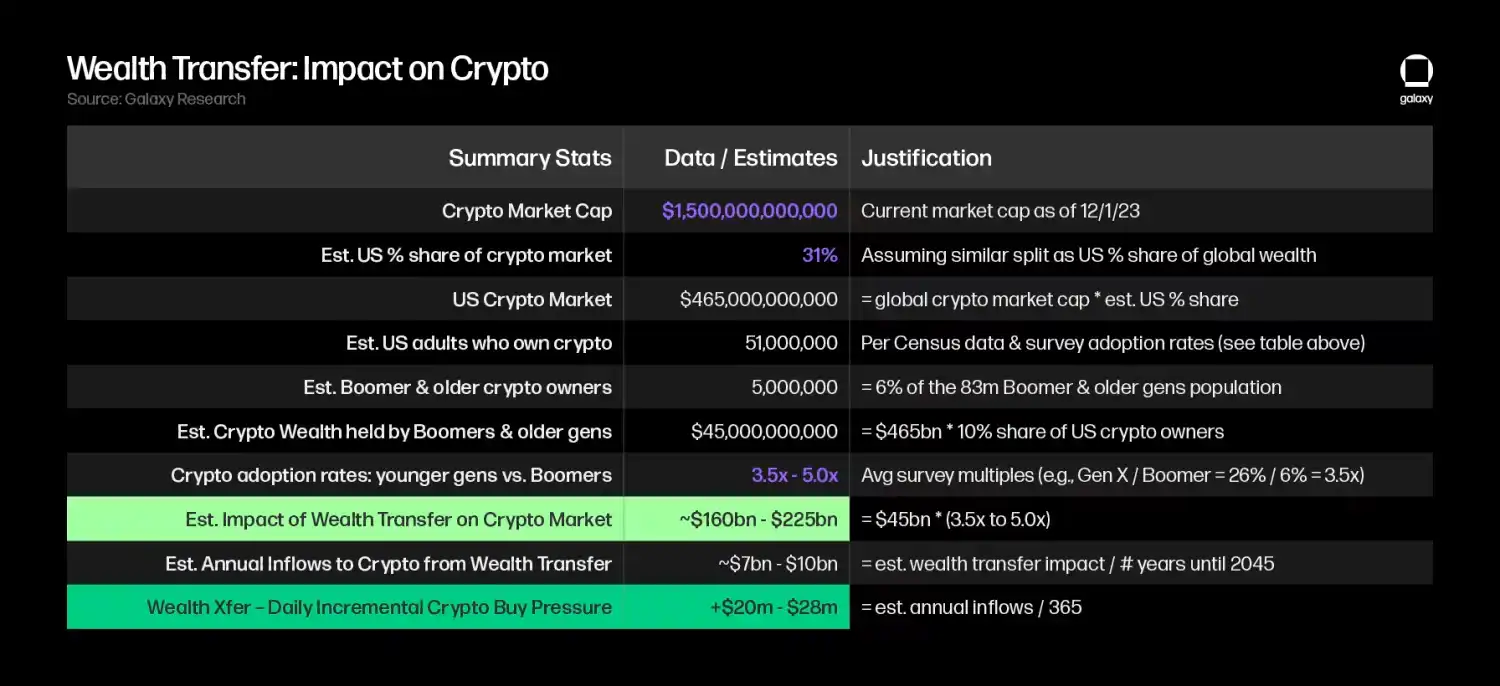
The transfer of wealth into the hands of these crypto-friendly individuals could lead to a significant increase in demand for Bitcoin and other crypto-assets. If The Great Wealth happened today, we estimate that an additional $160 billion to $225 billion would flow into the crypto market based on higher acceptance of the technology by younger generations relative to baby boomers. With the majority of the wealth of baby boomers and older generations expected to be transferred to younger generations by 2045, our estimates suggest that the impact of this wealth transfer could result in an additional $20 million to $28 million in daily purchases in the crypto market over the next 20 years pressure.
Although wealth transfer may not solve all the financial problems of Millennials and the next generation. Only a small proportion of the population is expected to receive any inheritance. Wealth transfers may not go to those low-income groups who stand to benefit most from inheritance. For those expecting an inheritance, the actual amount of wealth transferred may be less than expected due to longer life spans and higher medical costs, poor financial planning, shifting focus of spending, and fewer benefits.
However, the demographic shift in wealth/power towards younger generations is inevitable, which bodes well for cryptocurrencies. Even if a massive wealth transfer fails to materially address the financial burden of Millennials, the transition from Baby Boomers to younger generations will have profound social and political consequences — all of which have implications for the further adoption and future of cryptocurrency in the United States. development has had a positive impact.
massive wealth transfer
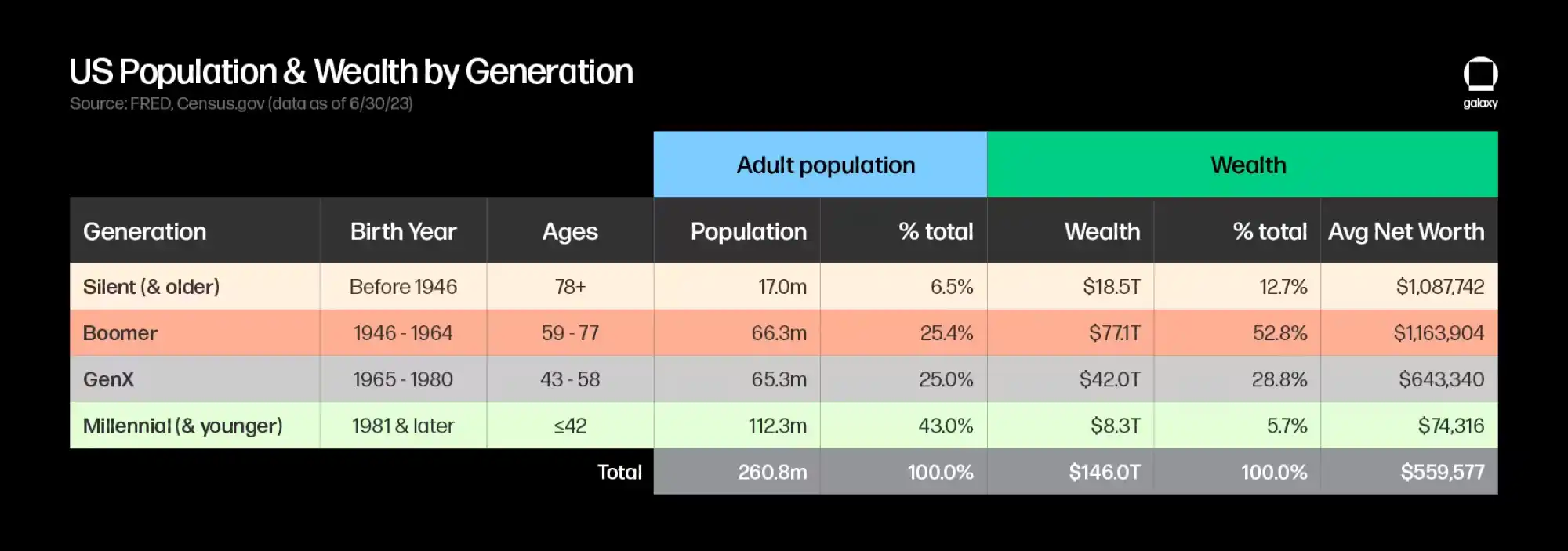
According to the Federal Reserves Survey of Consumer Financial Conditions, total U.S. household wealth reached $146 trillion as of the second quarter of 2023. Of this total, baby boomers and older generations (those born in 1964 and before) collectively hold $95.6 trillion, or about two-thirds of total U.S. wealth, although this group represents only the majority of adults Less than one-third of the population.
In recent years, Millennials have surpassed Baby Boomers to become the most populous generation in the United States. Despite their dominance in population size, Millennials and younger generations (including Generation Z) collectively hold $8.3 trillion (about 5.7% of total wealth), which is equivalent to the total wealth held by Baby Boomers and older generations. Some are about 11.5 times the amount, or the amount held by each person is about 15.5 times less.
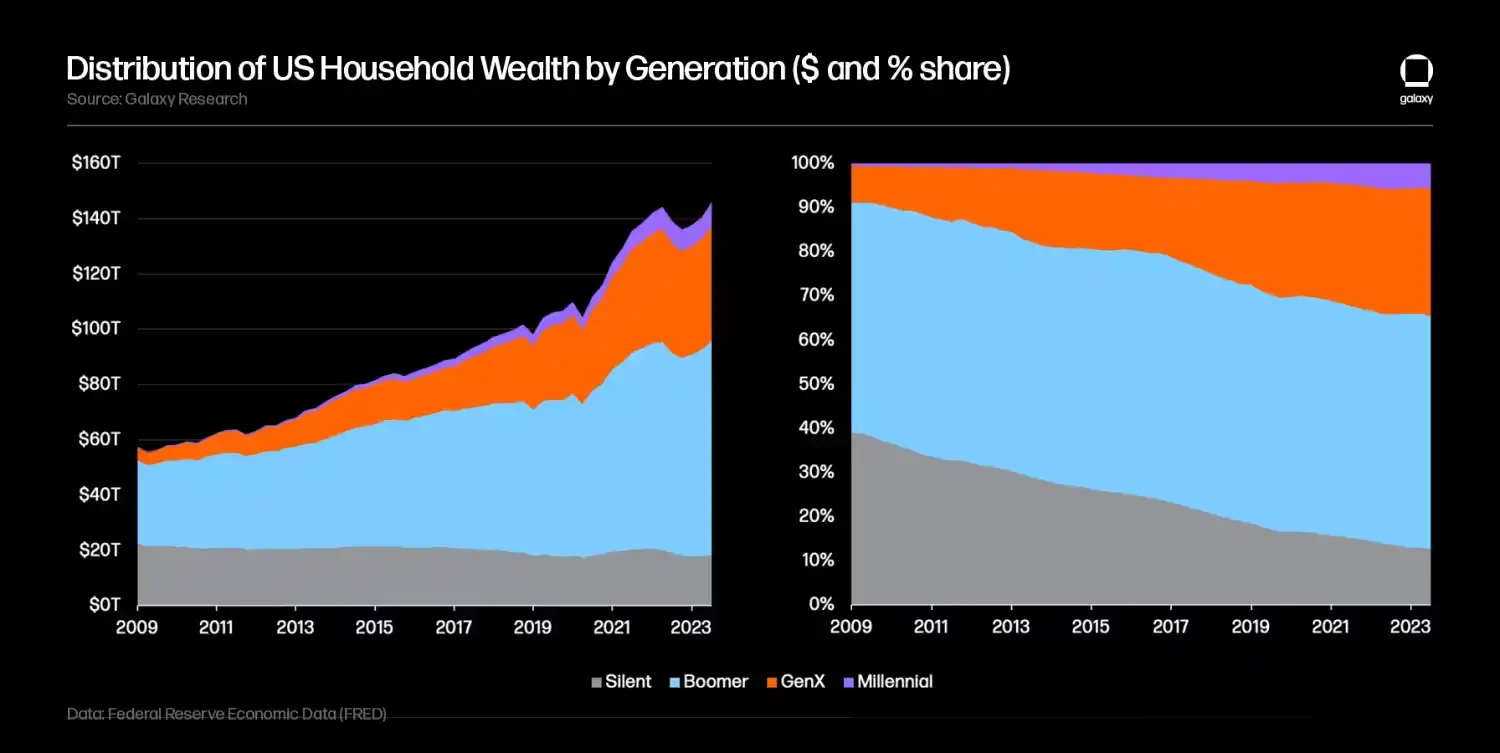
Over the next two decades, Millennials are set to be the primary beneficiaries of what many are calling the “massive wealth transfer,” in which older generations pass trillions of dollars of wealth to their children.
Cerulli Associates predicts that by 2045, the total wealth transferred will reach $84.4 trillion, of which $73.6 trillion (87% of the total) will be passed down to heirs, and the remaining $11.9 trillion (13% of the total) will be passed on to heirs. Donate to charity. Baby boomers (aged 59-77) are expected to transfer $53 trillion (63% of total transfers), while the silent generation (currently aged 78+) are expected to primarily transfer approximately $16 trillion over the next decade ( 19% of the total amount). Coldwell Banker estimates that by 2030, Millennials will hold five times as much wealth as they did at the beginning of this decade, largely due to inheritance.
generational divide
Recognizing key differences between these diverse groups and identifying generational trends provides valuable insights for individuals, investors, businesses and policymakers who wish to understand user behavior and preferences, exploit market opportunities or assess the impact of policy decisions .
Individuals of each generation experience a series of significant and influential events and challenges as they grow up, events that help shape their life principles and priorities. As young adults, the Silent Generation lived through World War II; Baby Boomers lived through post-World War II global conflicts and the civil rights and counterculture movements; Generation ; Millennials lived through the Great Recession and launched the Occupy Wall Street movement; Generation Z is entering the workforce after living through the COVID era. These major developmental events influence the way we interact with the world, including attitudes toward work and investment preferences.
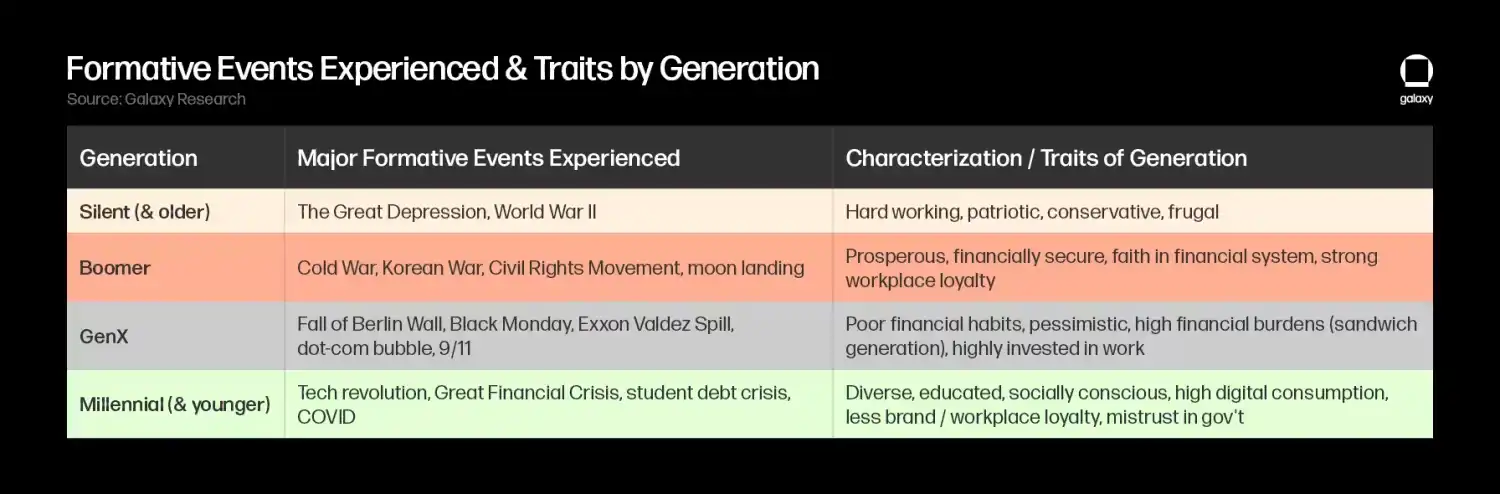
In our table above, we list several key developments in each generations formative years, as well as certain characteristics and values of each group. Most of these generational characteristics and idiosyncrasies are related to the global political and socioeconomic conditions in which each generation grew up (e.g. wars, capital markets, job markets, housing, etc.), while others may be technological advances or central banks and policymakers The result of other trends beyond your control (e.g. increased access to information, availability of technology and media, globalization).
Millennials and Generation Z stand out as the first people to grow up around the Internet and are known as the first digital natives. They are more racially diverse, better educated and more socially aware than older generations. There is also a generational gap between young and old. Today, older generations often view younger generations as lazy, arrogant, materialistic and sensitive. Conversely, younger generations may view older generations as out of touch, stubborn, and narrow-minded.
The merits and demerits of both sides are undoubtedly up for debate when it comes to these recommendations, but Millennials and younger generations are undeniably having to deal with some unique financial dilemmas and challenges that older generations didn’t experience at similar ages—not only do they Experiencing two major recessions in early adulthood and also facing higher education costs (and student loans) and housing costs impacted their savings and wealth:
For Millennials and Generation Z, student loans are a more serious issue than for Generation X and Baby Boomers. Not only are the costs of not attending college rising, but the cost of education has increased significantly, outpacing income growth and causing student loan levels to expand among younger generations. From 1982 to 2022, the average cost of attending a four-year college rose from $11,840 to $30,031 (a 40-year increase of 153%). Student loan debt has increased 163% over the past 15 years to $1.74 trillion, with the number of federal student loan borrowers increasing 45% as of the third quarter of 2023, Reaching 43.5 million Americans, average student loan debt per graduate increased 33% to $37,650. Millennials are more likely than Baby Boomers at age 30 to have some student debt at the same age (about 40% vs. about 20%), and they face four times the financial burden of debt (debt-to-income ratio 40% vs. 10%).
Housing costs have similarly become more expensive on a relative basis for younger generations (mainly benefiting baby boomer wealth as the value of real estate assets increases). Over the past 40 years, housing has become more unaffordable as median new home prices have exceeded median household income, causing outstanding mortgage debt to expand and slowing Millennial homeownership compared with previous generations. rates (rate increases over the past two years have further impacted housing affordability). Millennial homeownership rates lag behind older generations: 43% of Millennials will own their home by age 30 in 2022, compared with 52% of Baby Boomers at the same age.
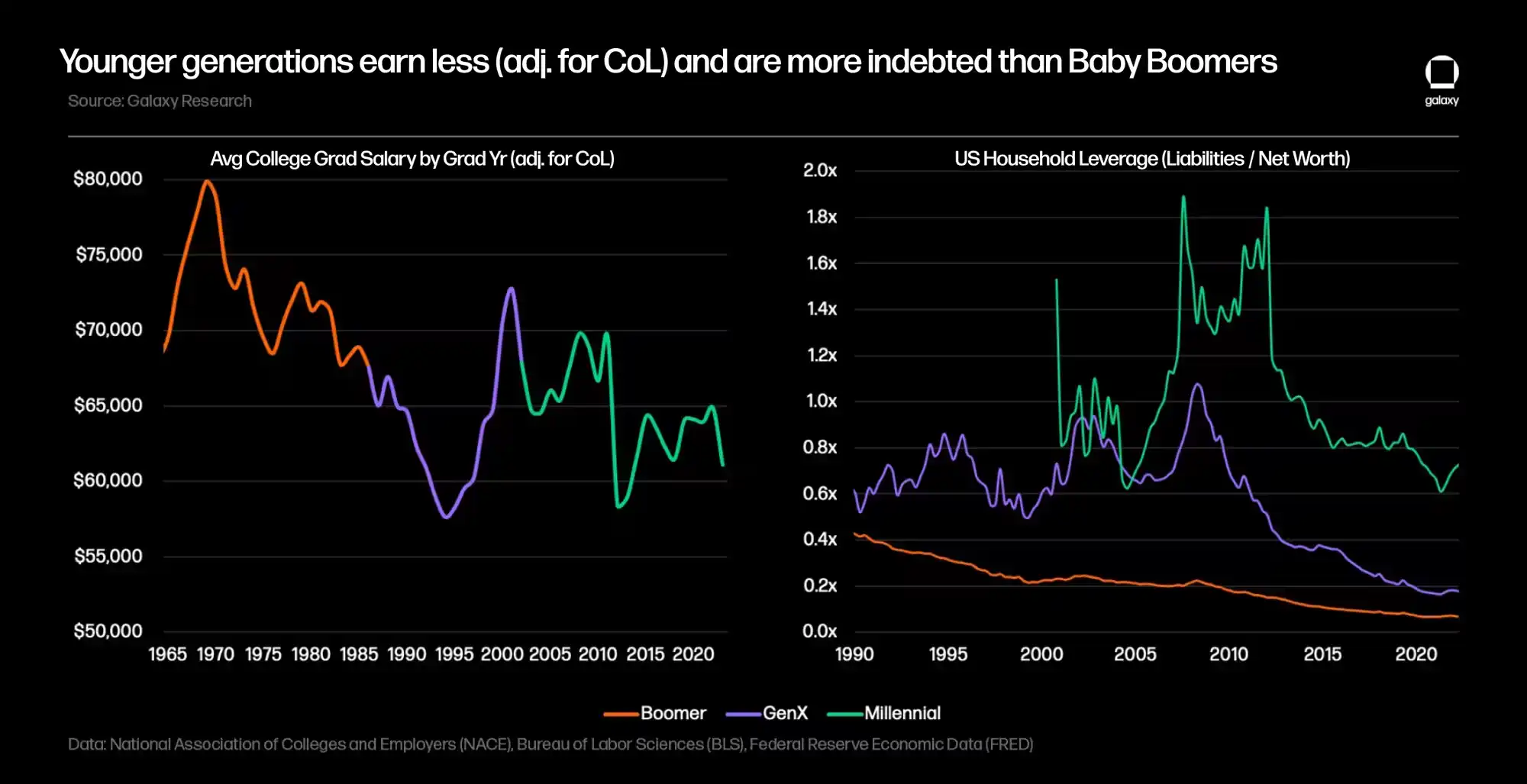
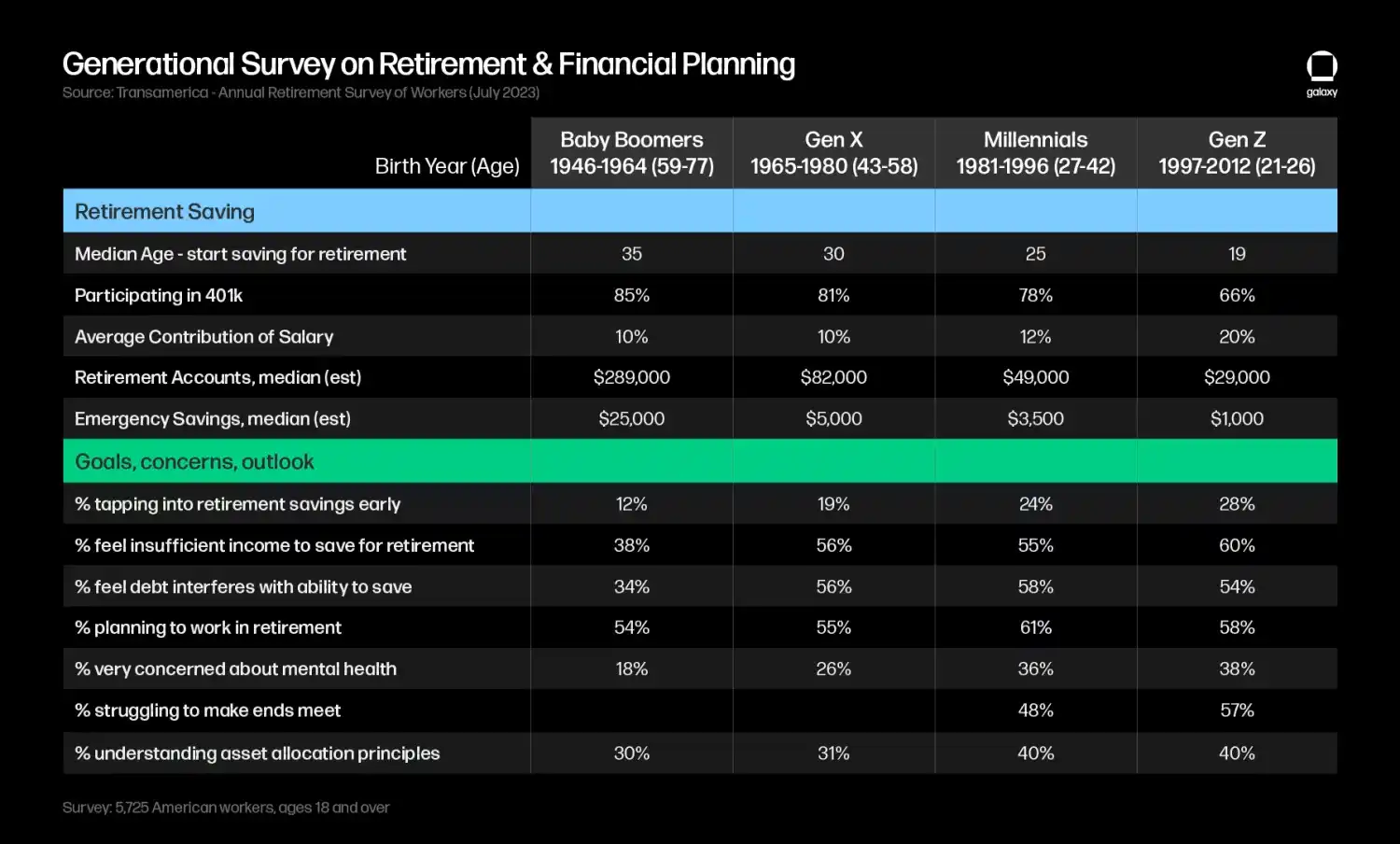
These economic challenges have negatively impacted Millennials’ net wealth-to-income ratio, causing their ability and propensity to invest or save to lag behind Baby Boomers at similar ages. Higher debt levels may delay the starting age of investing and the amount of savings, and may also have an impact on risk-taking behavior among younger generations. In addition, traditional sources of retirement income have shifted from Social Security and defined pensions to defined contribution plans (i.e., 401(k) plans), which shifts the burden of saving and investment management to employees. Millennials will be the first generation in which most people retire without a defined pension plan, and Social Security may no longer be a reliable source of retirement income. As a result, early access to retirement savings — that is, loans, early withdrawals, distress withdrawals — is becoming more common among younger generations, according to the Transamerica Institute survey. The survey also found that younger generations are more concerned about their mental health and their ability to save for retirement.
Attitudes towards and adoption of cryptocurrencies across generations
The traditional financial system has served baby boomers well—they have enjoyed relatively high incomes, a low cost of living, and many economically prosperous years—compared to millennials and younger generations. As a result, research shows they are more likely to have more faith in the financial system and choose to maintain the status quo.
Instead, many Millennials and individuals from younger generations are disillusioned with the financial system, feeling that it fails to meet their needs in the same way it did for their parents and grandparents. Especially in the wake of the 2008 financial crisis, which raised inflationary concerns and declining trust in institutions, these digitally native groups are naturally more open to alternative financial systems and investments. They are more likely to use non-traditional digital brokerage apps and robo-advisors than older generations, and have higher investment preferences in technology, ESG, social impact and alternative investing.
So, naturally, the idea of having an alternative financial system that uses digitally native currencies outside of banking and government control resonates with this demographic. The appeal of Bitcoin and cryptocurrencies aligns with the values of younger generations and is a digital-first, accessible, permissionless, privacy-focused, always-on approach to independent personal finance.
Bitcoin/Cryptocurrency Adoption Rates by Generation
Coinbase estimates that 52 million Americans own cryptocurrencies (roughly one in five adults), with ownership rates highest among Millennials (45%) and Gen Z (39%). The findings are somewhat similar to those of a Pew study, which found that 8% of adults over 50 have ever invested in, traded or used cryptocurrencies, compared with 25% of those aged 30-49 and 18-29 28% of people, indicating that adoption levels among younger generations are 3 times higher than those over 50 years old.
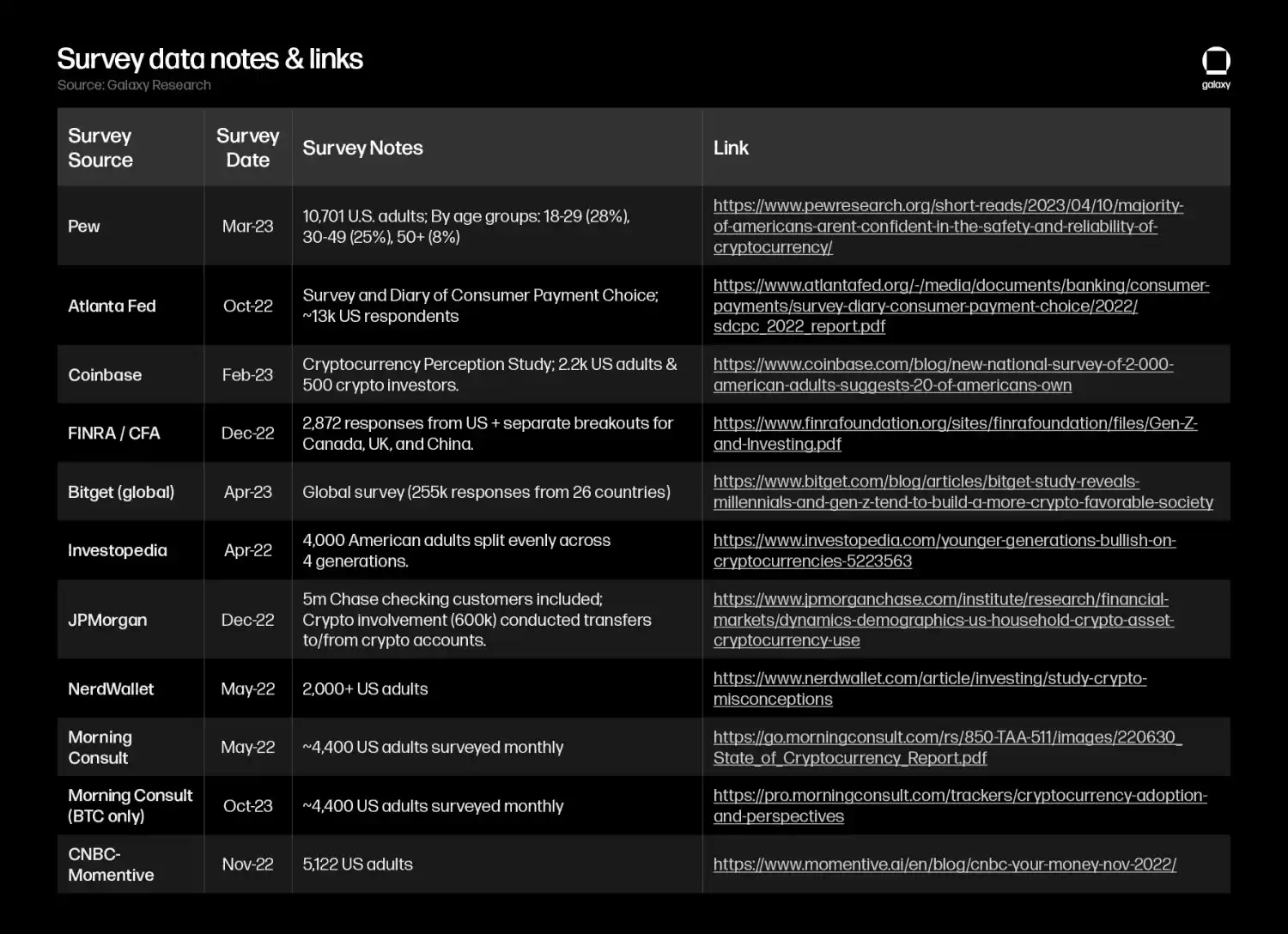
Other surveys tracking cryptocurrency adoption across generations have slightly different estimates, but each comes up with similar findings: Millennials’ cryptocurrency adoption rates are several times higher than those of baby boomers, averaging as shown in the table below 5.0x of the included surveys (details and links to each survey are included in the appendix):
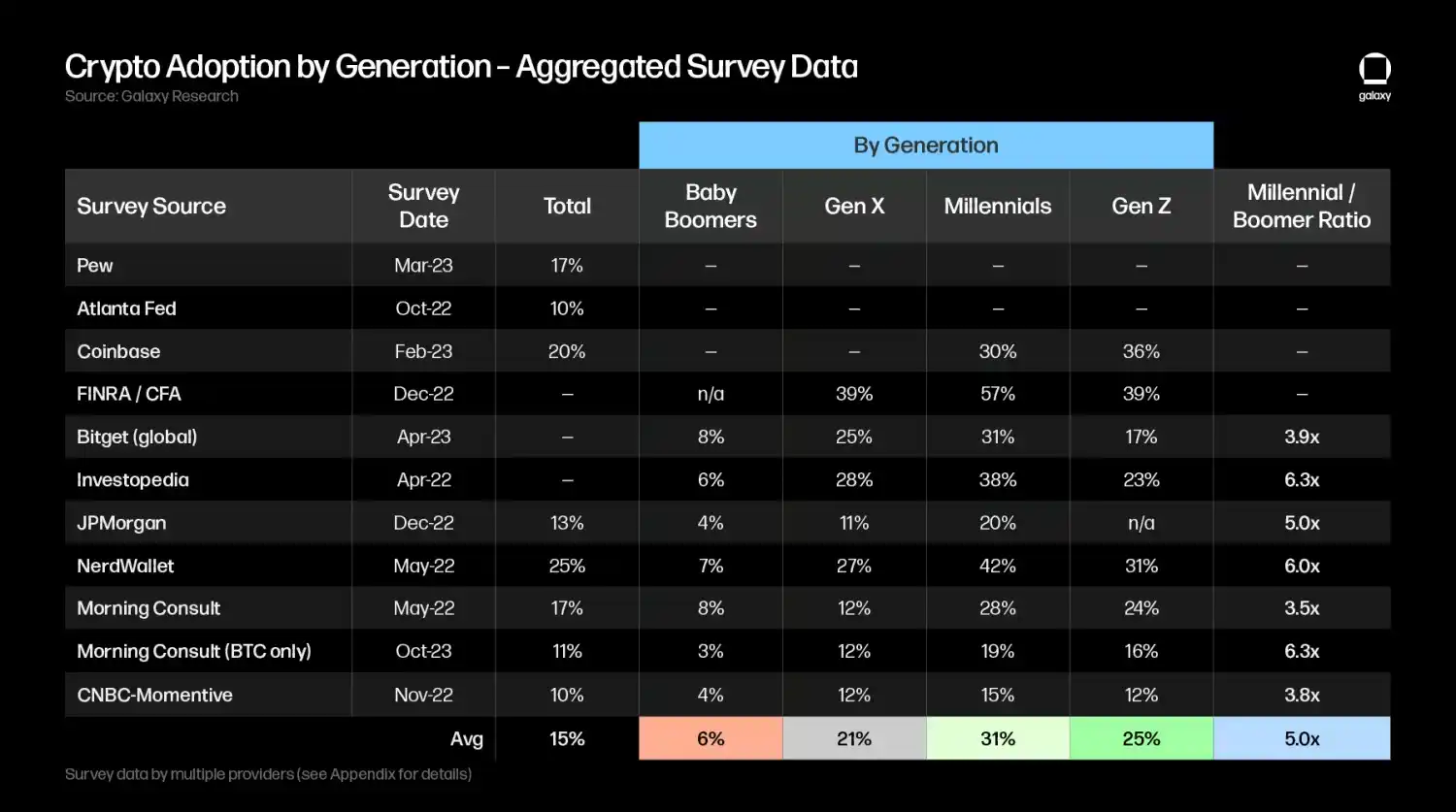
Other notable findings:
Cryptocurrency adopters tend to be individuals with higher education and higher levels of financial literacy. An empirical study of cryptocurrency adoption found that “individuals with higher levels of subjective financial literacy are more likely to perceive the benefits of using cryptocurrencies and express higher intentions to use them.” An Investopedia survey found that 69% of Millennials Generation Z report having an intermediate to advanced understanding of digital currencies, compared to 23% of Baby Boomers.
Younger generations like cryptocurrencies as much as stocks and have a larger allocation to the asset class. The same Investopedia survey found that millennials are more likely to invest in cryptocurrencies (38%) than stocks (37%). A FINRA/CFA survey of FINRA found that Gen Z investors are most likely to invest in cryptocurrencies for the first time (44%), followed by individual stocks (32%) and mutual funds (21%). The FINRA/CFA study also found that Gen Z reported a median investment in cryptocurrencies of $1,000, about a quarter of their median total investment holding of $4,000. A survey by BNY Mellon separately found that NextGen allocates 5% of its average portfolio to cryptocurrencies relative to the average North American family office allocation of just 1%.
The stance on cryptocurrencies could be a key topic influencing voters’ decisions. Millennials and Gen Z adults currently make up about 40% of the voting age population and will become the majority of the U.S. electorate by 2028. A Coinbase survey found that 44% of Millennials believe politicians and policymakers should support cryptocurrency/blockchain. Of the 52 million people who own cryptocurrencies, 55% say they are likely to vote for a pro-crypto candidate in 2024, with Millennials accounting for the highest share at 78%, surpassing Generation X (71%), Gen Z (69%) and baby boomers (51%).
So across all of these generational surveys, no matter how you phrase it, Millennials and Gen Z are more likely than Baby Boomers to be supporters of cryptocurrencies. Therefore, transferring wealth from older generations into the hands of this crypto-friendly population could lead to greater inflows into Bitcoin and the broader crypto asset class.
Impact of Massive Wealth Transfers on Bitcoin/Cryptocurrencies
As of November 27, 2023, the crypto market is worth approximately $1.5 trillion. Assuming a similar distribution to the U.S.s share of global wealth (31%), we estimate the U.S. crypto market is worth approximately $465 billion.
If we apply the average crypto adoption rate per generation from the survey to population data from the Census, we estimate that a total of 51 million Americans own cryptocurrencies (in line with Coinbase’s estimate of 52 million), with baby boomers and older generations making up the majority of the U.S. About 10% of the crypto population (compared to 27% for Generation X and 63% for Millennials and below). Assuming an even distribution of the estimated $465 billion in U.S. crypto wealth, we estimate that baby boomers and older generations currently hold approximately $45 billion in crypto wealth.
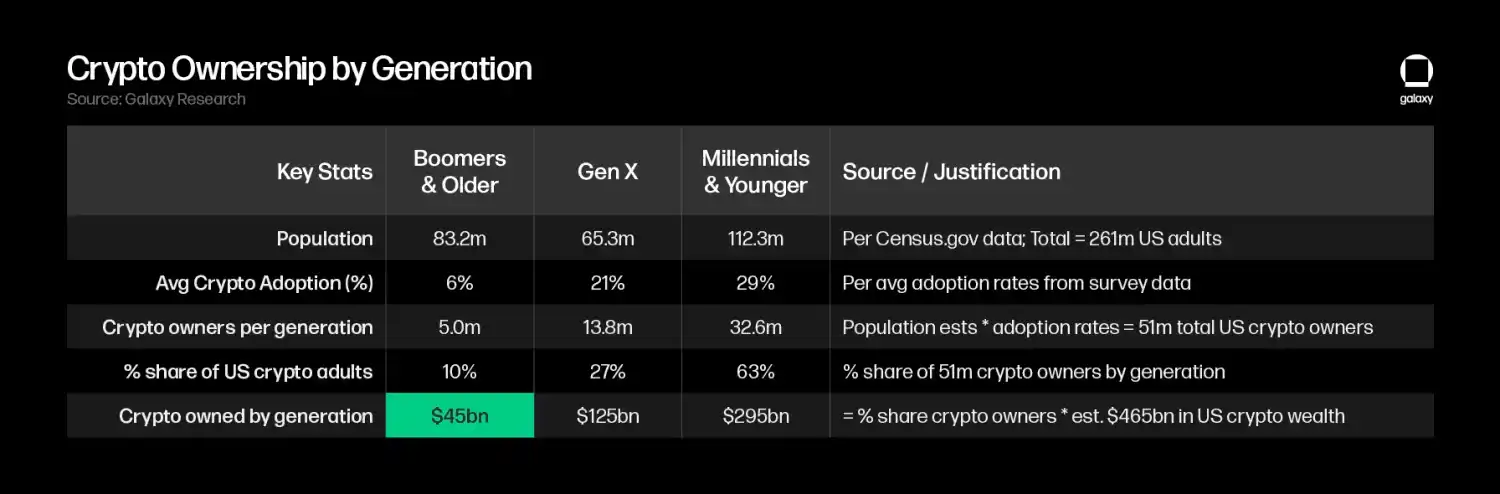
If the Great Wealth Transfer occurred today, we estimate that an additional $160 billion to $225 billion would flow into the crypto market, as wealth flows into crypto that is more popular with younger generations. This assumption is based on younger generations having 3.5x to 5x higher adoption rates relative to baby boomers (average based on survey data, with a Gen times the Millennial multiple as a cap), and this is equated to the fact that the younger generation will have 3.5x to 5x more crypto wealth than Baby Boomers currently hold.
As the majority of wealth held by baby boomers and older generations is expected to be passed on to younger generations by 2045, our estimates suggest that the impact of wealth transfer could bring $20 million to $28 million daily to the crypto market over the next 20 years additional buying pressure.
Note that this approach described may underestimate the impact of wealth transfers on crypto markets, as it uses a rough estimate of crypto wealth held by baby boomers as baseline data, which essentially means that while crypto adoption increases, The propensity to invest in crypto assets remains unchanged. Instead, what is more likely to happen is that there will be an additional multiplier effect as Millennials and younger typically allocate a greater proportion of their investable wealth to crypto assets rather than traditional financial assets, including stocks and bonds.
This approach also implies conservatism, as it takes a static view of today’s crypto preferences and wealth potential, does not take into account the higher earning potential of today’s younger generations, and does not include the compounding effect of investment returns over time. Crypto acceptance and adoption should continue to grow as the infrastructure and application layers continue to evolve, and the potential benefits of the technology prove over time.
Expectations on financial impact of massive wealth transfers tempered
While some economists estimate that the wealth transfer will increase the overall wealth of Millennials by 5-10 times, which could significantly improve the financial situation of the economically struggling younger generation and trigger an economic (crypto) boom, there are several reasons Leading one to believe that the impact of wealth transfers may be much smaller:
Much of the wealth expected to be transferred is held by a handful of wealthy households. If the total wealth held by the baby boomers and older generations were transferred to the remaining roughly 250 million Americans, it would amount to about $380,000 each, which could easily resolve all of the younger generations existing debt. However, wealth transfers will not be evenly distributed - Cerulli estimates that 42% ($35.8 trillion) of the overall transfer volume is expected to come from high-net-worth and ultra-high-net-worth households, which together only account for 1.5% of all households. A University of Pennsylvania study of historical inheritances found that families in the top 5 percent of the income distribution received inheritances that were four to 12 times larger than those in the bottom 80 percent. Furthermore, the likelihood of receiving an inheritance in any given five-year period is only 7.4%, with this probability increasing among higher income groups.
For those who expect to inherit, the actual wealth passed down may be less than they expected. A Federal Reserve study found that people who received an inheritance in the past three years estimated they would receive an average of $72,200 (actually received an average of $46,200), creating a gap between expected and actual inherited wealth. . The gap is even more pronounced for the bottom 50 percent, who are estimated to receive an average of $29,400 (actually receiving an average of $9,700). In terms of massive wealth transfers, an Allianz Credit Union survey found that 52% of Millennials who expect to inherit said they expect to inherit at least $350,000, compared with 55% of Baby Boomers who plan to leave an inheritance. % said they would pass on less than $250,000.
As lifespans increase and pensions/benefits decrease, baby boomers spend more on themselves. A Fidelity study found that a retired couple at age 65 can expect to pay $300,000 in health and medical expenses during retirement (an 88% increase since 2002). A Coventry study found that 85% of retirees prioritize their own financial security and health, with more than 75% of retirees surveyed planning to leave no inheritance.
Previous episodes of intergenerational wealth transmission in history have led to greater wealth inequality. A U.S. Bureau of Labor Statistics (BLS) study of previous intergenerational wealth transfers, tracking inheritances from 1989 to 2007, found little evidence of an inheritance surge—inheritances and gifts accounted for an average of 19% of net worth. , continuing a downward trend, suggesting that inheritances and gifts account for a smaller share of household wealth accumulation over time.
Therefore, any Millennial who expects a wealth transfer to bring an immediate economic boom to pay off all their debt should moderate their expectations and prepare otherwise. Much of the wealth inherited from older generations is unlikely to flow to the low-income groups who need it most. Still, any inherited amount can improve a persons financial situation and provide greater investment capabilities, with Bitcoin and other cryptoassets likely to be the primary beneficiaries.
Outlook
The baby boom generation experienced prosperous economic growth after World War II, profoundly changing American society as a whole. However, there is a clear generational divide between them and Millennials and younger generations, who face greater economic pressures than their older counterparts. In addition to the vast wealth disparity, digital natives have very different social values, particularly in terms of receptiveness to technology, social awareness, and trust in institutions. This makes these groups more willing to accept alternative financial systems such as Bitcoin and cryptocurrencies.
As the last of the baby boomers enter retirement, millennials will be the primary beneficiaries of a massive wealth transfer, a process that will pass on nearly $100 trillion in wealth to older generations through inheritance. While “massive wealth transfer” may not solve all of the ballooning debt problems facing younger generations, it represents a substantial demographic shift that will reinforce a stronger crypto-proneness among the digitally native population. As time goes on and people get older, cryptocurrencies may see greater inflows and find a more supportive path to wider adoption.
Appendix: Survey Data