


From Private Key Protection to Systemic Defense: How Can Crypto Rebuild Security and Trust in the AI Era?


- Core Viewpoint: The security logic of the crypto industry is shifting from single-point private key protection to building a full-link, defense-in-depth system covering personnel, software, devices, and permissions. Attack methods in the AI era have rendered single-point defenses ineffective, and a verifiable, sustainable, and accountable security architecture has become the industry's new standard.
- Key Elements:
- In the Binance incident, attackers infiltrated through social engineering, the software supply chain, and internal AI tools, taking months to obtain signing service permissions. They did not directly breach private keys yet caused asset losses, exposing the risk of separation between permission security and key security.
- The Ledger chip and system were not compromised; the risk emerged in the distribution process after devices left the manufacturer. Trezor confirmed that 3 devices had hardware implants and subsequently reduced its authorized reseller network by approximately 80%.
- Coinbase disclosed that over 99% of customer assets are held in cold wallets, and it employs distributed key protection, transfer limits, and anomalous behavior monitoring, reflecting the logic of defense in depth.
- After the incident, South Korea's FSC required exchanges to consider increasing the cold wallet ratio (current law requires at least 80%) and to strengthen 24/7 monitoring and administrator permission controls.
- After AI Agents connect to wallets, querying, transaction construction, approval, and signing should be separated according to the principle of least privilege, and high-risk operations should be equipped with independent mechanisms such as out-of-band confirmation, Passkey, or multi-authorization.
- The security system needs to shift from one-time audits to continuous verification, and from trusting brands to transparent and verifiable mechanisms, covering asset reserve disclosure, code audit records, and firmware integrity verification.
For more than a decade, the security narrative of the crypto industry has been distilled into a single classic slogan: "Not your keys, not your coins."
Whether ordinary users or institutional practitioners, people have long defaulted to a linear logic of security—as long as you write down your mnemonic phrase offline, buy a hardware wallet, or entrust your assets to a top-tier compliant platform, security is covered.
However, a series of landmark security incidents that have erupted in quick succession recently is thoroughly shattering this illusion of single-point defense.
On one side, attackers have begun exploiting AI, social engineering, and software supply chain vulnerabilities to bypass traditional security protections and directly penetrate enterprises' internal systems; on the other side, even cold wallets and hardware wallets, which are considered relatively safe, may become new attack entry points due to issues with internal permission management, device circulation, and third-party suppliers.
Against the backdrop of AI dramatically changing the way attacks and defenses are conducted, the security boundaries of the crypto industry are also being redrawn. It can be said that from trading platforms to hardware wallet manufacturers, the entire industry seems to be forming a new consensus:
The competition in crypto security has shifted from who is better at protecting private keys to who can build a more complete, more verifiable, and more resilient security system (Further reading: "As Hackers "More Efficiently" Use AI, How Is Web3's "Spear and Shield" Arms Race Escalating?").
1. Private Keys Matter, But They Are No Longer Everything
Looking back at past security incidents in the crypto industry, the most common risks are nothing more than private key leaks, stolen mnemonic phrases, phishing websites, and smart contract vulnerabilities.
These problems have certainly not disappeared, but attackers are looking for more and more concealed breakthrough points. Especially after AI tools rapidly became widespread, traditional security boundaries are changing.
The Binance security incident on October 29 is a typical case for observing this change.
According to Binance's preliminary investigation, attackers gradually penetrated the working environment of the wallet development team through tampered software installers, fake recruitment interviews, and malicious code, then used infected employee devices and internal AI tools to further obtain credentials with container deployment permissions, ultimately reaching the wallet signing service and initiating unauthorized on-chain transactions.
The entire process lasted for months and involved multiple links including social engineering, the software supply chain, employee endpoints, and internal permissions. The attackers did not directly breach Binance's wallet system; instead, through a multi-stage penetration chain, they gained a springboard to reach the enterprise's internal systems and critical permissions.
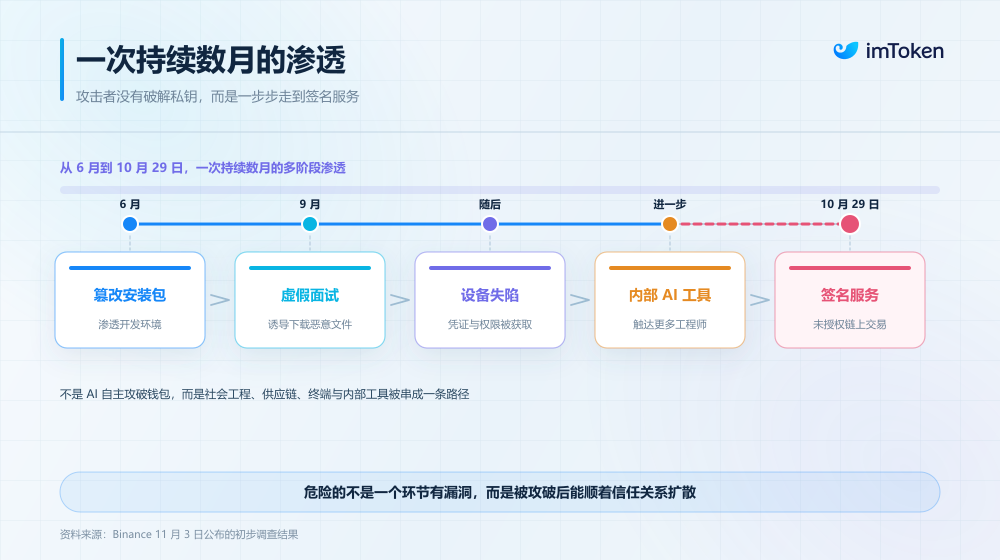
This also shows that attackers do not necessarily need to directly obtain private keys; as long as they can abuse the invocation permissions of critical signing services, they may likewise cause severe asset losses.
Even if private keys are protected through MPC (multi-party computation) sharding, it does not mean the entire signing system is inherently secure, because MPC solves how keys are managed in a distributed way and how signing can be completed without fully reconstructing the private key, but it does not automatically solve who has the right to initiate signing, which authorizations can be executed, and how abnormal authorizations can be revoked in a timely manner.
In other words, key security and permission security are two sets of protection mechanisms that must hold simultaneously.
Take the Ledger incident as another example. Its chip, operating system, and servers were not breached; the problem occurred in the distribution link after the device left the manufacturer's control, and users could still encounter attacks during the purchase and initialization stages.
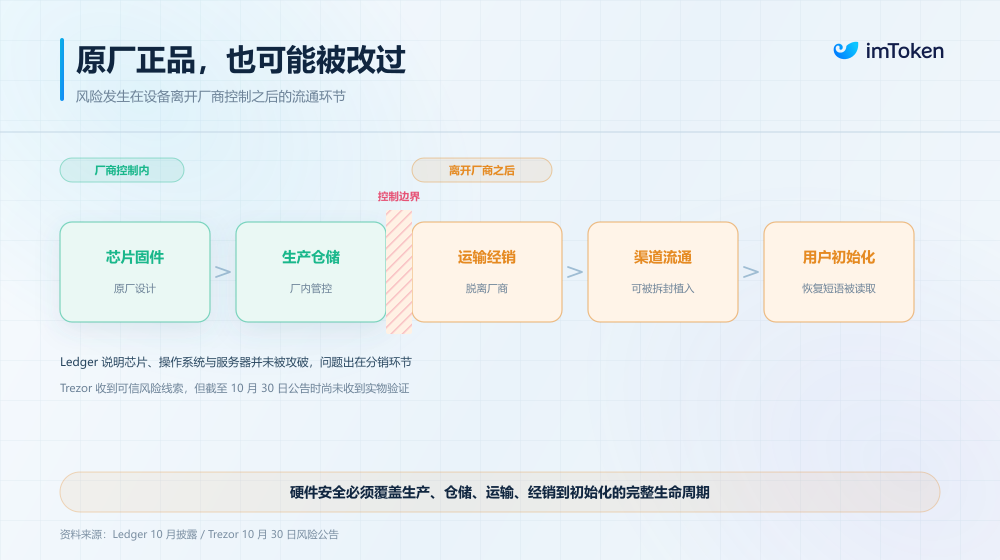
Looking at these incidents together reveals a common change: attackers are increasingly inclined to exploit trust relationships between different systems, rather than merely looking for an isolated technical vulnerability.
This also means that the crypto industry needs to redefine security boundaries—from protecting a single asset to protecting the entire asset lifecycle; from focusing on whether a certain device or system is secure to examining the complete chain of trust among people, software, devices, and permissions.
But what is noteworthy is that, in the face of these changes, the industry has not stopped at discussing risks.
2. From Binance to Ledger: How Is the Crypto Industry Upgrading Its Security Defenses?
After a series of recent security incidents, trading platforms, hardware wallet manufacturers, security firms, and regulators have all begun to push adjustments from their respective positions.
If these actions are viewed together, several noteworthy changes are taking place in crypto security.
1. Binance and Coinbase: From Protecting Keys to Protecting the Entire Signing and Fund Flow Process
After the Binance incident, the platform rebuilt the affected wallet system and internal AI tools in a new environment, replaced relevant employee devices, disabled compromised credentials and access tokens, and conducted further security checks on employee endpoints.
At the same time, Binance also strengthened risk control for wallet services and AI-driven abnormal behavior detection, and plans to bring in independent security institutions to conduct further reviews of the incident causes, internal permissions, and related protection systems.
These measures may appear scattered, but in fact they target the same problem: once attackers have entered the internal system, how can they be prevented from continuing to use existing permissions to reach higher-risk asset operations?
A similar approach can also be found in Coinbase's latest publicly disclosed asset protection system.
On November 4, Coinbase published a dedicated article introducing its customer asset security architecture, stating that more than 99% of customer assets are currently held in cold wallets, and disclosing a complete set of fund flow control mechanisms.
For example, at the key management level, Coinbase adopts a distributed key protection mechanism to avoid single-point private key exposure; during the transfer process between cold and hot wallets, it sets strict transfer speed and amount limits, and identifies suspicious operations through abnormal behavior monitoring.
They also provide a reference sample: where assets are stored is certainly important, but who can initiate transfers, under what conditions signing is allowed, and whether operations can be stopped in time when anomalies occur also determine the security level of the entire system.
This is actually the core logic of Defense in Depth.
No single link is assumed to be absolutely secure; on the contrary, even if an employee device is compromised or a certain permission is abused, other protection mechanisms should still be able to limit the continued spread of the attack.
2. Ledger and Trezor: Security Begins to Extend to Production, Circulation, and Delivery
Changes in the hardware wallet sector are equally representative.
After this hardware implantation incident, Ledger began adjusting device management requirements for authorized distribution channels, requiring relevant authorized dealers and distributors to suspend sales in Southeast Asia and Hong Kong, and to carry out device sampling inspections and inventory checks.
At the same time, Ledger further clarified that dealers must not resell returned devices, even if the packaging appears intact; devices should no longer be placed on open shelves or display areas, but should be stored in rear warehouse areas and delivered only when users make a purchase.
These measures also show that the boundaries of hardware security are expanding, essentially reducing the opportunities for attackers to access and tamper with devices.
Trezor's adjustments are even more direct.
On November 12, Trezor announced the latest investigation results, confirming that 3 Trezor Safe 5 devices sold through the distributor involved, CryptoBilis, had hardware implants; at the same time, Trezor announced that it had reduced its authorized dealer network by about 80% and required retained partners to comply with stricter procurement, warehousing, and device access management rules.
At the product level, Trezor released firmware version 2.13.1 on November 11, adding protections against the discovered implanted modules so that they can no longer read screen information.
This also reflects a change taking place in hardware security governance, namely that security no longer depends only on whether a product is reliable when it leaves the factory, but also on whether the manufacturer can continuously manage supply chain risks and provide effective detection, remediation, and user compensation measures after problems occur.
For wallet manufacturers, this means they need to manage not only chips and firmware, but also the complete product lifecycle.
3. From CZ's Security Alliance Initiative to Regulatory Action: Industry Collaboration Is Forming Real Capabilities
In addition to internal enterprise security upgrades, another noteworthy direction is cross-platform collaboration.
After the Binance incident, CZ publicly called for the crypto industry to establish a security alliance to promote security intelligence sharing, cross-security audits, and more efficient tracking and emergency handling of stolen funds.
Behind this is actually a long-standing contradiction in the crypto industry: blockchain assets can flow quickly across platforms and chains, but security defenses are often scattered among different exchanges, wallet manufacturers, security companies, and on-chain analysis firms.
One platform discovering an abnormal address does not mean other platforms can immediately identify it; one security team mastering a new attack signature does not mean the entire industry can promptly update its protection strategies.
This reflects a defense model different from traditional enterprises building their own security teams: connecting security research, threat monitoring, and emergency response capabilities scattered across different institutions so that attack information can be identified, shared, and used more quickly.
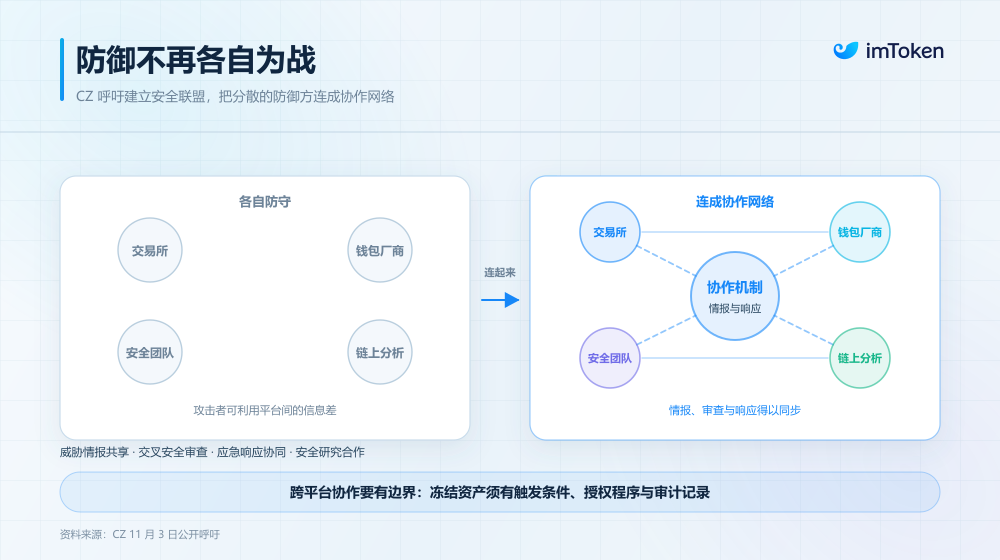
Of course, cross-platform collaboration does not mean that all enterprises should unconditionally share internal system information or have the power to freeze user assets at will.
How to establish clear boundaries among security intelligence sharing, trade secret protection, and user asset autonomy also needs further refinement.
But at least it can be seen that crypto security is gradually moving from the relatively isolated self-protection of enterprises in the past toward collaborative defense jointly participated in by security institutions, platforms, and communities.
It is worth noting that after the Binance incident, South Korea's Financial Services Commission (FSC) urgently convened the Financial Supervisory Service, the Korea Financial Security Institute, and major virtual asset trading platforms to inspect exchanges' asset custody and security protections.
One focus was re-examining the proportion of exchange cold wallet asset custody. Under South Korea's current Act on the Protection of Virtual Asset Users, exchanges must store at least 80% of the economic value of user assets in cold wallets.
But after this incident, regulators further required exchanges to consider raising the cold wallet ratio while strengthening 24/7 deposit and withdrawal monitoring, reserve fund management, wallet signing approval, and administrator permission controls.
This shows that regulators have also begun to realize that exchange security cannot rely solely on post-event compensation; it also needs to reduce as much as possible the losses that a single attack can cause through pre-event asset isolation and operational restrictions.
3. In the AI Era, What New Security Standards Do Crypto Products Need?
If these recent industry actions are connected, it becomes clear that they are gradually forming a more complete security logic.
Binance rebuilds internal systems and permissions, Coinbase emphasizes multi-layer signing controls, Ledger and Trezor tighten supply chains, the entire industry promotes cross-platform emergency collaboration, and South Korean regulators further strengthen round-the-clock monitoring and incident accountability.
imToken believes that future crypto products need to rebuild their security systems from at least the following aspects.
1. From Private Key Security to Full-Chain Permission Security
Private keys remain the core of digital asset security, but they should not become the entirety of the security system.
For trading platforms, it is necessary to protect keys, signing services, administrator accounts, development environments, and production deployment permissions at the same time; for wallet products, it is necessary to clearly distinguish different links such as key management, transaction construction, transaction authorization, and final signing.
Especially as AI Agents begin to connect to wallets, trading accounts, and on-chain applications, permission management will become even more important.
An Agent that can read market data and query balances should not naturally have the permission to transfer assets; an Agent that can help users construct transactions does not mean it can directly complete signing without additional authorization.
A reasonable design should be: allocate minimum permissions according to task needs, and separate querying, transaction construction, transaction approval, and final signing; set independent confirmation mechanisms for high-risk operations, such as out-of-band confirmation, Passkey, or multi-authorization; all authorizations should have clear scope, validity period, and revocation mechanisms; and retain verifiable audit records for critical operations.
Simply put, AI can help users complete more work, but it cannot thereby obtain unrestrained control over assets. This is not only a security requirement for AI Agents, but also a permission standard that the entire crypto product industry needs to establish in the future.
2. From One-Time Audits to Continuous Verification
In the past, many crypto products were accustomed to proving their security to users through smart contract audits, code reviews, or hardware security certifications. These efforts are certainly important, but the problem is that audits usually cover only a specific time, a specific code version, and a specific scope.
A product passing a smart contract audit does not mean there are no problems with the code in subsequent upgrades; a hardware wallet passing a chip security test does not mean it will not be tampered with during warehousing and transportation.
Therefore, future security systems need to shift from one-time audits to continuous verification.
3. From Single-Point Protection to Defense in Depth
No single technology can solve all security problems.
MPC can reduce the risk of single-point key leakage, but it cannot automatically prevent incorrect authorization; cold wallets can reduce the risk of remote attacks, but they cannot completely eliminate internal operational and supply chain risks; hardware wallets can isolate private keys, but they cannot identify all malicious transactions for users.
Therefore, a truly mature security architecture needs to let protection mechanisms at different layers complement one another.
For example, at the identity layer, use phishing-resistant authentication methods to reduce the risk of account and employee credential theft; at the permission layer, adopt least privilege, temporary authorization, and multi-person approval to prevent a single identity from holding complete control; at the device layer, strengthen endpoint security, hardware integrity verification, and trusted boot mechanisms; at the transaction layer, simulate transaction content, identify risks, and display it clearly to prevent users from completing signatures without understanding the intent of the transaction; at the asset layer, use cold wallets, MPC, multisig, limits, and anomaly monitoring to reduce the possibility of funds being transferred all at once; and at the response layer, establish emergency pause, permission revocation, incident notification, and cross-platform collaboration mechanisms.
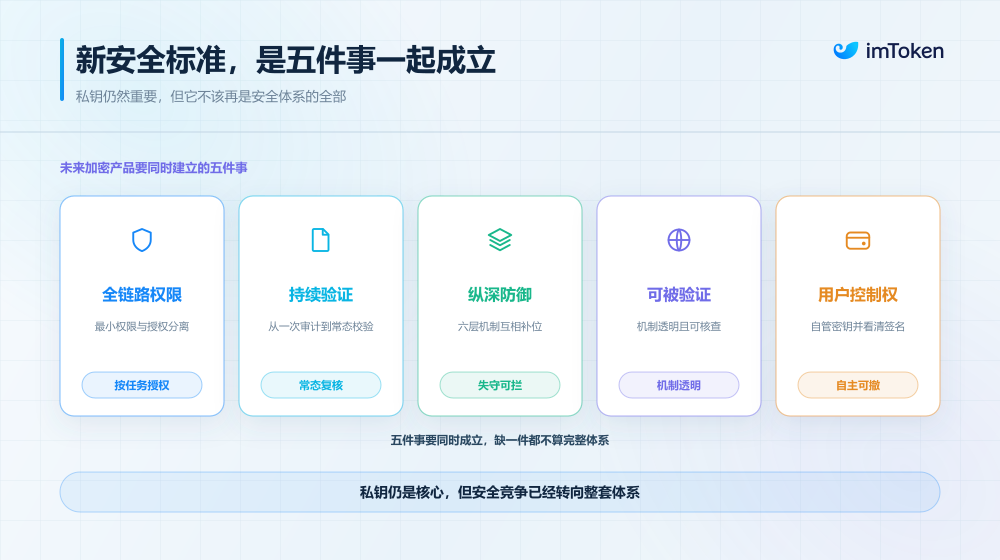
4. From "Trusting the Brand" to "Security That Can Be Verified"
For ordinary users, there is another long-standing problem with security: information asymmetry.
It is difficult for users to know exactly how a wallet manages private keys, nor can they directly judge whether an exchange's internal permissions are reasonable, let alone personally inspect the chips, firmware, and supply chain of a hardware wallet.
Therefore, security products cannot rely only on brand reputation or marketing slogans to build trust. What will matter more in the future is making security mechanisms as transparent and verifiable as possible.
For example, trading platforms need to continuously disclose asset reserves, custody structures, and key security mechanisms; wallet manufacturers need to disclose private key management principles, code audit status, vulnerability response processes, and version update records; and hardware wallet manufacturers need to enable users to verify device origin, firmware integrity, and official sales channels.
5. Returning to User Asset Control: The Value and Responsibility of Non-Custodial Wallets
After discussing so many security mechanisms, there is still one question worth reconsidering:
If exchanges, wallet manufacturers, hardware devices, and third-party services can all become attack entry points, then how should ordinary users choose their own asset management methods?
This is also the long-standing value of non-custodial wallets. Compared with centralized trading platforms, the core difference of non-custodial wallets lies in asset control.
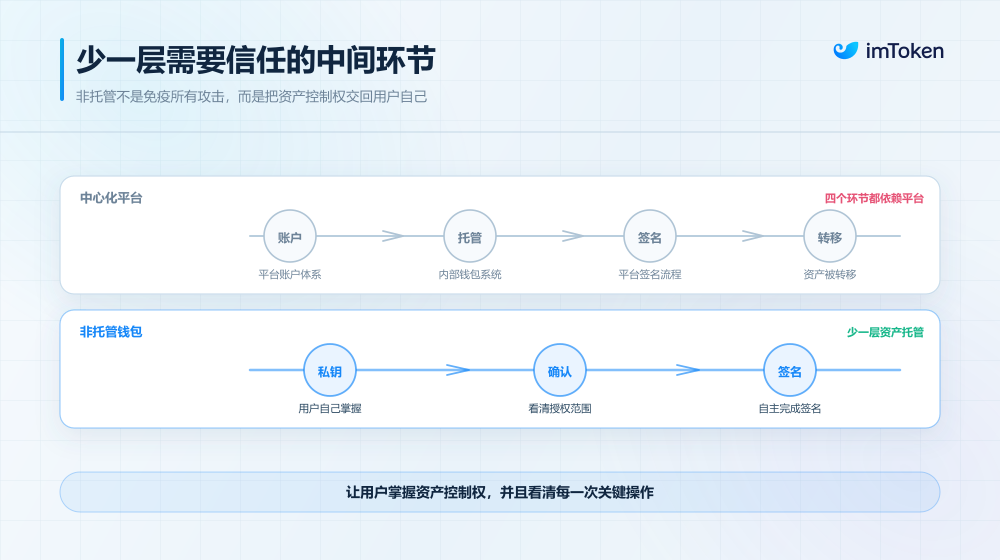
On centralized trading platforms, users usually need to go through the platform's account system, internal wallet system, and the platform's signing process to complete asset operations. The security of user assets depends not only on their own account protection, but also on the platform's internal permissions, custody architecture, employee management, and operational mechanisms.
In non-custodial wallets, users manage their own private keys or mnemonic phrases, and wallet service providers do not directly hold the transfer permission for user assets. Structurally, this means there is one less intermediary link of asset custody that needs to be trusted, and it also reduces the custody risk brought by platforms centrally holding user assets.
But this does not mean that non-custodial wallets are immune to all attacks.
Users may still encounter phishing websites, malicious contracts, fake authorizations, device infections, and mnemonic phrase leaks, and they need to pay more attention to their own key management and transaction security.
Therefore, for a non-custodial wallet like imToken, what is truly worth continuously building is further improving the security experience throughout the entire usage process around user self-control.
Behind this is also a more complete security philosophy.
Final Thoughts
From Binance's internal permission breach to the hardware supply chain risks of Ledger and Trezor, and then to exchanges re-examining cold wallet ratios, a series of recent incidents all remind us that





