






A close look at the progress of Bitcoin NFT ecology from “Prints” and “Goose”


The Ordinals ecology during the holidays looks relatively dull. The main developments include:
- Casey Rodarmor, the founder of the Ordinals protocol, listened to the opinions of the community and promised to maintain the stability of positive inscription numbers. The debate on the variability of inscription numbers has come to an end. (Recommended reading:Ordinals Inscription Number renews the debate over variability: retain culture, or develop technology?)
- Although Casey was not sure whether creating a new FT protocol for Bitcoin was a good or bad thing and had a negative attitude towards FT, he still took action. Casey created for Rune ProtocolGithubpage, on which relevant discussions have already taken place.
But the most interesting thing is that during the week of September 25th to October 2nd, the cost of casting picture inscriptions finally accounted for more than 50% of all inscription casting costs that week, reaching 65.2%. This is the first counterattack of picture inscriptions on BRC-20 coin inscriptions since the end of April.
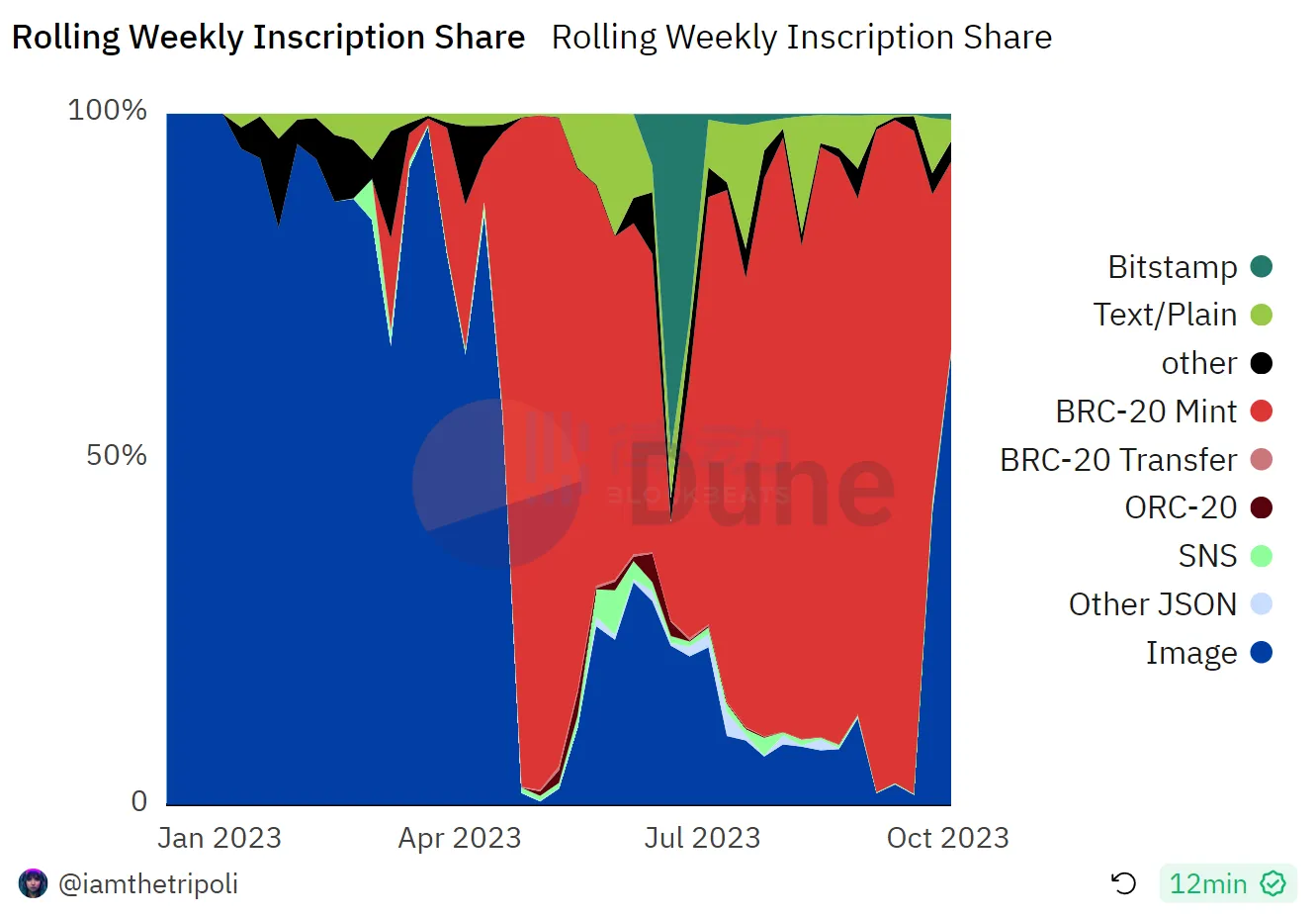
The casting of BRC-20 Token $SATS, which lasted for more than half a year, has finally come to an end. As a social experiment with high hopes, $SATS spent more than 10 million US dollars to complete the entire casting, but the final market performance was disappointing. Due to the lack of new hot spots and the impact of the Rune Protocol concept proposed by Casey on BRC-20, BRC-20 finally cooled down.
The cooling of BRC-20 also caused the overall cooling of the Ordinals ecosystem. From the data, we can clearly see that BRC-20 is the biggest contributor and engine to the emergence of the Ordinals protocol.
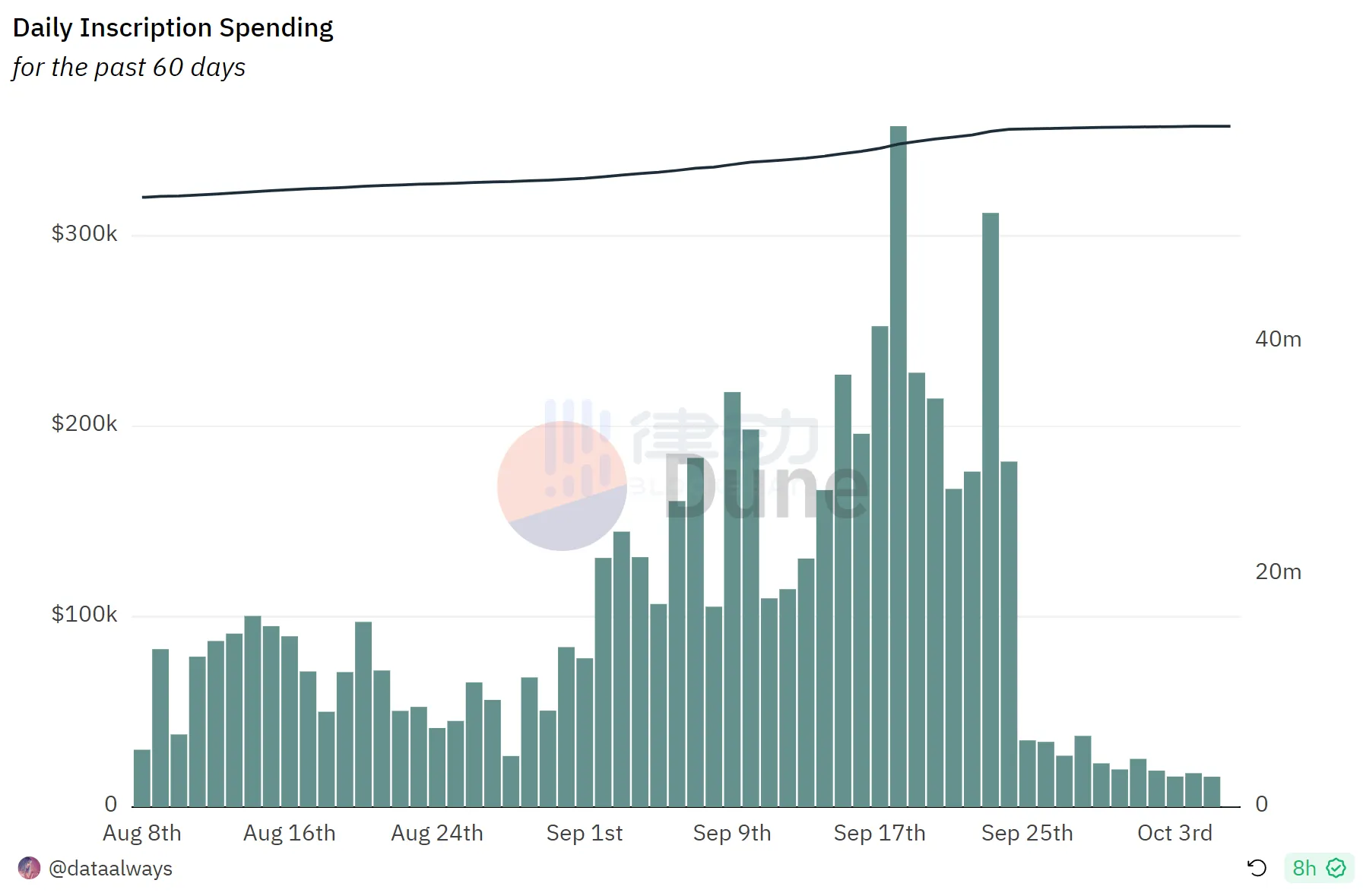
After all $SATS was minted on September 24, the daily gas cost of the Ordinals protocol decreased rapidly. Compared with the gas cost consumed on September 24, the maximum dropped by more than 90%
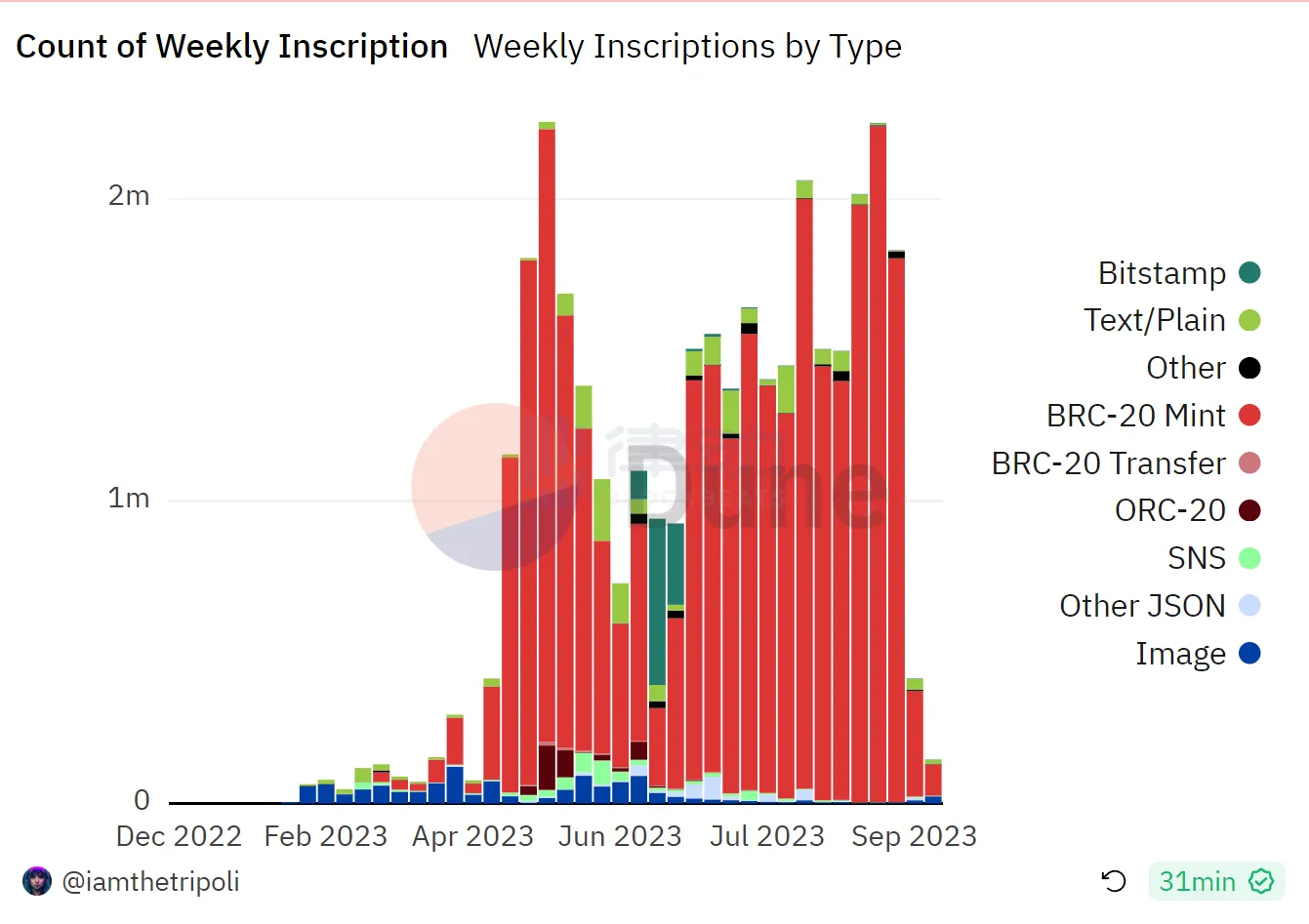
From September 25th to October 2nd, the ratio of cumulative new BRC-20 coin inscriptions to cumulative new picture-type inscriptions shrank to approximately 4.38:1, which is the closest ratio since late April
Regarding this on-chain situation, Casey said that this is returning to health. It seems that in my previous article introducing the Rune Protocol, I said that Caseys firing of the BRC-20 was scraping the bones to cure the poison, which is quite accurate...
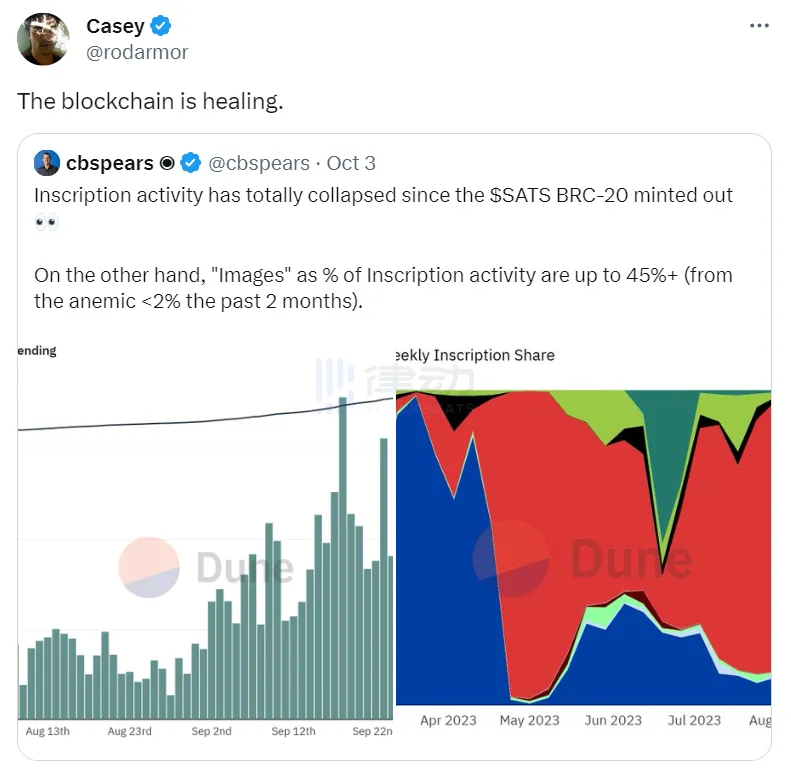
Of course, if we only rely on the temporary unilateral cooling of BRC-20, we cannot declare that the Ordinals ecosystem has ushered in an artistic victory. In addition to the above data, there are two interesting phenomena worthy of our attention:
- The “Prints” function on the Bitcoin NFT trading market Gamma.io is receiving more and more attention
- The popularity of Bitcoin NFT projects has spilled over to the emergence of new BRC-20 Tokens
“Prints” by Gamma.io
Let’s first talk about Gamma.io’s “Prints” function. I have been looking forward to a platform on Bitcoin that allows creators to quickly issue Open Edition NFT series like Zora/Manifold. The Prints function of Gamma.io basically realizes the Zora/Manifold experience for collectors.
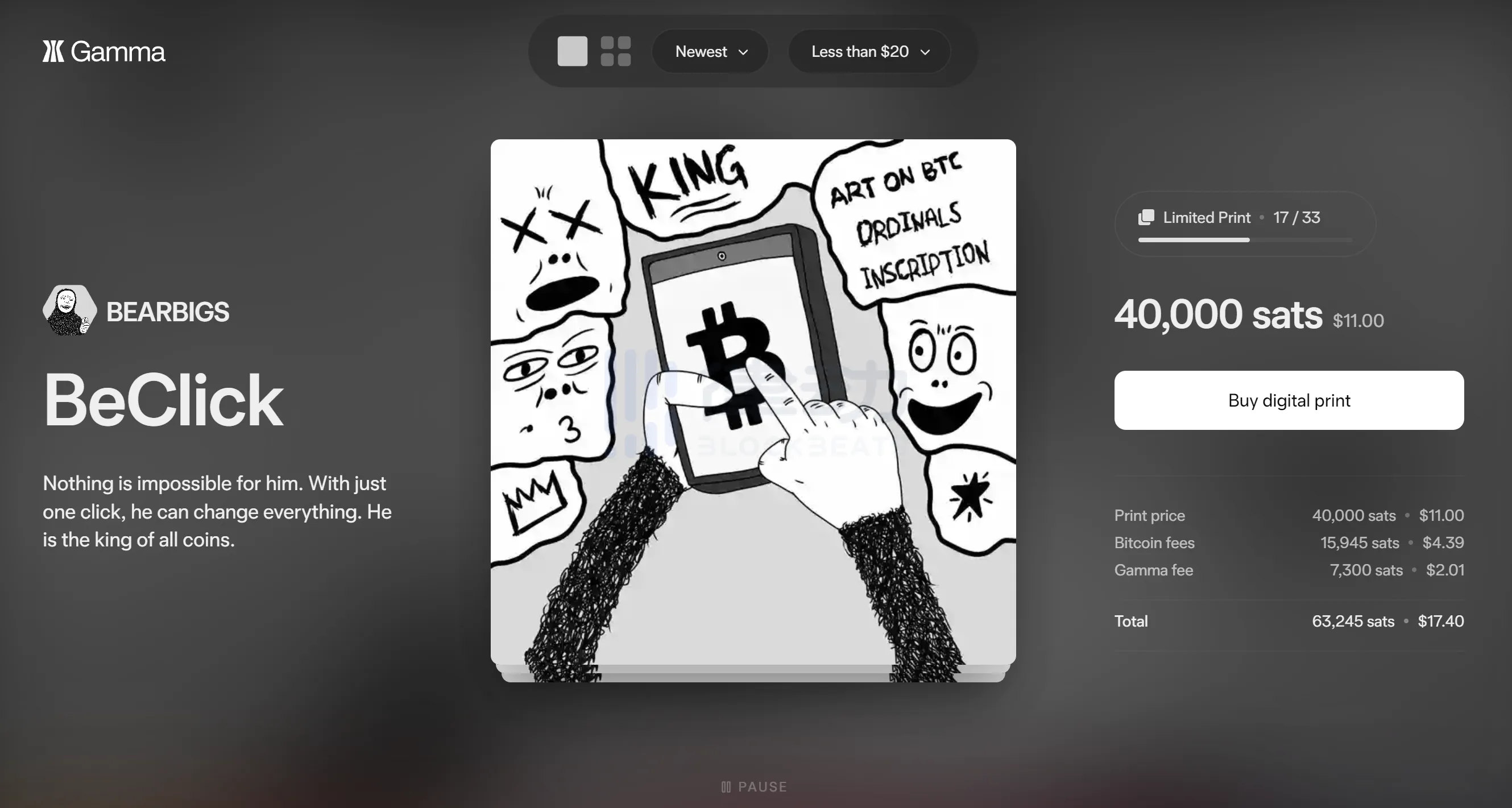
Gamma.io’s “Prints” function
For creators, if they want to use the Prints function, they must first apply to Gamma.io to participate in the artist cooperation program. As long as they are successfully selected into the program, creators can use the Prints function to issue Open Editions on Bitcoin, and Gamma.io will also provide a series of support from publicity to offline events and exhibitions.
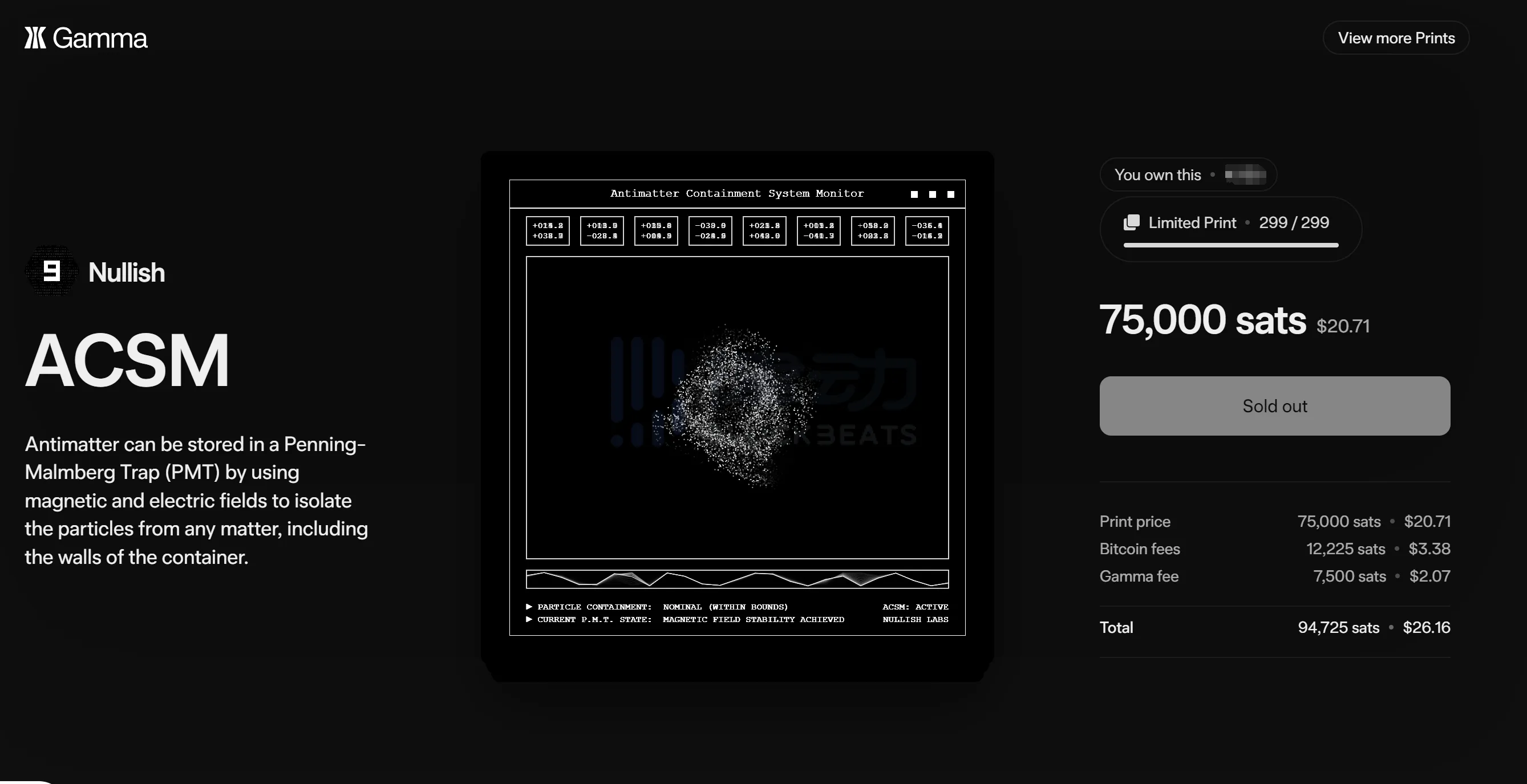
I used the Prints function to buy two works, one of which is ACSM by Nullish, one of the most influential artists in the Bitcoin NFT circle. The original version of the work was engraved on rare Satoshi and successfully sold for 0.48 BTC, then 299 additional versions were created with recursive inscriptions for 75,000 Satoshi (approximately $20 USD) via Gamma.io’s “Prints” feature It was released at a price of , and all sold out in just over 1 minute.
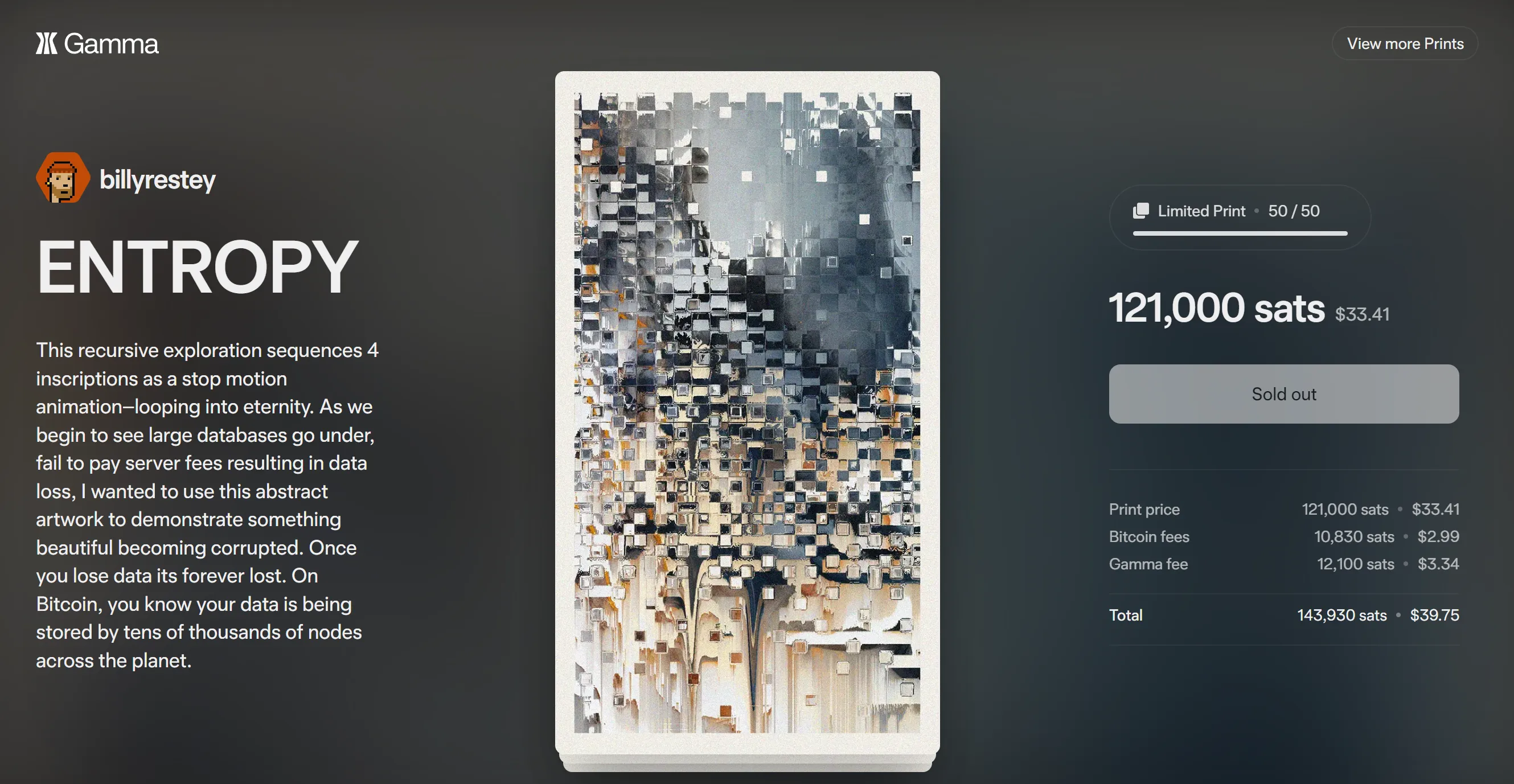
Another very influential artist in the Bitcoin NFT circle@billyresteyImmediately afterwards, ENTROPY was also issued on Gamma.io with a total supply of 50 copies, each priced at 121,000 satoshis (approximately US$30), and was eventually sold out.
When Recursive Inscription first came out, what I immediately thought of was that there was a new solution for the Open Edition on Bitcoin. Now, Gamma.io is expected to break out of the competition in the Bitcoin NFT trading market through the “Prints” function and catalyze the ecosystem of Bitcoin NFT creators.
First there is goose, then there is goose coin
Goose is actually a very typical Ordinals hype model - poor information, concentrated chips, and almost no profit after fission (the cost of burning is very low). Since the Ordinals ecology is still relatively cold at the moment, players who have been following this circle for a long time often feel that its hard to start a pot, but it lasts for three years.
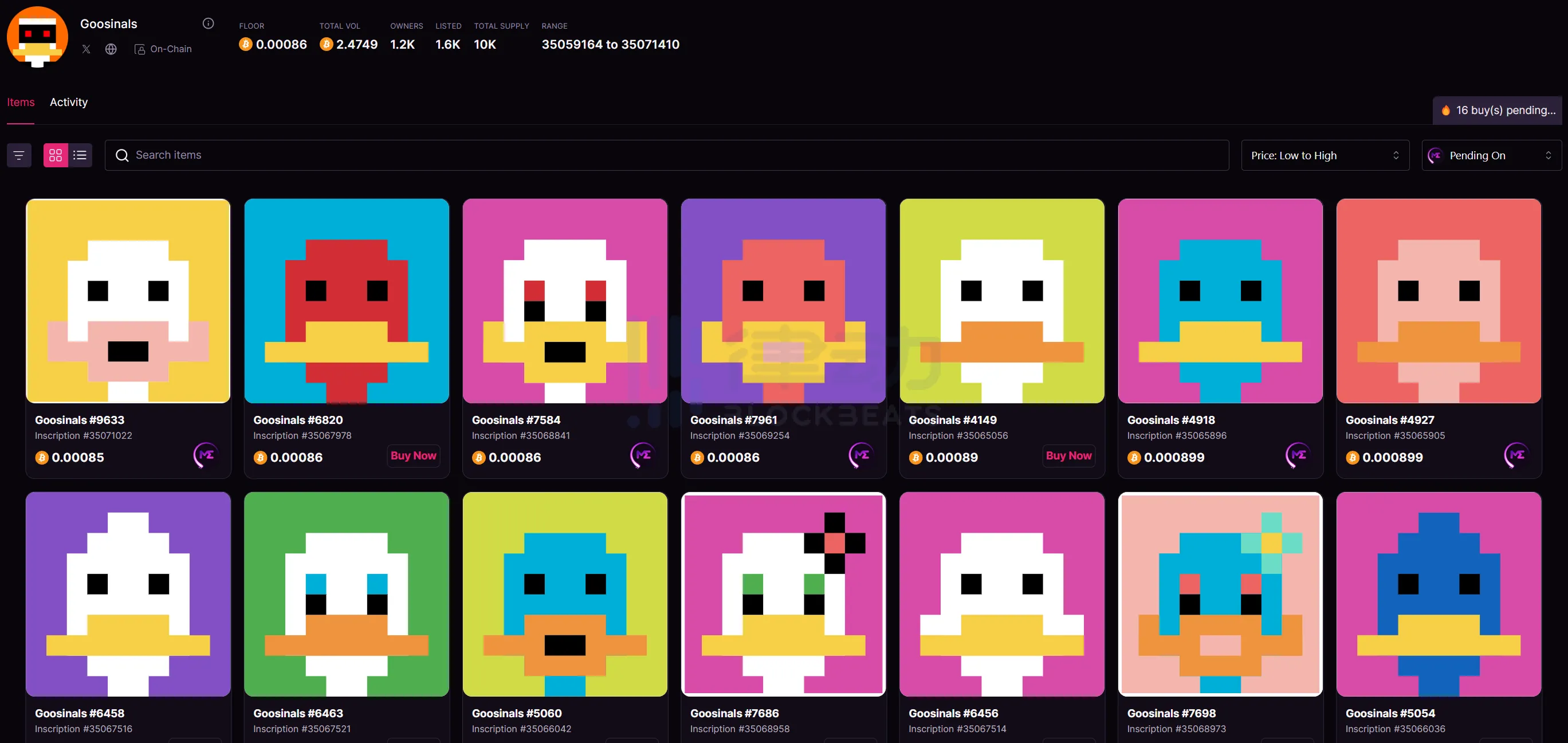
Goose, the cost can be as low as less than 1 U per bird, and at the highest point, it is only worth 40+ U. Look at this series with a total amount of 10K, there are only 1.2K holders...
Goose is actually not an NFT project specifically issued by an artist on Bitcoin, or even an NFT project exclusively issued by an artist on a specific chain.
“Father Goose” is the famous generative artist Dmitri Chernia, the creator of one of the star projects on Art Blocks, “Ringers”. In June of this year, Ringers #879 sold at a Sotheby’s auction for a hammer price of $5.4 million (total price of $6.2 million after buyer’s premium), setting the second-highest price ever for generative art. Sales volume of works. Its new owner is the famous crypto collector @punk 6529, and its previous owner was the bankrupt 3AC. The auction of Ringers #879 is part of the liquidation of 3AC NFT assets.
Ringers #879 is also called The Goose. Look, does it look like a cute goose?
But The Goose is valuable not because it is rare like the rarity system of PFP-like NFTs, but because the randomness and unpredictability of generative art make The Goose the crystallization of countless wonderful coincidences.
In order to commemorate Ringers #879 The Goose, Dmitri Chernia set such a creative theme in the MoMA Postcard project - if a simple, 10 x 10 pixel, Goose-themed 10 K PFP is designed for MoMA, What will you make? Other artists in the project use theBuilderTo create Goose.
(Here is a brief introduction to MoMA Postcard: It should be the most influential art museum in reality so far personally exploring the world of NFT. 15 artists collaborated across 35 cities, 11 countries and 5 continents. Everyone proposes a creative theme, and each person will contribute a work to others creative theme, and finally it will be compiled into 15 MoMA Postcards with different themes.)
Goose is very popular, but what really became a hypeable thing in Bitcoin NFT is because of the founder of BRC-20@domodataI tweeted and shouted - it would be interesting to create a 10K Goose series of First is First.
Goose is CC0, so there is no problem in making a bunch of geese directly through the generator provided by Dmitri Chernia and then selling them. As for why Goose rose so much? To be honest, I think it is FOMO caused by the information gap. Everyone still has too little understanding of NFT art (myself included)... I have indeed seen many people directly say that goose is done by big-name artists and then directly rush to it. My friends who are confused don’t understand the ins and outs of this thing at all.
But having said that, if we understand everything before starting, we will no longer be Degen. Grasping the simple logic of domo calling for orders is enough to move towards the right direction in the ambiguity, and hold the loot in the chaos. Other players run away from the battlefield.
The popularity of Goose has led to several BRC-20 Tokens led by $HONK and $GOOS. The popularity of the Bitcoin NFT project has spilled over to the emergence of new BRC-20 Tokens. The last time this happened was because Taproot Wizards caused $WZRDs FOMO. I havent seen it for a long time...
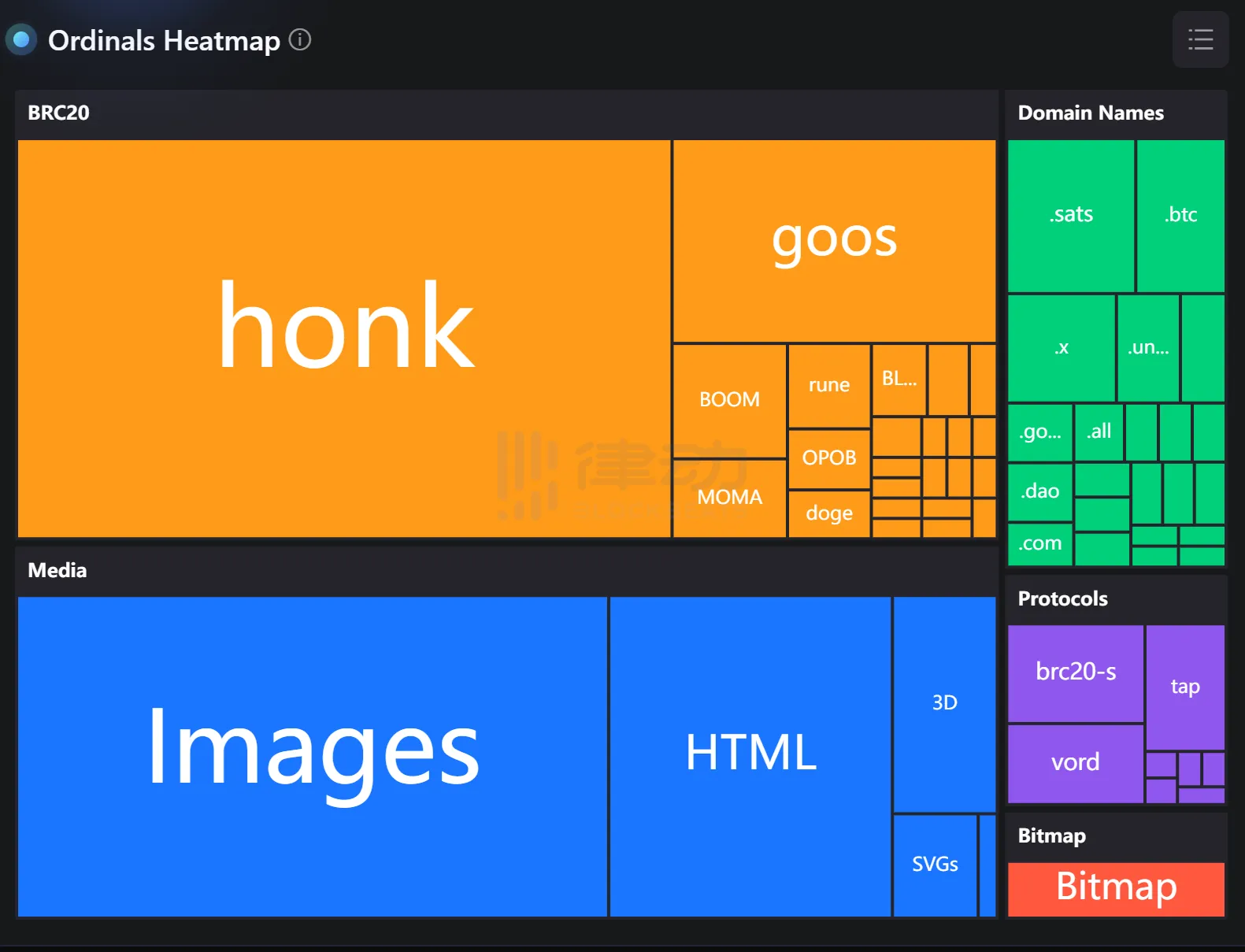
(Image Source:@GeniiData)
First there is goose, then there is goose coin. Whether it’s pictures or tokens, attention economy has room as long as it’s popular. Some people say that the trading volume of the 10 K Goose series on Bitcoin is much higher than the 879 Goose series on Ethereum, so Bitcoin NFT won this time. I just want to say that you can avoid being overly optimistic by understanding 10 K goose as BRC-20. Many artists on Ethereum have created themed artworks for Goose. Although this time it did not have such a high wealth effect, this accumulating and still growing crypto art and cultural atmosphere is the core competitiveness of Ethereum NFTs.
The last interesting thing is that domo’s voice advertised the 10K “Goose” series, and Casey sent a tweet that was equivalent to advertising $HONK. Have these two brothers exchanged souls?
Conclusion
Is the Bitcoin NFT ecosystem returning from the big casino to the art museum? This is definitely temporary. But at least its getting a little more interesting than the dull past few months...
What we should pay attention to:
- Runestone Progress on Rune Protocol?
- Which new crypto artists focusing on Bitcoin NFT will stand out through Gamma.io’s “Prints”?
For me, who firmly believes that creators are the core competitiveness of the NFT ecosystem, Bitcoin NFT still has a long way to go, but it seems to have finally made a good start.





