






Fellowship plans have been launched one after another, has the competition on the L2 track entered the meet-to-hand stage?


Original author:Jaleel、Luccy,BlockBeats
Original editor: Jack, BlockBeats
The day before yesterday, Consensys announced the launch of a Web3 Fellowship program that will select and support 15 startups within 12 weeks, aiming to find the best Web3 builders to unleash the collaborative power of the community. What is worth pondering is that the next day, zkSync also announced the launch of a 4-6 month Fellowship plan, hoping to promote the development of zkSync, ZK Stack and ZK Credo through the technical contributions of individuals and teams.
In addition to the Fellowship plan, major L2 projects seem to be competing in all aspects such as project legitimacy, code originality, and RaaS. The competition on the L2 track seems to be turning into a brutal hand-to-hand battle.
Fellowship
In this wave of Fellowship plans, there are obvious differences between Consensys and zkSync in terms of preparation completion and amount settings.
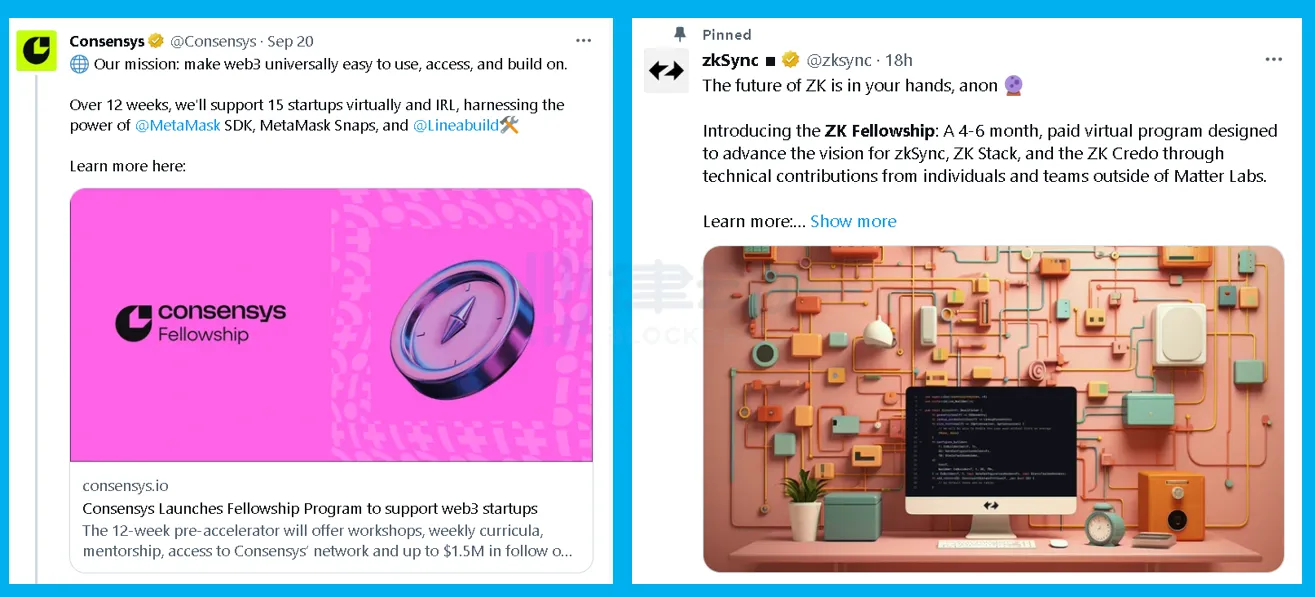
As seen on the Consensys Fellowship Program website, the program is a pre-accelerator program designed to support web3 startups and founders using the Consensys software suite. This is also a non-equity program offering the opportunity to receive potential investments of up to $1.5 million. Through this scholarship, Consensys aims to help participating teams develop new use cases that will significantly benefit the larger Ethereum community.
The first cohort of the Fellowship program will support 15 startups over 12 weeks, including hands-on exercises, interactive workshops and case studies that address challenges faced by web3 builders. Currently, the project considers three vertical areas, namely scalability, optimization, and L2. Among them, scalability refers to projects that Consensys aims to support by leveraging web3 technology capabilities to drive scalability within the web3 ecosystem through the wallet or application layer.
Additionally, optimization refers to projects that provide valuable tools, middleware, and other solutions that simplify the development process. Provides information on projects related to L2 solutions and zero-knowledge proofs in the L2 field to contribute to the scalability and performance of Ethereum and EVM chains.
The Consensys Fellowship program team will select the top 15 startups to join its first batch of startups, and an additional 3 startups will be on the waitlist. The program will officially begin on November 6, 2023, with an immersive real-life demonstration day on April 5, 2024. In addition, the program will feature professional mentors including Austin Griffith, co-founder of Buidl Guidl, Lindsey Winder, co-founder of Hedgey Finance, Vanessa Grellet, managing partner of Algaé Ventures, and Clemens Wan, solutions architect at Consensys.
On the other hand, compared to the well-prepared Consensys, zkSyncs Fellowship plan appears to be rough, with no extra information except a list of topics. Consensys attached a web page specifically designed for the Fellowship program and application methods in its official tweet, while zkSync only has one article.
Currently, zkSyncs Fellowship program has several topics for candidates, including the ZKP memory model related to trace expansion/recursion/folding, scalable cross-aggregation review resistance, and trace expansion techniques/continuations at the trace extension level. The aggregation technology level includes how to avoid the fragmentation of consensus rights in a multi-aggregation ecosystem, MEV aggregation, aggregated privacy support and privacy primitives, and aggregated data exploration beyond L2B EAT.
In addition, zero-knowledge DeFi primitives are included at the zero-knowledge and verification level, including but not limited to transaction matching, risk management, settlement, custody and certification, as well as zero-knowledge proof aggregation and verification solutions, zero-knowledge proof production, and zero-knowledge virtual machines Model, Validator and Sequencer Market Dynamics, and the self-sovereign TX Validation Assistant that correctly parses ABI-encoded data and provides visualization of fields and values.
It also includes cross-L2 Gas fee mechanism, distributed operation and parallelization of ZK prover, fuzz testing of zkSync components and generalization of web3 js/ethers.js/ethers.rs, which can combine interaction intentions with ABI encoding and tx encoding. , signature creation, etc. separately.
If the applicants proposal is accepted, they will receive a response from Matter Labs before November 1 and will receive a monthly stipend of US$3,500 during the Fellowship. Matter Labs says this is a grant-based grant, not a contract position, and expects applicants’ own work product to be such that the output is open source, fully documented, and accessible to others. The most accomplished participants will have the opportunity to receive long-term scholarships and positions at Matter Labs, or join Matter Labs incubation program and work closely with the Matter Labs investment team.
Although zkSync has previously received high-level financing of US$458 million, it is still dwarfed by ConsenSys, the parent company behind Linea. After all, ConsenSys has received US$726 million in financing, which means it is fully funded. At the same time, MetaMask, a project of ConsenSys, is the undisputed leader in the wallet circuit. It not only brings considerable profits to ConsenSys, but also provides strong support to Linea.
Not just Fellowship, L2 competition is everywhere
This time, zkSync follows the footsteps of competitors and launches the Fellowship plan. It is reminiscent of the ZK Stack that zkSync quickly launched after the OP Stack.
In October 2022, Optimism introduced the OP Stack, which is a highly scalable, highly interoperable modular open source blueprint of various types. As a set of standardized open source modules, developers can assemble a customized chain through OP Stack to serve any specific blockchain use case.
After nearly half a year of research and development, zkSync also immediately announced the launch of ZK Stack, a modular open source framework for building customized zkRollups, giving developers complete autonomy, from selecting the data availability mode to using the projects own Token decentralized sorter.
Related Reading:Can the OP Stack competing product launched by zkSync win the battle for L2 expansion?》
The design of OP Stack allows for code forking in an easier manner than current efforts, as developers can easily abstract out the various components of the blockchain and modify it by plugging in different modules. ZK Stack provides two key functions: sovereignty and seamless connection. These zkRollup chains operate independently, relying solely on Ethereum L1 for their activity and security, while cross-chain bridges exist to facilitate the interconnection of each chain, enabling trustless, fast and cheap interoperability.
Due to the large number of star projects, fierce competition on the L2 track has become a well-known fact in the entire encryption industry. In addition to OP Stack and ZK Stack launched by Optimism and zkSync, competition between the OP Rollup camp and ZK Rollup camp in the RaaS field also includes Orbit launched by Arbitrum and Appchain launched by Starknet. In the field of zkEVM, the tense relationship between the two domestic light projects Scroll and Taiko has also become an open secret in the industry.
In addition, at the beginning of last month, Polygon Zero, Polygon’s official zero-knowledge proof team, published an article titledProtecting the Open Source SpiritIn the article, zkSync was publicly criticized, claiming that it had copied Polygons open source code without permission and published misleading remarks, which immediately aroused widespread concern in the industry.
Polygon Zero said that its recently released Boojum library uses extensively the code of the Plonky 2 proof system, which was developed by Polygon Labs. Polygon Zero said that although Plonky 2 is open source, Matter Labs did not give proper attribution. In addition, Polygon Zero also accused Matter Labs of misleading when describing the performance comparison between Plonky 2 and Boojum. The founder of Matter Labs claimed that Boojum is more than 10 times faster than Plonky 2.
Alex, the founder of Matter Labs, responded immediately. Alex strongly denied Polygon Zeros accusations and said that when using Plonky 2s code, clear attribution has been given in its GitHub code base.
Alex also attached relevant links as theoretical support for his response. In response to Alexs response, storm from Paradigm agreed, saying that the attribution of zkSync could be better, but this is definitely not plagiarism and can be called a bit sloppy at most.
Related Reading:Polygon Zero accuses zkSync of copying code, founder responds Open source may not be suitable for you》
Looking across the entire L2 track, zkSync still stands out in terms of transaction activity. With the launch of zkSyncs zkEVM mainnet ZkSync Era in March 2023, its TVL once rose to US$700 million.
A large part of the reason for this may be that zkSyncs L2 competition strategy is to never admit defeat to its competitors and often follow closely behind. But zkSync may also face a big problem: whether following the pace of its competitors means that it still needs to work hard on innovation. How to make new attempts in attracting users and transactions in the ecosystem may also be a big challenge for ZkSync.





