From a strong competitor to liquidation closure, how did Saddle Finance get to this point?


Original author: Jiang Haibo, PANews
Saddle Finance was once seen as a strong competitor to Curve and raised a total of $11.8 million in two rounds of financing in 2021, with investments from Coinbase Ventures, Alameda Research, Polychain, Framework Ventures, Nascent, Electric Capital, and others.
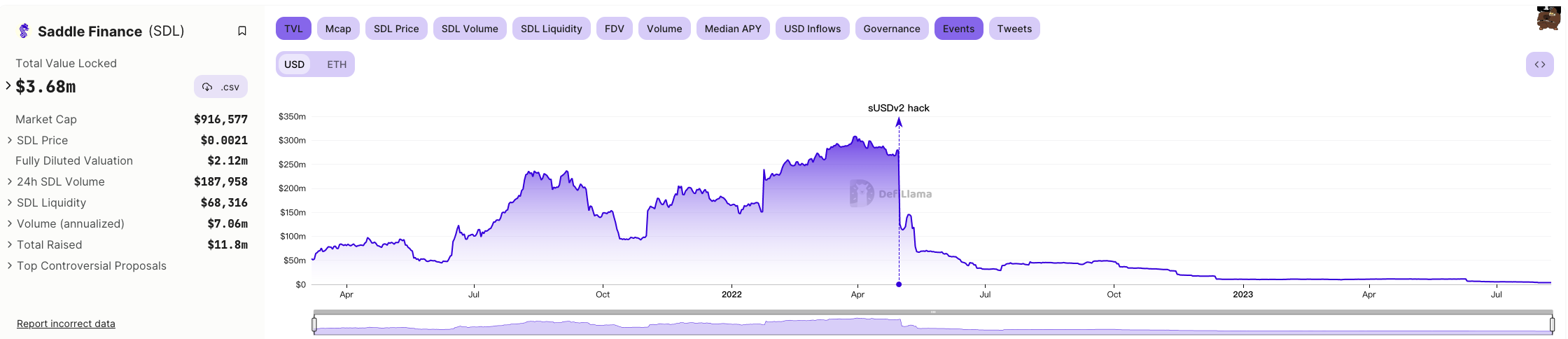
On August 8th, the Saddle community initiated a proposal to shut down operations and liquidate funds. According to DeFiLlama's data, Saddle Finance has a TVL of only $3.68 million and the market value of the governance token $SDL is only $917,000. How did it develop to its current situation step by step?
Top VC support, launch, and airdrops attract attention
One important difference between Saddle and Curve is that Curve is implemented using Vyper (the programming language that recently had vulnerabilities), while Saddle has ported these codes to Solidity, thereby avoiding the impact of the recent theft issues with Curve.
When it was launched in January 2021, Saddle announced that it had raised $4.3 million in seed funding from top-tier VCs such as Coinbase Ventures, Alameda Research, Polychain, and Framework Ventures. Before the launch, Saddle also underwent audits from multiple security institutions including Certik, Quantstamp, and OpenZeppelin.
Saddle did not issue governance tokens at the start of the project, but it was basically certain that they would be issued. Because for DEXs, liquidity is crucial, and projects like Curve have rewarded liquidity providers with valuable governance tokens. The combination of top-tier VCs, multiple security audits, and the expectation of airdrops garnered high attention for Saddle at its launch.
High expectations also bring some problems. At the beginning of the launch, liquidity providers flocked in. Since Saddle and Curve have the same mechanism, a pool contains multiple similar assets. If the same asset is used to add liquidity, it will cause imbalance in the proportion and price of assets in the pool. People who continue to add liquidity will suffer from high slippage. A transaction on Etherscan shows that when Saddle was just launched, a user exchanged 0.34 sBTC for 4.36 WBTC in Saddle's BTC pool. This means that liquidity providers suffered permanent losses, and there were many such arbitrage examples at the beginning of the launch.
In November 17, 2021, Saddle announced the issuance of governance tokens and the launch of liquidity mining rewards, airdropping 15% of the total tokens to users. In mid-2022, the $SDL token began circulating. In addition to the $SDL airdrop, other projects have also rewarded early liquidity providers of Saddle, such as $KEEP rewarded by Keep Network. Keep Network, Saddle, and Fold are all projects under Thesis. This has brought high praise to Saddle during the early launch and airdrop period.
$11 million stolen, starting to decline
On April 30, 2022, Saddle's sUSD v2 pool was hacked. This pool is composed of Synthetix's sUSD and SaddleUSD-V2 LP tokens. SaddleUSD-V2 LP tokens, similar to Curve 3 pool's LP tokens, include DAI, USDC, and USDT stablecoins.
According to Rekt, this is because there is an error in the old version of the MetaSwapUtils library, which does not use "VirtualPrice" to calculate the value of LP tokens during the transaction. The hacker manipulated the price of LP tokens by conducting a series of sUSD/saddleUSD-V2 transactions and obtained more sUSD.
Saddle was stolen $11 million in this process, but $3.8 million was returned by the white-hat hacker BlockSec, and BlockSec received a reward of $380,000. Saddle's misleading statements also caused dissatisfaction among users, such as "user funds are safe", but it actually only refers to the part returned by BlockSec.
As can be seen from the DeFiLlama TVL chart mentioned earlier, the liquidity in Saddle dropped linearly from $280 million before the attack to $120 million after the attack.
May 2022, with the collapse of UST, liquidity in Saddle dropped to 70 million USD and has been struggling since then.
Liquidation Plan
On August 8th, a SIP proposal from the Saddle community suggested dissolving the community and distributing the remaining value of the protocol to $SDL and veSDL holders. The reasons for liquidation stated in the proposal can be summarized as follows:
The core vision of Saddle has been achieved, and many key contributors plan to stop working by September 30th, 2023.
The recent Curve hack demonstrated potential vulnerabilities that the protocol may face.
The treasury value of the protocol has exceeded the circulating market value of the protocol token. Community members suggest distributing the DAO's $ARB airdrop to token holders.
Continuing operations is also an option, but it would require support for community multisig and Delos HQ multisig, which is difficult to achieve long-term coordination and management.
The main funds currently held by the treasury are 1.545 million $ARB received from Arbitrum. The proposal suggests liquidating all remaining DAO funds into $ARB and distributing them to everyone based on the weighting of $SDL and veSDL holdings.
According to the proposal, the approximate value of $ARB airdropped per $SDL is $0.0026. However, as of August 10th, CoinGecko shows the price of $SDL as $0.00209, which is below the expected airdrop value.
Given the situation where the project is almost unused and there are remaining funds in the treasury, liquidation is indeed a feasible way to end the project. In the Saddle community, most people agree on the liquidation. However, there are some questions regarding the specific execution, such as the weight multiplier for $SDL and veSDL. The proposal suggests a 4x multiplier for veSDL and 1x multiplier for $SDL. As for the snapshot time, the proposal states it was at Ethereum block #17870642, but it has passed, meaning users who have funds stored on centralized exchanges would not receive the airdrop.