神鱼最新访谈:AI时代人的意志更重要,比特币是更好的黄金


- 核心观点:神鱼与金明探讨了AI时代下人的意志重要性、Builder的使命感、投资框架以及Web3未来方向。神鱼认为,AI大幅降低了从Idea到落地的成本,而Web3下一阶段核心在于Agent生态,以太坊等链可能主要给Agent而非人使用,并提出“垄断+增长”为核心资产筛选框架。
- 关键要素:
- 神鱼指出,AI将人类知识压缩并结构化,以极低成本赋予个人执行能力,使“人的意志性”愈发重要,打开了大量可能性空间。
- 神鱼投资哲学非分散派,而是集中持有少数真正理解的资产,如比特币、以太坊、特斯拉,并以“垄断+增长”为最核心的资产筛选标准,强调TAM(可触达市场)需足够大。
- 他观察Agent能否在以太坊生态实现大规模采用,认为若此点到来将成为转折点,因为链上产品对用户专业技能与安全意识要求过高,Agent作为中间层或更优。
- 神鱼每日通过三个AI Agent和笔记系统获取信息,AI会筛选关联观点与书籍提示阅读,使他“几乎不太直接读东西”,但在投资框架建立上,他自认为始于DeFi浪潮,经历了从实践到理论的学习过程。
- 关于BTC,神鱼看法“数字黄金”十余年未变:无需中介可持有是核心优势,价值在极端情况下呈现,因此市场繁荣时不获关注属正常;他视“主权个人”为核心,BTC与AI分别强化资产处置与个人能力。
Original Author: Da Qianzi, PANews
Recently, Cobo co-founder Shen Yu and Extreme Vision Technology founder Jin Ming engaged in an in-depth dialogue covering AI, entrepreneurship, investment, Bitcoin, Web3, Agents, and life's purpose.
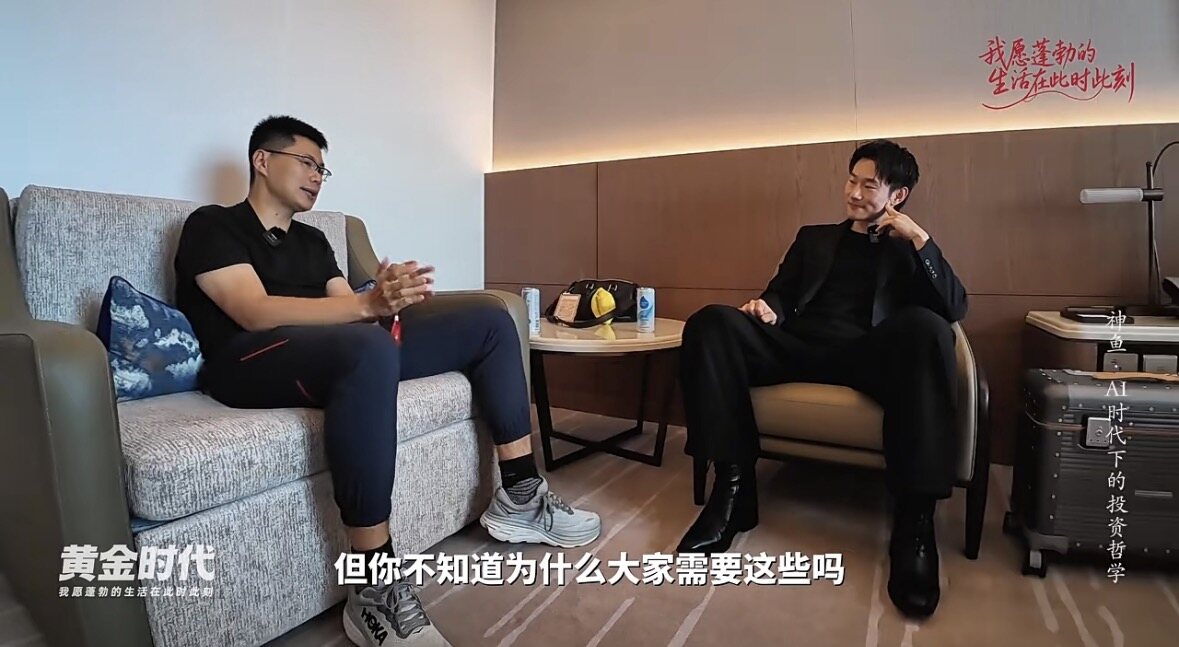
Shen Yu is an early participant in the crypto industry, having been involved in cryptocurrency since 2011, making him one of the earliest Bitcoin evangelists and participants in China. Jin Ming is a member of China's national freediving team and founder of Extreme Vision Technology, having long focused on video AI technology development and commercial applications, with investments from institutions including Alibaba, Yunfeng Capital, and Megvii Technology.
From an entrepreneur's sense of mission to the relationship between humans and technology in the AI era; from freediving and death anxiety to investment frameworks and asset allocation; and from BTC, RWA, and Agents to the future of Ethereum, the two engaged in deep discussion around technology, capital, and individual life experiences.
Shen Yu believes that one of the most important changes brought by AI is the dramatic reduction in the cost of moving from an Idea to execution. In the past, an idea might remain in your mind forever due to prohibitive execution costs. Today, AI is compressing and structuring vast amounts of human knowledge, handing execution capabilities to individuals at extremely low cost. This technological development has made human will even more important. However, he also admitted that while AI has opened up a vast array of possibilities, he has yet to find a sufficiently large and systematic endeavor. He still defines himself as a Builder, believing that "in a sense, living means that through your existence, the world's possibilities have increased a little."
This Builder mindset also permeates his investment philosophy. Shen Yu believes that good assets don't need to rely on continuous narratives. Compared to broad diversification, he prefers to concentrate on a few assets he truly understands, because human energy is limited, and what truly matters is understanding the underlying logic of an asset.
For the next phase of Web3, the key direction Shen Yu is observing is Agents. He believes that ecosystems like Ethereum may not primarily serve humans in the future, but rather Agents.
The following is the full text of the interview, compiled by PANews:
In the AI Era, Human Will Is Becoming More Important
Jin Ming: The last time you did an interview was ten years ago, in 2017. At that time, you made a classic statement: "With all this money, I suddenly don't know how to spend it."
Shen Yu: Now I know how to spend it. Essentially, I think human will is becoming increasingly important. Since the AI era arrived, many things that used to require significant time and cost can now be done quickly as long as you have an idea. This is a massive change.
Right. You see, essentially, human will is becoming more and more important. Since the AI era arrived, many tasks, or things you previously thought were extremely difficult, can be done instantly as long as you have an idea. This change is huge. Things we couldn't have imagined ten or twenty years ago are now easy to deliver. We might have thought certain things were unimaginable ten or twenty years ago, but now, with just an idea, the backend execution cost has dropped incredibly low, and many things can be delivered very quickly.
Jin Ming: So it's about moving from an idea to final execution.
Shen Yu: Exactly. Before, you had a seed and a dream, but it might forever remain just a dream. Now, backend costs are dropping rapidly, and with AI compressing and structuring vast human knowledge, you can access these capabilities at low cost.
If you have a seed, it can take root quickly. Before, it was like, "OK, I have a seed and a dream," but it could only be a dream. Now, the backend costs have dropped dramatically, and AI has compressed a lot of human knowledge, so you can tap into these abilities at a low cost. I feel this has suddenly opened up a vast space of possibilities. So, I feel AI has suddenly opened up a vast space of possibilities.
From a Sense of Mission to Confusion, Builders Are Also Searching for Answers
Jin Ming: Are you satisfied with your current life? Do you feel happy and fulfilled every day?
Shen Yu: It's okay, but I still feel a bit lost. It's not like the early days of entrepreneurship when I had a very strong sense of mission. Now, I've entered a state of chaos: you see AI opening up many possibilities and feel this is the best of times, but you don't see a particularly clear path yet. Whether it's the sense of mission or the specific commercial path, I haven't fully figured it out. So right now, I'm doing more exploring and self-improvement.
Jin Ming: When you first started your business, how did you define your sense of mission?
Shen Yu: At that time, you saw a window of opportunity, and it created an incredibly strong creative impulse. You felt that if you didn't do this thing, you would definitely regret it for the rest of your life. It felt like a force was pushing you, and you simply couldn't break free from it, so you went out and did it.
Jin Ming: The huge demand you saw back then was mining?
Shen Yu: Actually, it started in 2013, and the core issue was hash power. Mining originally started in the US and began migrating to China. When China first started making ASIC miners, the machines still had to connect to US mining pools. There were two problems: first, network issues – international internet had latency and packet loss, making mining inefficient; second, the settlement system of the entire mining industry was unreasonable at the time. So what we did was solve these two problems.
Essentially, you see a market gap, a niche market with unmet demand, and you happen to have the ability to fill it. That creates an incredibly strong impulse to build this thing out.
Jin Ming: After all this time and accumulation, what do you think your mission is now?
Shen Yu: I think I still need to build things. I've always defined myself as a Builder. Since the AI era began, I've made various small tools and dashboards, but I haven't found that truly big, systematic thing yet. I'm still observing.
When you're on the front lines and have built many things, confusion and doubt inevitably arise later on. So you have to supplement yourself with a vast amount of human historical knowledge: How did similar things happen in the past? How did philosophers think about these issues? All of this comes back to influence you. Standing here and now, you can see many possibilities unfolding in the future, but you haven't found that specific path yet.
Finding a Sense of Life Mission
Jin Ming: In my sharing yesterday, I talked about purpose awareness, the sense of life purpose. I likened it to a scale.
Many people initially want to create big things and hope to leave a legacy. On the other end of the scale are experiences and happiness – many young people feel life should be about pursuing joy. If you were to place yourself on this scale, where would you be?
Shen Yu: I neither particularly want to leave something behind, nor do I particularly pursue experiences. I've even used AI to analyze a lot of psychoanalytic concepts about myself, but fundamentally, I'm someone with an inherent drive to build. I just want to build things. When the thing gets built, I feel great. I want to present something to the world because I believe that, in a sense, living means that through your existence, you've made the world's possibilities a little greater.
Jin Ming: That's actually quite far to the left, quite legacy-oriented. In psychology research, there's an interesting phenomenon where many people aspire to be Builders. And a potential psychological trait of Builders is a tendency toward anxiety. Because your life purpose is to constantly build. When you're not actively moving forward or building, you can easily fall into an anxious state. Have you ever experienced this? How do you usually deal with it?
Shen Yu: I certainly have a bit of it, but now I know how to switch modes. Since childhood, I've had ways to clear my mind, like keeping animals and pursuing hobbies. So basically, I enter this state every week. You have to allow yourself to decompress. When you're diving, how do you confront fear?
Reunderstanding Fear at the Limit
Jin Ming: When you hold your breath, your body constantly sends you signals. At that point, it's a battle between rationality and emotion. I think the most straightforward analogy is that freediving is very much like a spiritual practice. First, you have to enter the water with a sense of "knowing the outcome." You have to keep telling yourself: you are safe.
The human brain is incredibly smart. Humans are controlled by the autonomic nervous system. For example, on land, it's very difficult to actually suffocate yourself by holding your breath. When you reach your limit, your brain might experience a brief blackout, known as BO, a temporary state of unconsciousness. After about ten seconds, your airway reopens, and you naturally take a breath.
But why might people die from this underwater? Because when you lose consciousness underwater and your airway reopens, you inhale water instead of air. So ultimately, it could be drowning. That's why freediving training absolutely requires a buddy, a training partner.
But from another perspective, it's also a great spiritual practice. You constantly give yourself complete positive psychological suggestions: what you're doing is meditation, you're entering a flow state; you are healthy, you are safe; your brain is very smart.
And no one can hold their breath to their limit right away. In the beginning, after ten sessions, two months, three months, most people can only reach about 50% of their limit. With more training, they slowly approach 70%, 80%, and even 90%. Often, what limits beginners isn't their physical limit, but unfamiliarity with their bodies. As you become more familiar with your body, you trust yourself more and get closer to your limits. So the whole process isn't as much of a struggle as you might imagine; often it's very peaceful.
Shen Yu: Doesn't this process help you get rid of your fear of death? Or rather, does it make you face death more directly?
Jin Ming: That's a great question. I think after long-term freediving or breath-hold training, my fear of death has indeed decreased significantly. I haven't really thought deeply about why. During my first breath-hold, or the first few training sessions, I still had a fear of death, but now it's completely gone. Even joking with my parents in daily life, I'd say I feel my life experience is already very complete and abundant. Even if an accident happened tomorrow and I were gone, I'd feel I've already been very happy. Before, I definitely felt that the longer you live, the better, and death was a very regrettable thing. But now I'm not so afraid of it anymore. Are you afraid?
Shen Yu: I think on some level, there's still anxiety. Or rather, outside observers might tell me, and my Agent companion also tells me, that I do have death anxiety.
AI Agents Are Becoming the New Information Gateway
Jin Ming: What channels do you currently use to gather information every day?
Shen Yu: Almost all AI. When I open my eyes, AI tells me it has read everything I've done yesterday. I have three AI Agents now. One Agent is instrumental rationality – it tells you what you should do; one is more feminine and gentle, digging into your inner feelings; and another combines what you did yesterday to tell you which blind spots it observed.
For example, it might tell you: there's a good book in history, and a certain chapter discusses a problem that the ancients also encountered, and it resonates perfectly with your current state. Would you like to spend 15 minutes reading that chapter? Then three things pop up, and you can go read them directly.
Additionally, I have a note-taking system. They use evolutionary thinking to connect things I've focused on in the past with things relevant to my life. In a sense, my attention is a "God" – it determines which ideas or propositions survive. AI "cross-breeds" a batch of new things daily, then selects one and tells me: here's an article you might want to read. So I hardly read things directly anymore. There are also daily digests and long-form articles filtered by AI – AI processes them first, then tosses them to me. I usually quickly compress them into PPT format to review.
Building an Investment Framework Starting from DeFi
Jin Ming: But this approach is still mainly processing existing information. A lot of information happens in real-time – like a conflict breaking out one second ago. Getting such information through AI might not be as timely.
Shen Yu: I don't care. The most important information will find you on its own; you'll definitely see it. Also, I don't do that kind of short-term trading. I realized early on that I have no talent for it. Making simple decisions is easier, but for longer-term matters, I might be better suited.
I actually started investing seriously after playing around with DeFi. DeFi essentially helped me catch up on investment history. We went from the "underground Federal Reserve" to seeing how traditional finance was invented, reviewing the entire two-hundred-year development trajectory. During this process, you generate tons of questions, then go back to fill in historical and financial knowledge. It was only at this point that I began investing seriously.
I just got lucky on day one, somehow ended up with some decent methodology and walked a path that wasn't too wrong. But it was only after fully experiencing the DeFi wave that I started building my own knowledge structure and investment framework. Before that, I didn't have a complete investment framework at all.
Jin Ming: So, during that long period of mining, you hadn't really formed an investment framework.
Shen Yu: At that time, I didn't even consider what I was doing as investing. It was just a vague intuition: I should hold some Bitcoin, with a bit of position management thinking.
I'm an ISTJ personality type. Many things are abstracted through practice. I first form some frameworks, then train my intuition; during this process, new questions arise, leading to the abstraction of new frameworks. That's how my investment framework gradually formed.
From DeFi to RWA, Reunderstanding Financial Products Themselves
Jin Ming: Very few people form investment frameworks from DeFi. Because DeFi in essence is often just "farm and dump," which is a completely different logic from investing.
Shen Yu: But you need to look at what functions these financial products themselves provide and how they meet market demand. It's about building a financial market from 0 to 1 on-chain. What I focus on is this process, not arbitrage or farming within DeFi – those I consider more muscle memory, intuitive stuff.
But through this process, you accumulate valuable experiences, and you also accumulate a wealth of questions, which are equally valuable. You might initially not understand why people need these things, but once you figure it out and then look at history, many things start to connect.
Jin Ming: So this round of RWA tokenization, including bringing US stocks on-chain, is essentially extending the financial product understanding you developed in DeFi to traditional finance.
Shen Yu: Exactly. It's like US stocks are being shoved in front of you again, and you have to understand the logic behind them.
Jin Ming: But ten years ago when you were mining, you never thought about holding US stocks, right?
Shen Yu: I didn't even understand when others borrowed money from me to trade US stocks. I can only say I was lucky to have walked a path that wasn't too wrong. At the time, I was muddling through without really understanding. Later, many questions arose, and conveniently, AI came along, accelerating my learning speed dramatically. I could quickly go through many books and materials to understand why these things happened.
Good Assets Don't Need Constantly New Narratives
Jin Ming: You've been involved with Bitcoin for over a decade now. How has your view of BTC changed?
Shen Yu: No change – it's still digital gold. In this world, there are very few assets you can hold without intermediaries; virtually all other assets have one, two, or even three layers of intermediaries wrapped around them.
Jin Ming: Quite a few people in our group chat are currently pessimistic.
Shen Yu: BTC's value precisely emerges under extreme conditions. So it's perfectly normal that people don't care about it when markets are booming.
Jin Ming: Do you agree with this view: BTC, under classical liberal thought, massively enhances the capabilities of the sovereign individual?
Shen Yu: A core aspect of the sovereign individual is asset disposal capability. AI brings an enhancement of capabilities, while BTC is a core asset in terms of asset disposal for the sovereign individual. Both are extremely important.
Jin Ming: I have some friends who were very bought into BTC early on and had strong faith. But I feel that after this cycle ended, many people started feeling they couldn't see new narratives.
Shen Yu: Good assets don't need narratives, and the longer time passes, the more they prove things.
Jin Ming: I think there are probably only two major narratives in this Web3 cycle. One is the full-asset arbitrage done by Ethena, and the other is RWA tokenization. But both are still early and haven't really matured.
I actually think Web3's true killer ToC application hasn't emerged yet. I'm not talking about the products investors and traders use today, but products that ordinary end-users can use as easily as WeChat – something that truly changes people's lifestyles. I don't think that thing has appeared yet.
Shen Yu: I've held