A Look at 5 DeFi Projects Worth Paying Attention to Recently


Bitcoin broke through 31,000 two weeks ago and fell back to around 29,000. It seems difficult to make high profits from cryptocurrency trading, but new projects are emerging and the project teams are still working hard. At this time, we need to shift our focus to the new projects themselves. BlockBeats has compiled a list of DeFi projects worth paying attention to recently, and there might be the next Alpha among them. Here are the details:
Pound Swap
Pound Swap is a community-driven ve(3,3) liquidity book DEX built on zkSync, providing a powerful trading platform for DeFi liquidity and token swaps. As a branch of Trader Joe Liquidity Book, Pound Swap is designed and functions similarly to Traderjoe LB, offering users a zero-slippage, capital-efficient AMM solution. Pound Swap is the first DEX to combine ve(3,3) with Liquidity Book, marking the first attempt to combine LB and ve(3,3), aiming to provide a fairer and more efficient solution for liquidity management and token incentives. Pound Swap is not yet launched, but you can follow its progress.
The characteristics of Pound Swap are:
- Zero slippage: Traders can swap tokens with zero slippage on the platform.
- Surging Pricing: LPs can earn additional dynamic fees during volatile market periods.
- High capital efficiency: The liquidity book can support high-volume trades with low liquidity requirements.
- Flexible liquidity: LPs can build flexible liquidity allocations according to their own strategies.
Mori Finance
Mori Finance is a next-generation native stable asset DeFi protocol on Ethereum. It generates low-volatility stable assets by collateralizing ETH without causing any losses. In addition, users can choose to create asset derivative assets (ETHS, ETHC) as hedging assets against ETH price fluctuations, allowing them to hold ETH long positions for free without facing liquidation risks. It is currently in the testnet phase.
Previously there have been stablecoins based on ETH, such as LUSD, but these types of stablecoins have limitations in terms of capital efficiency and scalability, and are lagging behind fiat-backed stablecoins in terms of volume. Mori Finance proposes to classify the volatility of ETH into low volatility stable assets and high volatility derivative assets. Using ETH as an example, users can choose to hold high-volatility ETHC (ETH Coin) assets and low-volatility ETHS (ETH Stable) assets based on their risk preferences.
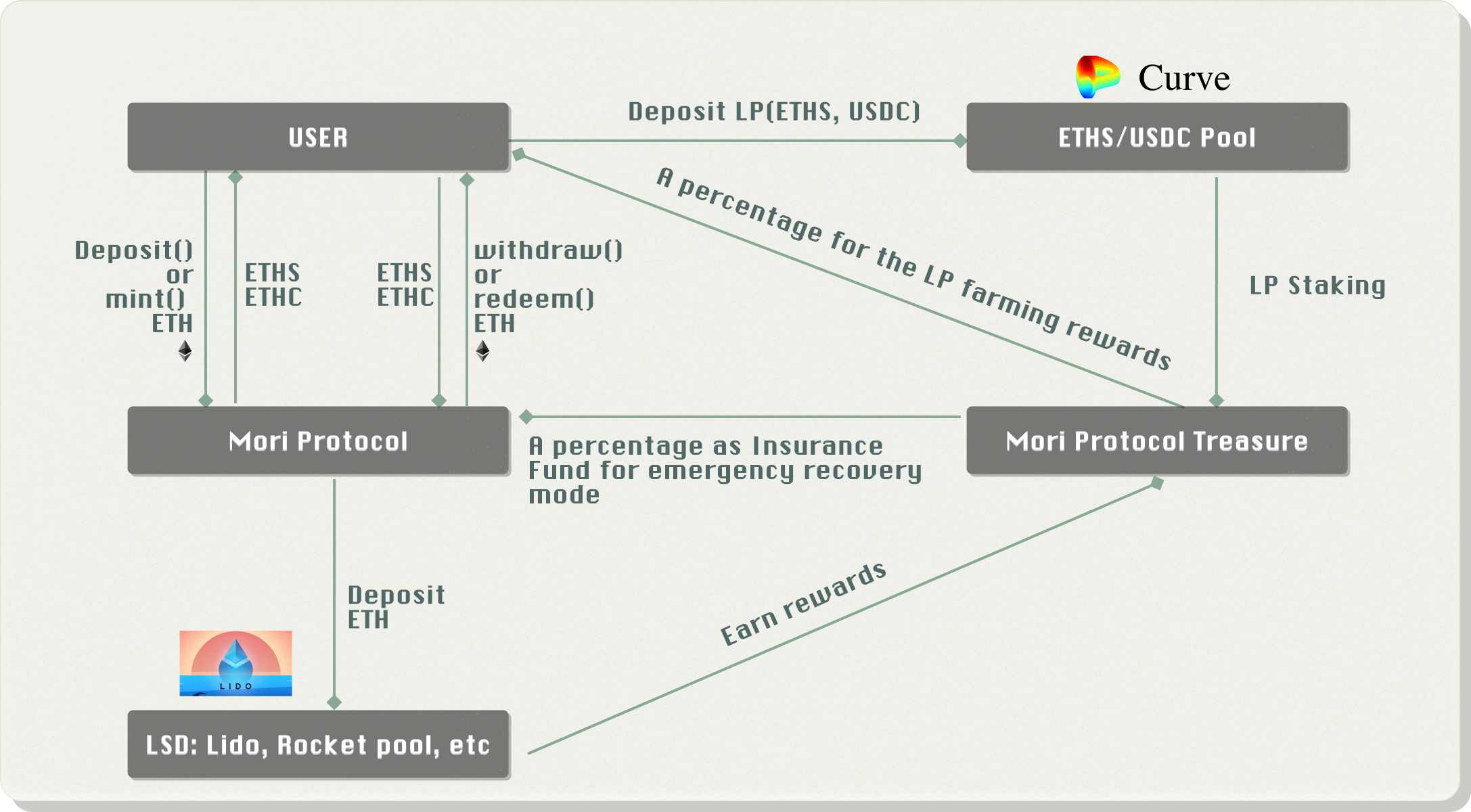
ETHS is a stablecoin token backed by ETH, which minimizes asset volatility and is a low-volatility token. In addition, it can earn additional LP (ETHS/USDC) income. ETHC, on the other hand, is designed as a leveraged long ETH perpetual token, which can be used as leverage to go long on ETH without forced liquidation. This token also has an emergency control mode that can reduce the leverage multiple of ETHC.
Currently, the protocol only supports stETH as collateral. Users can decide the ratio of their ETH to be split into ETHC and ETHS. The price movement of ETHS is 10% of ETH, for example, if ETH increases by 10%, then ETHS increases by 1%.
Zephyr Protocol
Zephyr Protocol is a stablecoin protocol that combines the privacy of Monero and the 3-token model. The three types of tokens are:
- ZEPH (base token)
- zephUSD (algorithmic stable token)
- zephRSV (reserve token)
ZEPH can be obtained through mining, used for over-collateralizing zephUSD (with a factor of 400%), and has a supply cap. The disadvantage of ZEPH is its "low availability" and can only be purchased on Seven Seas. To some extent, this is also part of its "privacy", as the protocol is currently in the beta testing phase. Zephyr inherits the privacy features of Monero, and its highlight is being a decentralized, privacy-focused stablecoin. The concept of the protocol is inspired by "Djed, the first decentralized stablecoin on Cardano", and to bridge the gap between privacy and stability, Zephyr utilizes the mechanism of Djed Protocol along with the inherent strong privacy features of Monero. It is also the industry's first privacy-focused over-collateralized stablecoin, signifying a significant leap in crypto development.
Galador
Galador is a DEX built on the Mantle network, aiming to provide the most liquid market for DeFi infrastructure, traders, LPs, DAO treasuries, and developers based on the Mantle network. Unlike traditional DEXs, the protocol focuses on providing customized methods of liquidity provisioning with a priority on composability.
The characteristics of Galador after its mainnet launch include:
- Dual AMM models, supporting volatile (Uni V2) and stable asset (Curve-like) swaps
- Concentrated liquidity for higher capital efficiency
- LPs earn platform token GLDR by providing liquidity
- Mining and platform revenue through staking platform tokens
Currently, Galador supports the Mantle testnet and is preparing to launch as one of the DEXs on the upcoming Mantle mainnet Alpha. The token has not been issued yet, but users can prepare in advance to swap and add liquidity on their network for potential future rewards.
OmxLab
OmxLab is one of the newer projects among these, with its social media opening in July. Similar to GMX, Omx is a fork of GMX. Its feature is supporting up to 50x leverage trading with zero slippage. The reason worth paying attention to is that this DEX is built on Osmosis and aims to transform Osmosis into a comprehensive "universal trading hub" with increased capital efficiency and a seamless trading experience for Osmo users.
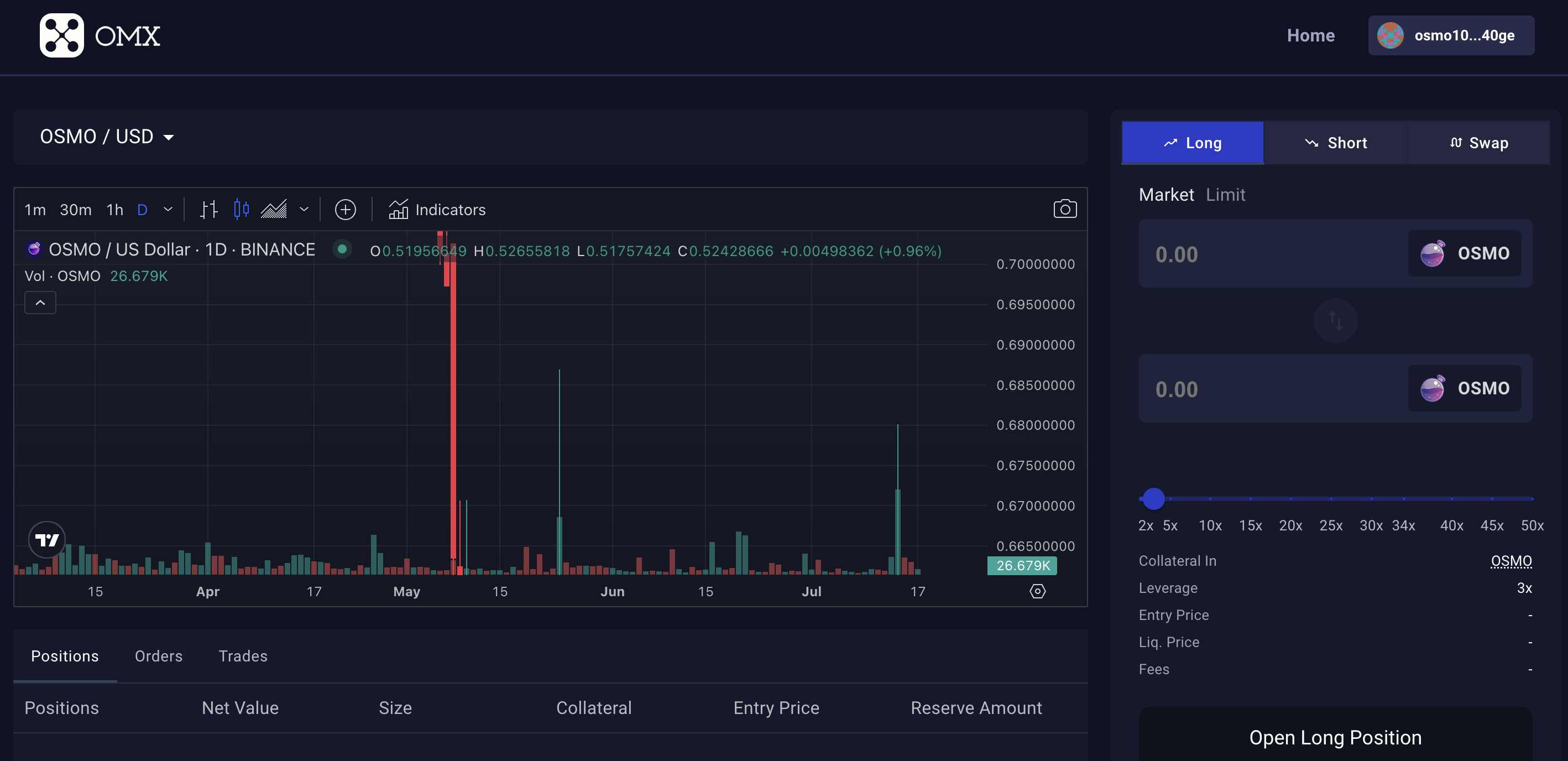
The trading function is as follows:
Transaction: zero price impact trading, up to 50x leverage, zero interest rate difference for blue-chip assets, no counterparty risk environment;
Integration: OMX seamlessly routes liquidity between margin trading, IBC-supported DEX, and EVM-based DEX to ensure optimal asset utilization;
Liquidity: experience unified liquidity depth in various multi-chain networks in the Cosmos and EVM ecosystems, including support for wallets such as Metamask;
Chains: OMX will initially be deployed on Osmosis and Polygon, and may be expanded to more chains in the future.
In addition, OmxLab is also the winning project in the first Delphi Labs hackathon and currently supports the Keplr wallet, with DEX supporting 4 tokens: BTC, ETH, ATOM, OSMO.