






Upgrade version of quadratic funding, how does Gitcoin achieve self-sustainability through PGN?


Original author: LeftOfCenter, BlockBeats
On July 7th, Gitcoin and multiple organizations have launched a layer 2 application chain called PGN (Public Goods Network). The network is built on top of the OP Stack and aims to explore a new funding mechanism to provide sustainable funding for public goods both within and outside of Ethereum.
With the addition of a new member to the OP Stack family, the sorter income will be applied to the funding mechanism for public goods for the first time.
PGN can be seen as an upgraded version of Gitcoin Grants Phase 2 fundraising.
Unlike pure donations relying on users' own pockets, all funding sources in the PGN network are generated through direct user interactions. Once the EIP-6969 proposal is successfully included in the Cancun upgrade, Ethereum application developers will be able to directly receive sorter fees as income based on CSR, making it possible for developers who truly create value for active users on the chain to be rewarded, and Ethereum may usher in the era of "developer economy".
Can be said, if the previous donation was stagnant, then the self-sufficient income model brought by PGN is a flowing stream, and the source of this stream is the sorter fee. Gitcoin's Developer Ecosystem Lead zakk.eth told BlockBeats that the team uses RaaS service Conduit for hosting, and most of the fees obtained from the sorter will be allocated to public goods developers.
So, what does PGN mean for ordinary users and developers respectively? What impacts may it bring to the fee structure of the Ethereum ecosystem? What is its relationship with Gitcoin Grants and the quadratic funding model? And what does the October Cancun upgrade mean for PGN?
What is PGN?
PGN is short for Public Goods Network, which is initiated by Gitcoin and is an experimental program for funding public goods. It has obtained support from the Protocol Guild and the Merkle Mountain Range Foundation.Public Nouns, Clr.fund, Hypercerts, Protocol Labs, Octant, Eco, <Hedgey and other groups' support. As an upgraded version of Gitcoin Grants, PGN aims to provide sustainable funding for public goods through a trial funding mechanism.
This second-layer application chain, built on OP Stack, not only inherits the performance advantages of OP Stack (including easy one-click deployment of application chains and EVM-compatible rollup with high composability), but also adheres to the fee structure of OP Stack's super chain, earning fees through the self-deployed sequencer in the network, and PGN promises to allocate most of the revenue to the development of public goods in Ethereum and other areas, providing them with an organic and sustainable source of income rather than distributing it to the development team or token holders.
For ordinary users, interacting with decentralized applications on the PGN network not only enjoys extremely low transaction costs and high security, but also a portion of the gas fees generated by each interaction will be contributed to the sequencer, which can be seen as a "use and donate" model to support public goods.
Gitcoin Grants and Quadratic Fundraising
If you are familiar with public goods and quadratic funding, you probably have heard of Gitcoin Grants.
Gitcoin Grants is an initiative operated by Gitcoin DAO in the cryptocurrency field to fund public goods. It adopts the "quadratic funding" model. In simple terms, it is an early attempt to improve crowdfunding using a matching pool, which encourages the largest number of people to participate and benefits the most favored projects. For example, compared to receiving a single donation of $500, a project that receives 500 donations (each donation being $1) will receive a greater matching amount.
Gitcoin Grants experiment can be considered quite successful. So far, it has provided funding to many high-quality crypto projects through 16 donation rounds. It not only helps project teams grow but also brings retroactive rewards to donors. More and more users are entering the Web3 world through Gitcoin.
However, all of this is just an experiment. At least in the mind of Ethereum's founder, Vitalik Buterin, quadratic funding is only a trial, and the long-term goal is to "directly channel transaction fees from L2/applications (such as rollup MEV auctions) into the matching pool".
According to Vitalik Buterin's previous tweet, those who say "Whale funding is a terrible mechanism, we need [something better X]" have missed the point. Gitcoin Grants is a "trial run" of quadratic funding, with the long-term goal of directing transaction fees from L2/applications (such as rollup MEV auctions) directly to the matching pool.
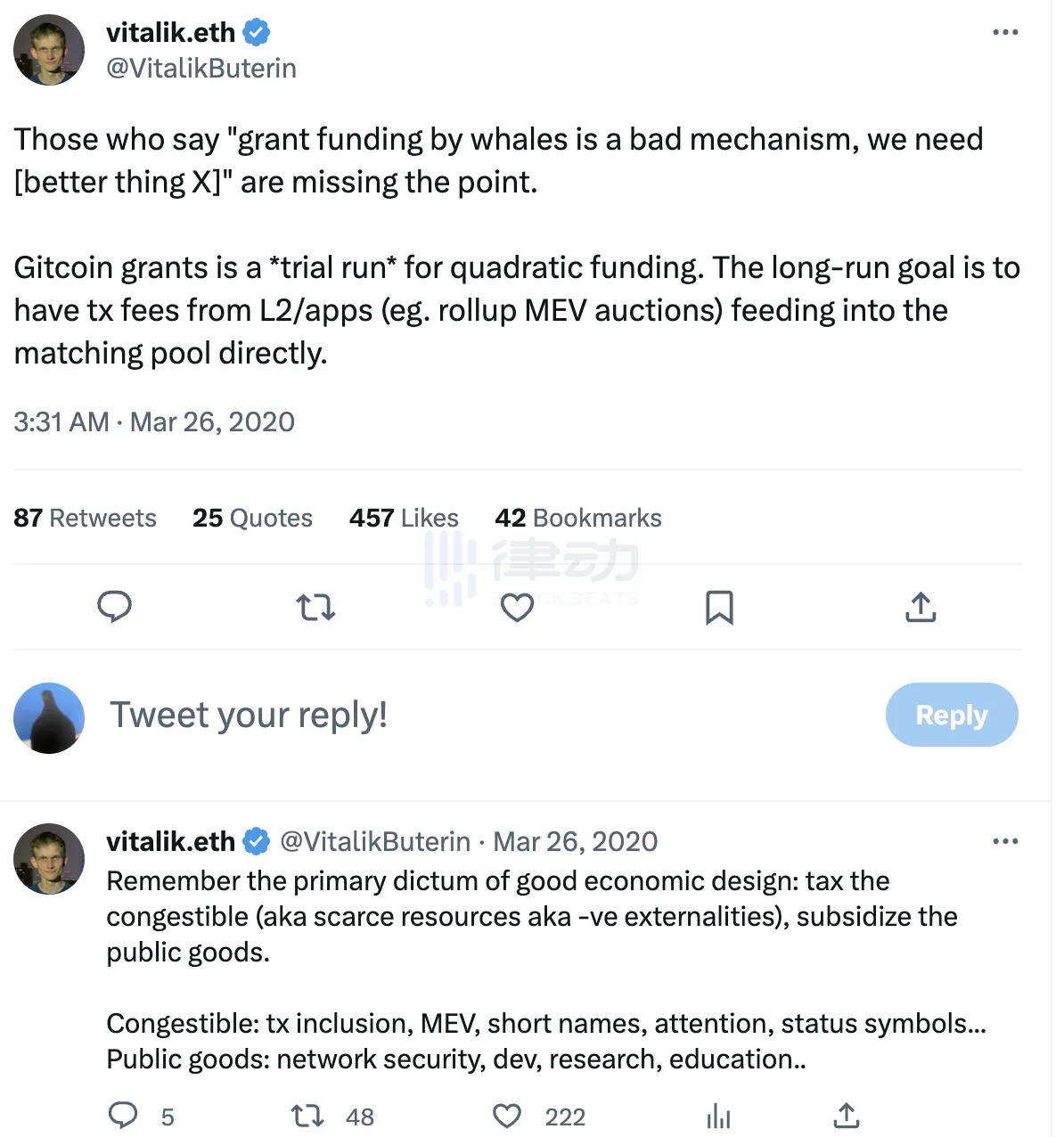
Vitalik believes that, from a systemic perspective, a well-designed economic model should "tax scarce resources to subsidize public goods." He lists a series of scarce resources, including bundled transactions, MEV, shorter domain names, attention, symbolic status, etc., while public goods are items that do not immediately generate income but are meaningful to the overall well-being of humanity, including network security, development, research, education, etc.
PGN is an upgraded version of quadratic funding
If Gitcoin Grants' quadratic funding is just a test, then the launch of PGN marks a new journey for Gitcoin.
PGN will bring a self-sustaining model to the Ethereum ecosystem, making underfunded public goods a source of active funding, with the source being the sorter fees from PGN.
Based on OP Stack, PGN naturally inherits OP Stack's fee structure, which means that every transaction generated in this network will incur sorter fees, and PGN intends to use these fees to support the development of public goods in the Ethereum ecosystem and beyond.
Public goods in the Ethereum ecosystem, of course, refer to open-source software and applications.
As one of the most common digital public goods, open-source software and applications create significant value for society. The development and maintenance of fundamental internet protocols such as TCP/IP, HTTP, FTP, and SMTP have brought free, non-excludable, and non-rivalrous access to information to the global community. However, the compensation for the core maintainers of these open-source software is still relatively low.
For developers, deploying applications on the PGN network not only allows them to inherit the advantages of "high security, stability, and scalability" brought by the OP Stack modular framework, but more importantly, developers deploying decentralized applications on it have the opportunity to receive donations from the network without any financial commitments.
Unlike Gitcoin Grants' matching donation mechanism, PGN Network's funds are generated through user interactions. It arises from real interactions between users and Dapps, and each interaction generates a sorter fee that is somehow redistributed to the builders in the ecosystem.
It can be said that if Gitcoin Grants' matching donation mechanism is like "stagnant water," then, starting with PGN, the Ethereum ecosystem has become a "flowing stream," with developers in the network as its source. They develop and create Dapps that attract user interactions and generate revenue, which is then redistributed to contributors in the ecosystem, forming an organic cycle. It can be said that Ethereum has achieved true externality.
Ethereum Enters the Era of Developer Economy
It can be seen that whether it is the EIP-6969 proposal, which will be incorporated into the Ethereum Cancun upgrade in October this year, or the launch of PGN, Ethereum's revenue system is intentionally leaning towards the developer community.
EIP-6969 is an Ethereum proposal that aims to introduce the concept of contract guaranteed income CSR, allowing contract creators to receive a portion of the Gas consumed by their own contracts. This economic mechanism can also be applied to L1.
In other words, starting from EIP-6969, Ethereum's revenue system begins to consider the interests of developers.
Prior to this, the Ethereum mining community was the main group benefiting from Gas fees. After all, in the early stages of development, miners were the most essential group in maintaining network security and the foundation of the entire network. Therefore, they needed to be rewarded sufficiently to ensure network security.
If network security was the most important aspect of Ethereum in its early stages, then, as the Ethereum ecosystem matures and improves, the importance of applications and ecosystem development in the network becomes increasingly significant. As the most important contributors to the ecosystem, the importance of developers is self-evident.
Therefore, incorporating incentive mechanisms for developers' income into the protocol layer is crucial for the development of the ecosystem. The greatest value of EIP-6969 lies in more reasonably distributing Ethereum's revenue to contributors, who are not only validators (or miners) but also developers and builders.
Since the generation of gas fees is provided by contract creators who develop Dapps that attract user consumption and transactions, it is only natural for them to benefit from gas fees. By introducing the contract creator income mechanism EIP-6969, Ethereum further aligns the incentive mechanisms of contract creators and the network, promoting the participation and rewards of contract creators.
Once the Cancun upgrade in October this year is successful and incorporated into the EIP-6969 proposal, then PGN will realize that Ethereum developers directly obtain a portion of the sequencer fees as their source of income based on CSR, rewarding contract developers who truly create value for on-chain active users. Ethereum may usher in a self-sufficient era of "developer economy".
Conclusion
PGN has made a good start, with the testnet going live for less than a week, and the number of deposit-withdrawal transactions has exceeded 100,000. However, this is just the beginning.
For ordinary users, there is still very little that can be done at the moment. Users can only transfer test tokens between the Ethereum Sepolia network and PGN through the testnet bridge.
In the future, sequencer fees will be allocated through some mechanism, but the specific mechanism has not yet been determined. Providing a stable source of income for developers is important, but how to reasonably allocate these funds and whether the distribution criteria are reasonable is a more important issue to be solved. According to the PGN team's plan, after the mainnet has been launched for 6 months, the fees will be evaluated and allocated based on accumulated impact data.
In the long run, PGN is still a long-term experimental project that carries great responsibilities and has a long way to go. According to the official announcement, such experiments will need to be maintained for at least two years.
And experiments mean continuous trial and error, uncertainty, and even a high probability of a future failure. However, at the same time, experimentation also means vitality, an exploration of possibilities. From visible human history, we can discover that experimentation is also the place where groundbreaking things are most likely to be born.





