






A Decade of Turbulent Development in Cryptocurrency: Disappearing Tokens, Failed ICOs...


Original link: CoinKickoff
Original translation: Leo, BlockBeats
The history of cryptocurrencies can be traced back to the financial boom in the 1980s, when the financial culture was glorified in movies like "Wall Street," and "Trading Places." In 1983, pioneering cryptographer David Chaum published research that laid the foundation for electronic payments, blockchain, and cryptocurrencies.
At that time, these were groundbreaking ideas. For many years, cryptocurrencies were rarely discussed outside of the libertarian communities advocating for free markets. However, there was a turning point in 2009 when Satoshi Nakamoto developed Bitcoin. The cryptocurrency market saw explosive growth around 2010.
Today, there are thousands of cryptocurrencies in the market, posing challenges for both investors and regulatory bodies. Many people consider the number of circulating tokens to be excessive, drawing comparisons to the "dot-com bubble" of 25 years ago.
To analyze the cryptocurrency market, we conducted a visual analysis of tokens that have collapsed and disappeared over the past decade, from failed initial coin offerings (ICOs) to waning interest in the market.
We referenced data from Coinopsy, which lists over 2,400 defunct tokens, to compile information on the current status of each token. We analyzed the performance of each token over the past 10 years and documented the time and reasons for their elimination.
After organizing this data, we compared it to CoinMarketCap's annual snapshots to provide accurate data on all the tokens that have ever circulated in the market.
Data Overview
In 2017, 704 tokens that have now disappeared began circulating, compared to 224 in 2016.
2018 was the most dangerous year for the crypto industry, with 751 tokens disappearing.
2014 saw the highest death rate of tokens, with 76.5% of the 793 tokens no longer in circulation, totalling 551 that disappeared.
The Crypto Crash of 2014
When looking back at the price history of encrypted tokens, 2013 can be seen as the first era of encryption prosperity. In the technological background dominated by emerging technologies such as drones and smartwatches, the price of Bitcoin skyrocketed from $150 to $1000, reaching a high point of $1127 in November 2013. Before the surge of Bitcoin, there were only 14 tokens in the encryption market, and as of 2022, only Bitcoin and Litecoin remain in the top 10.
The surge in Bitcoin prices led to a wave of competition among tokens vying for market benefits. Data shows that in 2013, there were 84 tokens entering the market, and in 2014 there were 607, all in order to profit from the collapse of Bitcoin in early 2014, when most Bitcoin transactions were related to the dark web black market Silk Road.
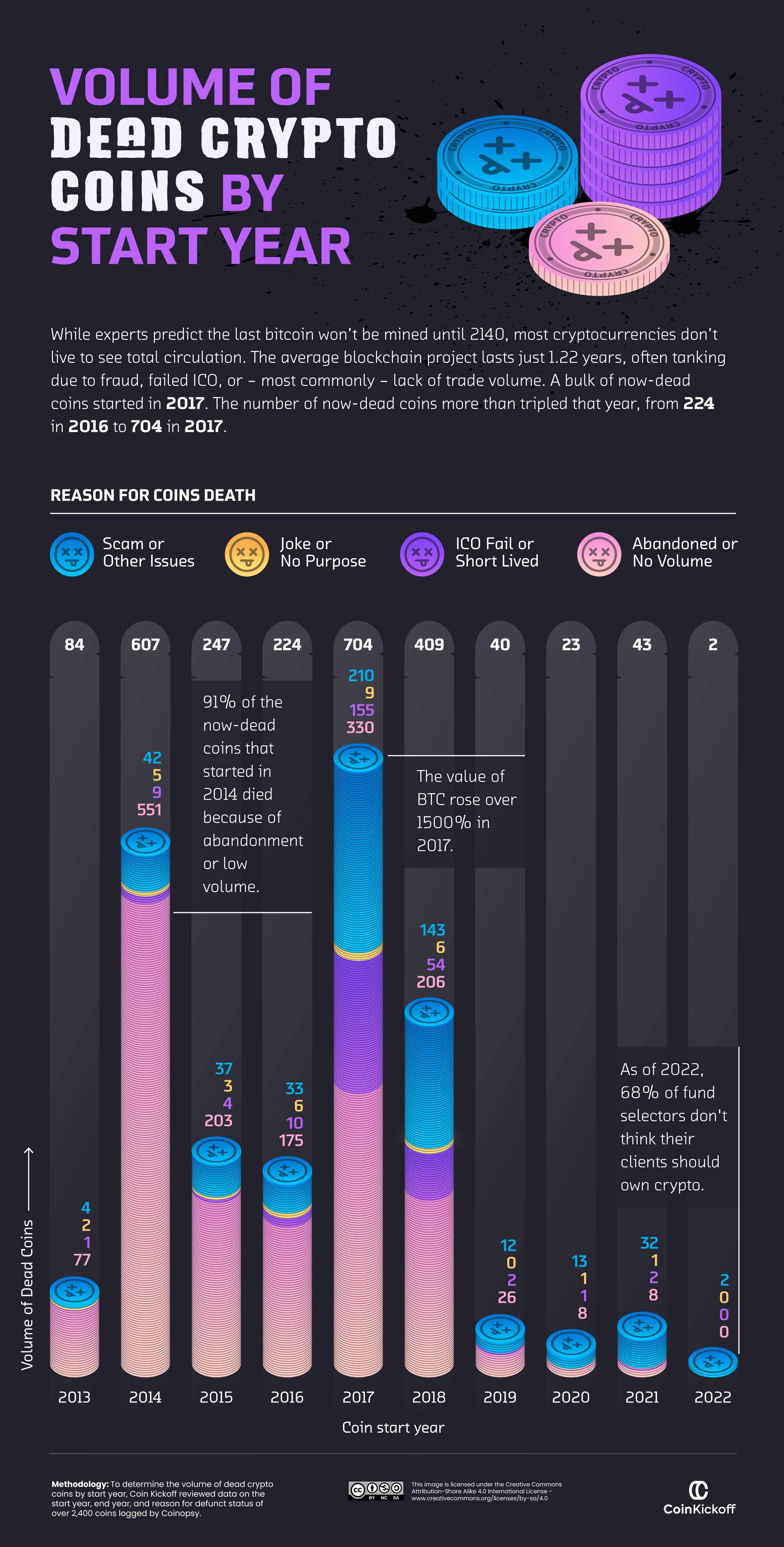
However, the squeeze of emerging cryptocurrencies in 2014 did not last. Data shows that 91% of the tokens established in 2014 eventually disappeared due to low trading volume or abandonment (of course, there are exceptions, such as Dogecoin), and many opportunists who attempted to monopolize the early encryption market ended in failure.
The Second Surge in Cryptocurrency Prices
2017 became the "Summer of Love" in cryptocurrency history, with everyone loving encryption, and emerging blockchain technology attracting the attention of global business leaders for the first time, leading to a surge in investment. In July 2017, Goldman Sachs technical analyst Sheba Jafari predicted that Bitcoin would reach $3600 by the end of this year.
That year saw many lucrative ICOs, with the most famous being Filecoin, which raised $257 million. However, things were not as they seemed. In that year, 704 tokens have entered the cryptocurrency market and are now disappeared, making it the year with the highest number of tokens in the past decade. In a 2018 report, ICO advisory company Stasis Group stated that 80% of ICOs in 2017 were identified as scams, accumulating a total of $11.9 billion in assets.
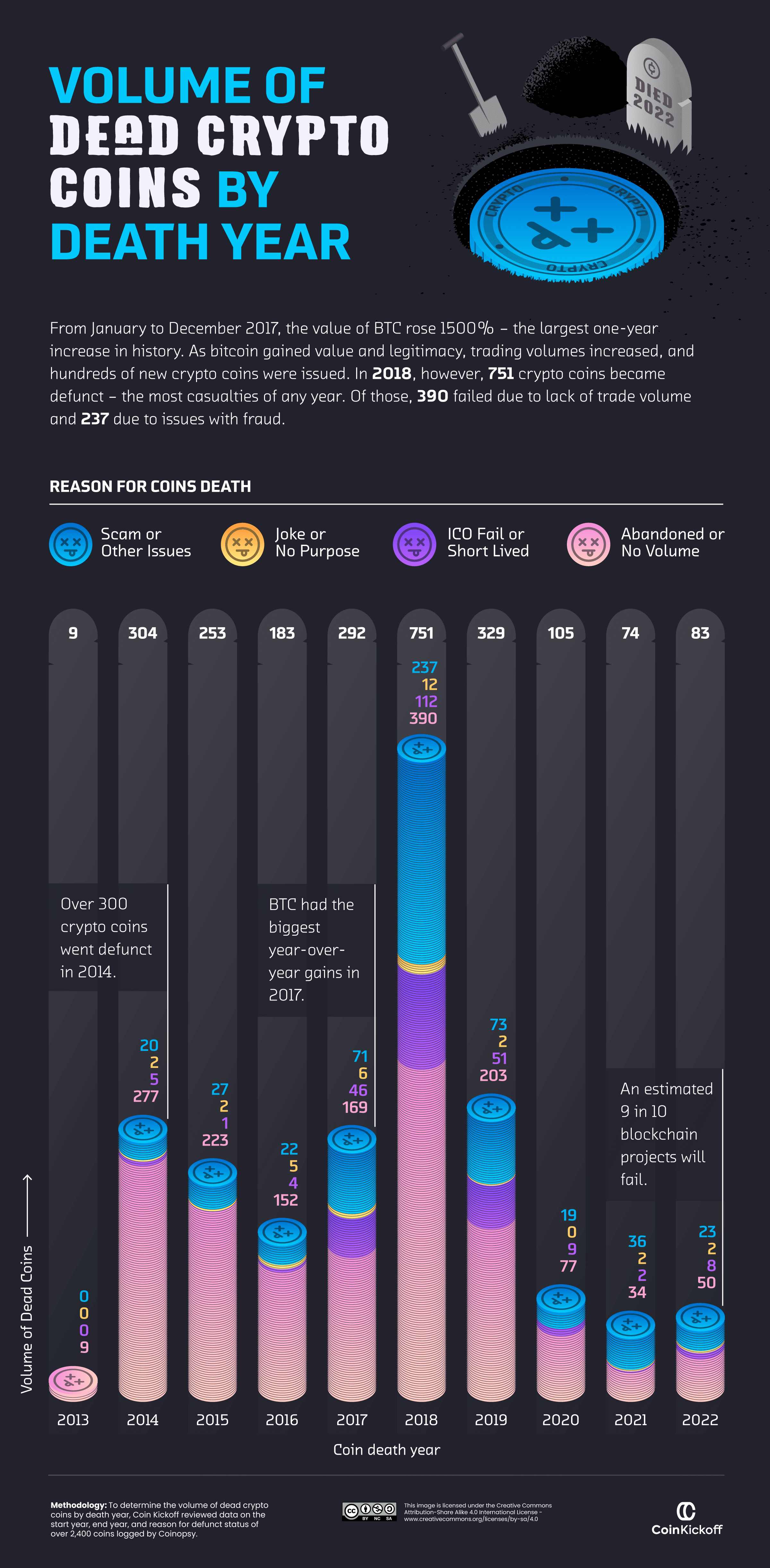
Our research shows that in 2018, out of the 751 coins that died, 30% were fraudulent, the highest in the past decade. The most famous ICO scams were PinCoin and iFan in Vietnam. Local journalists exposed these companies for defrauding up to 32,000 investors, with a total amount of 660 million USD. The Ho Chi Minh City police also conducted an investigation at that time.
Token Data in 2014
But it is easy for people to forget that cryptocurrency is still in its early stages. The stock market has been around for hundreds of years, and the first Bitcoin transaction took place in 2010 at a pizza shop in Florida. The market has not yet fully stabilized, and economists have differing opinions on the future of the crypto industry.
The crypto market has already shown that cryptocurrency trading and investment can easily disrupt traditional financial systems, but there are also many cases of failure in this industry. A report from the China Academy of Information and Communications Technology (CAICT) shows that 92% of blockchain projects in the market are inactive, with an average lifespan of only 1.22 years.
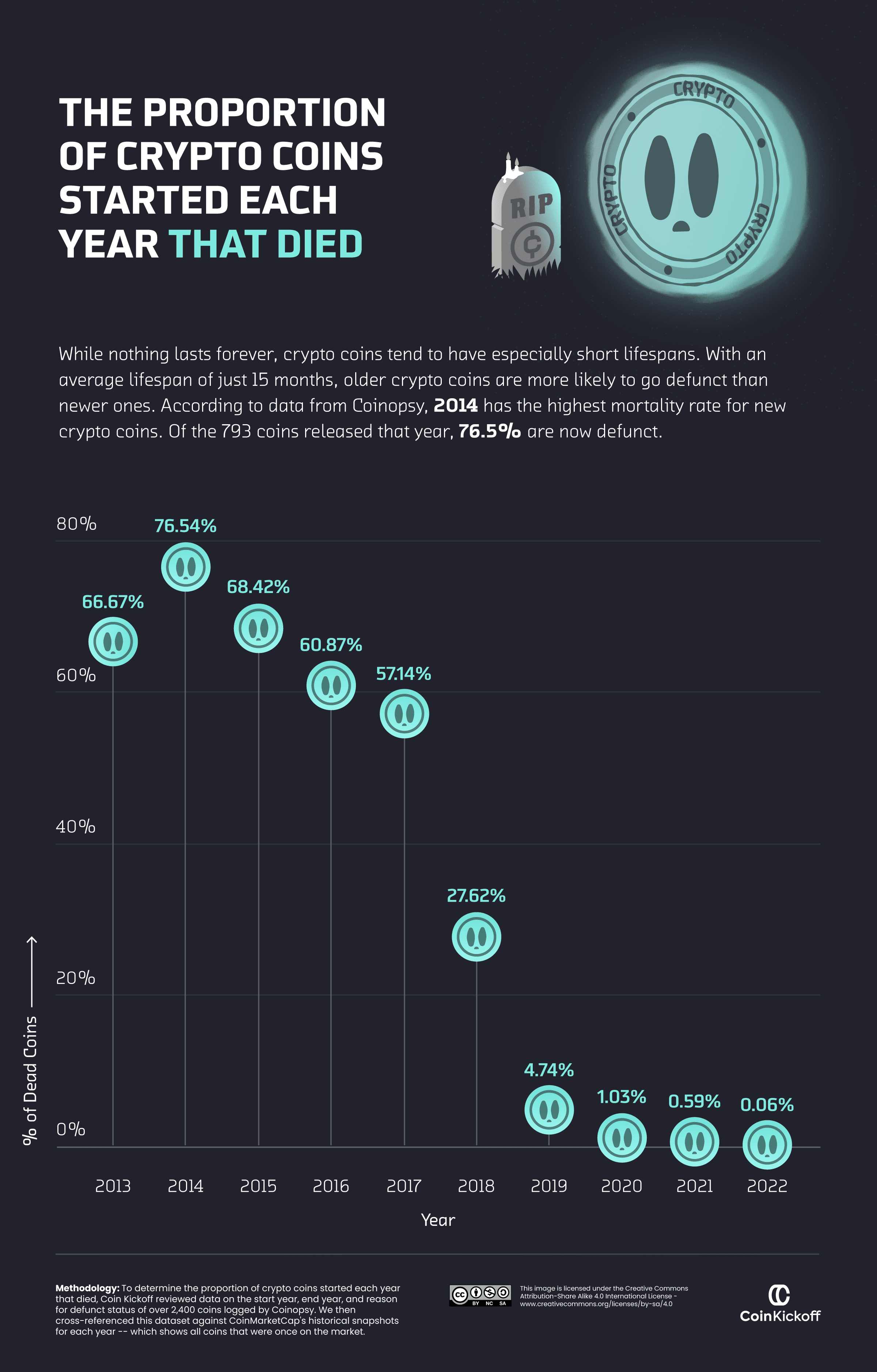
The early stages of the crypto market were fatal for many ambitious tokens. According to our research, more than half of the tokens launched between 2013 and 2018 no longer exist. In 2014, during the first major boom of cryptocurrencies, over three-quarters (76.5%) of the tokens issued have already disappeared.
Improvement in Data, Only 16 Tokens Abandoned Since 2020
According to data from blockchain research platform LongHash, 63.1% of the disappearance of cryptocurrencies is due to investors abandoning them, leading to price collapses. In a saturated market with over 12,000 tokens, well-intentioned projects naturally fail to attract people's interest. Coinopsy summarizes reasons why a token may be abandoned, ranging from outdated blockchain designs to the personal circumstances of developers.
For example, if the trading volume is below $1000 in 3 months, or if the project website stops updating, it will be considered a dead token.
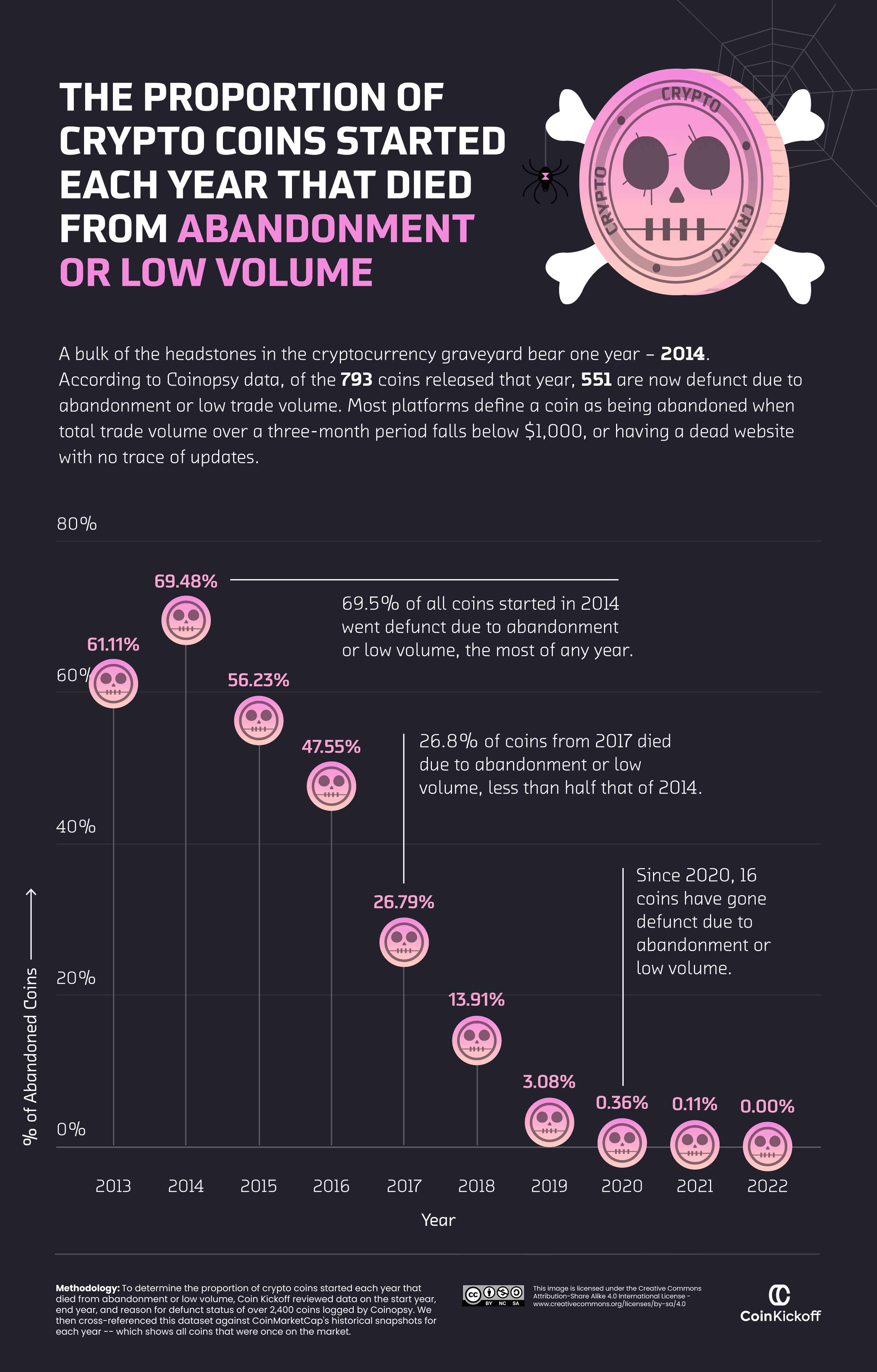
Data shows that after the first price surge of cryptocurrencies in 2013, the probability of some tokens disappearing started to increase. In 2013, 61.1% of tokens vanished, and in 2014, 69.5% of tokens disappeared. However, looking at the subsequent data, the rate at which tokens are abandoned and disappear has been decreasing, indicating a decreasing frequency of people losing interest in cryptocurrencies. Since 2020, only 16 types of tokens have been delisted from the market due to lack of investment. Nevertheless, people are still concerned that a significant drop in cryptocurrency value in 2022 will lead to more tokens being abandoned.
2017 was the peak period of crypto scams
Due to the lack of regulation in the crypto market, fraud schemes and opportunistic scams have been prevalent and accounted for a large proportion of the crypto market. In addition to these tokens designed for fraud, criminals can also deceive investors using mainstream currencies like Bitcoin and Ethereum.
A report from the Federal Trade Commission stated that since the beginning of 2021, over 46,000 people have become victims of cryptocurrency scams, with a total loss exceeding $1 billion. According to Chainanalysis data, the recent price surge in 2021 has once again increased people's interest in the market, leading to a wave of cryptocurrency crimes involving up to $14 billion.
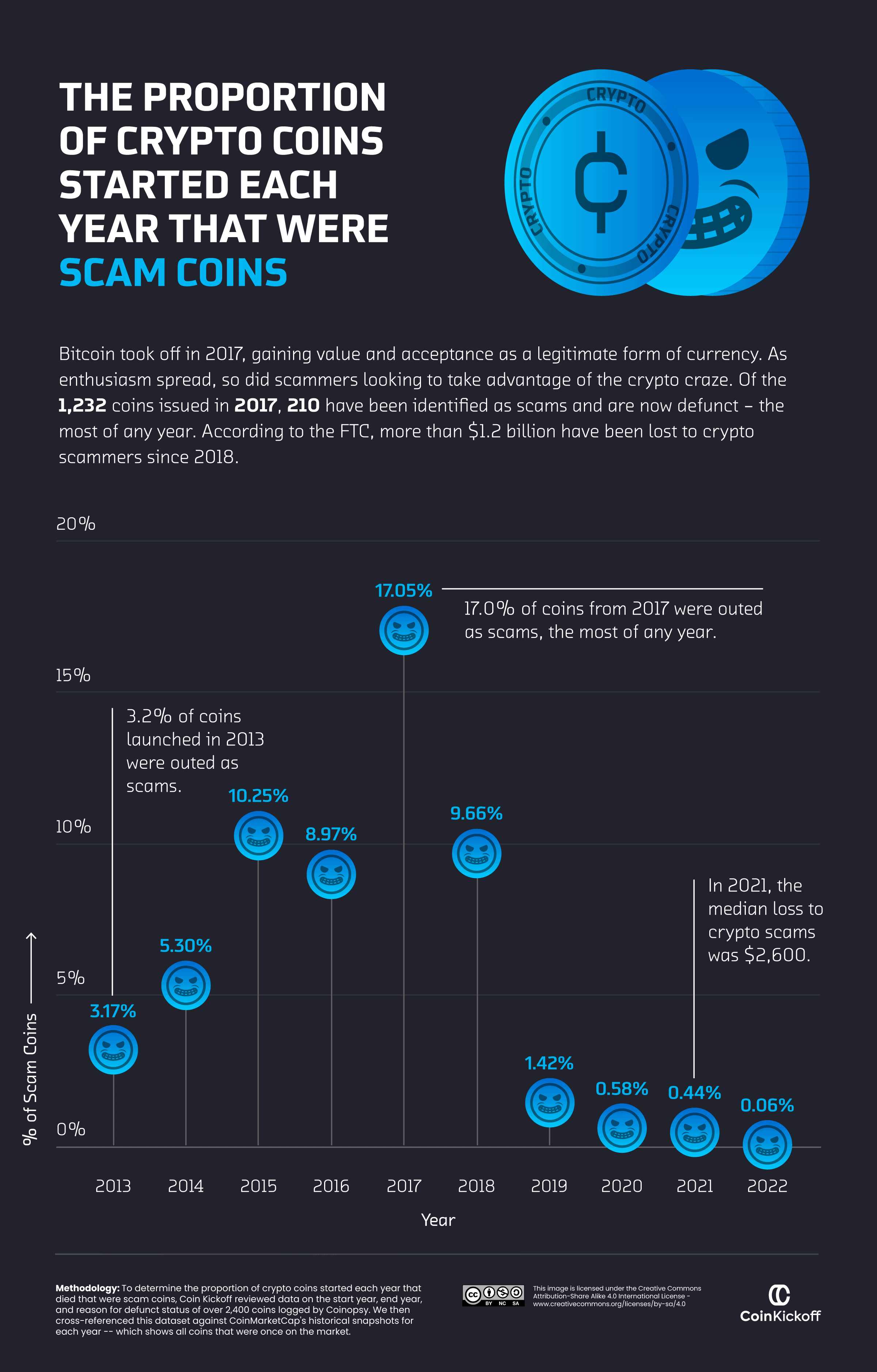
However, since 2019, less than 2% of the issued tokens have been exposed as fraudulent tokens. 2017 was the peak year of crypto scams, with 17% of tokens being fraudulent (210 out of 1232 tokens are considered fraud and have now disappeared), allowing scammers to earn $490 million during the ICO boom in 2017.
When a company becomes large enough to trade on the stock market, it launches an Initial Public Offering (IPO) to raise funds from the public investors. In contrast, an ICO is a primary channel for attracting people to buy newly launched cryptocurrencies, where investors purchase tokens that can also provide broader interests related to the company's products, including shares in the company itself.
Mastercoin is the first project to launch an ICO in 2013. With the growing interest in cryptocurrency from the mainstream as its price rises, this practice reached its peak in 2017. However, our research shows that 12.6% of all tokens launched that year became invalid due to ICO failures, which is more than any other year in the past decade.
A study by consulting firm GreySpark Partners found that nearly half of all ICOs launched in 2017 and 2018 failed to raise any funds, and this practice is prone to fraud, ultimately leading to strengthened regulation and severe penalties for misconduct in the industry. Therefore, our data shows that only 5 types of tokens had ICO failures.
What will happen next after a turbulent decade for cryptocurrencies?
The cryptocurrency market is growing at an unprecedented pace, with rapidly advancing technologies bringing new investment opportunities - most notably the NFT frenzy in 2021. Bitcoin still dominates the market, with some investors predicting its price could reach $100,000 by 2023. However, in 2021, the value of Ethereum increased by 409%. Despite global instability caused by Russia's invasion of Ukraine and resulting economic downturn worldwide, analysts predict that Ethereum will bring $4.9 billion in value to the cryptocurrency industry by 2030.
Many experts have drawn parallels between the growth of cryptocurrencies and the "dot-com bubble" of the early 2000s when innovations led to a surge in internet companies and investors searching for the next Amazon or eBay. In comparison, cryptocurrency investments surged in 2013 and 2017, flooding the market with new currencies as investors sought to profit from the "next big thing."
While many of these tokens vanished due to lack of investment, ICO failures, or scams, the market also faces numerous challenges in regulating cryptocurrency to protect investors. However, the investment community has started to take the cryptocurrency industry seriously, as it has demonstrated its ability to disrupt traditional financial markets over the past decade.





