






Analyzing why Azuki's Elementals would have overlap in release?


Original author: Jaleel, Jack
Original editor: Jack
As the NFT market enters a bear market, even the market leader "Bored Ape" could not escape, while Azuki, on the other hand, has performed exceptionally well. Over the past three months, Azuki has defied market trends and successfully risen to become the strongest blue-chip project. During the peak of the bull market, Azuki reached a floor price of over 30 ETH, and even recently rose to 17 ETH. Furthermore, the Azuki community has a rare sense of activity and cohesion, even in a bear market.
However, the release of Elements early this morning has caused a major disruption in the community. Apart from the whitelist minting window being only ten minutes long, which led to a short period of website overload and a direct crash. After the release, the project team directly transferred 20,000 ETH. The most discussed topic in the community is the high degree of similarity between Elements and the first generation of Azuki, which may directly dilute the value of the first generation of Azuki.
Initially, the community questioned the high similarity between Elements and Azuki, but as more Elements were revealed, many owners found that their Elements looked exactly the same as other owners', not just highly similar, but completely identical.
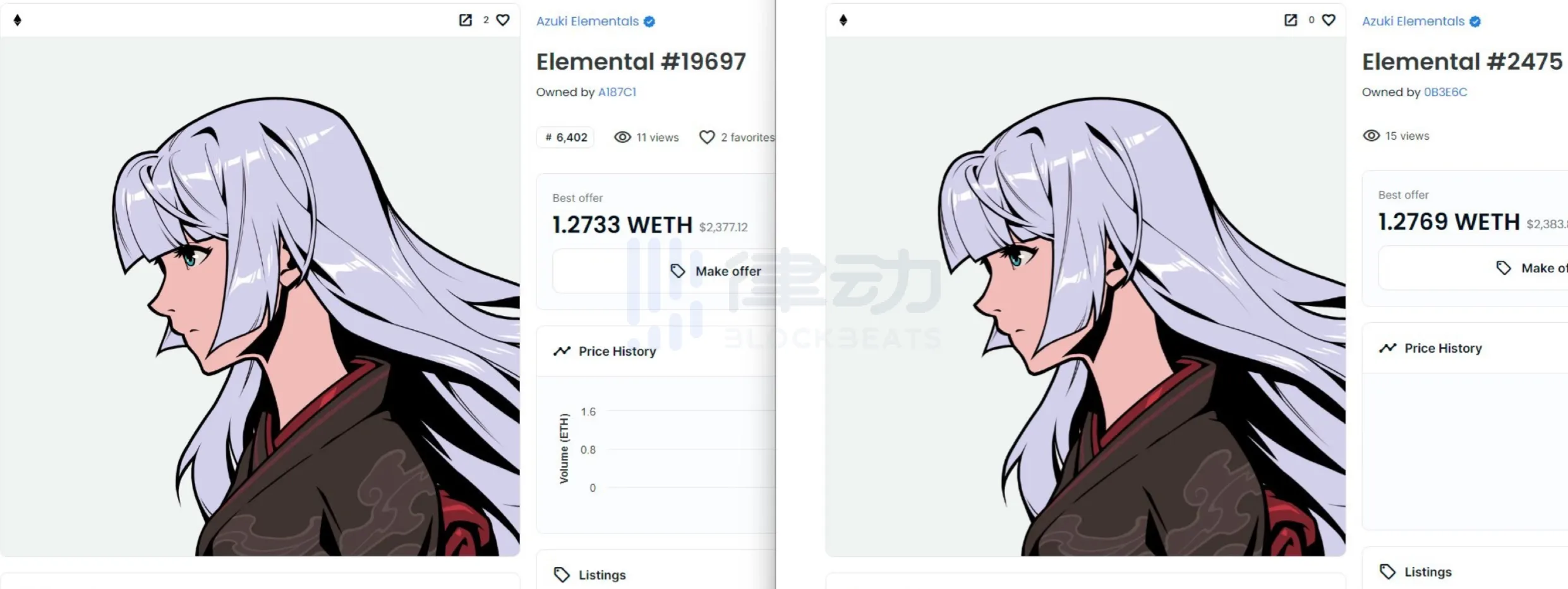
So far, five sets of identical images have been discovered for Elements. The numbers of these five sets are: #2210 and #10744; #1077 and #8600; #16046 and #8914; #16580 and #5613; #19697 and #2475. Not only are the NFT images of Elements identical, but even the saved images have the same names.
As more instances of image collisions were discovered during the opening of Elements, the team realized this issue and made a response. PMFLOW, co-founder of Azuki, replied to the community on social media, stating that this situation was due to technical issues. The event logs of the data provider became outdated due to Ethereum blockchain reorganization, causing incorrect processing of metadata for a few tokens. The team is working hard to restore the correct images and metadata.
"Block reorganization" occurs when blocks are produced on a blockchain simultaneously, and if there are errors or malicious attacks, it can result in a temporary duplicate blockchain. Because the miner adding to the next block must decide which side of the fork is the correct or canonical chain, "block reorganization" can occur. Once the miner chooses the fork or canonical chain, the other chain is discarded.
The most recent significant case of "block reorganization" occurred on May 25, 2023, when the Ethereum Beacon chain experienced a reorganization of seven blocks, exposing an advanced security risk known as chain reorganization. Validators on the Eth 2 (the current consensus layer upgrade) Beacon chain became out of sync after upgrading a specific client.
"Image collision" is not uncommon
In response to Azuki co-founder 2 PMFLOW's statement that the image collision was due to Ethereum block reorganization, scriptmoney.lens, founder of cryptochasersco, disagrees. He expressed his own views on social media, suggesting that the cause of the image collision was a failure to handle exceptions in the server-side event listener, not the data provider. Implied in his remarks is the suggestion that Azuki's claim of a technical fault causing the image collision seems inconsistent.
When discussing the technical principles of NFT image generation, three key elements need to be considered: layer styles, generation algorithms, and the upload format of the generated NFT images. Due to the variability of these three factors, countless forms of NFT can be created.
Firstly, layers can be considered as pre-made materials, such as: 10 different colored backgrounds, 10 different hairstyles, 10 different hats, 10 different handheld accessories, and so on, each of which is an independent layer. Once the number and styles of layers are determined, we can preset factors that influence the rarity index, the number of target generated images, and more, in order to create an NFT algorithm capable of generating various combinations. Then, based on the generation algorithm, the various material layers are stacked from bottom to top to form a complete NFT.
The probability of image collision in the generated NFT varies depending on the number of prepared layers and the complexity of the algorithm. For example, if an NFT project only prepares 3 layers, each with just over 10 elements, and the generation algorithm is relatively simple, the probability of image collision in that NFT series will be very high. However, for blue-chip projects like Azuki with multiple layers and hundreds of elements, as well as extremely complex generation algorithms, even generating tens of thousands of new NFTs, it is unlikely to encounter image collision situations.
Of course, because the process of generating the image is completed off-chain, even if there are cases of duplicated images, they can be checked again before the image is officially put on the chain to filter out the repeated images. This requires the project team to undergo a thorough screening process for the generated NFT images before they are put on the chain. Even if the project team directly applies the generated images to the original materials, there should still be a reasonable screening process to ensure the performance of the program and that all combinations strictly follow the predetermined probability distribution.
So, what exactly is the problem with Elementals?
First and foremost, Elements most likely directly applied the layer, elements, or even the generation algorithm of Azuki or BeanZ. However, perhaps due to the limited "elemental concept" of the NFT series revolving around water, fire, electricity, and other elements, the related generation algorithm was not properly debugged, resulting in the occurrence of duplicate NFTs.
Secondly, the claim in the community that "the same image is minted in the same block" does not seem to be entirely true. According to an NFT technician, the occurrence of duplicated NFTs in the Elementals series did not have sequential or similar numbering, indicating that their probability of being minted in the same block is relatively small. Therefore, another explanation is that the Azuki team did not perform secondary screening on the generated Elementals, resulting in duplicate images being directly uploaded to the chain.
Of course, regardless of the reason, it is unacceptable for blue-chip NFT projects like Azuki to experience incidents of duplicated images. Clearly, the team did not adequately prepare before the release of Elementals.
Why can the on-chain images be modified even under our noses?
In response to the issues of casting and image generation of Elementals, 2 PMFLOW, co-founder of Azuki, replied to the community on social media that the team is working hard to restore the correct images and metadata for Elementals. Subsequently, BlockBeats also discovered that when querying the Elementals series contract, some NFTs' tokenURL no longer display any results. At the same time, certain preview images of the Elementals series on platforms like Blur in the NFT marketplace cannot be displayed properly. Azuki team thus conducted a live "image replacement" in front of the community in real-time.
Why is it possible to change and modify NFTs that have already been uploaded and minted on the chain? This requires a simple review of how NFT image storage works.
We know that today's Internet is built on the HTTP protocol, which is a transmission protocol used to transfer hypertext from a network server to a local browser. When we retrieve web pages or files through HTTP, we request and retrieve information from a server. This is a centralized process that has several issues, such as the file becoming inaccessible if the server fails, and the server bandwidth being overwhelmed if a large number of users try to access the same file simultaneously.
In contrast, IPFS adopts a more distributed approach. IPFS is a protocol and network designed to create persistent and distributed storage and sharing of files. It is a new hypermedia transfer protocol that addresses issues related to data storage and bandwidth. IPFS stores files and other data as blocks on multiple nodes and uses unique hash values to identify each block. When a user requests a file, IPFS retrieves the blocks from the nearest nodes instead of the original server. This allows for faster and more stable data access, without the risk of data becoming inaccessible due to a single server failure.
Due to these advantages, IPFS has become the ideal choice and the predominant consensus for storing NFT metadata. NFTs typically contain information such as descriptions of artworks, including the artist and creation date. This information is known as metadata. Because NFTs are immutable, metadata needs to be stored permanently, and IPFS's distributed nature can provide such a service. Additionally, IPFS's distributed nature can prevent tampering with NFT metadata, ensuring the security of NFTs.
In the IPFS file system, each file is assigned a hash value based on its content, and files in IPFS are indexed based on these hash values. The system also checks whether the hash value has been stored in advance. If it has been stored, the file is read directly from other nodes, avoiding redundant storage and saving space to some extent. This greatly improves the efficiency of resource storage and reduces transaction costs.
However, after querying the Elementals contract, we discovered that the image metadata of Elementals has not been uploaded to IPFS, but instead is stored on Azuki's centralized server. As a result, Azuki's team has full ownership and modification rights over the metadata, allowing them to make changes at any time.
In fact, Elementals is not the only project that chooses to store images on its own servers. Many "wealthy" blue-chip NFTs also do this to have greater control over the project. But compared to Elementals, the previous Azuki series stored metadata on IPFS. So why did the team "revert" to a centralized approach in the decentralized process of the project? Perhaps everyone foresaw that Elementals might run into issues from the beginning.
What's even more outrageous is that the team made new mistakes during the process of modifying the metadata. scriptmoney.lens also found that the fix metadata uploaded by the Azuki team seems to be a file, so it redirects to the download page when accessed. In other words, the server did not upload the normal json metadata, but directly uploaded an image file. Therefore, when third-party trading platforms like Blur try to read NFT image data on the server, they cannot read it properly, resulting in the issue presented at the beginning of this paragraph.
And when we look at the downloaded files pointed to by the metadata, we will find that these new images cannot even be described as "fixes." Take Elementals #16580 as an example, as of the time of writing this article, the NFT metadata file is completely different from the original version (see the image below). Although the team had previously announced their image swap actions, such a big difference may be difficult for many people to accept.
No matter how you evaluate it, the release of Elementals has been a catastrophic event. It not only affects the Azuki community itself but also the entire avatar NFT field. From experience, people's confidence and trust in NFT projects are often very fragile, and Azuki's vampire behavior is rapidly eroding the last remaining faith in this industry.
Of course, in response to the community's questions and criticisms, the Azuki team has also made a positive response, stating that they will make efforts to make up for their mistakes and announced a new "Green Bean" airdrop this afternoon. Although the situation with Elementals is extremely chaotic, perhaps we can still reserve some faith and give the Azuki team one last chance?





