






Binance Launchpool meets Uniswap V4, will the DEX vs CEX war escalate?


Last night, Binance announced the launch of Maverick Protocol (MAV), a new Launchpool project. Users can put BNB and TUSD into the MAV mining pool on the Launchpad website after June 14 to get MAV rewards. Binance will release MAV tokens after the MAV Token meets the liquidity requirements Open the MAV trading market.
Coincidentally, one hour after Maverick announced the launch of Binance Launchpool, Uniswap released a code draft of the V4 version, hoping to bring more innovative power to the DeFi field by introducing new functions such as Hooks and Singleton. For example, V4 will allow the pool itself to support dynamic fees, add on-chain cap orders, or act as a time-weighted average market maker (TWAMM) to spread out large orders over time.
After the release of the V4 code, the most discussed in the community is the innovation of the new function Hooks in customizing liquidity. The pool can make the same trade-offs as V3, or it can add entirely new functionality to contracts that run at various points in the pool's operational lifecycle. Additionally, V4 pools will exist in a single contract, which will reduce the cost of creating a mining pool by 99%.
first level title
Directional LP: Maverick's solution to custom liquidity
Maverick AMM introduced the design of Dynamic Distribution AMM, which includes the following three functions:
1. The first AMM has the underlying native ability to automatically move centralized liquidity according to the transaction price
2. Provide tools to empower LPs to implement different liquidity market-making strategies: only follow price rises, and stay where they are; only follow price drops, and stay where they are; move down; and fix liquidity to a certain/some price points.
3. AMM helps LP earn real-time compound interest
Specifically, Maverick generated four modes including static mode (liquidity does not move), right mode (liquidity changes as prices rise, but does not change when prices fall), left mode (liquidity moves with price declines, but not when prices rise) and bi-directional patterns (liquidity moves with both increases and decreases in price).
Based on the left and right modes of the four liquidity modes, Maverick introduced the innovative AMM concept of Directional LP, which allows liquidity providers (LP) to follow the price of the trading pair to choose the direction of mobile liquidity, and obtain Excess returns while avoiding impermanent losses.
Concentrating liquidity in the face is not always capital efficient and can lead to problems of misallocation and inefficiency. Maverick AMM helps users improve capital efficiency by automatically re-centralizing liquidity. Liquidity providers can choose from four liquidity transfer modes, thereby eliminating the high gas fees caused by self-adjusting positions around prices.
In the current AMM field, liquidity providers cannot set a single definitive call or put when providing liquidity. For any existing AMM in the DeFi space, the liquidity provider would implicitly bet that the price of the pair of assets in their pool would move sideways, allowing them to charge transaction fees, while the ratio of their deposited assets would not Significant changes occur. If this bet is wrong — that is, if the price moves in any direction other than sideways — liquidity providers will suffer impermanent losses that may exceed any fees they charge.
In a static liquidity AMM, it is advantageous for LPs to have bilateral asset allocations so that LPs have immediate access to volume and hence fees. But bilateral LP increases the possibility of impermanence loss.
In AMMs like Uniswap V2 xy=k, unilateral LP is not even supported. In existing interval AMMs such as Uniswap V3, unilateral LP is possible, but through unilateral LP, as the AMM price deviates from your interval, your capital may stagnate. Without a built-in mechanism to move its liquidity closer to price, the capital efficiency of a one-sided LP is zero.
In Maverick, directional LPs can provide liquidity to an asset while still maintaining high capital efficiency thanks to the underlying Maverick liquidity transfer mechanism.
Liquidity providers can now choose to follow asset prices in one direction, effectively betting on the price trajectory of a specific token. These directional bets are similar to unilateral liquidity strategies in that liquidity providers will have most or all of their exposure to a single asset in a given pool.
As the price moves in the selected direction, the AMM will automatically refocus liquidity to follow it, capturing more fees. If liquidity providers make the right bets on the price direction, they can enjoy liquidity re-focused around the price as it moves in their chosen direction without suffering any impermanent loss (IL).
first level title
Hooks in Uniswap V4
So how does the just announced Uniswap V4 realize custom liquidity? In the official Uniswap blog post, there is a relatively detailed explanation of Hooks and the custom liquidity it brings. The following is excerpted from the blog post "Our Vision for Uniswap v4》:
What are "Hooks" and custom liquidity pools? Each Uniswap liquidity pool has a life cycle. During the lifecycle of a liquidity pool, several things happen, including users creating a liquidity pool with default fee tiers; liquidity being added, removed, or rebalanced; and users trading tokens.
In Uniswap v3, these lifecycle events are tightly coupled and executed in a very strict order.
To create room for customizable liquidity in Uniswap v4, Uniswap wanted to create a way for liquidity pool deployers to introduce code to perform specified actions at key points throughout the lifecycle of a liquidity pool— — such as before or after trading tokens, or before or after LP position changes.
Enter “Hooks,” plugins that customize how liquidity pools, exchanges, fees, and LP positions interact. Developers can innovate on top of the liquidity and security of the Uniswap protocol, creating custom AMM pools through "Hooks" integrated with v4 smart contracts.
Some experiments of interest to Uniswap include: time-weighted average market maker (TWAMM); dynamic fees based on volatility or other inputs; on-chain cap orders; depositing out-of-bounds liquidity into lending protocols; customized on-chain oracles Machines, such as geometric mean oracles; automatic compound interest LP handling fees to LP positions; internalized MEV profit distribution to LP;
But in reality, imagination has no limits. Since each liquidity pool is now defined by more than just tokens and fee tiers, we will see liquidity pools of all colors, shapes, and sizes. The core logic of Uniswap v4 is the same as that of v3, which is not upgradeable. While each liquidity pool can use its own "Hooks" smart contract, "Hooks" can only be restricted to specific permissions determined when the liquidity pool was created.
Uniswap created sample "Hooks" contracts to get started with the current framework. Uniswap also expects developers to come up with new and interesting ways to build features they didn't even think of.
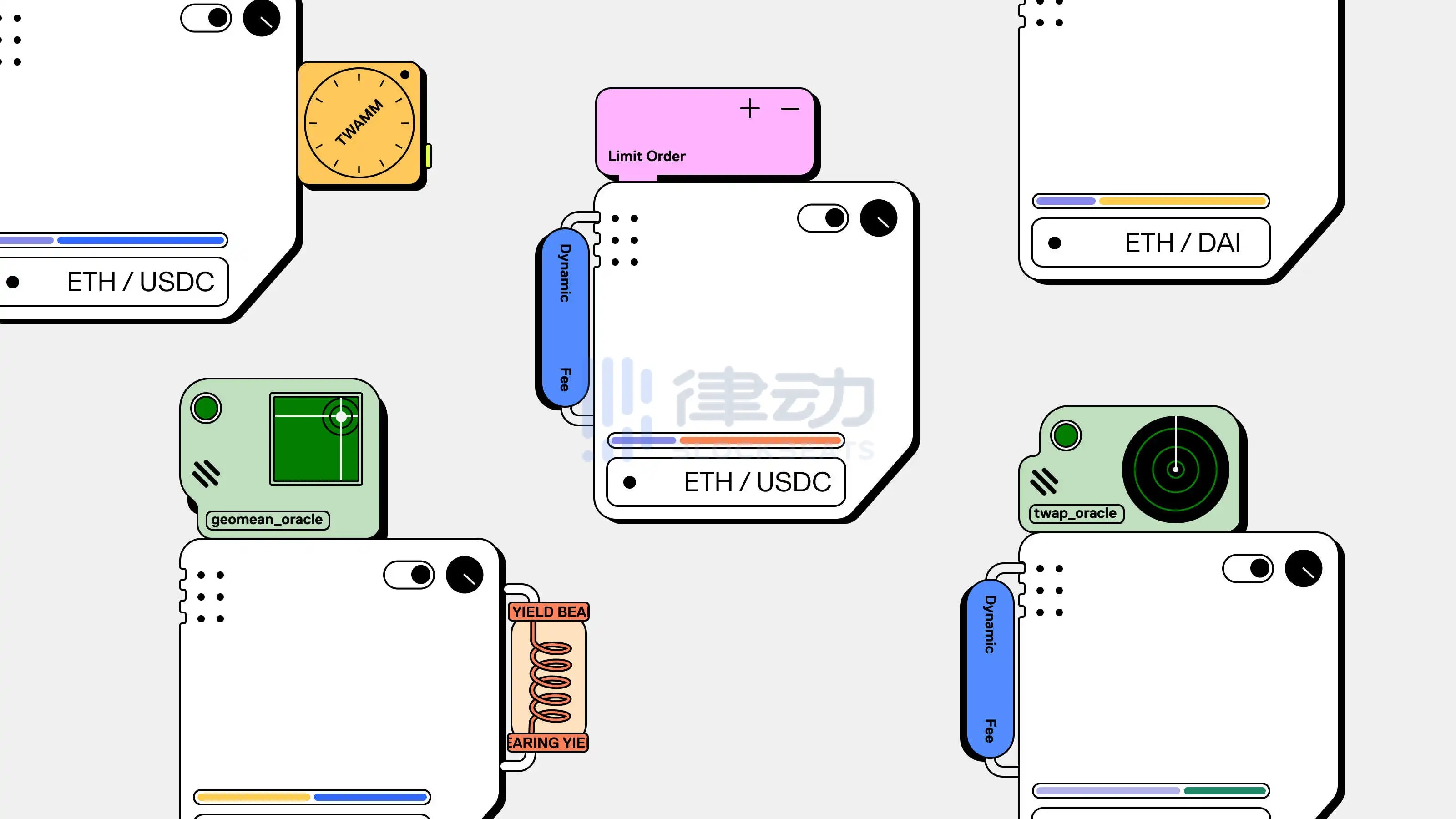
In addition, Uniswap V4 also improves the architecture to save Gas.
In v3, Uniswap deploys a new contract for each liquidity pool, which makes creating liquidity pools and performing multi-pool swaps more expensive. In v4, Uniswap keeps all liquidity pools in a "singleton" contract, which will greatly save Gas, because token transactions will no longer need to transfer tokens between liquidity pools held in different contracts currency. Preliminary estimates v4 will reduce the Gas cost of creating a liquidity pool by 99%, "Hooks" introduces a world with endless options, and "Singleton" allows users to efficiently route to all options.
This "singleton" architecture is complemented by a new "flash accounting" system. In v3, instead of transferring assets in and out of the liquidity pool at the end of each swap, the system only makes transfers on the net balance - meaning a more efficient system that can be provided in Uniswap v4 Additional Gas savings.
Uniswap believes that the best "fast bookkeeping" design is to use "transient storage", a feature that will be enabled by EIP-1153. This EIP is regarded as part of the Ethereum Cancun hard fork, and will bring large-scale Gas improvements and simpler contract designs in various applications.
With "singleton" and "fast billing", there is no need to limit the fee level. Liquidity pool creators can set them to the most competitive level or customize them using dynamic fee "Hooks". v4 also restores support for native ETH, which saves additional Gas.
Not only that, the Hooks function also allows to use Uniswap's liquidity in different ways. This is similar to Balancer's Boosted Pools, where excess liquidity can be deposited into other protocols, such as lenders, for additional returns.
first level title
Will Uniswap V4 Escalate the DEX vs CEX War?
There is no doubt that the emergence of Uniswap V4 will have a wide-ranging and inevitable impact on the entire DeFi ecosystem. In the eyes of many, Uniswap's ambition is not to "rule" DeFi, but to replace the CEX camp that relies on centralization and trust.
Because the Hooks function can improve the capital efficiency of the protocol, it is more customizable and more efficient than V3. The latter two features should help Uniswap attract more order flow from DEX aggregators and longer-tailed heterogeneous trading pairs, while keeping it on higher-volume trading pairs (such as ETH/USDC, ETH/USDT, Dominance in ETH/DAI, etc.).
The significance of the Uniswap V4 version upgrade will not only help Uniswap maintain its position as the DEX with the largest trading volume, but also enable Uniswap to create more types of orders, such as TWAP and limit orders, which will help Uniswap attract more diverse demand of traders turn to DEX to enhance their competitiveness with CEX.





