萬字長文:從 1996 說起,誰在鋪下一代資本市場的底層軌道我們相信,RWA 今天所處的位置,大致相當於 1996 年的網際網路。- 核心觀點:傳統金融價值數百萬億美元的底層軌道——清算、結算、支付系統——正在被區塊鏈重構,這比簡單的資產代幣化更具變革意義。基於 Canton Network 的機構級基礎設施已在回購、證券結算和資本募集等核心市場投入實際運行,標準化與網絡效應正在形成,先行者將獲得結構性優勢。
- 關鍵要素:
- 真實案例表明鏈上金融已非實驗:Broadridge DLR 月處理 7.7 萬億美元回購;香港政府透過 HSBC Orion 發行 60 億港元數字債券,並立即用作回購抵押品。
- 鏈上基礎設施解決了傳統金融的結構性低效:通過原子結算與 DvP 消除對手方風險和結算延遲;通過共享賬本削減巨額對賬成本。
- 機構參與的核心前提是同時滿足交易級隱私、原子結算互操作性和公共許可結構,Canton Network 通過 Daml 語言和子網架構實現了這一設計。
- 巴塞爾銀行監管委員會將無許可鏈資產歸為 Group 2(1250% 風險權重),而 Canton 的許可結構符合 Group 1 要求,使受監管銀行可合規持有代幣化資產。
- 市場加速跡象明確:鏈上發行資產達 340 億美元(5 年 20 倍),DTCC、LSEG 等核心基礎設施已獲監管許可並啟動遷移,亞洲(韓國、日本、香港)的監管與機構佈局同步跟進。
- 核心觀點:傳統金融價值數百萬億美元的底層軌道——清算、結算、支付系統——正在被區塊鏈重構,這比簡單的資產代幣化更具變革意義。基於 Canton Network 的機構級基礎設施已在回購、證券結算和資本募集等核心市場投入實際運行,標準化與網絡效應正在形成,先行者將獲得結構性優勢。
- 關鍵要素:
- 真實案例表明鏈上金融已非實驗:Broadridge DLR 月處理 7.7 萬億美元回購;香港政府透過 HSBC Orion 發行 60 億港元數字債券,並立即用作回購抵押品。
- 鏈上基礎設施解決了傳統金融的結構性低效:通過原子結算與 DvP 消除對手方風險和結算延遲;通過共享賬本削減巨額對賬成本。
- 機構參與的核心前提是同時滿足交易級隱私、原子結算互操作性和公共許可結構,Canton Network 通過 Daml 語言和子網架構實現了這一設計。
- 巴塞爾銀行監管委員會將無許可鏈資產歸為 Group 2(1250% 風險權重),而 Canton 的許可結構符合 Group 1 要求,使受監管銀行可合規持有代幣化資產。
- 市場加速跡象明確:鏈上發行資產達 340 億美元(5 年 20 倍),DTCC、LSEG 等核心基礎設施已獲監管許可並啟動遷移,亞洲(韓國、日本、香港)的監管與機構佈局同步跟進。


- 核心观点:传统金融价值数百万亿美元的底层轨道——清算、结算、支付系统——正在被区块链重构,这比简单的资产代币化更具变革意义。基于Canton Network的机构级基础设施已在回购、证券结算和资本募集等核心市场投入实际运行,标准化与网络效应正在形成,先行者将获得结构性优势。
- 关键要素:
- 真实案例表明链上金融已非实验:Broadridge DLR月处理7.7万亿美元回购;香港政府通过HSBC Orion发行60亿港元数字债券,并立即用作回购抵押品。
- 链上基础设施解决了传统金融的结构性低效:通过原子结算与DvP消除对手方风险和结算延迟;通过共享账本削减巨额对账成本。
- 机构参与的核心前提是同时满足交易级隐私、原子结算互操作性和公共许可结构,Canton Network通过Daml语言和子网架构实现了这一设计。
- 巴塞尔银行监管委员会将无许可链资产归为Group 2(1250%风险权重),而Canton的许可结构符合Group 1要求,使受监管银行可合规持有代币化资产。
- 市场加速迹象明确:链上发行资产达340亿美元(5年20倍),DTCC、LSEG等核心基础设施已获监管许可并启动迁移,亚洲(韩国、日本、香港)的监管与机构布局同步跟进。
Introduction: The Underwater Part of the Iceberg
This article is from Tiger Research. What the market calls asset tokenization is just the tip of the iceberg above the water. The real transformation is happening beneath the surface, where the multi-trillion-dollar underlying rails of traditional finance are being rebuilt.
Many observers view the on-chain tokenization of U.S. Treasuries as the entirety of the RWA market, seeing only the surface. The real shift isn't in the visible part of asset digitization, but in the comprehensive reconstruction of the long-submerged financial infrastructure: the underlying rails supporting every transaction—clearing systems, settlement layers, and liquidity networks.
The scale can no longer be ignored. According to Broadridge, its DLR platform processes approximately $7.7 trillion in on-chain repo transactions monthly; the DTCC has also entered the Treasury tokenization space. Neither is a pilot experiment; both are operational components of the financial market structure. The Hong Kong government issued HKD 6 billion in digital green bonds through HSBC Orion and immediately deployed them as repo collateral, demonstrating a future where issuance and circulation merge into a single, seamless process.
The infrastructure layer for the new financial standard is being assembled *right now*. Institutions that join now will participate in defining this architecture itself before latecomers arrive.
1. The Internet of 1996 and the RWA Market
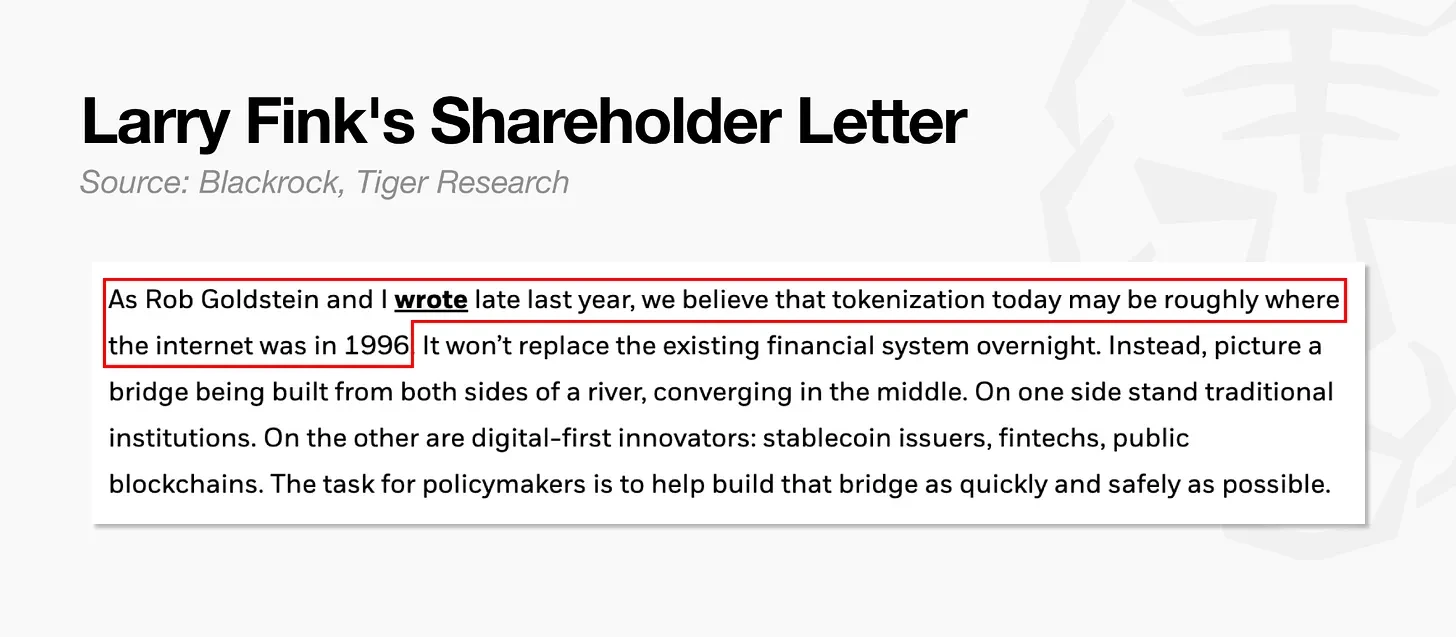
BlackRock CEO Larry Fink wrote in his 2026 shareholder letter: "We believe tokenization today is roughly where the internet was in 1996."
1996 was an inflection point. The internet existed, but most businesses held back. Only 26% of Fortune 500 companies had integrated online operations. When early adopters demonstrated success, others rushed in, but by then, the pioneers had already solidified their positions.
The RWA tokenization market is at a similar juncture. Many institutions are still waiting, but leading use cases have already emerged. The most prominent is BlackRock's BUIDL (BlackRock USD Institutional Digital Liquidity Fund), an on-chain tokenized fund holding U.S. Treasuries. Launched in March 2024, it expanded to seven blockchains in 18 months. According to rwa.xyz data, the fund's market cap grew to approximately $2.5 billion.
Scale alone doesn't capture this shift. The market has moved beyond simply putting on-chain Treasuries. New financial services are being layered on top of issued assets. Multiple DeFi protocols use BUIDL as a base asset, and Binance officially accepts BUIDL as trading collateral.
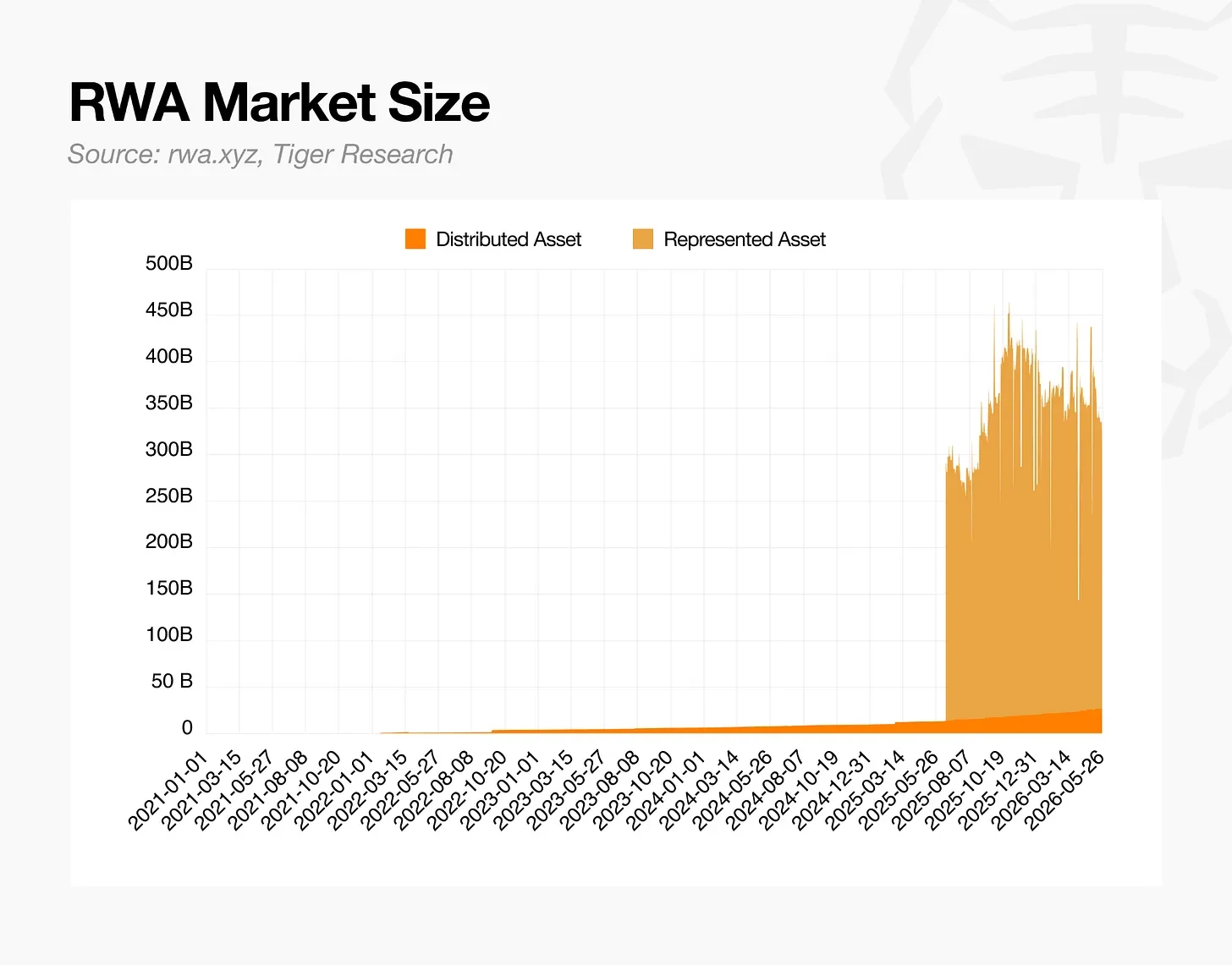
According to rwa.xyz, as of May 2026, on-chain issued assets (Distributed Assets) stood at approximately $34 billion, over 20 times the $1.5 billion at the beginning of 2020. Including Represented Assets—where physical assets are custodied and ownership is recorded on-chain—the total scale reaches approximately $360 billion.
2. The RWA Market Has Launched
Asset tokenization isn't just swapping existing financial products for a digital form. It changes the fundamental way products operate, including settlement speed, post-trade infrastructure, and the entire processing flow from start to finish. This approach isn't about replacing old systems but building faster, more precise new rails on top of them.
Most discussions about RWA tokenization stop at BlackRock's BUIDL. BUIDL is indeed a landmark case for the RWA market, but a single example can't answer *why* tokenization matters.
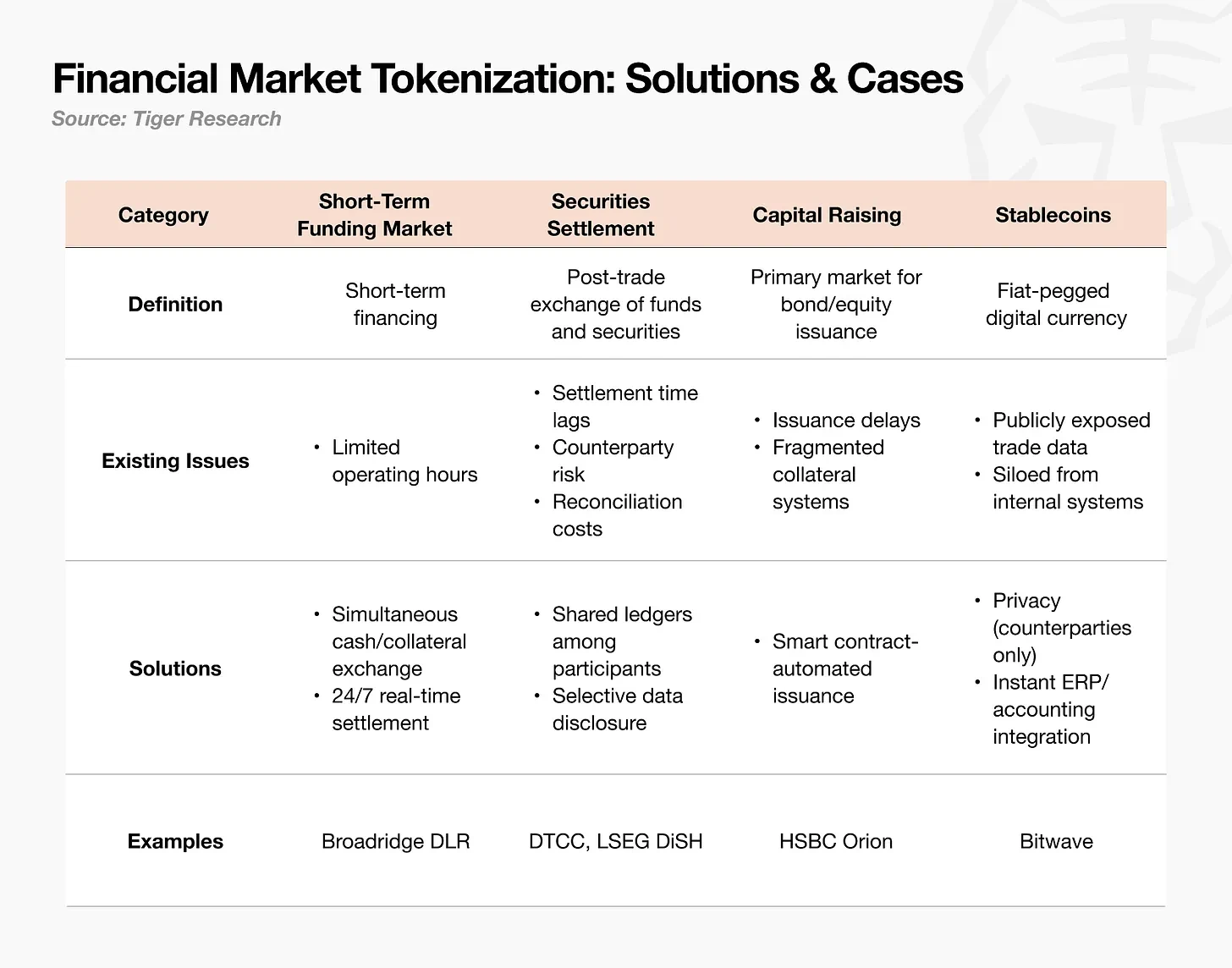
Finance extends far beyond bond issuance. The repo market, securities settlement, and capital raising each bear different structural inefficiencies, and the value tokenization can unlock varies accordingly. To understand why tokenization matters, we need to examine these sub-markets one by one in their respective contexts.
2.1 Short-term Funding Market (Repo)
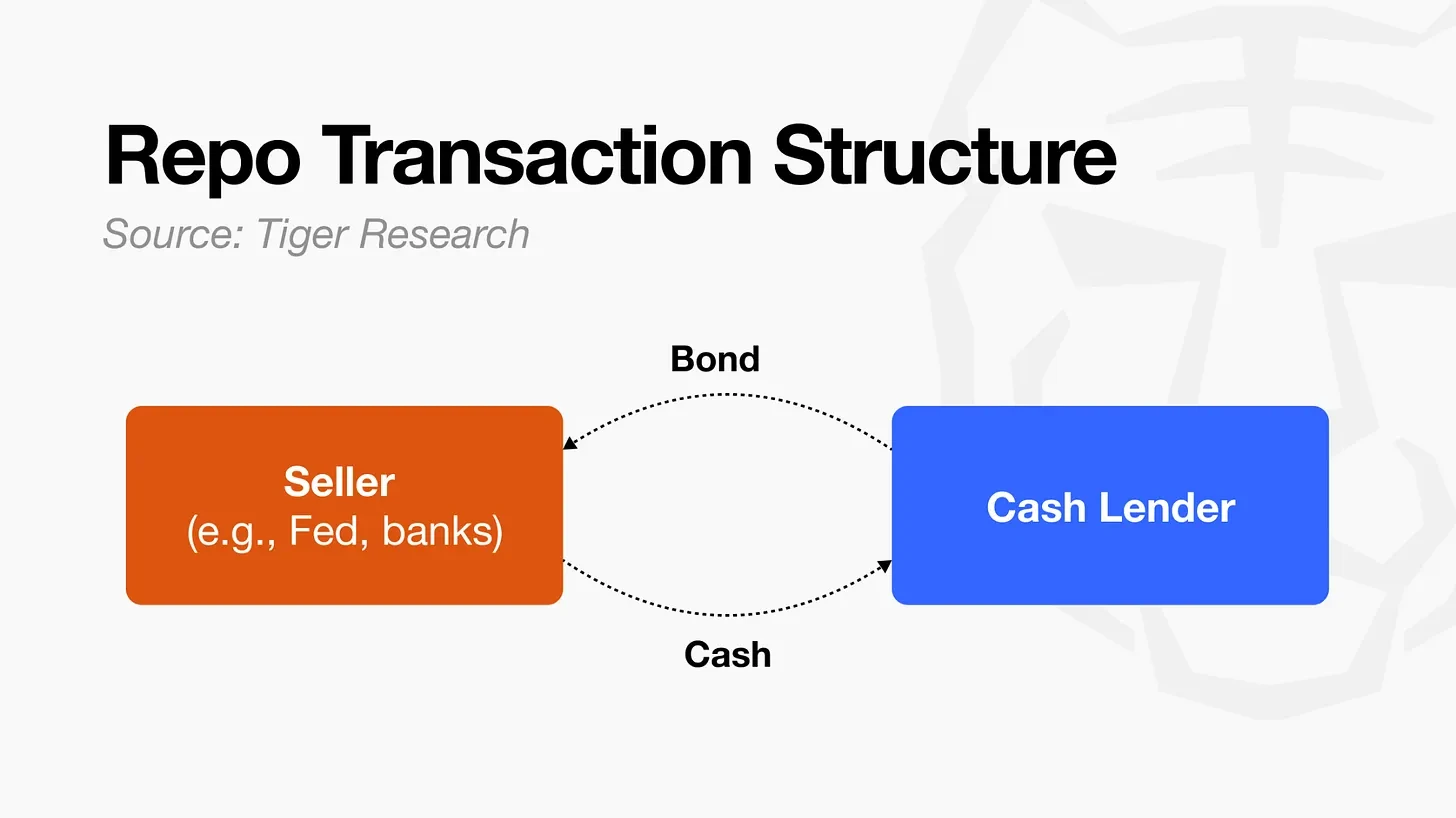
Repurchase agreements (repos) are the defining transaction in the short-term funding market. An institution lends cash against bonds as collateral, agreeing to return the principal plus interest to get the bonds back at maturity. Most contracts are overnight, the collateral is safe, the interest rates are low, and the transactions are routine.
Problem: Limited Operating Hours. The repo market only runs during system operation hours. Settlements happen once daily on business days, and operations completely halt on weekends and holidays. But risk doesn't take breaks. If adverse news emerges over the weekend, mark-to-market losses accumulate while settlement is impossible. When markets open on Monday, the entire weekend's cumulative exposure hits as a single margin call. Addressing this call immediately isn't realistic: selling bonds or raising cash via repo takes time. The only solution is to hold excess cash reserves preemptively—capital that sits idle precisely because the settlement infrastructure can't operate continuously.
Solution: On-Chain DvP Mechanism for Repo. On-chain repo structurally solves this problem, centered on the DvP (Delivery versus Payment) mechanism. It works like paying at a checkout counter: collateral and cash are exchanged simultaneously, making it structurally impossible for one party to transfer assets before the other.
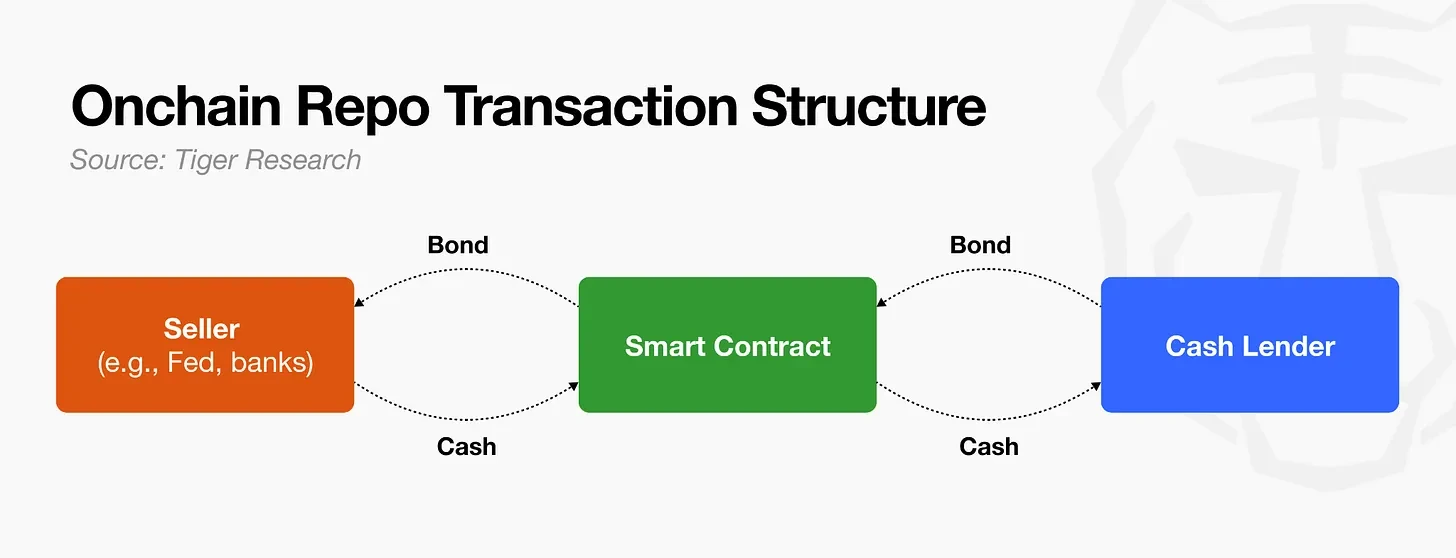
In practice, a party seeking funds posts the amount, interest rate, and maturity conditions; a counterparty accepts. Both parties deposit their assets into a smart contract—a digital agreement that executes automatically when conditions are met. The borrower deposits tokenized bonds; the lender deposits tokenized cash. Once both confirm receipt, the exchange happens automatically.
Tokenized bonds and stablecoins flow on-chain 24/7. Since they don't rely on old settlement infrastructure, collateral can move on a Friday afternoon or a Sunday morning, eliminating the constraint of system operating hours. Settlement frequency also changes. Under the old system, manual confirmations limited settlement to once daily; smart contracts automatically trigger margin calls and settlements the instant a position incurs a loss. With no time gaps, there's no need to pre-position excess cash.
Case Study: Broadridge DLR.
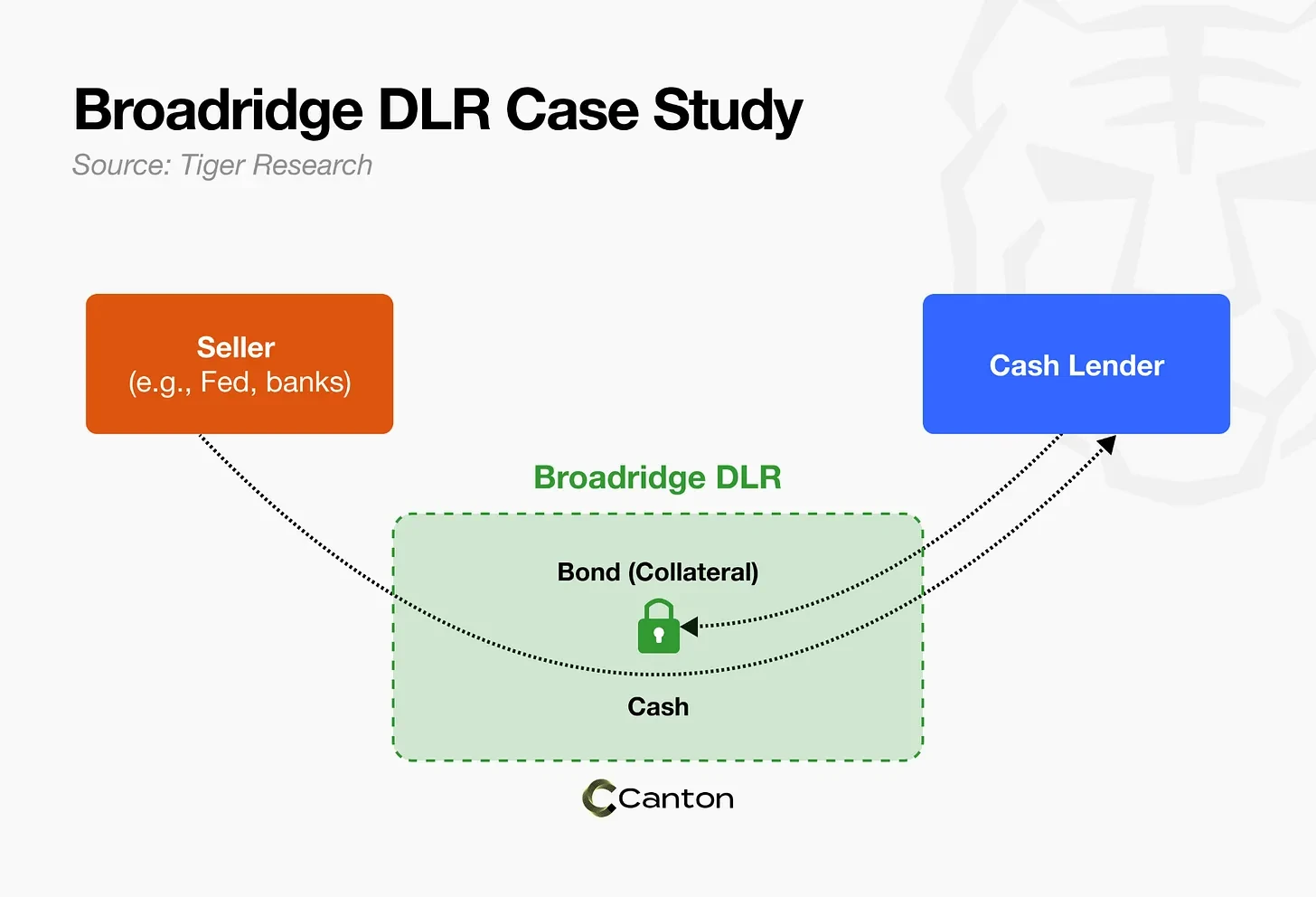
Broadridge is a global capital markets infrastructure company that handles settlement and clearing processing for banks and brokerages via technology. Its DLR (Distributed Ledger Repo) platform is a distributed ledger repo trading platform built on the underlying Canton Network blockchain.
Because it's blockchain-based, DLR isn't constrained by the operating hours of legacy settlement infrastructure. Collateral moves and settlements are executable on weekends and public holidays; repo transactions can be initiated and closed at any time of day. The risks inherent in limited operating hours are structurally neutralized. Smart contracts also automate the entire repo lifecycle, reducing settlement failures and disputes while improving collateral reuse efficiency.
As of April 2026, DLR's monthly settlement volume reached $7.7 trillion, with an average daily trading volume of $368 billion. Global banks like HSBC, UBS, and Societe Generale are already participating in the platform.
2.2 Securities Settlement Infrastructure
Securities settlement is the phase after trade execution: the buyer delivers funds, and the seller delivers securities. T stands for Trade Date. Standard practice settles on T+1 or T+2, meaning funds move at least one to two days after the trade.
Problem 1: Settlement Delay and Counterparty Risk. A real estate transaction is a useful analogy. Signing a purchase contract for a house doesn't immediately transfer the deed or complete the final payment; that happens days later. The trade and the asset transfer occur at different points in time.
Similarly, existing securities settlement infrastructure creates a time gap between trade execution and asset transfer. If a counterparty defaults within this window, it can lead to massive losses. Central Counterparty Clearing Houses (CCPs) exist to prevent such events. A CCP sits between the buyer and seller; if one party defaults, the other doesn't have to bear the loss directly. In the U.S., the NSCC plays this role; in Korea, it's the clearing and settlement division of the Korea Exchange (KRX).
Historically, no CCP has completely defaulted, because the systemic consequences of a CCP failure are so severe that member institutions and governments always step in beforehand. But CCPs have been pushed to their limits under extreme market conditions. During the 1987 Black Monday crash, the Hong Kong Futures Exchange Clearing House faced bankruptcy due to massive margin call failures; the Hong Kong government intervened by injecting capital and suspending trading for four days to resolve the situation. Following the 2008 Lehman bankruptcy and the 2018 Nasdaq clearing crisis, parts of loss absorption funds were indeed exhausted.
Problem 2: Fragmented Ledgers and Reconciliation Costs. When an equity trade executes, the issuer, custodian, clearing house, and settlement institution each record it in their own separate ledgers. The same transaction is entered four times across four institutions. Since these ledgers aren't synchronized in real-time, they must be matched later using standardized message formats. This process is called reconciliation.
The ledgers don't always match. Each institution processes the same trade at different times, and differences in internal system formats can cause data loss or alteration during message conversion. When records are inconsistent, staff must manually identify and correct the discrepancies. While some steps are automated, errors still occur frequently. This is why the personnel and system costs for reconciliation and position difference handling persist. Corporate actions (events affecting a company's structure or shareholder rights, like dividends, stock splits, or mergers) add further complexity; each institution must independently update its ledger and re-reconcile, exponentially increasing the workload.
Solution: Shared Ledger + Atomic Settlement. Putting securities settlement infrastructure on-chain changes two things: all participants see the same ledger, and trade execution and asset transfer happen simultaneously.
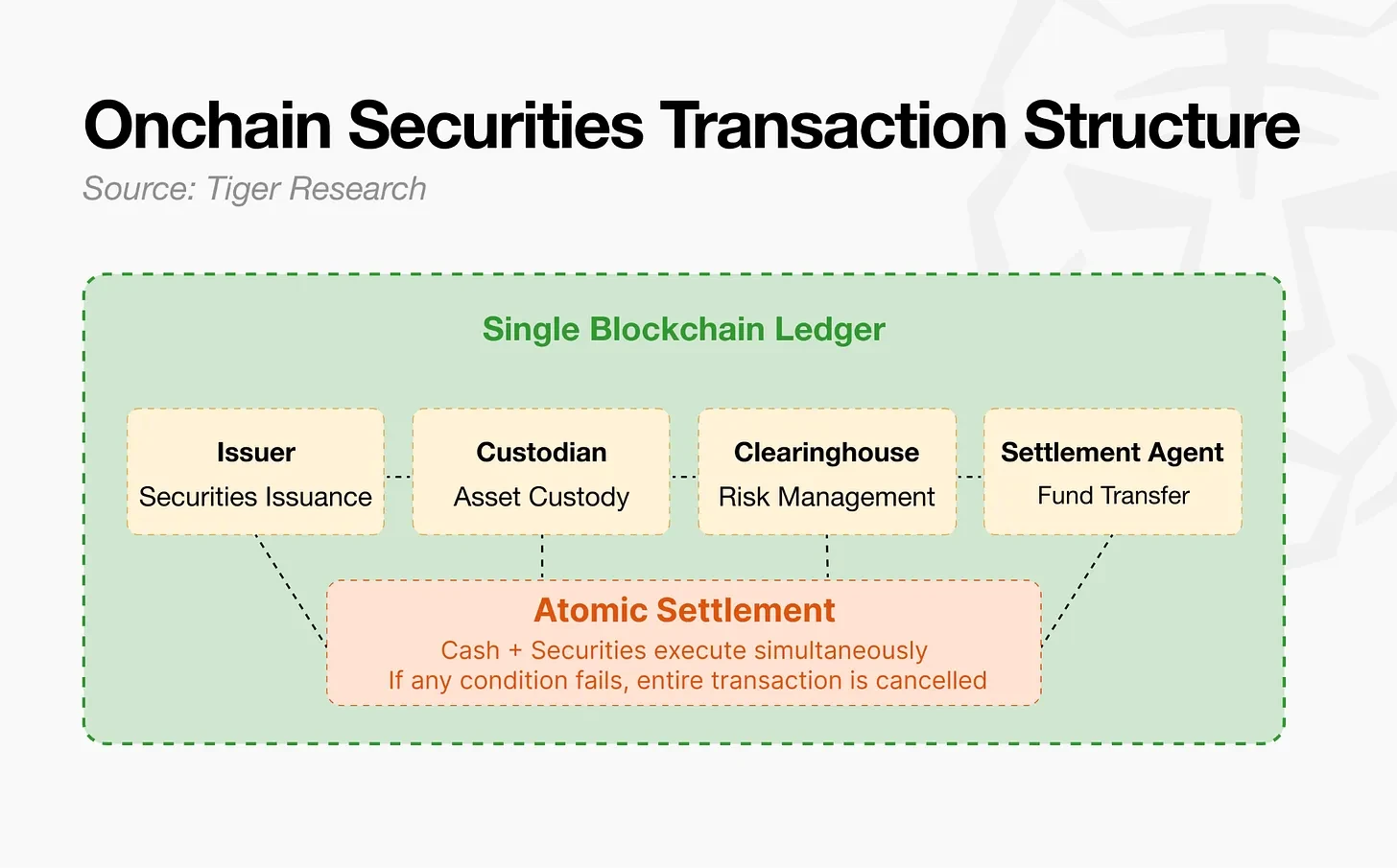
A shared ledger means each participant's data updates simultaneously when a trade is recorded, eliminating post-trade reconciliation. Placing cash and securities in the same environment also removes the settlement delay that creates counterparty exposure. When both cash and securities are on-chain, trade execution and asset transfer can be bundled into a single transaction. Currently, cash flows through the banking system and securities through central securities depositories, separate from each other. On-chain, both exist in the same environment and execute simultaneously.
This is atomic settlement: all conditions must be met for the entire transaction to succeed; if any condition fails, the entire transaction is cancelled.
Case Study: DTCC.
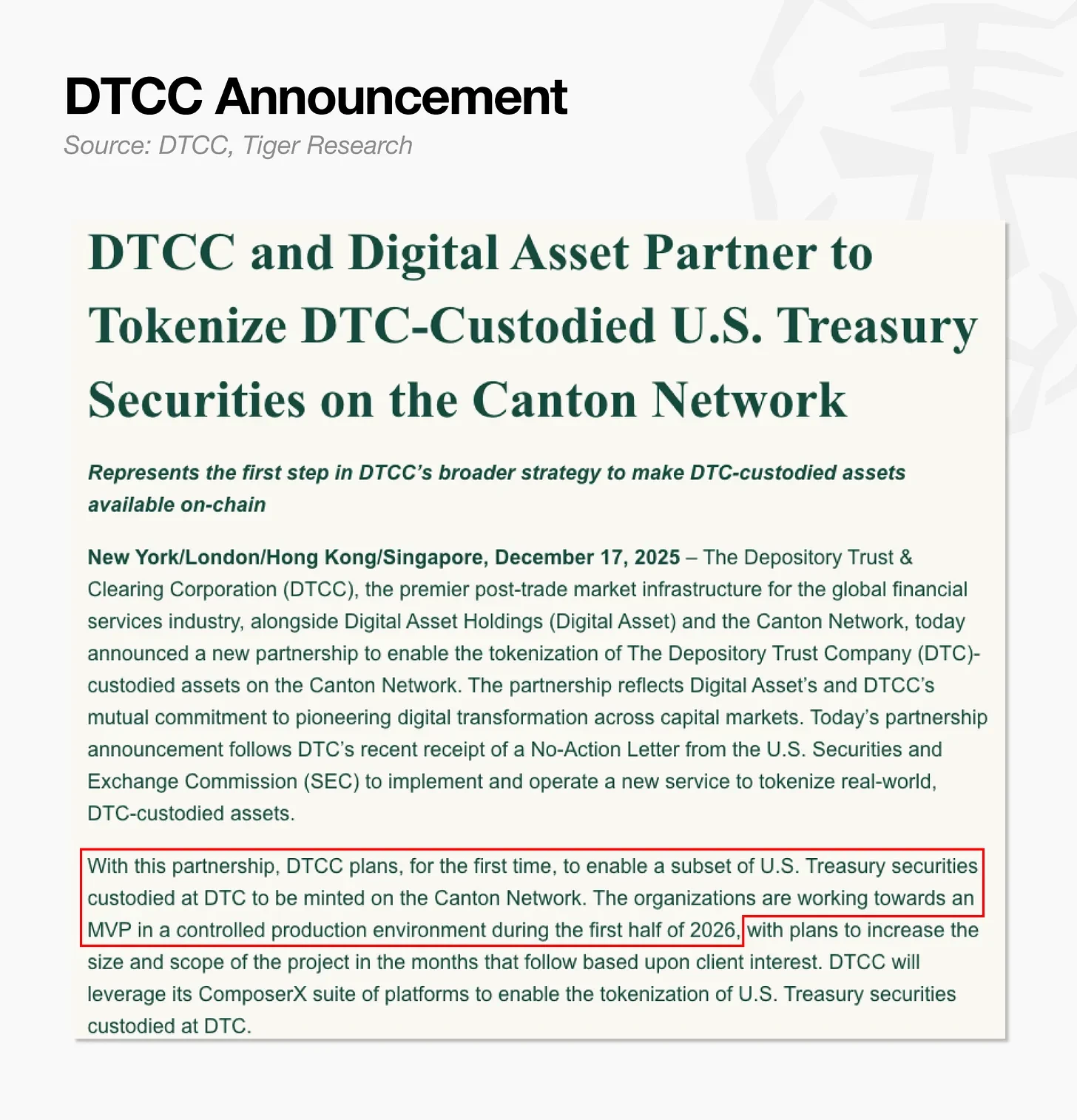
On-chain securities settlement is already operational in live trading. The London Stock Exchange Group (LSEG) deployed its digital settlement platform DiSH on Canton for securities settlement. Lloyds Bank completed a transaction using tokenized deposits to purchase tokenized UK government bonds, with the entire process from issuance to settlement handled on-chain.
The most significant case is the DTCC. The Depository Trust & Clearing Corporation is the core infrastructure for U.S. securities settlement, handling clearing and settlement for most U.S. traded securities. Partnering with Digital Asset, the company behind the Canton Network, the DTCC obtained a no-action letter from the SEC in December 2025—a pre-commitment from the regulator not to take action regarding specific activities. The goal is to launch an MVP (Minimum Viable Product) in the first half of 2026.
The DTCC is an institution that could have its license revoked with a single settlement failure. Its decision to adopt on-chain infrastructure is by no means a casual experiment. It represents a deliberate judgment: the risks embedded in the current settlement architecture have exceeded the operational risk of migrating to a new set of rails.
2.3 Capital Raising Market
The capital raising market is where governments and companies issue bonds and equity to raise funds. It comprises the primary market (new securities issuance) and the secondary market (where issued securities are traded and utilized among investors). Bonds represent a promise to repay principal plus interest; equity grants the holder an ownership share in the issuing company.
Problem 1: Issuance Process Delays. The longer the preparation period, the more variables outside the issuer's control accumulate. Hedging costs rise, investor demand may shift, and in the worst case, the entire transaction collapses. Each additional week on the timeline exposes the issuer to an extra week of market conditions beyond their control.
Problem 2: Fragmented Collateral System. Institutional investors buy assets for yield, but the real issue lies *after* the purchase. If the purchased asset can be deployed in repos, used as collateral, or linked to other transactions, capital keeps working. The smoother these connections, the more transactions the same asset can support, making the asset more valuable from the issuer's perspective.
However, even when counterparties agree on using the collateral, execution is difficult. Collateral transactions require sequential eligibility verification, haircut calculation, and title transfer, each step involving different institutions whose systems aren't interconnected. At every stage, staff must send messages and wait for confirmations. In this structure, a vast gap exists between the size of issued assets and the amount practically usable.
Solution: On-Chain Issuance.
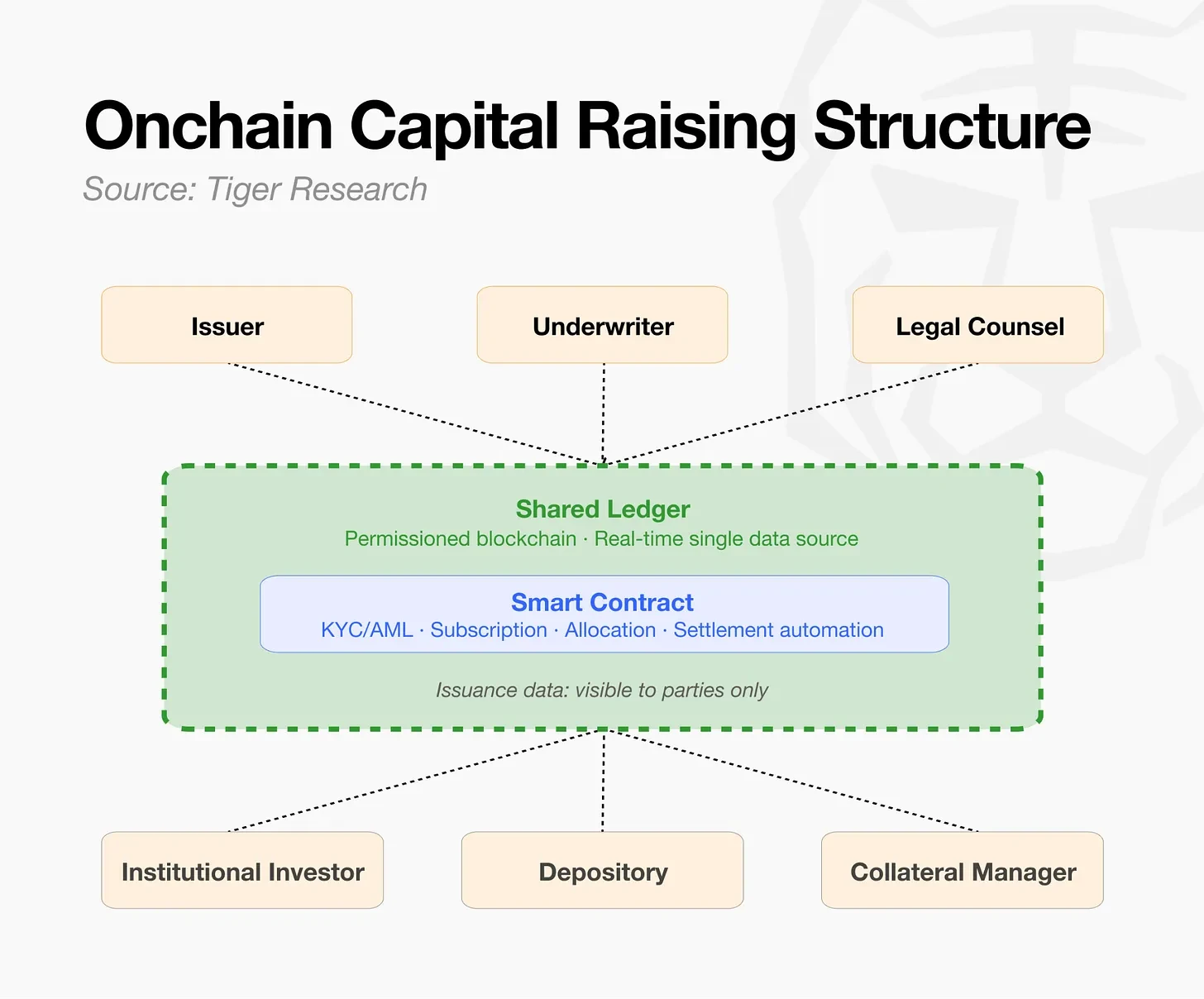
The entire issuance process runs on smart contracts. Within regulatory parameters, agreed-upon issuance terms are defined in code. After KYC and AML verification, subscription, allocation, and payment settlement are automated. Manual confirmation and message conversion steps are thus eliminated, significantly compressing the issuance cycle.
The structure for utilizing assets post-issuance also changes. Tokenized assets exist in an environment where all participating institutions share the same data in real-time on the same network. Eligibility verification, haircut calculation, and title transfer for collateral transactions are processed in a single workflow, without needing to shuttle between separate systems. The ledgers once maintained independently by the issuer, underwriter, depository, and collateral manager are merged into one. Once an asset is issued and adopted, it can be immediately used as collateral or a base asset for other transactions.
This model presupposes issuance privacy. Issuance terms, underwriter allocations, subscription prices, and investor lists are data that cannot be made public. If such information leaks, market prices move prematurely, imposing higher costs on the issuer. Existing public permissionless blockchains only hide wallet addresses but expose all transaction data to everyone. For on-chain issuance to scale, it must run on permissioned infrastructure where transaction data is visible only to relevant parties.
Case Study: HSBC Orion. HSBC is a UK-headquartered global bank with $3 trillion in assets and a leader in bond underwriting and issuance. It launched its own digital asset platform, HSBC Orion, in 2023 as a digital bond issuance infrastructure. HSBC Orion runs on the Canton Network.
In February 2024, the Hong Kong government issued HKD 6 billion (approximately $770 million) in digital green bonds via HSBC Orion. This was the first multi-currency digital bond issued by a government, covering HKD, offshore CNY, EUR, and USD simultaneously. Over 50 global investors from eight nationalities participated, an exceptionally broad base for an early digital bond issuance. The settlement cycle was compressed from T+5 to T+1.
The significance of this issuance wasn't just the issuance itself, but what happened *after*. Within days of issuance, HSBC executed a repo transaction with the Bank of East Asia (BEA) using the digital green bond as collateral. The moment the bond went live on the market, it was directly put to use as collateral on the same network. This was the first confirmed case of issuance and utilization linking without interruption.
The structure was as follows: When HSBC Orion issued the digital green bond, the bond was recorded as a token in the Bond Registry on Canton. When HSBC and BEA executed the repo transaction, another application on the same Canton Network used that token as collateral and settled the payment simultaneously.
The Hong Kong government didn't treat this issuance as a one-off event. The Hong Kong Monetary Authority subsequently launched a digital bond subsidy scheme, committing to subsidize half the issuance costs for issuers of digital bonds, turning a single experiment into a standard for market infrastructure.
2.4 Stablecoins and Payments
Stablecoins are digital currencies pegged 1:1 to the US dollar. Unlike regular cryptocurrencies, their value is broadly stable, allowing them to function like money circulating on a blockchain. USDC and USDT are the most typical examples.
Problem 1: Completely Public Transaction Data. On public blockchains, all transactions are visible to anyone. Who sent how much to whom, when, and their balances—all of this is