美光財報前夕:韓美科技股巨震之際,如何才能守住儲存牛市?


- 核心觀點:美光科技即將發布的財報不僅是季度業績檢驗,更是對AI儲存牛市邏輯的一次壓力測試。核心矛盾在於,市場預期已被推至極高水平,美光需證明供需缺口遠未結束且能持續上調指引,否則可能引發股價劇烈波動並波及整個產業鏈。
- 關鍵要素:
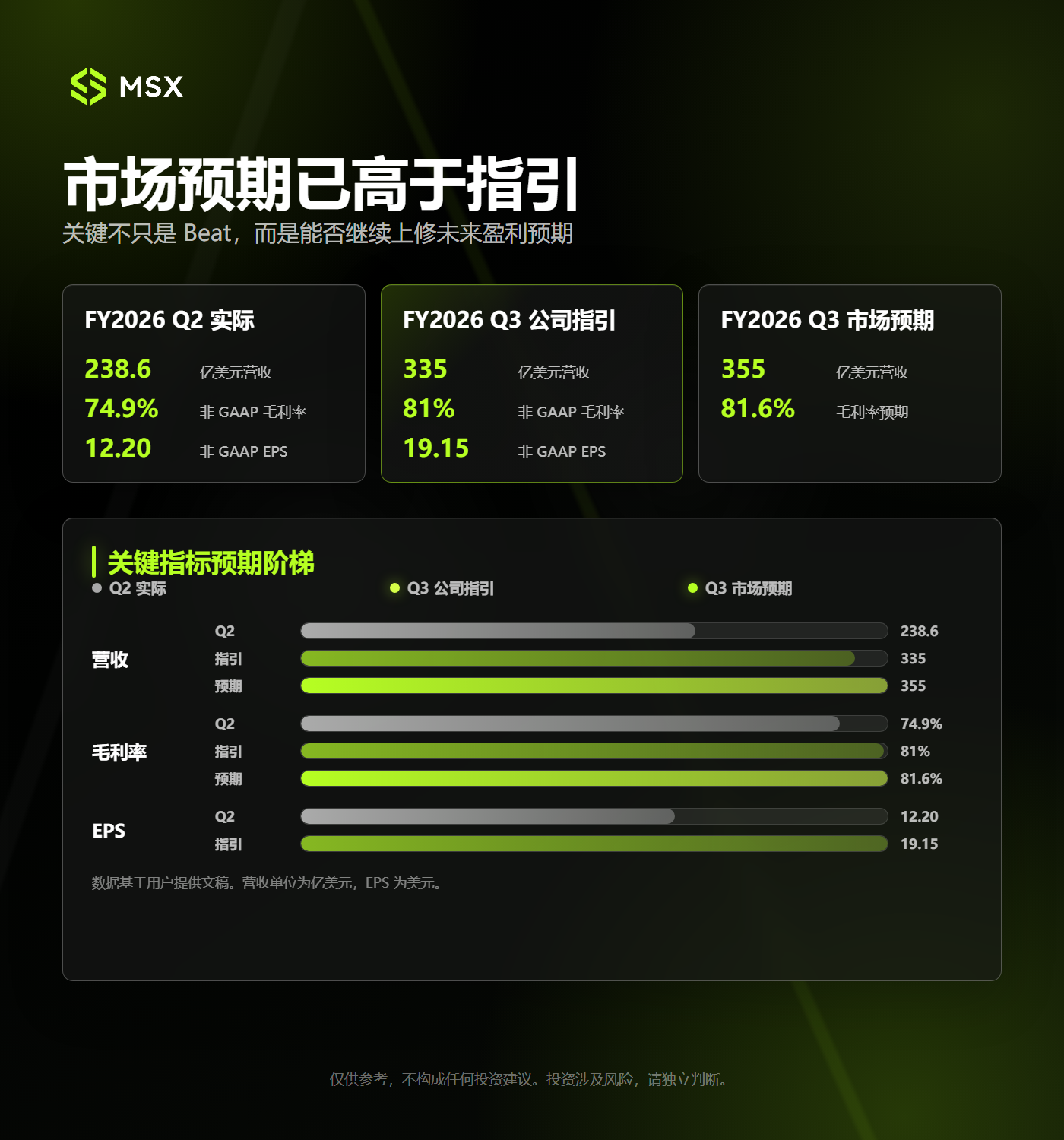
- 市場預期與公司指引存在巨大落差:市場對美光第三季度營收預期已達355億美元,高於公司此前335億美元的指引,要求業績不僅超預期,還要超出已極樂觀的市場一致預期。
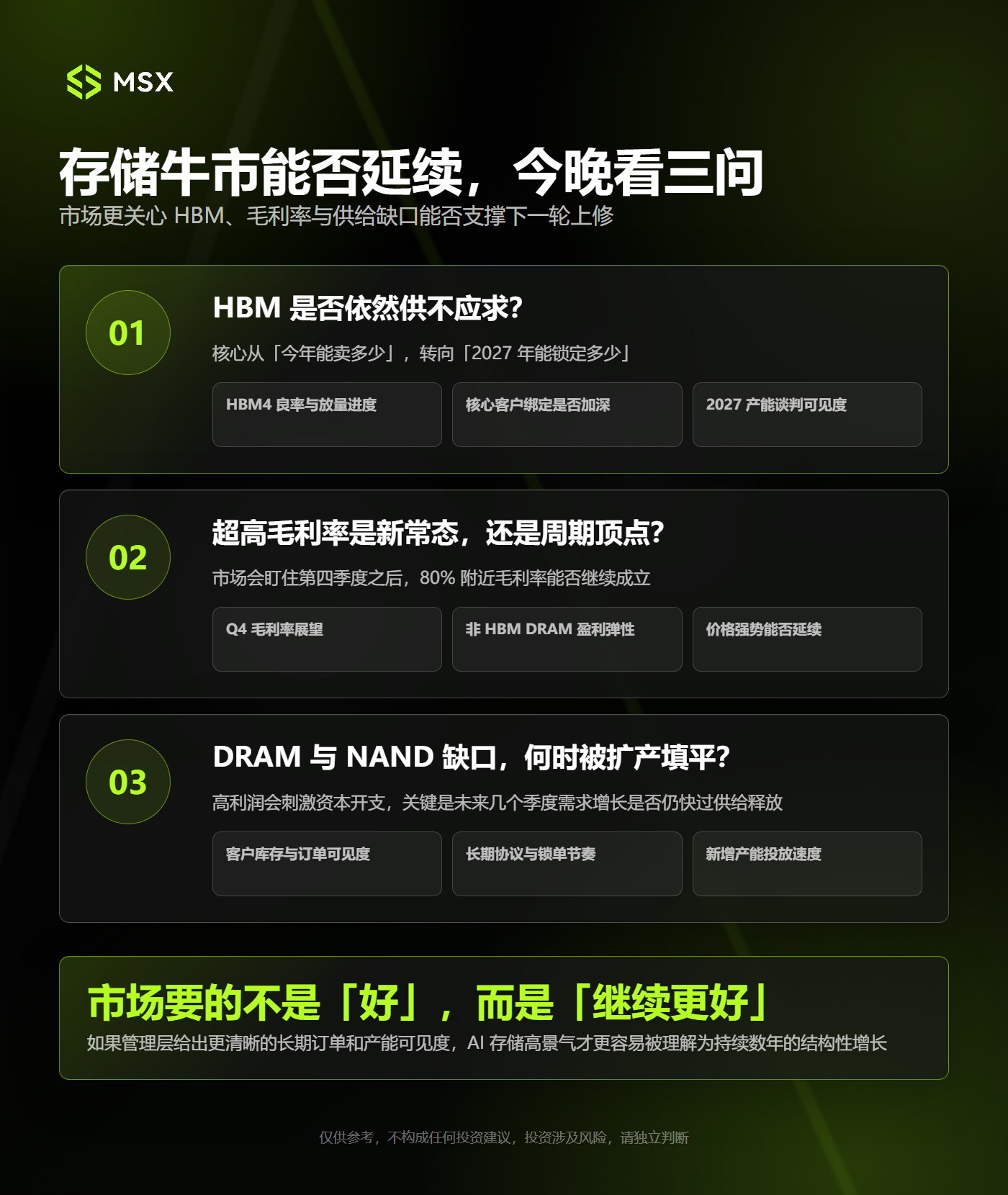
- HBM供需持續性成焦點:美光需在電話會中明確HBM4良率進展、2027年訂單鎖定情況及與輝達等客戶的合作深度,以證明高景氣是結構性成長而非短期產品週期。
- 超高毛利率(第三季度指引約81%)是否為常態:市場關注管理層對毛利率未來走向的描述,若展望保守,高估值邏輯或將鬆動,觸發「Sell the News」行情。
- 供需缺口何時被產能填平:市場關注新增產能投放節奏,若供給釋放快於AI需求成長,儲存行業可能重回價格競爭,美光需證明需求增速仍快於供給。
- 選擇權隱含波動率高達13%:市場已押注財報後股價出現兩位數漲跌,反映了當前資金對儲存主線的高分歧與擁擠交易風險。
On June 23, global tech assets, from South Korean stocks to U.S. equities, experienced a sharp cooldown in sentiment.
Starting in the Asian session, the KOSPI index fell nearly 10% in a single day, with Samsung Electronics and SK Hynix both dropping over 12%, triggering a market-wide trading halt. The sell-off quickly spread to U.S. markets in the evening, with AI and memory assets — the strongest performers over the past year — becoming the epicenter of the global tech stock correction.
Paradoxically, this market turbulence coincided with Micron Technology's scheduled release of its fiscal Q3 2026 earnings report after the market close on June 24 — a rather delicate timing.
On one hand, global AI memory stocks are experiencing a collective pullback, prompting the market to reassess high valuations and crowded trades. On the other hand, Micron is about to deliver a highly anticipated earnings report. The convergence of these two factors has elevated the significance of this earnings report beyond a single company's quarterly performance, making it a concentrated stress test for the entire memory sector.
After all, the core narratives driving the sustained rally in global memory stocks — surging HBM demand, DRAM and NAND price hikes, persistent supply tightness, and rapidly expanding gross margins — all require renewed confidence. This raises a direct question: With stock prices and market expectations already pushed to lofty heights, can Micron once again deliver answers that exceed imagination?
In other words, a report that merely "meets expectations" may no longer suffice. What the market truly awaits is whether Micron can once again revise its guidance upward, proving that the supply-demand gap in AI memory is far from over.
1. Why is this Micron Earnings Report So Important?
Looking at last quarter's data, Micron's fundamentals can hardly be described simply as "beating expectations."
In Q2 of fiscal 2026, Micron reported revenue of $23.86 billion, nearly tripling year-over-year. Non-GAAP gross margin reached 74.9%, and non-GAAP EPS hit $12.20, both setting company records.
More importantly, Micron's Q3 guidance was remarkably aggressive: revenue projected at $33.5 billion, non-GAAP gross margin around 81%, and non-GAAP EPS of $19.15.
However, the capital market's appetite rose faster than the company's guidance. The current consensus estimate for Micron's Q3 revenue has already reached approximately $35.5 billion, exceeding the upper end of the company's previous guidance range. The gross margin consensus is around 81.6%, indicating that the market has already priced in another earnings beat.
This creates the central paradox of this earnings report: Micron's performance must not only surpass its own guidance but also exceed an already highly optimistic market consensus.
Therefore, this earnings report is not just about whether revenue and EPS "beat" estimates. It's more about whether the market is willing to revise its earnings forecasts for future quarters upwards post-announcement. Simply put, a report that is merely "good" might not be enough. But if the report is strong enough to prompt upward guidance revisions, then yesterday's decline might have been a pre-emptive shakeout.
After all, for a high-expectation stock that has already appreciated significantly, the most dangerous scenario is often not terrible performance, but rather performance that is decent yet not good enough to justify its elevated valuation.
This is precisely the pricing environment Micron currently faces.
2. Can the Memory Bull Run Continue? Three Questions for Tonight
1. Is HBM Still in Short Supply?
Micron's core growth narrative remains HBM.
As is well known, AI servers require more than just GPUs. As the computing power,功耗 (power consumption), and data throughput of individual AI accelerators continue to increase, HBM has evolved from a standard supporting component to a critical factor determining the performance of an entire AI system.
Micron has already started ramping up production and shipments of HBM4, aiming to supply NVIDIA's new Vera Rubin platform. With most of its 2026 HBM capacity already allocated, the market's focus during this earnings call is likely shifting from "how much can be sold this year" to "how much can be secured for 2027."
During the earnings conference call, investors will likely be seeking answers to several key questions:
Are HBM4 yields and production ramp progressing on schedule? Is Micron's partnership with key customers deepening? How far along are capacity negotiations for 2027? Can subsequent products like HBM4E help narrow the gap with SK Hynix?
If Micron can provide clearer visibility into long-term orders and capacity, the market will be more inclined to view the current HBM boom as a multi-year structural growth trend rather than a product cycle approaching its peak.
Conversely, if management's commentary on 2027 demand and orders is vague, the market might begin to suspect that the most intense, high-pricing-power phase of the HBM cycle has already been priced into the stock.
2. Is the Ultra-High Gross Margin a New Normal or a Cyclical Peak?
For Micron, profit leverage comes not just from shipment volumes, but also from pricing and gross margins.
Recall that last quarter, Micron's non-GAAP gross margin reached 74.9%, and its Q3 guidance is around 81%. This implies that for every $100 in revenue, Micron expects to retain over $80 in gross profit.
Such a high gross margin is uncommon in past memory cycles. This is driven by a combination of factors: a rising share of high-value products like HBM, comprehensive DRAM and NAND price increases, supply constraints, and a continued shift in product mix towards data centers.
Importantly, the driver of Micron's margin expansion is not solely HBM. Micron management has previously stated that profitability for some non-HBM DRAM products is also exceptionally strong, at times even surpassing HBM. This suggests that the current memory upcycle is no longer confined to a niche high-end segment but is spreading across the broader DRAM market.
Therefore, the most critical aspect of this earnings report is not just whether gross margin reaches 81%, but how management describes the trend for Q4 and beyond.
If Micron provides a gross margin outlook exceeding 80%, it signals that the supply-demand gap and pricing uptrend remain robust, potentially prompting the market to revise its earnings power upwards. However, if the margin merely meets guidance, or if management's tone regarding future margins becomes cautious, the stock could face a "Sell the News" reaction.
3. When Will the DRAM and NAND Gap Be Filled by Capacity Expansion?
Every memory bull run eventually circles back to the same question: when will supply catch up with demand?
The reason this cycle has persistently exceeded market expectations is twofold. First, AI data centers are driving rapid demand growth for HBM, server DRAM, and enterprise SSDs. Second, memory production capacity cannot be brought online simultaneously in the short term.
This is particularly true for HBM, which consumes more wafer and advanced packaging resources. As manufacturers allocate more capacity to HBM, it somewhat constrains the supply of traditional DRAM, pushing prices up across the entire product line.
Micron has previously indicated that it can only meet about one-half to two-thirds of customer demand in the medium term, and some new fabs won't contribute meaningful output until later stages. This means that in the short term at least, new supply is unlikely to quickly close the demand-supply gap.
However, the market will also be monitoring the other side. Driven by high profit margins, Micron, Samsung, and SK Hynix are all increasing capital expenditure. If the release of new capacity outpaces AI demand growth, the memory industry could still revert to its traditional cycle of price competition and inventory digestion.
Thus, in this conference call, management's commentary on customer inventory levels, order visibility, long-term agreements, and the pace of new capacity deployment may be more important than single-quarter shipment numbers. The focus will be on whether Micron can demonstrate that demand growth continues to outpace supply release, at least for the next few quarters.
3. 13% Implied Volatility from Options: What is the Market Betting On?
Beyond fundamentals, the options market has already provided another answer.
Based on option prices near the close on June 22, the combined cost of at-the-money Call and Put contracts expiring on June 26 was approximately $159. Relative to Micron's stock price of around $1,211 at the time, the options market implied an earnings-related volatility of about 13%.
This means that if you buy options now, Micron's stock theoretically needs to move more than approximately 13% after the earnings report for you to overcome the premium cost. For investors holding the underlying stock, this figure implies that a double-digit gap move post-earnings is not unexpected.
In other words, the options market is not pricing in a small move, but a very significant reaction to the earnings report.
More importantly, high implied volatility itself reflects the current market divergence: some capital believes AI memory is still in its early supply-constrained phase, while other capital fears that the stock price has already discounted too much future growth.
From the perspective of post-earnings performance, MSX Research Institute suggests three potential scenarios:
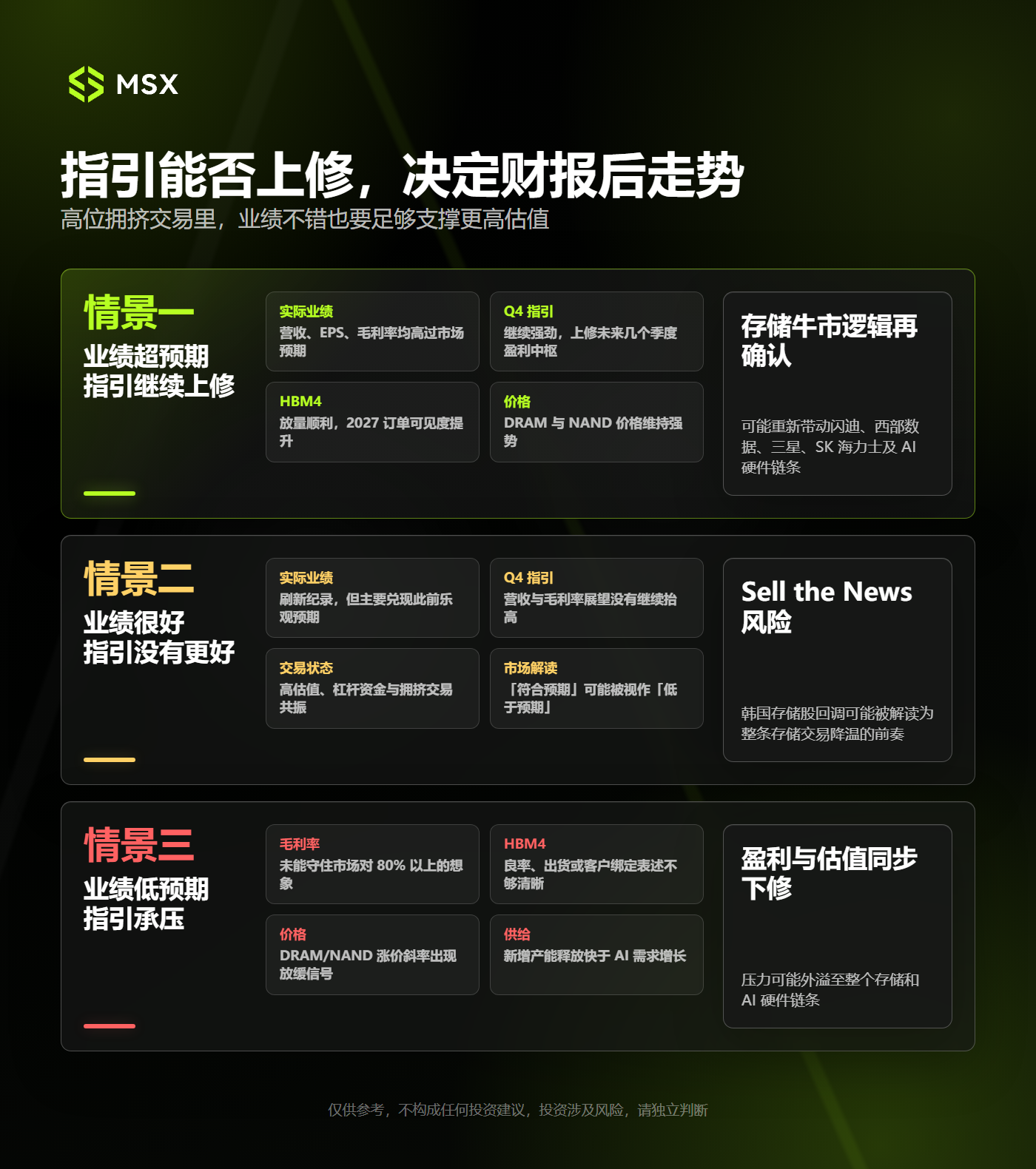
Scenario 1: Earnings Beat, Guidance Revised Upwards
This is the most ideal outcome.
If Micron exceeds current market expectations for revenue, EPS, and gross margin, provides strong Q4 guidance, and continues to emphasize smooth HBM4 ramping, improved 2027 order visibility, and robust DRAM/NAND pricing, then the logic of the memory bull run will be further confirmed.
In this case, Micron's gains could re-energize the entire memory supply chain, including Sandisk, Western Digital, Samsung, SK Hynix, and some semiconductor equipment and AI server-related stocks.
However, even with a very strong report, one must be aware of profit-taking at high levels. As mentioned, the options market has already priced in significant volatility. A strong after-hours surge does not guarantee a one-directional upswing on the following trading day.
Scenario 2: Strong Earnings, But No Upward Revision in Guidance
This may be the scenario requiring the most caution from this earnings report.
It is entirely possible for Micron to deliver a record-breaking scorecard. However, if the data merely confirms previous guidance, or if Q4 gross margin and revenue outlook are not revised upwards, the market could still choose to sell.
This is not because Micron's fundamentals have suddenly deteriorated, but because the market has already front-run a "beat." Ultimately, for stocks at high valuations with high crowding, meeting expectations can sometimes be equivalent to falling short.
The recent turmoil in the South Korean market has reinforced this risk. On June 22, South Korean regulators publicly reflected on their rapid approval of single-stock leveraged ETFs for Samsung and SK Hynix. A day later, the KOSPI index plunged nearly 10%, with the two memory giants falling over 12% each.
This correction doesn't necessarily imply a reversal in long-term AI memory demand, but it serves as a reminder to the market: when high valuations, leveraged capital, and crowded trades converge on the same theme, any information falling short of expectations can be rapidly amplified.
Therefore, the decline in South Korean memory stocks appears as a stress test ahead of Micron's earnings: If Micron is strong enough, it can help stabilize market confidence; if Micron is merely "normally good," the South Korean market's correction could be interpreted as a sign that the entire memory trade is beginning to cool.
Scenario 3: Gross Margin or Forward Guidance Falls Short of Expectations
If Micron's HBM4 progress, gross margins, product pricing, or Q4 guidance clearly miss market expectations, the stock could face significant downward pressure.
The reason is that Micron's current stock price incorporates at least three layers of expectations:
- The first layer is long-term memory demand driven by AI computing expansion.
- The second layer is the price upcycle fueled by tight DRAM and NAND supply-demand dynamics.
- The third layer is Micron's continued improvement in market share and profitability within the high-end HBM segment.
If any one of these layers weakens, the market could simultaneously lower future earnings forecasts and valuation multiples. The impact in this scenario would not be limited to Micron, but could spread to the entire memory and AI hardware chain.
Conclusion
Based on available information, Micron's long-term thesis has not been broken.
AI servers continue to consume more HBM and DRAM. Data center SSD demand is growing steadily. The traditional NAND market is also recovering. New capacity cannot be rapidly brought online in the short term, and supply constraints continue to provide memory manufacturers with strong pricing power.
But strong fundamentals do not mean the stock is without risk.
When revenue, margins, and stock price have all been setting consecutive records, the yardstick for measuring Micron changes: In the past, it needed to prove the industry was recovering. Now, it must prove this cycle of high prosperity can not only persist but be even stronger than what investors have already envisioned.
Therefore, the real suspense of this earnings report is not whether Micron can deliver another good scorecard but whether it can continue to elevate the market's imagination of the future.
In a nutshell, what Micron needs to prove is no longer that the memory bull market continues, but that the endpoint of this bull market lies further out than where the market has currently priced it.