告別Meme敘事,Solana用「美股DeFi」打了一場翻身仗


- 核心觀點:Solana公鏈已憑藉PropAMM高效定價機制和生態可組合性,在代幣化股票現貨市場取得絕對領先地位,正挑戰CEX在這一新興賽道的主導地位。
- 關鍵要素:
- Solana上週代幣化股票交易量達13億美元,遠超Base(約1414萬美元)和BNB(約1291萬美元)等競品公鏈。
- PropAMM(如Zerofi)貢獻重要成交量,其採用主動定價、閉源、高頻報價機制,現貨定價效率已接近主流CEX。
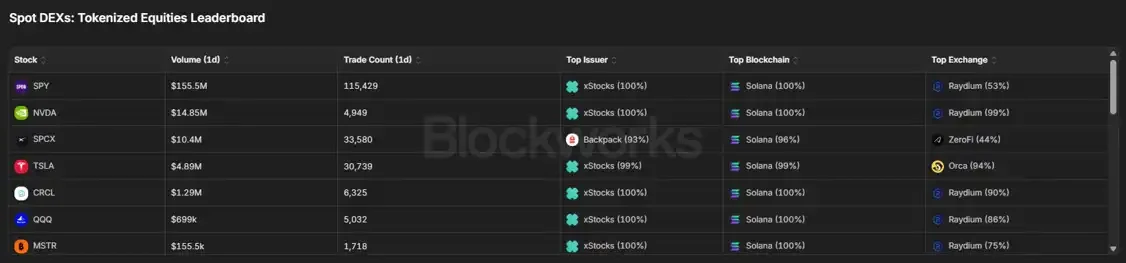
- 在SpaceX IPO後一週,Solana創下10.4億美元單週記錄,其中$SPCX交易量佔全部代幣化SpaceX股票交易量的91.7%。
- 今年5月,Solana代幣化股票成交量約8.7億美元,僅次於Binance(11億)、Gate(10.88億)和Bitget(8.8億)。
- 鏈上DeFi(如Jupiter、Kamino)支持代幣化股票借貸與流動性策略,Nest協議允許用戶質押股票鑄造穩定幣nUSD以獲取收益。
US stock trading has become the new prevailing trend in the crypto space, leaving no room for doubt. When we talk about US stock trading in this context, we often focus on the notion that "this is a competition between various CEXs and Hyperliquid."
Solana, a public chain widely regarded by players for its core competency in meme coins, has received relatively little attention in the US stock trading track. However, it has quietly entered this latest battle for market share in the crypto space.
Solana is Winning the Battle for the On-Chain Tokenized Stock Market
From Solana's official Twitter feed's recent activity, it's clear that its tweets have been heavily centered on on-chain US stock trading. The night before last, Solana officially announced the launch of tokenized MU stock on Solana.
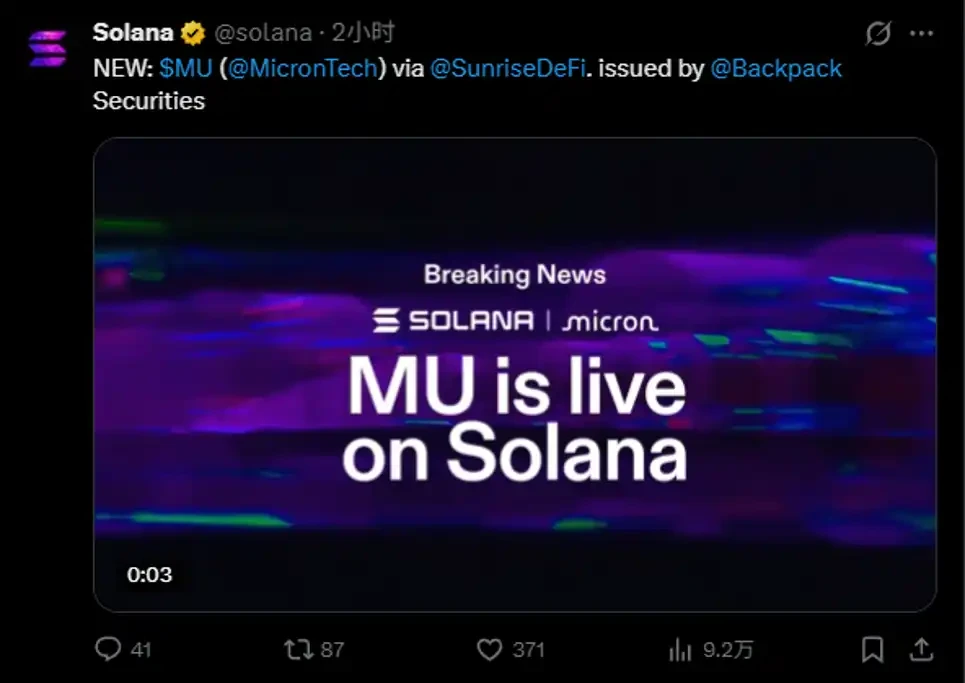
Clearly, as a public chain, Solana has made US stock trading a key development priority. And judging by the data, it has performed quite well, taking a clear leading position in the competition among public chains for US stock trading.
One week after the SpaceX IPO, Solana recorded a single-week tokenized stock trading volume of $1.04 billion. The trading volume of $SPCX accounted for $439 million of that, representing 91.7% of all SpaceX tokenized stock trading volume.
In the past week (June 15-21), tokenized stock trading volume on Solana reached nearly $1.3 billion. In comparison, Base and BNB recorded approximately $14.1445 million and $12.9154 million, respectively, while Ethereum's mainnet saw a meager $312,800.
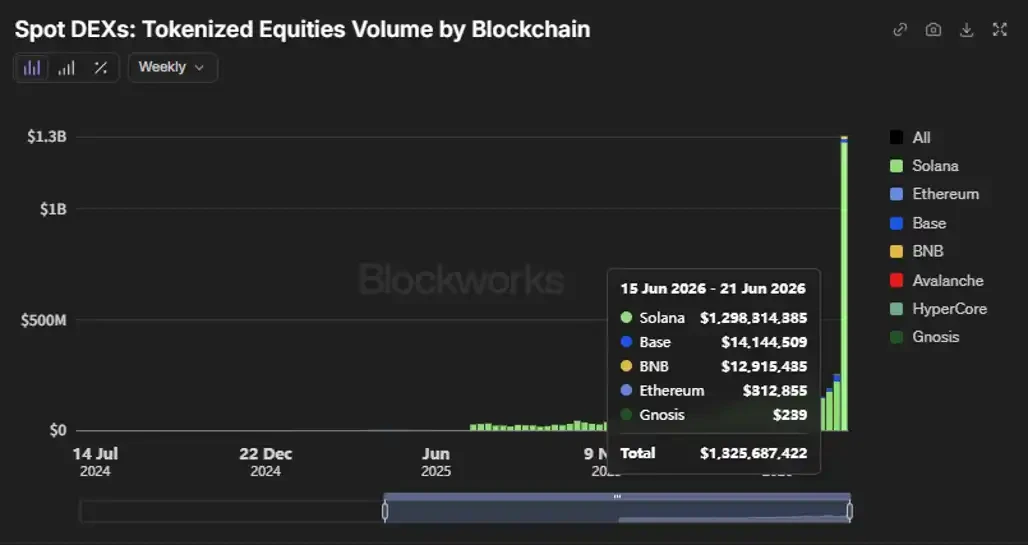
Comparing this to various CEXs, Binance's tokenized stock trading volume over the past week was nearly $500 million, followed by Gate's nearly $220 million and Bybit's $107 million. Furthermore, in May of this year, Solana's trading volume of approximately $870 million ranked behind only Binance (~$1.1 billion), Gate (~$1.088 billion), and Bitget (~$880 million).
PropAMM has also made significant contributions to these results. Taking the past week's data as an example, the trading volumes of PropAMMs like Zerofi, Goonfi, and Tessera ranked just behind Orca and Raydium.
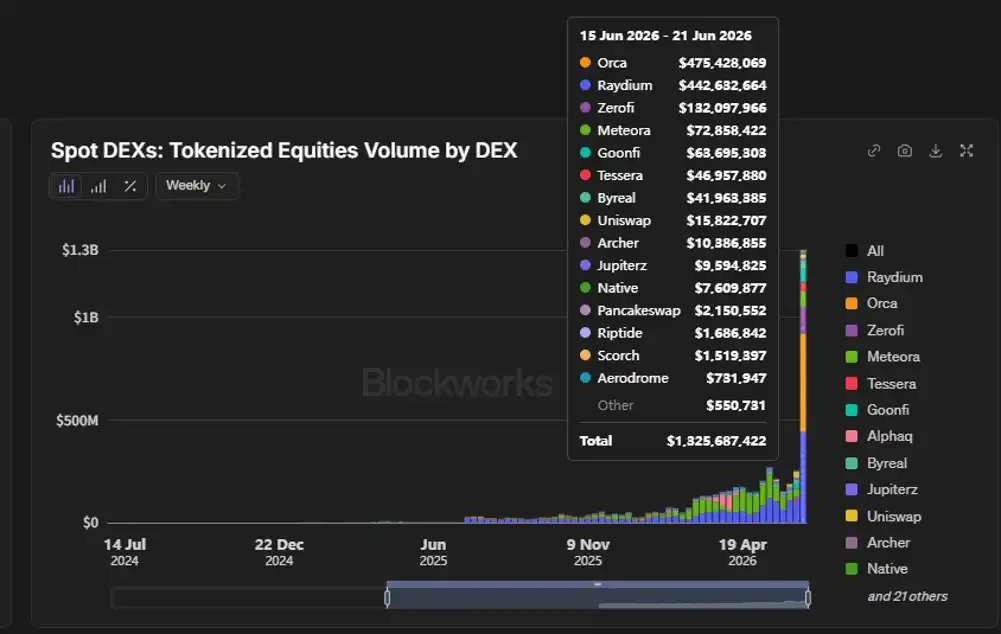
These proprietary AMMs managed by professional market makers use 100% of the market maker's own capital. Unlike the traditional, simple x*y=k, open-source, passive AMMs, these PropAMMs actively set prices, are closed-source, do not disclose liquidity publicly, typically lack a front-end and route through aggregators, can update quotes multiple times every 50ms per block, and can also avoid MEV attacks.
In terms of spot asset price discovery efficiency, the gap between Solana and mainstream CEXs is already very small. Leveraging this spot efficiency advantage, the primary source of trading volume for Solana's DEXs has become uniformly tokenized stocks.
"US Stock DeFi"
Although Solana's momentum in the tokenized stock spot market is strong, perpetual contract trading volume still vastly exceeds spot volume for US stock trading in the crypto space. The stock trading volume for Perp DEXs over the past week was in the tens of billions of dollars:
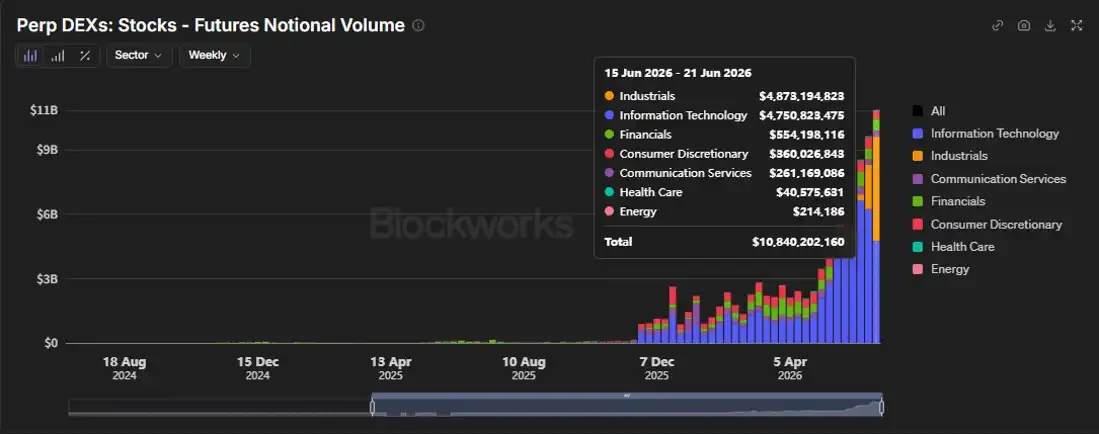
Solana will likely ramp up its efforts to catch up in this area as well. However, beyond trading, tokenized stock spots still have room for development. The composability of tokenized stock spots is a potential advantage for Solana.
Compared to simply trading stocks for gains, on-chain DeFi offers more diverse and flexible yield channels for tokenized stock positions. On platforms like Jupiter, Raydium, and Kamino, users can lend out their tokenized stocks or provide liquidity. Users can implement combination strategies for their tokenized stocks, such as partially lending and partially providing liquidity.
In addition to these conventional DeFi strategies, some newer and more innovative use cases have recently emerged on Solana. Nest allows users to mint the stablecoin nUSD using tokenized stocks or USDC.
nUSD can be staked to obtain snUSD, earning protocol revenue (with an estimated 6% APY) as well as dividends.
After the protocol revenue is distributed, the remaining portion will be used to buy back and burn the governance token $NEST.
While looking forward to more innovative use cases, what is even more promising is Solana leveraging collaborations between projects within its ecosystem to promote stock DeFi use cases to on-chain players in a more prominent way (e.g., through more intuitive guidance in mobile apps). Combined with cross-chain asset gateways like Sunrise, this could create network effects, leading to surprising and differentiated results in the tokenized stock derivatives market.