Gate Research: Under the Epic IPO Wave, Can Pre-IPO Tokens Open the Era of Retail Primary Market Investing?


- Core Insight: The 2026 mega-IPO wave from SpaceX, OpenAI, and Anthropic, totaling trillions of dollars, will create a significant short-term liquidity drain effect on the crypto market. However, the long-term wealth spillover effect after lock-up periods and innovative mechanisms like Pre-IPO tokenization (RWA) will bring structural incremental capital and opportunities for deep integration into the crypto market.
- Key Elements:
- Mega IPO Scale: SpaceX targets a $2 trillion valuation, raising $75 billion; OpenAI and Anthropic valuations both break or approach $1 trillion, with combined new share issuance potentially reaching $400-600 billion.
- Short-term Liquidity Impact: Institutions need to raise cash for IPO subscriptions, potentially triggering net selling of crypto assets (e.g., Bitcoin), similar to the historical fund rebalancing effects seen before the Coinbase and Facebook IPOs.
- Long-term Wealth Spillover: The value of SpaceX employee shares upon unlocking could reach $160-200 billion. Historical precedent indicates such wealth creation significantly spills over into high-growth sectors, with AI infrastructure tokens and high-performance public chains being the prime beneficiaries.
- Pre-IPO Tokenization Mechanism: By using SPV plus tokenization structures, the investment threshold is lowered from $1 million in traditional VC to 100 USDT, offering 7x24 trading, pushing the RWA market size towards $30 billion in Q1 2026.
- Gate Pre-IPOs Product: Utilizes a mirror note structure to track valuation changes of unlisted companies; minimum investment of 100 USDT, no leverage, no funding fees, supports immediate entry into the pre-market trading after subscription.
- Trading Landscape Evolution: Crypto exchanges use Pre-IPO products to intercept funds from traditional IPOs, blurring the boundaries between crypto and stock markets, but face risks such as SEC regulatory compliance and pricing deviations.
摘要
In 2026, the global capital market is ushering in an unprecedented "IPO super cycle." Leading private tech companies such as SpaceX, OpenAI, and Anthropic are progressively advancing their initial public offering (IPO) plans. Among them, SpaceX's target valuation is as high as $2 trillion, with plans to raise $75 billion, potentially making it the largest IPO in history. Meanwhile, valuations for OpenAI and Anthropic in the private market have either surpassed or are approaching the $1 trillion mark. This capital feast of record-breaking scale will not only reshape the landscape of traditional financial markets but also have a profound impact on the cryptocurrency market.
This article delves into the multi-dimensional effects of this macro event on the crypto market. First, we analyze the potential short-term liquidity impact of the massive IPO "capital absorption" effect. Second, we focus on how the crypto market, through innovative mechanisms like Real World Asset (RWA) tokenization and Special Purpose Vehicles (SPVs), provides retail and institutional investors with on-chain channels to participate in Pre-IPO investments in top tech companies. Finally, we systematically compare the Pre-IPO products offered by Gate and look ahead to the long-term implications of this trend for the future trading landscape.
1. The Capital Market's Super Cycle
The capital market of 2026 is destined to be etched in history. After several years of a high-interest-rate environment and a reshaping of private market valuations, the world's three most influential private tech enterprises—SpaceX, OpenAI, and Anthropic—are accelerating their IPO plans. This wave of IPOs, dubbed the "super cycle," will not only shatter historical records in terms of fundraising scale but will also profoundly impact the pricing logic of global macro asset classes, including cryptocurrencies.
1.1 SpaceX: The Space Titan Challenging a $2 Trillion Valuation
SpaceX is an American commercial aerospace company founded by Elon Musk. Its core businesses include reusable rocket launches, Starlink satellite internet, and deep space exploration and crewed spaceflight. On April 1, 2026, SpaceX confidentially filed its IPO registration documents with the U.S. SEC, officially starting the listing process. Subsequently, SpaceX publicly disclosed its S-1 prospectus on May 20, 2026, further clarifying its listing timeline. Market expectations generally suggest the company could list on the Nasdaq as early as June 2026, under the ticker symbol "SPCX."
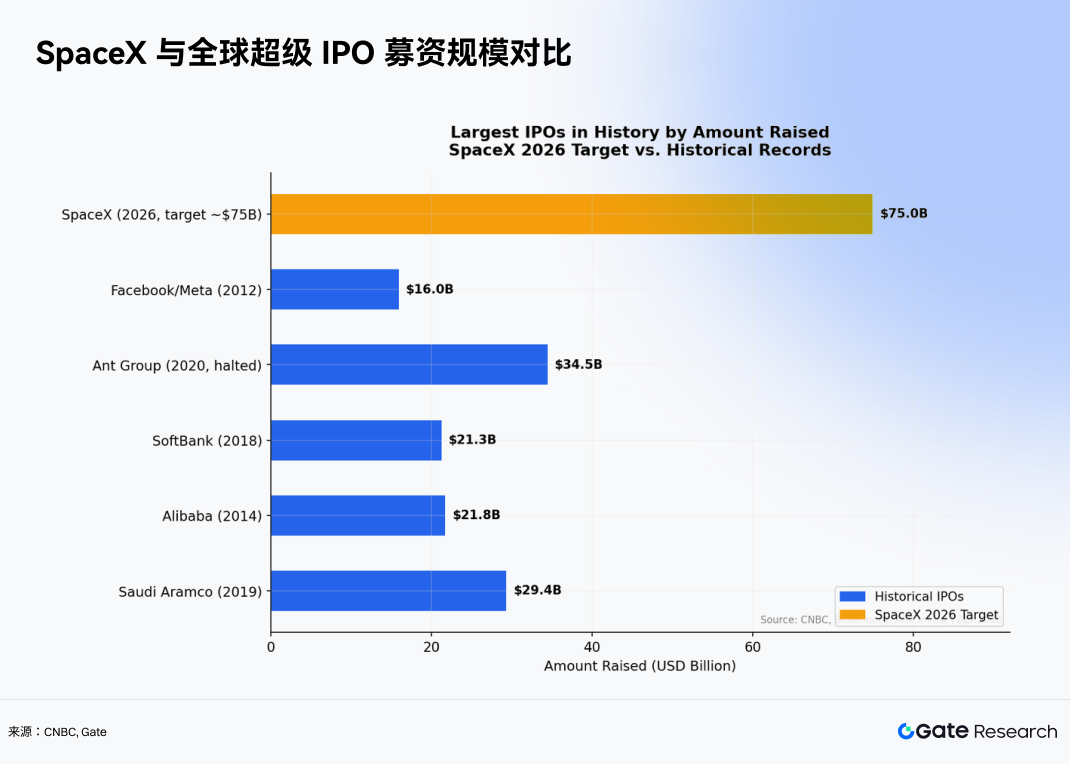
SpaceX's IPO could become the largest public offering in global history. Multiple reports indicate a potential fundraising size of around $75 billion, with a valuation range between approximately $1.75 trillion and $2 trillion. Some market communications even point towards a valuation exceeding $2 trillion.
If this target is achieved, SpaceX's IPO would overwhelmingly break the $29.4 billion fundraising record set by Saudi Aramco in 2019. In comparison, SpaceX's anticipated fundraising of $75 billion will make it one of the most iconic IPOs in the history of global capital markets.
Supporting this astonishing valuation is the robust growth and vertical integration of SpaceX's three core business segments:
• Starlink: SpaceX's global satellite internet business, providing high-speed broadband connectivity to users worldwide via a low Earth orbit satellite network.
• Launch Services (Falcon Rocket / Starship): SpaceX's aerospace launch business, responsible for launching satellites, cargo, crewed spacecraft, and deep space missions, serving as one of the company's primary revenue sources.
• Starshield: SpaceX's military aerospace business for government and defense clients, offering satellite communication, remote sensing, and national security-related infrastructure services.
Among these, Starlink, the world's fastest-growing satellite internet service, surpassed 10 million active users in early 2026. It is projected to generate over $20 billion in revenue by 2026 and achieved cash flow breakeven in 2023. In terms of launch services, SpaceX completed 165 orbital launches in 2025, deploying approximately 85% of the world's spacecraft. Its Falcon 9 rocket has reduced launch costs to below $1,000 per kilogram. In a core move related to the AI sector, SpaceX completed a merger with Musk's xAI in February 2026, integrating aerospace launch, global communications, and AI model infrastructure under a single entity. Furthermore, Musk has articulated a grand vision of launching 100 gigawatts of AI computing capacity annually.
1.2 OpenAI and Anthropic: The AI Titans with Trillion-Dollar Valuations
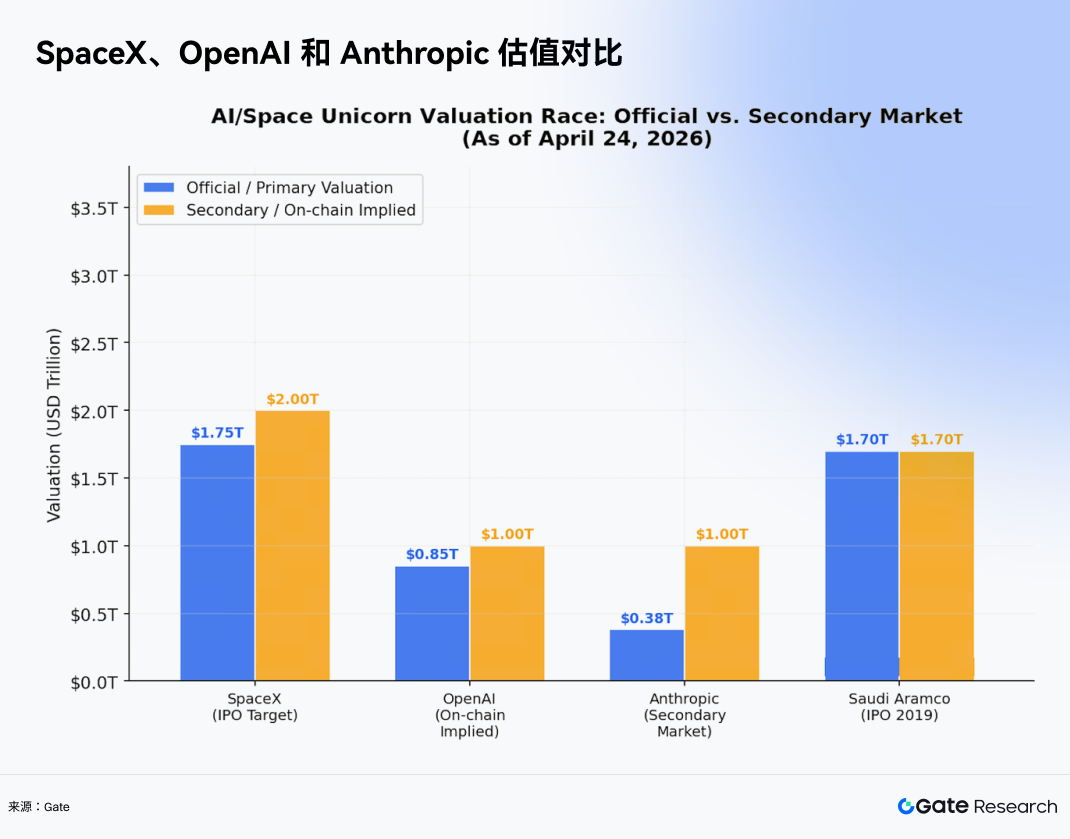
As SpaceX advances its IPO, the two giants of artificial intelligence, OpenAI and Anthropic, are also engaged in fierce competition in the capital market. OpenAI is an AI company focused on developing Artificial General Intelligence (AGI), with core products including ChatGPT, the GPT series of models, and a multimodal AI platform. OpenAI's commercialization has been exceptionally rapid, with annualized revenue surging from approximately $200 million in 2022 to over $10 billion in 2025. Based on trading data for SPV tokenized assets on the Jupiter chain, OpenAI's implied valuation reached $1 trillion in April 2026, a 163% increase from October 2025. Currently, OpenAI plans to go public as early as the fourth quarter of 2026.
Anthropic is an AI company founded by former OpenAI members, focusing on developing the Claude series of large language models, which emphasize safety, controllability, and long-term alignment. Anthropic's recent valuation surge is equally remarkable. In February 2026, the company achieved a post-money valuation of $380 billion in its Series G funding round. However, just three months later, data from secondary market platforms like Forge Global shows Anthropic's valuation has soared to approximately $1 trillion, surpassing OpenAI on the secondary market for the first time (OpenAI's trading valuation on Forge was around $880 billion). This surge is primarily attributed to the widespread adoption of its enterprise-level coding tool, Claude Code, which propelled its annualized revenue from $9 billion at the end of 2025 to $30 billion in March 2026, a single-quarter growth rate of 233%. Market expectations currently suggest Anthropic could launch its IPO as early as October 2026, potentially raising over $60 billion.
The concentrated listing of these three giants means that a total asset pool of nearly $4 trillion will gradually enter the public market. The resulting capital diversion effect is bound to transmit to various risky assets, including the cryptocurrency market.
2. Profound Impact on Crypto Market Liquidity and Trading Landscape
When hard-tech assets with extremely high certainty and growth potential, such as SpaceX, OpenAI, and Anthropic, enter the public market, they inevitably trigger a reallocation of capital. This brings both short-term pressure from capital outflows and, in the long term, provides new catalysts for the pricing logic of crypto assets and the integration of infrastructure.
2.1 Short-Term "Capital Absorption" Effect and Transmission Mechanism
Regarding the short-term capital absorption effect, during the subscription period and the initial listing phase of these giants (expected in the second half of 2026), institutional investors and high-net-worth individuals often need to raise substantial cash to secure allocated shares. This liquidity demand may lead to capital outflows from high-risk assets like the crypto market, particularly from crypto funds and family offices that have profited handsomely in the previous bull market. They might choose to take profits on some crypto assets to invest in these once-in-a-century tech unicorns.
However, to gauge the potential magnitude of this specific siphoning effect, one must first anchor the fundraising scale of these three IPOs. Based on current secondary market valuations: SpaceX's latest funding round corresponds to a valuation of about $2 trillion, OpenAI about $1 trillion, and Anthropic about $1 trillion. Even if all three adopt a conservative public float of 10–15%, the total size of new share issuance could range from $400 to $600 billion. If shareholder selling is factored in, the actual capital demand could be further amplified.
Institutional investors don't typically use idle cash directly for large IPOs; they follow a systematic liquidity management logic. Firstly, the subscription and allocation system requires institutions to pay a deposit or full amount to the underwriter during the subscription period, with the fund lock-up window typically from T-5 to T+1. Secondly, for highly oversubscribed hot IPOs, institutions tend to oversubscribe, further amplifying short-term cash needs. Thirdly, family offices and hedge funds commonly use risky assets (including crypto assets) as liquidity reserves. During a concentrated surge in cash demand, these assets are often the first to be reduced. This transmission chain can be simplified as: surge in IPO subscription demand → institutions raise cash → net selling of crypto assets → increase in fiat withdrawals from exchanges, stablecoin market cap under pressure → one-way liquidity flow towards the stock market.
While historical samples of similar magnitude are scarce, there are some relevant local case studies. For example, Coinbase's listing on April 14, 2021, saw its price hit an all-time high of around $64,000 before correcting by over 50% shortly after. Some analysts attribute this to a classic "buy the rumor, sell the news" event, where institutions tended to cash out after the event rather than continue buying. Similarly, during Alibaba's IPO in 2014, there was a noticeable but temporary capital outflow from global emerging markets. Before Facebook's IPO in 2012, the Nasdaq Composite Index, which is heavily weighted towards tech growth stocks, experienced a structural correction of about 5% in the two weeks before the subscription window, which the market attributed to institutions reshuffling their portfolios to raise cash.
2.2 Long-Term Wealth Effect and Crypto Sector Divergence
Contrary to the short-term liquidity pressure, the long-term wealth effect and spillover are expected to be significant. The listing of SpaceX and the AI giants will convert illiquid equity held by early investors, founding teams, and employees into readily realizable wealth. Historically, this large-scale wealth realization after the lock-up period often generates a notable spillover effect. Some of this capital will seek new high-growth targets, and blue-chip crypto assets, AI infrastructure tokens, and high-performance blockchain networks are likely to be recipients of this capital.
Take SpaceX as an example. It employs over 13,000 people. According to public information, employee stock options and restricted stock units (RSUs) account for approximately 8–10% of the total share capital. At a $2 trillion valuation, the market value of employee-held shares alone would exceed $160–200 billion. After the lock-up period (typically 180 days post-listing), this wealth transitions from illiquid assets into readily deployable cash. Coupled with partial selling by early institutional investors (like Founders Fund, Google, Fidelity), the total realizable wealth could be in the hundreds of billions of dollars. Historical precedent suggests that the wealth effect from Google's 2004 IPO directly spurred an angel investment boom in the San Francisco Bay Area. After Facebook's lock-up expired in 2012, venture capital deal flow in Silicon Valley increased by over 40% year-over-year in the following twelve months.
However, not all crypto assets will benefit proportionally from this wealth spillover. Capital flows typically follow the principle of cognitive anchoring. For instance, investors who have just profited from the AI sector tend to deploy new wealth into familiar and logically related fields. Accordingly, crypto assets can be categorized into three groups:
• Alpha: AI infrastructure tokens, directly linked to the large model computing narrative, possess the strongest path for cognitive migration. High-performance blockchains, hosting numerous AI applications and DePIN projects, will be included in portfolios as infrastructure premium plays. Decentralized storage benefits from the AI data infrastructure narrative.
• Blue Chips: Major coins (BTC, ETH) may attract passive allocation from new wealth, serving as the entry ticket for capital flowing into the crypto market.
• Underperforming or Unrelated Sectors: Tokens unrelated to the AI and hard-tech narratives may come under pressure due to liquidity migration during the capital reallocation process.
Once this sector divergence leads to price increases, it will further reinforce the market narrative, attracting retail investors and creating a positive reflexive cycle. For example, an empirical high correlation has already been observed between AI tokens and tech stocks. If the listings of OpenAI and Anthropic re-ignite market enthusiasm for the AI computing cycle, the premium for related tokens could significantly exceed levels justified by fundamentals.
Synthesizing the two phases: In the short term (approximately 4–6 weeks around the subscription period), net outflow pressure is expected, weighing on the overall crypto market, though sector divergence begins to emerge. In the medium term (before the lock-up expiry, roughly 3–6 months post-IPO), the market enters a digestion phase, seeking new narrative anchors. In the long term (post lock-up expiry), the wealth spillover effect dominates, bringing structural incremental capital inflows to AI-related crypto assets. This temporal structure provides clear strategic windows for investors: avoid the short-term liquidity shock, use the dip to accumulate high-conviction AI infrastructure tokens, and complete position building before the lock-up expiration wave—this is likely the optimal path.
3. Crypto and Pre-IPO Mechanisms Reshape Retail Investment Barriers
Traditionally, pre-IPO investment opportunities in super-unicorns like SpaceX and OpenAI were almost exclusively monopolized by top-tier venture capital firms (VCs), sovereign wealth funds, and a select few ultra-high-net-worth individuals. Ordinary investors and retail participants could only buy shares on the secondary market at a significant premium after the company went public. However, the 2026 crypto market is shattering this barrier through Pre-IPO tokenization. For instance, the minimum investment threshold for Gate's SpaceX token is as low as $0.01, whereas traditional Pre-IPO investments for institutions like VC/PE typically require a minimum subscription amount of at least $1 million.
3.1 The Explosion of the RWA Tokenization Sector
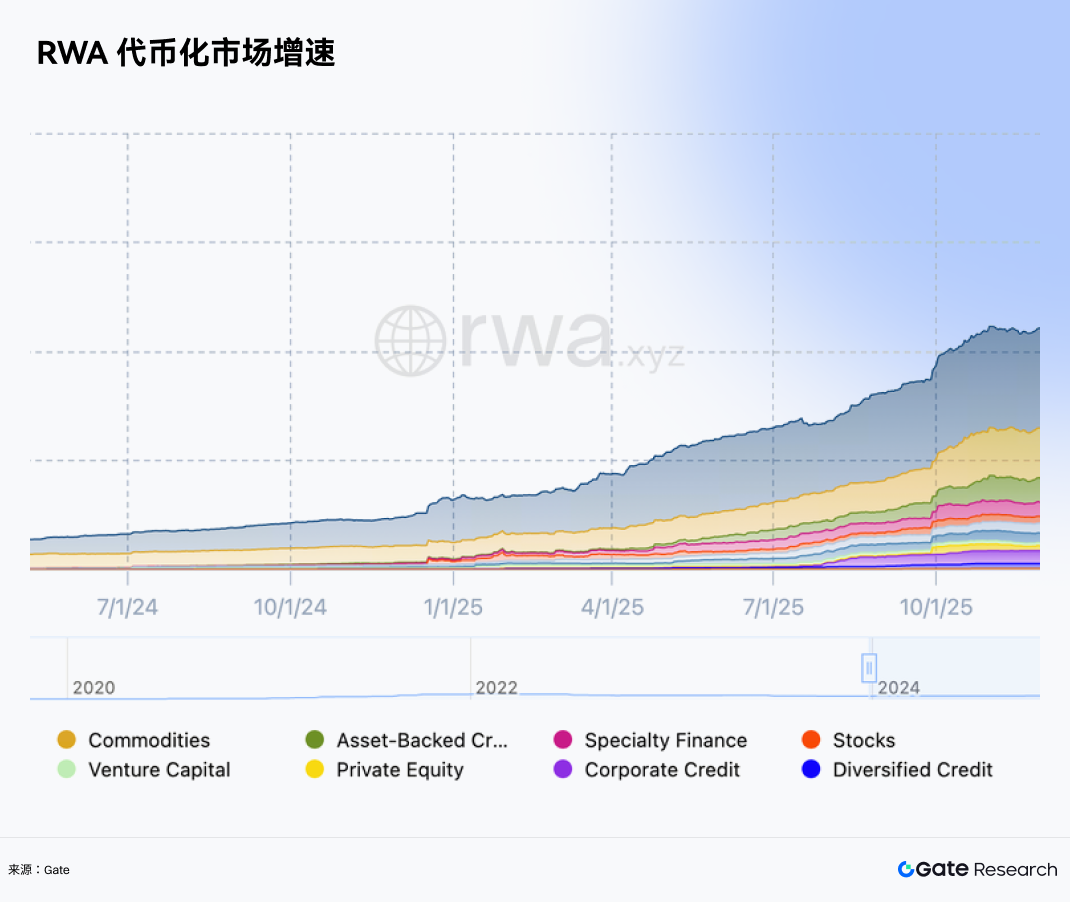
The rise of Pre-IPO tokens is a natural product of the maturation of the overall RWA tokenization infrastructure. According to a research report by Chainalysis from April 2026, the on-chain RWA market size (excluding stablecoins) saw a sequential quarterly growth of approximately 30% in Q1 2026, approaching a total size of $30 billion. Pre-IPO tokens are the fastest-growing and most narratively compelling sub-sector within this wave of growth.
Institutional-grade assets, such as asset-backed credit and tokenized U.S. Treasuries, are the main drivers of growth, but Pre-IPO equity tokenization is becoming one of the fastest-growing niches. Chainalysis' research also found that the time for institutional-grade RWA assets to go from first on-chain issuance to surpassing $1 billion in market cap is only 6.1 months, much faster than the 36.2 months for retail-oriented commodity-type assets. This indicates that large financial institutions are incorporating RWA tokenization into their asset allocation frameworks at an unprecedented pace.
For retail investors, the ability to lower the investment threshold from the traditional $1 million to just $100, while enabling 24/7 global instant settlement, is an unparalleled advantage over the traditional financial system.
3.2 Operational Mechanism: The Combination of SPV and Tokenization
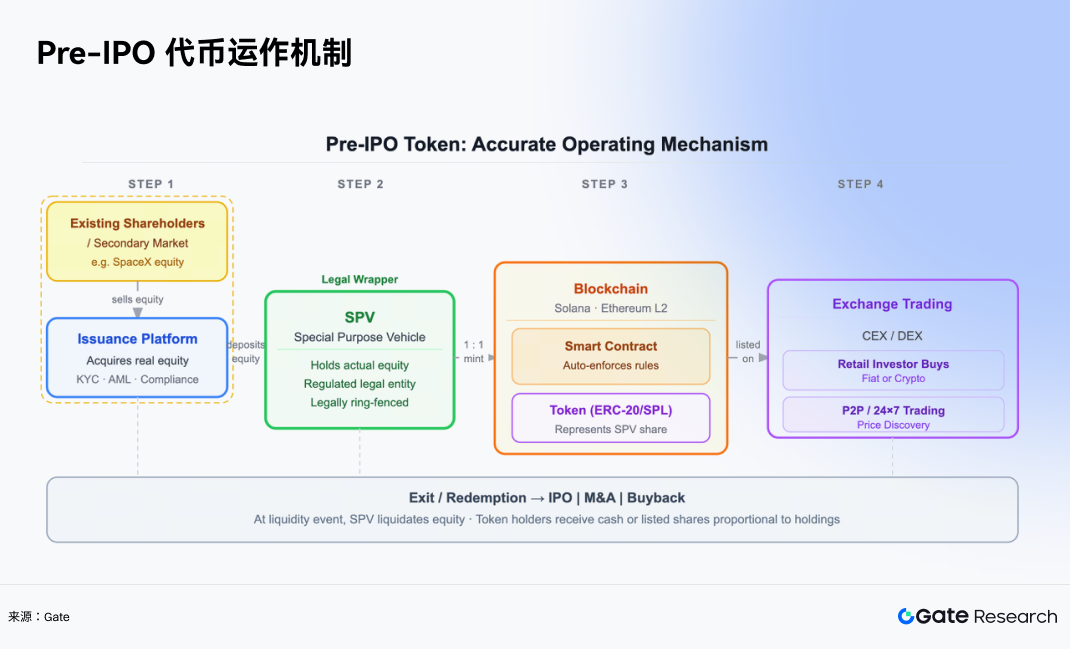
Pre-IPO tokens are blockchain-based digital assets designed to provide retail investors with economic exposure to the pre-IPO valuation of private companies. Their core operational mechanism typically involves the following steps:
1. Asset Acquisition: The platform acquires real equity in the target company (e.g., SpaceX) through the private secondary market or from existing shareholders.
2. Establishing an SPV: This equity is deposited into a regulated Special Purpose Vehicle (SPV), which holds it on behalf of token holders.
3. On-Chain Minting: The platform mints tokens representing shares of the SPV on a 1:1 basis, typically on a blockchain like Solana or an Ethereum L2.
4. Exchange Trading: Investors can buy and sell these tokens on the exchange.
It is crucial to emphasize that these tokens do not confer actual ownership, voting rights, or dividend rights in the company to the holder. They are purely economic certificates that track changes in the company's valuation.
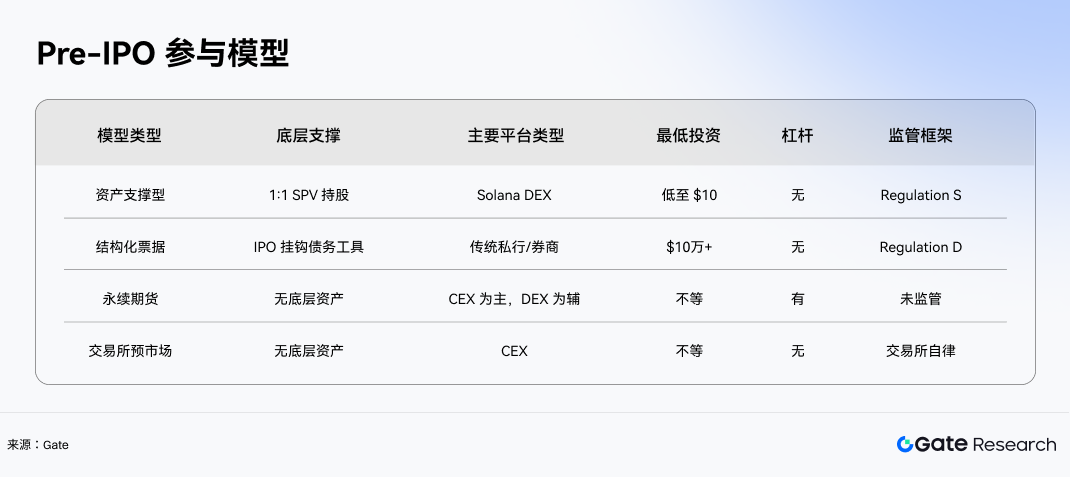
With the rapid development of the market, four main Pre-IPO participation models have evolved within the industry, each with its unique risk-return profile:
4. Evolution of the Trading Landscape: The New Battlefield for Crypto Exchanges
In the battle for the spoils of the "IPO super cycle," major global cryptocurrency exchanges are making this their core battleground for attracting traditional incremental capital and retail users.
4.1 Industry Exploration of Pre-IPO Products and Gate's Pre-IPOs Approach
Since April 2026, Pre-IPO assets have gradually moved from a niche concept towards productized exploration by trading platforms and Web3 gateways. Several models have emerged in the market. Some involve packaging equity exposure in high-profile private companies like SpaceX into tradable assets via compliant investment platforms, structured notes, or