Hãy xây nhà trên bờ vực thẳm, món nợ mà Google và Meta không dám công khai


- Quan điểm cốt lõi: Năm "ông lớn" công nghệ hàng đầu của Mỹ (Microsoft, Google, Amazon, Meta, Oracle) đã sử dụng các công cụ tài chính phức tạp như SPV, cho thuê tài chính và bảo lãnh tín dụng để che giấu khoản nợ xây dựng trung tâm dữ liệu AI lên tới 2,13 nghìn tỷ đô la Mỹ ra ngoài bảng cân đối kế toán, tạo ra rủi ro "cho vay ngầm" có thể đe dọa hệ thống tài chính toàn cầu.
- Các yếu tố chính:
- Tính đến quý 2 năm 2026, "nợ trung tâm dữ liệu" bị che giấu thông qua cho vay ngầm của năm công ty công nghệ lớn lên tới 2,13 nghìn tỷ đô la Mỹ, gấp 1,6 lần tổng nợ trong bảng (1,35 nghìn tỷ) của họ; trong vòng một năm, tổng nợ ngoại bảng đã tăng từ 1,02 nghìn tỷ lên 2,86 nghìn tỷ đô la Mỹ, tăng gần gấp ba lần.
- Meta đã huy động 27,3 tỷ đô la cho trung tâm dữ liệu Hyperion ở Louisiana thông qua SPV có cấu trúc vốn 80/20 (Dự án Beignet) để cách ly khoản nợ, khiến nó không xuất hiện trên bảng cân đối kế toán của chính mình, chỉ ghi nhận khoản đầu tư 2,37 tỷ đô la.
- Microsoft che giấu khoản nợ thông qua cho thuê tài chính, khoản nợ này đã tăng gấp đôi từ 27,1 tỷ lên 62,9 tỷ đô la nhưng không được tính vào mục "nợ"; Google sử dụng bảo lãnh tín dụng (quy mô danh nghĩa tăng từ 16,9 tỷ lên 43,8 tỷ trong vòng nửa năm), nhưng trong bảng chỉ ghi nhận ước tính 815 triệu đô la.
- Trong báo cáo năm 2026, Ngân hàng Thanh toán Quốc tế (BIS) đã xếp "cho vay ngầm" của các gã khổng lồ công nghệ ngang hàng với nợ chính phủ có chủ quyền, coi đây là rủi ro hàng đầu của hệ thống tài chính toàn cầu; S&P đã hạ xếp hạng tín nhiệm của Oracle xuống BBB-, khiến trái phiếu của hãng chỉ còn cách mức "rác" một bước.
- Các quỹ tư nhân đã tiếp quản ngân hàng trở thành nguồn vốn chính (ví dụ: Blue Owl, BlackRock), các khoản vay trung tâm dữ liệu trở thành tài sản được săn đón nhất trên Phố Wall; nhưng các quỹ phải đối mặt với áp lực mua lại, chẳng hạn như quỹ Blue Owl đã nhận được gần 40% yêu cầu mua lại trong hai quý liên tiếp, nhưng chỉ thực tế chi trả hơn một phần mười.
- Rủi ro cốt lõi nằm ở chỗ: 60% các trung tâm dữ liệu đã được lên kế hoạch vẫn chưa được khởi công (ví dụ: Hyperion dự kiến hoàn thành vào năm 2029), trong khi nợ đã được bán ra; tuổi thọ của phần cứng như GPU thường là 5-6 năm, nhưng kỳ hạn trái phiếu lên tới 24 năm (ví dụ: trái phiếu Meta đáo hạn vào năm 2049).
In August 2025, seven companies were registered in Delaware, all bearing the name "Beignet."
Beignet, a fried dough pastry commonly found on the streets of New Orleans, is generously dusted with powdered sugar, some of which inevitably falls onto your clothes.
No matter how closely you look, you wouldn't guess the connection between this dessert and AI.
A month after the Beignet companies appeared, Meta built a data center in Louisiana named Hyperion, covering an area equivalent to four New York Central Parks.
To construct this massive data center, Meta borrowed a total of $27.3 billion.
But if you scrutinize Meta's financial reports, you'll find that on its balance sheet, the entire record related to this project amounts to only a $2.37 billion investment.
The remaining debt of over two hundred billion dollars has vanished.
This is not an isolated case.
On July 22, the Nikkei reported that U.S. tech giants had hidden up to $1.65 trillion in debt where it couldn't be seen, a figure even surpassing the $1.35 trillion in total liabilities on their balance sheets.
After reviewing the filings these five companies submitted to the U.S. Securities and Exchange Commission, we found the reality is even more dramatic than the report suggested.
On July 23, the day after the report was published, Google's parent company, Alphabet, filed its quarterly report. Its procurement commitments jumped from $332.4 billion three months prior to $811 billion. A year earlier, this figure was $62.1 billion.
In one year, it increased thirteen-fold. This also pushed the $1.65 trillion figure reported by Nikkei up to $2.13 trillion.
Over the past year, the debt generated by Microsoft, Google, Amazon, Meta, and Oracle for data centers surged from $710.8 billion to $1.55 trillion. If you include procurement and construction contracts for hardware like GPUs, the figure jumped from $1.02 trillion to $2.86 trillion. In one year, it nearly doubled.
And the portion actually sitting on their balance sheets is only a quarter of this final number. A staggering $2.13 trillion in "data center debt" has disappeared from the tech giants' balance sheets.

Where did this debt go?
The Bank for International Settlements (BIS) noticed this trend early on. In a quarterly report from March 2026, it gave this practice a name: Shadow Borrowing. The report stated that these arrangements are economically equivalent to debt but remain largely off-balance-sheet.
Three months later, in its annual report, the BIS, in a rare move, listed AI bubbles and circular financing alongside sovereign debt as primary risks to the global financial system.
Digging through various filings of the five companies reveals at least five different techniques: SPVs, credit enhancement derivatives, finance leases, residual value guarantees, and uncommenced leases.
And the people helping them create this shadow debt are turning this into a whole new business.
Tech Giants Are Collectively "Going Broke"
For the past two decades, tech giants have been the most comfortable type of company in the U.S. capital market. They make money, have cash on their books, and buy back their own stock.
In Q4 2021, Microsoft, Google, Amazon, Meta, and Oracle collectively bought back $48 billion in shares, with Meta alone spending $20 billion. With such an abundance of cash, shareholders didn't worry about them running out of money.
But in Q1 2026, the total buybacks of the five companies plummeted to $4.6 billion.
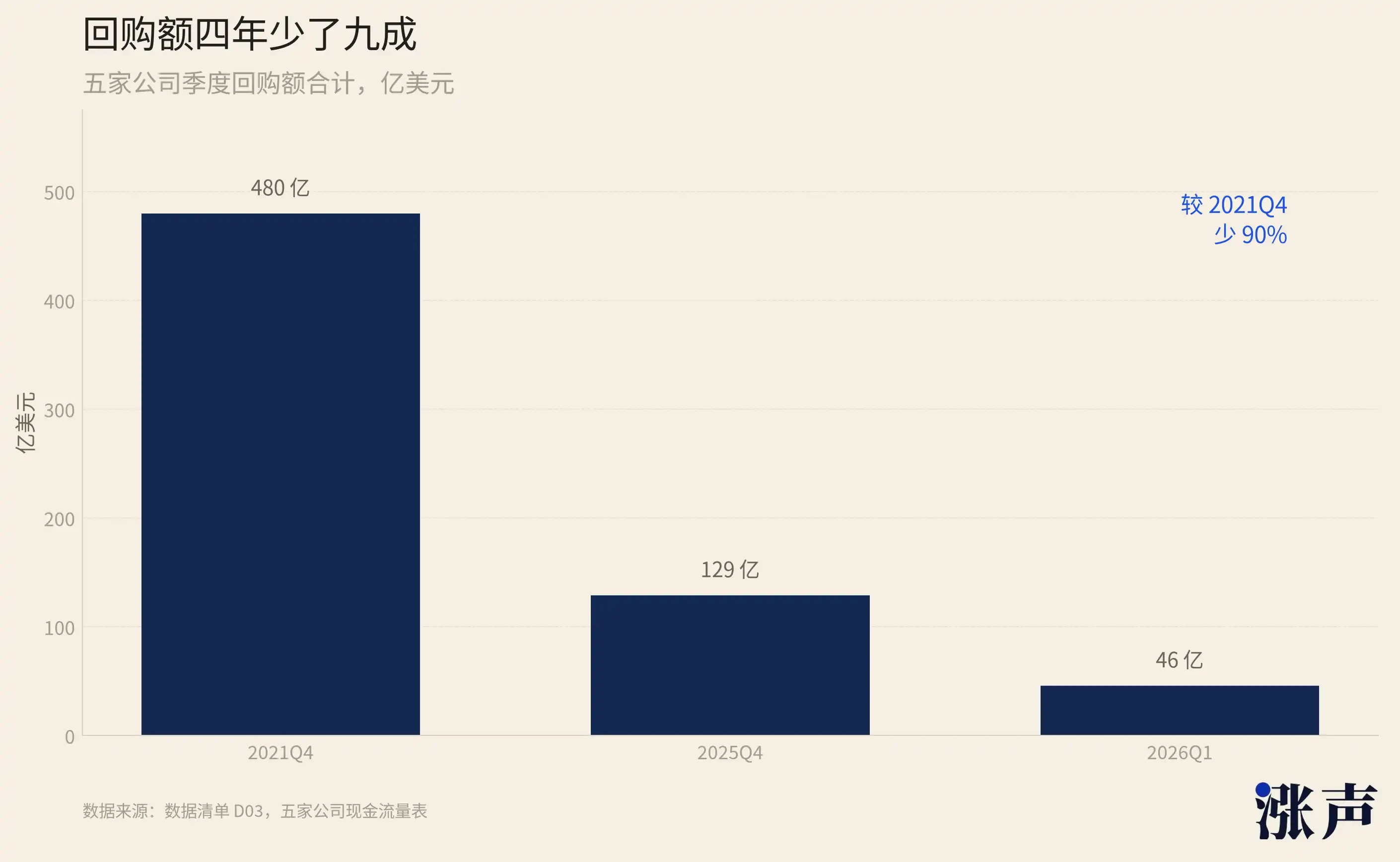
Over the past two years, tech companies' AI-related capital expenditures have more than doubled, while operating cash flow growth is less than 60%. If this growth rate continues, by mid-2027, the tech giants will collectively "go broke," returning to an era of losses.

Morgan Stanley estimates that by 2028, tech companies will need to spend approximately $2.9 trillion on AI, but they can generate only about $1.4 trillion internally. The gap of $1.5 trillion must be found outside of cash flow.
So they started borrowing. From 2020 to 2023, the five companies issued an average of about $31.3 billion in debt per year. By July 2026, this number had reached $189.7 billion, six times the historical average.

The sheer volume of corporate bonds has started to strain the market. Over the past nine months, Amazon's bond oversubscription ratio has been in steady decline. It was 5.3x in November 2025 but dropped to just 1.6x by July 2026.
The cost of issuing bonds has also increased. This year, in the entire investment-grade bond market, new bonds can be sold with an average concession of just 4 basis points. However, for Amazon's July issuance, it needed a concession of 18 to 21 basis points to sell.
Google and Oracle went even further, resorting directly to equity offerings to raise funds. After raising nearly $80 billion, they launched a total of $60 billion in ATM (At-The-Market) offering programs.
Financial media outlets are collectively complaining that tech giants have broken an "unspoken covenant" with investors. The market used to buy these companies' stocks assuming net cash, low debt, and continuous buybacks. Now they are heavily issuing debt and have had to halt buybacks.
But the real trouble is written on the giants' balance sheets.
The more debt on the balance sheet, the more cautious rating agencies become, and the smaller the pool of potential bond buyers. Oracle was the first among the five to hit this wall. Its capital expenditure jumped from $21.2 billion to $55.7 billion in one year. In July 2026, S&P downgraded Oracle from BBB to BBB-, just one notch above junk status. If downgraded further, global insurance companies and pension funds would be forced by regulations to sell Oracle's bonds.
So, the tech giants need not just more money; they need money that is more discreet, longer-term, and carries less responsibility. And this kind of money simply isn't available in the public markets.
After SaaS Faltered, Wall Street Looked for New Business
Just as tech companies were struggling for cash, others on Wall Street were also searching for an exit.
In the first half of 2026, a fund managed by Blue Owl received redemption requests close to 40% for two consecutive quarters, but its actual payout was only slightly over 10%. The company's stock price fell from $24 to $9.

Blue Owl is one of the world's largest private credit institutions, managing over $310 billion in assets. The fund hit by the redemption run specializes in the software sector, with software loans comprising over 60% of its portfolio.
As it happens, in 2026, the last thing Wall Street wanted to hold onto was software loans.
From its peak in October 2025, software stocks have fallen nearly 40%. The market's explanation is simple: AI will kill software. Investors were willing to give software companies high valuations because customers seemed to renew annually, making revenue seem contractually sustainable. Now, the question of whether customers will renew has suddenly become uncertain.
But in reality, the software companies' fundamentals aren't that bad. Microsoft's 365 subscription revenue growth accelerated from 15% to 19%. Revenue growth for software companies like ServiceNow, Salesforce, and Snowflake has been picking up for five consecutive quarters. Gartner has even raised its global software spending forecast.
However, in the financial world, confidence often trumps fundamentals.
Blue Owl acknowledged in its shareholder letter that market concerns about AI's impact on software companies have significantly changed how investors view software credit exposure.
Wall Street urgently needed a new narrative to get investors interested again. That narrative is the data center.
Software loans bet on whether a customer will renew next year. Data center loans bet on whether AI companies will need computing power. The former question is getting harder to answer; the latter question seems almost rhetorical. The stronger AI gets, the more valuable the server rooms become.
Currently, data center loans are the hottest commodity on Wall Street. In December 2025, Blue Owl, citing underwriting standards, rejected Oracle's data center project in Michigan. However, Pacific Investment Management Company (PIMCO) quickly snatched the deal at a higher price. Such deal-poaching incidents are happening on Wall Street almost every month.
On one side, you have cash-strapped tech giants; on the other, asset management firms with nowhere to invest their money. A natural match was made.
Their first major creation is Beignet, the dessert mentioned at the beginning.
How Did Meta Hide $28 Billion in Debt Inside a Dessert?
The Hyperion hyperscale data center in Louisiana, co-developed by Meta, is initially registered under Laidley LLC. This entity operates the campus and signed a 15-year power purchase agreement with the local utility company.

Hyperion site area compared to Manhattan, New York. Source: Bloomberg
Laidley belongs to Project Beignet Holdings, a joint venture. The property rights for the data center reside here.
The joint venture's majority shareholder is Beignet Investor, which issued the $27.3 billion in bonds.
The debt is not placed on the company that owns the data center but on its shareholder.
Above that sits Beignet Pledgor. In finance, a pledgor is one who offers assets as collateral. It wholly owns Beignet Investor and pledges all of Beignet Investor's equity to a trustee.
This provides creditors with a very straightforward form of collateral. If trouble arises, the trustee doesn't need to first go to Louisiana to appraise a data center, sell it, and wait through a lengthy lawsuit. The contract allows for the execution of the equity pledge instead. The campus continues operating, the lease continues running, but the entity collecting the rent changes.
Above Beignet Pledgor are four more companies, including one called Beignet Net Lease Aggregator. At the very top is a net lease real estate investment trust (REIT) managed by Blue Owl called OSNL, along with co-investors who contributed capital.
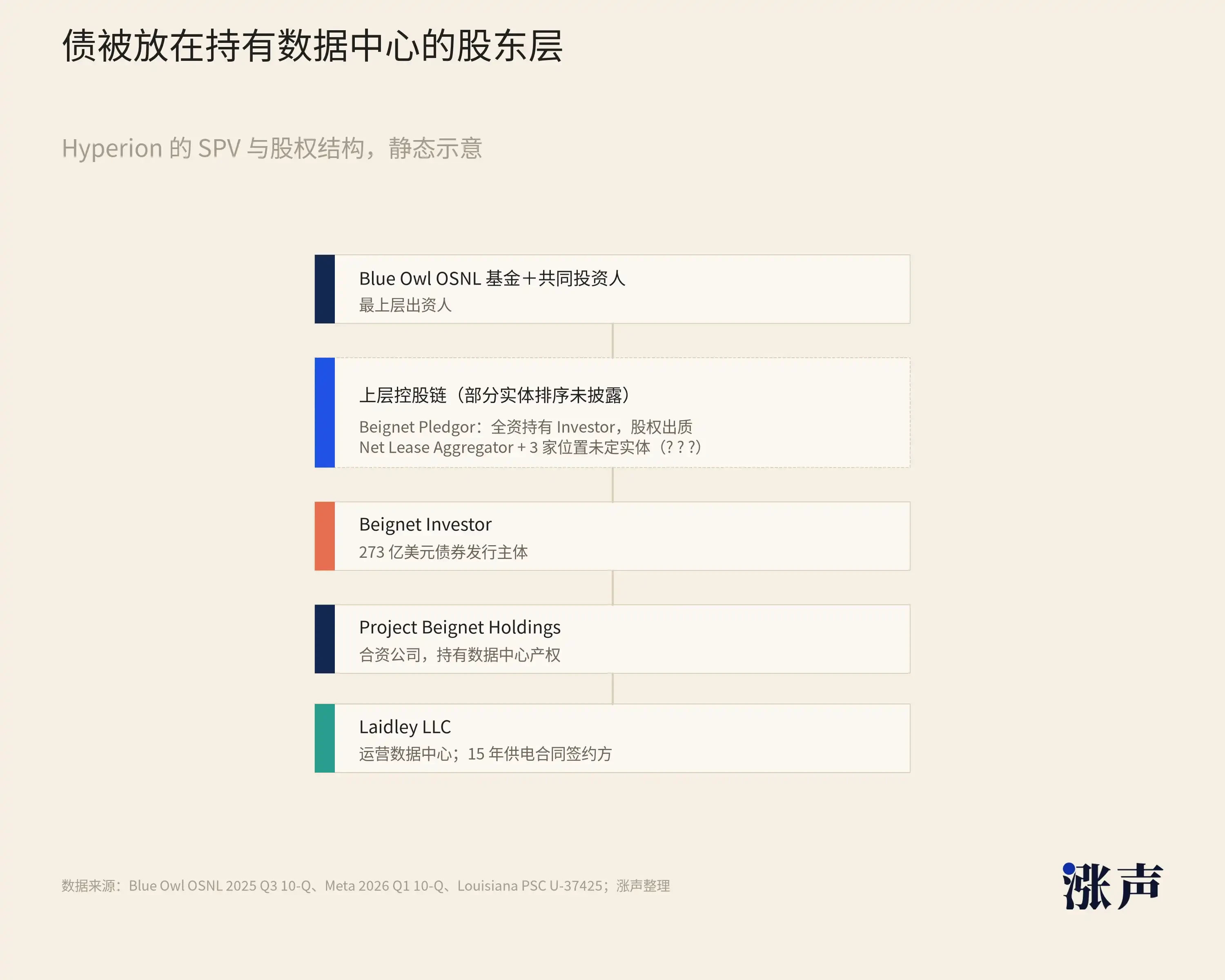
All seven companies are registered in Delaware. Local limited liability companies there are not required to publicly disclose their members or capital contribution ratios.
The $27.3 billion in bonds were also not publicly issued. They were placed through Rule 144A, sold only to qualified institutional investors without a public prospectus. To review the transaction terms, one must sign a non-disclosure agreement. They are also "life-of-issue 144A" bonds, meaning they will never be converted into registered public bonds.
A search for "Beignet" in the SEC's full-text retrieval system yields only one narrative hit: a footnote in Blue Owl's quarterly report regarding subsequent events. By the annual report, it disappears along with mentions of "Meta" and the parish where the project is located, leaving only a single line summarizing the "net lease data center" holdings.
This is already dizzying enough, but it's just the legal isolation.
SPVs are not new. The real estate and infrastructure industries have used them for decades. Accounting standards have long been aware that entities might try to stash debt within them, creating two hurdles for consolidation. Whether an entity must be consolidated into a company's financial statements depends not only on ownership percentage but also on who can direct the most significant operating activities and who bears most of the risks and reaps most of the rewards.
Meta is Hyperion's sole tenant, providing capital, credit, and overseeing construction and property management. Based on these criteria, this debt should ideally be consolidated onto Meta's own books.
But Meta retained only 20%.
Blue Owl's OSNL fund, along with co-investors, holds 100% of Beignet Investor through Beignet Pledgor and four other holding companies. Beignet Investor, in turn, holds an 80% stake in the joint venture. Meta holds the remaining 20%.
80 and 20 are the recurring numbers in this story.
Meta's explanation in its financial reports states that the company does not have the power to direct the activities that most significantly impact the joint venture's operating performance, and therefore, it is not the primary beneficiary and does not consolidate. Since the joint venture is not consolidated into Meta's report, the $27.3 billion in debt naturally isn't consolidated either.
The debt didn't disappear. It just changed its storage location.
Converting Mortgages into Leases: The "Debt Repayment Art" of Silicon Valley Giants
Just because the debt isn't on Meta's balance sheet doesn't mean Meta isn't paying for it.
Meta has a subsidiary leasing company called Pelican Leap. It signed a four-year lease with Laidley. Starting in 2029, Pelican Leap pays rent to Laidley monthly. The money flows from Laidley to the joint venture, then to Beignet Investor, and finally to repay the bond investors' principal and interest.
After this circular flow, the rent ultimately still comes from Meta's pocket.
The $27.3 billion bond has a coupon of 6.581%, maturing in May 2049, with a fully amortizing structure. Unlike typical corporate bonds that pay a lump sum at maturity in 2049, this opens a small hole each period, paying down gradually over 24 years.
More like a mortgage.
Meta's total rent for the first four years is $12.3 billion, averaging $3.08 billion annually. This amount just covers the annual debt service, with an extra 12% left for the equity contributors.
The key twist starts with the lease term.
The bond has a 24-year life. The initial lease is only for four years, starting in 2029, with renewal options attached, potentially extending up to 20 years. Theoretically, Meta could choose not to renew in 2033 and simply leave.
But what happens to the over two hundred billion dollars still unpaid?
The answer lies in another part of the lease agreement. Besides the monthly rent, Meta provides a residual value guarantee, capped at approximately $28 billion – slightly higher than the debt itself, decreasing over time. If Meta does not renew and the campus's value falls below this threshold, Meta must make up the difference.
Seeing $28 billion and $27.3 billion together makes it hard not to connect the two.
So, the bond's true backing isn't just the building or the machines inside.
It relies on Meta's credit rating.
This also explains the ratings. S&P rated this bond A+, while Meta itself is rated AA-. The rating agency didn't price it based on a building yet to be operational; instead, it essentially downgraded Meta's credit profile by one notch.
Meta provides the money, provides the credit, oversees operations, and is the sole tenant, yet it states in its financial report that it is not the primary beneficiary.
This clean balance sheet came at a cost. If Meta had issued bonds of the same tenor on the open market, the cost would have been around 5.5%. Through this structure, the cost rose to 6.581%. For the same amount of capital, Meta pays nearly $300 million more in interest annually.
Clearly, Meta is paying this premium to buy more than just a building.
In July 2026, the second similar project emerged, named Sopaipilla, another fried dessert from the American Southwest. The project is located in El Paso, Texas, with a bond issuance size starting at $12 billion, also using the 80/20 split. The difference this time is that the 80% stake went to BlackRock instead of Blue Owl.
Meta has previously used internal codenames like "Avocado" and "Mango" for its next-generation large language models. The finance side appears to have a more appetizing naming convention.
Meta's structure is the most sophisticated, but it's not the only approach.
Microsoft didn't create a shell company, nor did its on-book debt increase significantly. Over the past two years, its total debt actually decreased from $44.9 billion to $40.3 billion. However, during the same period, its finance lease liabilities more than doubled, from $27.1 billion to $62.9 billion, surpassing its total reported debt by over $20 billion.
The $62.9 billion is on Microsoft's balance sheet, just not under the "Debt" line. It's broken down into "Other current liabilities" and "Other long-term liabilities." Looking only at the most prominent line makes it appear quiet.
The meaning of a finance lease is straightforward. It's a lease in name but